
Gas Actuated vs Powder Actuated Concrete Nailer
This post contains affiliate links. As an Amazon Associate, we earn from qualifying purchases.
Gas-actuated concrete nailers use a combustible gas cell to drive fasteners and require no special license, while powder-actuated tools use an explosive cartridge for higher power and legally require a trained, licensed operator. The choice is forced by your material and the load: gas for high-volume, light-duty interior framing; powder for heavier-duty applications into hard concrete or steel.
That licensing line isn’t a suggestion. It’s written into ANSI/ASSE A10.3, the American standard that governs powder-actuated tool use. Ignore it, and you’re not just risking a bad fastener, you’re operating outside the legal safety framework on any commercial site. The standard’s requirements apply whether you use a gas actuated vs powder actuated concrete nailer.
What follows is a breakdown of power, specs, and real holding capacity. By the end, you’ll know which system fits your wall, your concrete, and your wallet.
Key Takeaways
- Powder-actuated tools deliver more power and higher load limits, with shank diameters up to 0.157″ versus a maximum of 0.138″ for some gas-actuated systems, though some gas fasteners also use a 0.138″ shank.
- ANSI A10.3 mandates trained, licensed operators for powder tools; gas tools like the Powers Fasteners C3 Trak-It need no special license.
- For light-duty, high-volume interior work like drywall track, a gas system is the efficiency pick. For sill plates or anything structural, you need powder’s holding power.
- Concrete must be three times thicker than the fastener embedment, and you must wait for it to reach its designated minimum compressive strength before driving any fastener.
- A low-velocity tool is defined as one where the average test velocity does not exceed 328 feet per second, all modern powder tools, including Hilti and DEWALT, fall into this category.
How They Work: Gas Cell vs. Powder Charge
The core difference is in the bang. A gas-actuated tool, like the fischer FGC 100 or Powers C3 Trak-It, uses a sealed fuel cell of combustible gas. Pull the trigger, a spark ignites the gas in a controlled chamber, and the expanding gases drive a piston that smacks the pin home. It’s a contained mini-explosion, repeated thousands of times from one cell.
A powder-actuated tool is a different animal. It uses a small, color-coded cartridge of propellant. You load a .27 caliber strip into the breech, seat a single pin or stud, and fire. The burning powder creates gas that acts on a captive piston, this is the indirect acting principle that defines all modern low-velocity tools like the Hilti DX 2. The piston hits the fastener.
All DEWALT powder actuated tools operate using the indirect acting principle and are classified as low velocity tools. A low velocity powder-actuated tool is one in which the average test velocity does not exceed 328 feet per second (100 meters per second) per ANSI A10.3.
That indirect action is a critical safety feature. It controls energy transfer, making misfires and over-penetration less likely than in old direct-acting tools.
The 3-Hour Rule That Decides It
Your project’s timeline often makes the gas actuated vs powder actuated concrete nailer choice for you. If you’re hanging miles of drywall track in a new build, speed is money. A gas tool with a magazine of pins is built for that.
High-volume repetitive fastenings, that’s the phrase Hilti uses for their gas and battery systems. The Powers C3 Trak-It claims 1,200 shots per fuel cell for its model using pins from 1/2″ to 1 1/2″ in length. The fischer FGC 100 promises at least 300 nails from a 10-minute charge. You can fire all day with a magazine, not fumbling with single pins.
Now, walk to the other side of the site where they’re fastening sill plates. Each fastener matters. Each one needs to hold hundreds of pounds. This is a powder job. You’re not shooting a pin every two seconds; you’re placing a critical anchor. The Hilti DX 2 handles a maximum nail length of 62 mm, or 72 mm for wood-to-concrete applications. The process is slower, more deliberate. This shift from production speed to structural permanence often dictates the gas actuated vs powder actuated concrete nailer choice.
Power and Holding Capacity: The Numbers Don’t Lie
This is where powder’s advantage becomes concrete, pun intended. Manufacturer data sheets tell the story. The allowable loads in 4,000 psi concrete from Simpson Strong-Tie are shown here.
| Fastener Type | Shank Diameter | Min. Embedment | Allowable Tension Load | Allowable Shear Load |
|---|---|---|---|---|
| Powder-Actuated | 0.157″ | 1″ | 310 lb | 310 lb |
| Powder-Actuated | 0.157″ | 3/4″ | 110 lb | 135 lb |
| Gas-Actuated (GW/GTH) | 0.126″ | 3/4″ | 190 lb | 215 lb |
| Gas-Actuated (GDP) | 0.106″ | 3/4″ | 30 lb | 75 lb |
That table changes the conversation. A powder fastener with an extra 1/4″ of embedment nearly triples its tension capacity. Even the strongest common gas fastener (0.126″ shank) is outperformed by the standard powder pin. The smallest gas fastener, at 0.106″, is for track and furring, not for holding anything substantial.
Where this goes sideways: Driving a fastener into green concrete. Simpson Strong-Tie specifies fasteners must not be driven until the concrete has reached the designated minimum compressive strength. Do it early, and you’ll crush the immature concrete around the pin, reducing its hold by half or more.
The power source dictates the fastener. Hilti powder systems offer thicker shanks (0.138″, 0.145″, 0.157″) for higher loads. Hilti gas and electro-mechanical systems use thinner shanks (0.101″, 0.108″, 0.118″) for easier penetration in high-volume work.
Licensing, Safety, and the Jobsite Rulebook
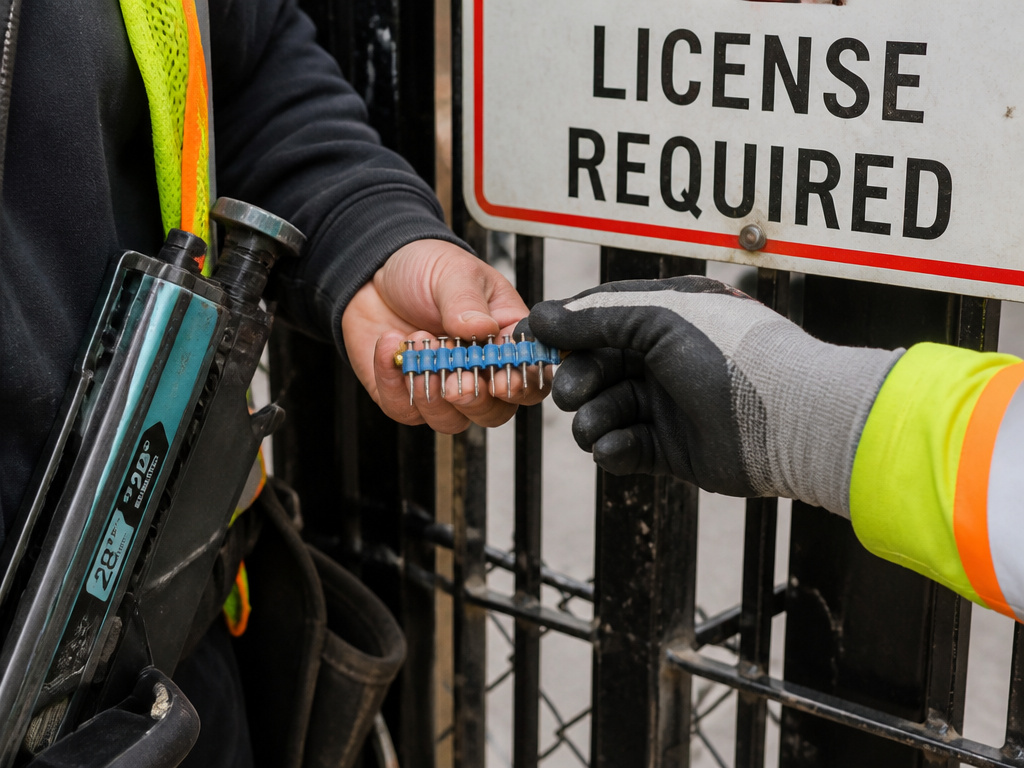
Here’s the line in the sand that every contractor feels. Picking up a powder-actuated tool comes with paperwork.
Many union and commercial sites will card you at the gate. No license, no powder tool on site. Full stop.
Gas systems like the Powers Fasteners C3 Trak-It sidestep this entirely. Its manual states operation does not require special safety training or licensing. That’s a massive advantage for small crews, DIYers, or interior finishing teams.
The safety protocols, however, share common ground. Hilti’s cartridge warnings apply to all powder loads: do not crush, strike, or pry cartridges, keep them dry, and always use eye and ear protection. Both tools demand respect. But the law only tracks one of them.
Gas vs. Powder: A Side-by-Side Decision Guide
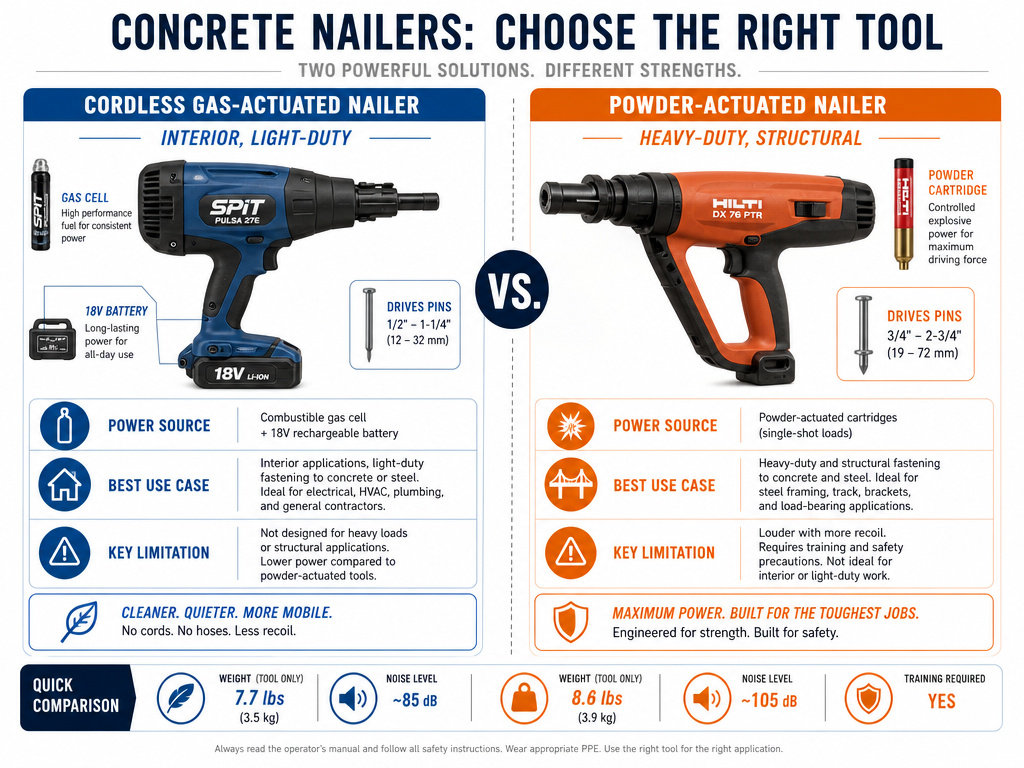
You need a rule, not more features. This table cuts to the chase.
| Criteria | Gas-Actuated Nailer | Powder-Actuated Nailer |
|---|---|---|
| Best For | High-volume, light-duty interior framing (drywall track, furring). | Heavier-duty fastening (sill plates, electrical straps, concrete formwork). |
| Power Source | Combustible gas cell. | Explosive powder cartridge (.27 cal). |
| Key Limitation | Lower load capacity; shorter max fastener length (1-5/8″). | Requires operator licensing (ANSI A10.3). |
| Portability & Setup | Cordless, battery-powered. Magazine-fed for speed. | Tool-only, no cord. Single-shot or semi-auto strip load. |
| Indoor / Enclosed Use | Good. Less noise and fumes than powder. | Requires adequate ventilation per safety sheets. |
| Brand/Model Example | Powers Fasteners C3 Trak-It (13″, 8 lbs). | Hilti DX 2 (5.3 lb, 62mm nail length). |
If your work is interior, non-load bearing, and nonstructural, Hilti’s phrasing for their gas and electro-mechanical systems, the gas tool wins on speed and simplicity. The moment your fastener needs to resist a defined load, or you’re shooting into high-strength concrete or steel, you graduate to powder.
The Concrete Specs You Can’t Ignore
The tool is only half the equation. The concrete is the other. You can have the right gun and still fail.
First, thickness. The rule is minimum concrete thickness must be three times the fastener embedment. Aiming for 1″ of embedment? Your slab or wall needs to be at least 3″ thick. Blow through the back, and you’ve made a dangerous, useless fastener.
Second, strength. You can’t fasten to a curing slab. You must wait for the concrete to reach its design strength, often 2,500 to 4,000 psi. Driving a pin into 1-day-old concrete is a waste of a pin.
Third, edge distance and spacing. Fasteners need room. For a 0.157″ powder pin, consult manufacturer specifications for required minimum edge distance and spacing. Crowd them, and you risk cracking out a chunk of concrete, compromising every fastener in the group. This requirement is critical for any plan for structural concrete fastening.
Speed, firing rate, and productivity comparison
Gas-actuated systems like those from Hilti are designed for high volume repetitive fastenings, like drywall track to concrete. Powder-actuated tools typically require loading individual cartridges and fasteners, which can slow the cycle time between shots. For large interior framing jobs with many identical fasteners, the gas system’s streamlined process often leads to higher productivity. Powder systems trade some speed for greater power and are better suited for varied, heavier-duty applications where each fastener may require a different power level.
Cost comparison (tool, consumables, total cost of ownership)
The initial tool cost is only part of the picture. You must also factor in ongoing consumables. Gas-actuated tools use proprietary fuel cells and nails, while powder-actuated tools require purchasing color-coded power cartridges and fasteners. Operational requirements for powder-actuated tools include special training and licensing, which can add to the total cost of ownership. Gas systems typically do not require this certification. Consider your annual fastener volume and job types to determine which system offers a lower long-term cost for your specific work.
Maintenance and reliability
Both systems require regular cleaning for reliable operation. Cartridges must be kept dry and handled properly. Fuel cells can be sensitive to extreme cold; for example, the Powers Fasteners C3 Trak-It fuel cells work in temperatures down to 10°F. For reliability, follow the manufacturer’s instructions, use only the recommended consumables for your tool model, and store propellants and fasteners in a dry, secure place as advised in safety sheets.
Frequently Asked Questions
What nail gun is best for shooting into concrete?
For most light-duty interior work like hanging drywall track, a gas-actuated nailer like the Powers C3 Trak-It is the best balance of speed and simplicity. For heavier applications like attaching sill plates or electrical conduit straps, a powder-actuated tool is necessary for its higher load capacity. The “best” tool is defined by the load it must hold.
Why are powder-actuated tools prohibited on some jobsites?
They are often prohibited due to insurance and liability requirements tied to the ANSI A10.3 operator licensing mandate. Sites that cannot verify every operator is trained and licensed will ban the tools outright to mitigate risk. It’s a compliance and safety policy, not a judgment on the tool’s effectiveness.
Can a brad nailer be used on concrete?
No. A standard brad nailer lacks the power to penetrate concrete. Attempting to use one will damage the tool, destroy the nail, and likely not leave even a scratch on the surface. You need a tool designed for the task of fastening to concrete, which means either a powder-actuated, gas-actuated, or specialized rotary hammer system.
Are powder-actuated tools legal?
Yes, they are legal when used in compliance with local regulations and safety standards. In the U.S., the ANSI/ASSE A10.3 standard governs their safe use and requires operator training and licensing. Always check local codes, as some municipalities may have additional restrictions.
Before You Go
To be clear about this. The choice between gas and powder isn’t about brand loyalty or what’s on sale. It’s about the allowable tension load on page 175 of the Simpson Strong-Tie catalog and whether your site foreman requires a license card.
If you’re buying for a specific, repetitive task like hanging track, get the gas tool. It’s the right tool for that job. If you need a versatile anchor for unpredictable concrete work, the powder tool’s power reserve is your only real option. Just budget for the half-day training course, it’s the cheapest insurance you’ll ever buy for your toolbox.
One final spec to memorize: the 3x embedment rule. It’s the difference between a fastener that holds and one that’s just expensive debris in your slab. Measure your concrete before you choose your pin. Everything else follows from that.
