
Gas vs Electric Air Compressor: Which Should You Buy?
This post contains affiliate links. As an Amazon Associate, we earn from qualifying purchases.
For the gas vs electric air compressor choice, a gas model runs on fuel for full portability and high-volume output at remote sites, while an electric model plugs into the wall for quiet, clean operation in fixed locations like a workshop. Your decision hinges on three things: where you have power, what you need to run, and how much you value upfront cost versus long-term operating expense.
That power-source distinction in the gas vs electric air compressor choice drives everything else—noise, air quality, maintenance, and where you can safely use the machine. Get it wrong, and you’re either hauling fuel cans to a wired shop or tripping breakers on a generator in a field.
What follows is a breakdown of the hard numbers for the gas vs electric air compressor: CFM requirements for your tools, the real cost of fuel versus electricity over five years, and the one spec that matters more than tank size. By the end, you’ll know which type fits your garage, jobsite, or shop.
Key Takeaways
- Match your highest continuous CFM tool, not the tank size. A die grinder needing 4-8 CFM dictates a bigger compressor than a nail gun.
- Gas compressors are for sites without reliable power. They emit fumes and require fuel, making them strictly outdoor tools.
- Electric models save 30-40% on operating costs over their lifespan but are tethered to an outlet or a sufficiently large generator.
- Install a moisture trap at the regulator. This is essential for protecting air tools from corrosion, regardless of compressor type.
- A variable speed drive (VSD) rotary screw compressor can cut energy use by 20-35% in a busy shop, paying for itself in 2-4 years.
The Core Difference: Power Source & Mobility
The divide starts at the plug. Or the lack of one.
Gas air compressors run on petrol, diesel, or natural gas, using a 4-stroke industrial engine to drive the pump. This makes them completely self-contained. Manufacturers like Air Master Engineers build them for outdoor, remote, and heavy-duty industrial operations where grid power is absent or impractical. Their mobility is high—you can wheel a portable gas unit anywhere on a site. But that freedom comes with a tailpipe. They produce toxic exhaust fumes, confining them to well-ventilated outdoor spaces.
Electric air compressors run on an AC motor. They need a steady, high-amperage electrical connection. This makes them ideal for fixed locations like workshops, factories, and service centers. Without combustion, they produce no toxic fumes, so they’re safe for indoor use. The trade-off is cord length. While the units themselves are often more compact, their mobility is limited by the need to be near a high-amperage electrical outlet.
Gas-powered compressors utilise gasoline to generate power. They are portable and better used for sites without electrical power systems. — Adaptive Air Compressors
Where this goes sideways: Assuming a small electric compressor is “portable” like a cordless drill. Most experts discourage using extension cords with them due to voltage drop, which can overheat and damage the motor. Your mobility is the length of your air hose, not your power cord.
Power Output: CFM, PSI, and What Your Tools Actually Need
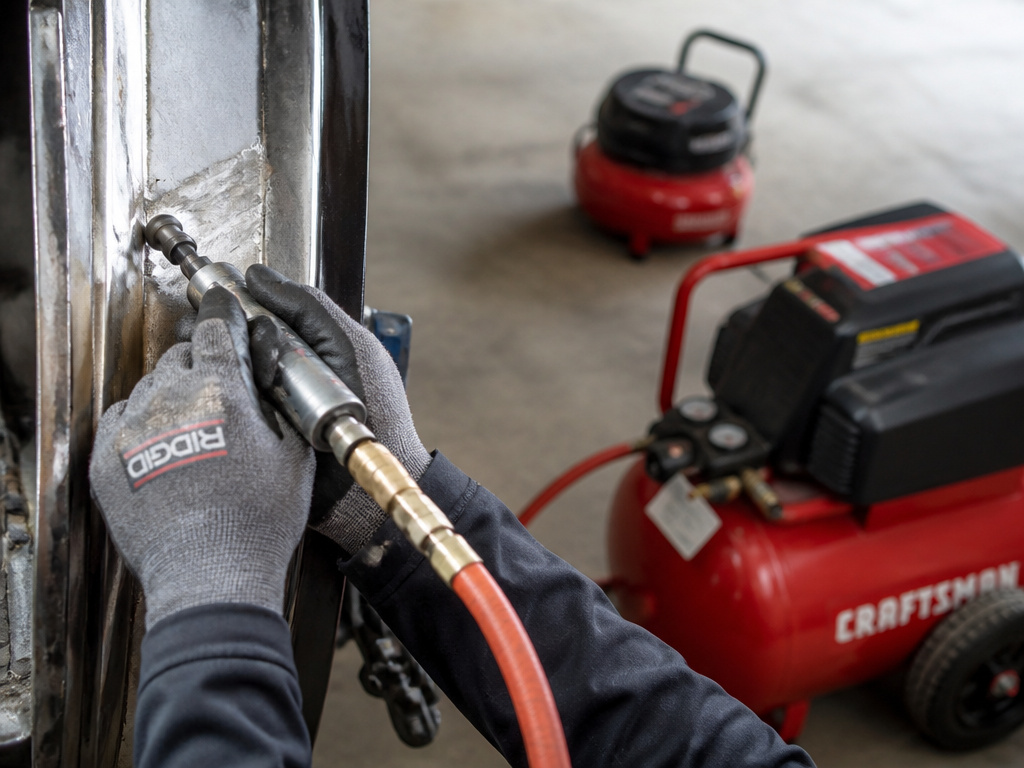
Forget horsepower. The specs that matter are CFM (cubic feet per minute) and PSI (pounds per square inch). CFM is the volume of air delivered; PSI is the pressure. Your tool with the highest continuous CFM demand sets your compressor’s minimum size.
A framing nailer might only need 2 CFM in bursts, but a die grinder or orbital sander can have a significant continuous CFM demand; for reference, hobby woodworking requires 4-8 CFM at 90 PSI. If your compressor can’t keep up, the tool stalls and the motor cycles constantly, burning out prematurely. Tank size just buys you time between cycles; it doesn’t increase the compressor’s ability to produce air.
| Tool / Application | Required CFM (Continuous) | Required PSI (at tool) | Notes |
|---|---|---|---|
| Brad Nailer | 0.3 – 0.5 CFM | 70-90 PSI | Low demand, easy for most compressors. |
| Die Grinder / Sander | 4 – 8 CFM | 90 PSI | This is the benchmark for a “serious” home garage compressor. |
| HVLP Spray Gun | 18 – 25 CFM | 135-150 PSI | Requires clean, oil-free air for a proper finish. |
| 1-Bay Auto Body Shop | 20 – 25 CFM | 135-150 PSI | Demands a rotary screw compressor for continuous duty. |
| Bead Seater | 30-50 CFM (2-3 sec burst) | (PSI not specified) | Tank size is critical here to absorb the short, massive air draw. |
The Bostitch BTFP02012 electric air compressor, for example, delivers 2.6 CFM at 90 PSI. That’s fine for a nailer but will not run a sander. Industrial gas compressors from Air Master Engineers, however, range from 5 CFM to 1000+ CFM. That upper end is for sandblasting and large industrial applications.
Cost Breakdown: Purchase Price vs. The 5-Year Reality
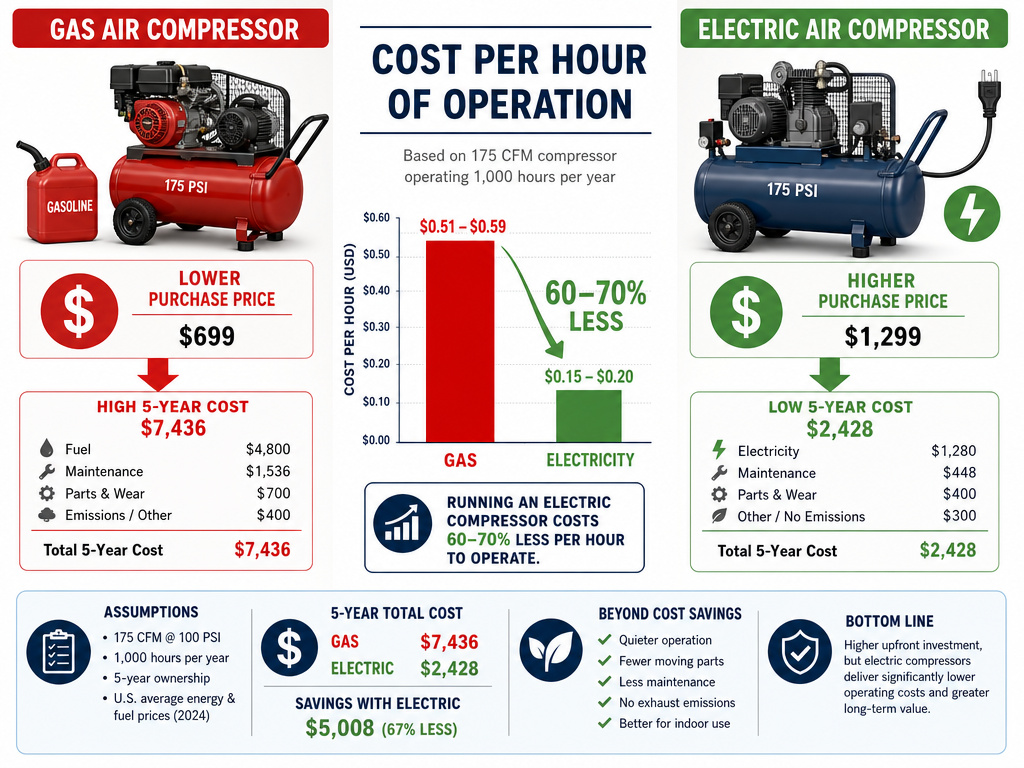
Be realistic. The sticker price is a down payment.
Adaptive Air Compressors states gas air compressors are cheap to buy, though Sustain Wise Hub notes electric compressors often cost 30-40% less to operate over their lifespan. But you’re committing to fuel. According to Sustain Wise Hub, a typical gas compressor consumes 0.5-1.5 gallons of fuel per hour of operation. Compare that to electricity, which typically costs 60-70% less than gasoline per unit of compressed air. Over a machine’s lifespan, electric compressors often cost 30-40% less to operate.
Common mistake: Comparing only the purchase price. A cheaper gas compressor will almost always be more expensive to own within three years of moderate use.
Here’s a simple framework. For a stationary shop you use weekly, the electric model wins on total cost. For a remote site used sporadically, the gas model’s higher operating cost is the price of admission for having power at all.
The natural gas option exists as a middle ground for stationary applications. It can be more efficient than gasoline and offers a continuous fuel supply, but it requires a fixed gas line, eliminating portability.
Noise, Air Quality, and Where You Can Work
This is the quality-of-life and safety section.
Gas compressors are loud. You’re standing next to a small engine. Electric motors, especially newer ones with insulated cabinets, are significantly quieter. Some brands build their reputation on quiet operation. For a home garage or indoor shop, this isn’t just about comfort—it’s about being able to hear, think, and not annoy everyone nearby.
Air quality is critical for certain tasks. Electric compressors are widely used in the medical industry and HVAC systems due to minimal contamination risk, according to Sunrise Metal. This is why they’re standard in medical industry, home, and office HVAC systems. A gas compressor’s exhaust fumes pose a contamination risk for painting or sanding; you’d need extensive filtration. For indoor air tool use, electric is the default.
Maintenance & Lifespan: Engine vs. Electric Motor
A gas engine has more moving parts: spark plugs, oil, air filters, fuel systems. It may require high maintenance. You’re doing routine oil changes, winterizing fuel, and dealing with carburetor issues. An electric motor has essentially one moving part (the rotor) and requires far less day-to-day care.
However, the pump technology matters more for lifespan than the power source. A well-maintained oil-lubricated piston pump, whether on a gas or electric unit, will typically outlast an oil-free pump. Oil-free pumps are convenient (no oil changes, less contamination risk) but run hotter and louder, often leading to a shorter service life.
My stance? For a home shop, the convenience of oil-free is fine. For a production environment where the compressor runs daily, an oil-lubed pump is an investment in longevity.
Matching Your Compressor to the Job (The Decision Matrix)
Stop thinking “gas or electric.” Start with your job site.
Scenario 1: The Home Garage / Fixed Workshop
You have 120V or 240V power. You work indoors. You need clean air for finishing.
- Verdict: Electric. Full stop. Look at brands like Makita or Rolair. Size it based on your most demanding continuous-use tool (likely a sander or grinder).
Scenario 2: The Remote Construction Site / Raw Land
No grid power exists. You’re outdoors. You need to run a framing nailer, occasionally a sprayer.
- Verdict: Portable Gas. It’s your only option. Focus on CFM output and fuel tank capacity.
Scenario 3: The Professional Auto Shop
You have 240V three-phase power. You run sanders, impacts, and spray guns daily, sometimes simultaneously.
- Verdict: Large Electric Rotary Screw, preferably with a Variable Speed Drive (VSD). A VSD unit can reduce energy use by 20-35% in this variable-demand setting, with a payback period of 2-4 years. This is where the long-term cost savings of electric power become a major business advantage.
Scenario 4: The Farming or Mining Operation
Remote, heavy-duty, continuous operation. Maybe you have a diesel generator on site already.
- Verdict: Large Industrial Gas/Diesel or a gas-powered rotary screw. These units, like those from Air Master Engineers, are built for continuous pressure in harsh environments.
Frequently Asked Questions
What is better, a gas or electric air compressor?
Neither is universally better. Electric is better for cost, noise, air quality, and indoor use. Gas is better for raw power output and true cordless portability; Adaptive Air Compressors states they are ideal for work needing continuous pressure, while Sunrise Metal suggests electric compressors are better for low load applications. The “better” one is the one that matches your power availability and your most air-hungry tool.
Are gas-powered air compressors better for big jobs?
They can be, but not because they’re inherently more powerful. Large industrial electric compressors exist. Gas is “better” for big jobs when those jobs are off the grid. On a powered site, a large electric rotary screw compressor is often more efficient and cheaper to run.
What type of air compressor is best for home use?
For 95% of home garages, an electric air compressor is the only practical choice. It’s quiet, clean, and plugs into a standard outlet. Choose a model with enough CFM (for hobby woodworking, 4-8 CFM at 90 PSI is typical) to run a sander or grinder if you plan to do more than nail trim.
Are electric air compressors worth it?
Absolutely, if you have electricity. Their higher efficiency and lower operating costs make them worth the investment for any fixed location. The savings on fuel alone will often cover the purchase price difference over a few years of regular use.
Can you use a generator with an electric compressor?
Yes, but the generator must be significantly oversized. Compressor motors have a high startup surge (locked rotor amperage). A generator that can only handle the compressor’s running watts will bog down and trip, potentially damaging both machines. It’s often simpler to use a gas compressor.
The Bottom Line
Your location decides the fight before it starts. If you have a reliable outlet, buy electric. If you don’t, you’re buying gas.
For home shops, ignore the tank-gallon hype and shop by CFM at 90 PSI. A tank that recovers fast is more useful than a larger tank that strains to keep up. And no matter which type you choose, spend $50 on a moisture trap and filter regulator. It’s the cheapest insurance for your expensive air tools.
The right tool for the job isn’t about brand loyalty. It’s about matching the machine to the reality of your power source, your task list, and your tolerance for noise and maintenance. Buy for the work you actually do, not the work you imagine doing someday.
