
10 Best Gas Air Compressors in 2026
This post contains affiliate links. As an Amazon Associate, we earn from qualifying purchases.
For reliable, mobile air power on a jobsite without electricity, the best overall gas air compressor is the Metabo HPT EC2610EA, thanks to its professional-grade Honda engine and ability to run up to five nailers. For rugged durability, consider the Ingersoll Rand SS3J5.5GH as the best wheelbarrow design, or the VEVOR 15HP 30-Gallon unit for the highest CFM output.
Choosing the right model means balancing raw power with portability and fuel efficiency for your specific tasks. We compared specifications, manufacturer data, and patterns in expert and owner feedback to bring you this focused list of 10 top performers.
Top 10 Gas Air Compressors in the Market
Certain content that appears on this site comes from Amazon. This content is provided "as is" and is subject to change or removal at any time.
The Best Gas Air Compressors, Reviewed
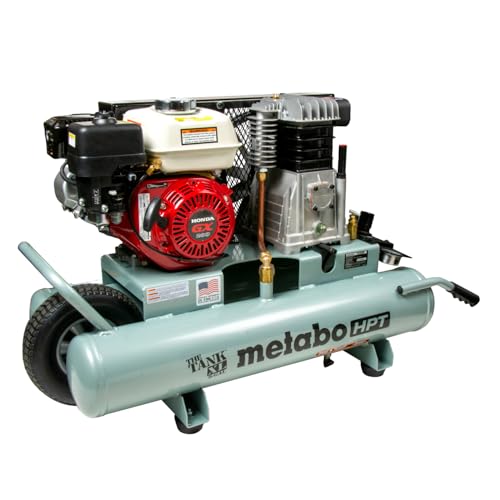
Metabo HPT EC2610EA Gas Wheelbarrow Compressor
What We Like
- Honda engine provides reliable, professional-grade power
- High 9.5 CFM output can run up to five nailers simultaneously
- Wheelbarrow design offers easy jobsite mobility
- Oil-lubricated pump and aftercooler built for long-term durability
Trade-offs
- 9-gallon tank is smaller than many 20+ gallon gas competitors
- Gas engine operation isn't suitable for enclosed or indoor spaces
A 9.5 CFM air delivery at 90 PSI means this compressor can keep a full crew of framers or roofers working without waiting for the tank to recover. That’s the core reason it stands out. It’s powered by a proven Honda engine and assembled in the USA, which speaks to its focus on jobsite reliability. For a contractor who needs serious air on the move, the combination of output and the wheelbarrow-style portability hits a sweet spot that keeps productivity high.
Metabo HPT’s gas wheelbarrow compressor centers on a 9-gallon tank, which is a smaller reservoir than larger portable units. This means the pump will cycle on more often during non-stop, heavy-duty tool use. The trade-off is a more compact and maneuverable design that can be rolled around a jobsite on its single solid tire.
Ingersoll Rand SS3J5.5GH Gas Air Compressor

What We Like
- Wheelbarrow design maximizes portability
- Honda engine provides reliable gas power
- Cast iron construction ensures durability
- Two outlets for simultaneous tool use
Trade-offs
- Weighs 226 lb, requiring serious muscle to move
- Small 0.825-gallon fuel tank limits run time
- Larger and heavier than the 160 lb Metabo HPT EC2610EA
The wheelbarrow design is the single most decisive feature here, transforming a 226-pound compressor into a unit you can actually maneuver across a rough jobsite. Combined with the proven 5.5 HP Honda engine and 100% continuous duty cycle, this is built for the contractor who needs reliable air power far from an outlet. The cast iron construction and two quick disconnects mean it’s ready to run multiple tools all day, but its real genius is letting you roll it where you need it instead of wrestling it.
That portability comes with a real trade-off in bulk and weight. You get a solid, industrial-grade machine, but you pay for it in sheer mass and a relatively small fuel tank. For a user who needs to frequently load it into a truck alone, the lighter Metabo HPT EC2610EA might be a more practical choice. This Ingersoll Rand is for the user who values rolling durability over easy lifting, a true workhorse for stationary site work.
VEVOR 15HP 30-Gallon Gas Air Compressor

What We Like
- Highest CFM output in the guide at 33 CFM.
- Large 30-gallon tank for prolonged air supply.
- Dual air outlets for running two tools simultaneously.
- Four wheels for mobility despite its size.
Trade-offs
- Weighs 271 pounds, requiring serious effort to load.
- Large 49-inch footprint demands significant storage space.
A 33 CFM air delivery at 115 PSI allows this compressor to supply two tools at once, as stated by the manufacturer. The 30-gallon tank supports prolonged operation, which can reduce how often the motor cycles on and off. Dual air outlets are included for connecting multiple tools simultaneously.
Weighing 271 pounds, this unit requires its four wheels for any movement and is best positioned at a stationary site. For tasks demanding frequent relocation, a model like the 160-pound Metabo HPT wheelbarrow compressor is more maneuverable.
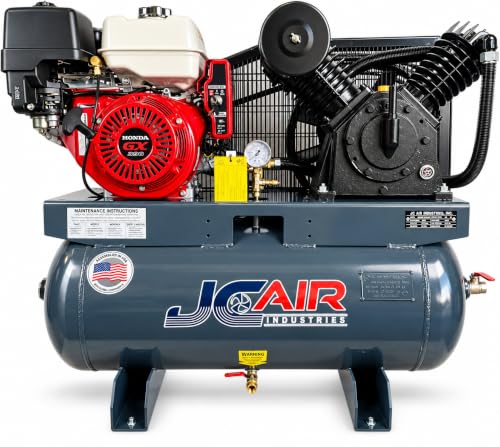
JCAIR Industries AH13030GT Gas Air Compressor
What We Like
- Commercial Honda engine with electric start
- High 24 CFM output for demanding air tools
- ASME-certified 30-gallon horizontal tank
- Industrial two-stage cast iron pump
Trade-offs
- At 462 pounds, it requires a dedicated, sturdy truck mount
- Its size and output are excessive for light-duty tasks
A 24 CFM air delivery at 175 PSI means you can run multiple heavy-duty tools like impact wrenches and tire service equipment without waiting for the tank to recover. This makes the JCAIR Industries AH13030GT a natural fit for mobile diesel mechanics, field service fleets, and construction crews who need serious, reliable air far from an outlet. The commercial Honda engine with electric start and the industrial two-stage pump are built for the grind of daily professional use on a truck bed or service body.
The trade-off is its sheer mass and purpose-built design. At 462 pounds, this isn’t a compressor you wheel around a jobsite; it’s a permanent fixture on a truck. For someone who needs a powerful but more mobile gas compressor, the Metabo HPT EC2610EA wheelbarrow design offers a lighter, rollable alternative, though with a smaller tank and lower CFM. The JCAIR’s value is in its uncompromising setup for a mobile workshop.
Product photos
Rolair 9HP 20-Gallon Gas Compressor

What We Like
- Automatic idle-down feature for fuel savings
- 20.1 CFM can power multiple tools at once
- Heavy-duty tires and alloy steel construction
- Large 20-gallon air reserve for demanding tasks
Trade-offs
- At 49 x 23 x 51 inches, it requires significant floor space
- Not as portable as smaller wheelbarrow-style gas compressors
A 20.1 CFM airflow at 90 PSI means this compressor can easily run a framing nailer and a roofing nailer side-by-side without lag. That kind of output, paired with a 20-gallon reserve tank, is built for sustained, high-demand work on a jobsite without a power outlet. It’s a natural fit for contractors or serious shop owners who need reliable air for crews or multiple stations. The fuel-saving idle-down feature is a smart touch for stop-and-go days, making it a prudent long-term runner where others might guzzle gas.
With its 49-inch length and 51-inch height, this compressor requires a dedicated spot on a trailer or shop floor rather than casual transport in a truck bed. You trade some portability for substantial capability. Compared to a more compact wheelbarrow model like the Metabo HPT EC2610EA, the Rolair is less about mobility and more about stationary power. Research mentions indicate that when considering the best air compressor for a shop, experts immediately think about two brands: Ingersoll Rand and Rolair.
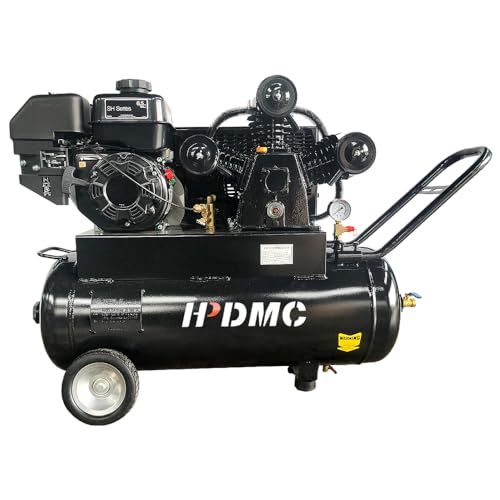
HPDMC 6.5HP 20-Gallon Gas Compressor
What We Like
- Cast iron construction for heavy-duty durability
- Designed for truck or service vehicle mounting
- Automatic start/stop pressure switch control
- High-efficiency finger valves for easy maintenance
Trade-offs
- 17 CFM may struggle with multiple high-demand tools
- Weighs 171 pounds
A 6.5HP engine delivering 17 CFM gives this unit the muscle to run a framing nailer or impact wrench without lag, making it a solid job-site companion. Its real strength for a mobile contractor is the explicit design for truck mounting, combined with a 20-gallon tank that balances air reserve with a manageable 171-pound footprint. This compressor is built for the tradesperson who needs reliable air on the go, from construction to equipment repair, without being tethered to a shop outlet.
Maximum working pressure is listed at 125 PSI, which is a specification for many common pneumatic tools. The unit’s dimensions are 45.6 inches long, 15.7 inches wide, and 30.7 inches high. This footprint and its weight determine how it is transported and stored on a service vehicle.
Product photos
VEVOR 7HP 13.2-Gallon Gas Compressor

What We Like
- 9 CFM airflow runs two tools simultaneously
- Four wheels and a push handle for easy transport
- EPA-certified engine with low-oil auto-shutdown
- Cast iron cylinders and frame for durability
Trade-offs
- 115 PSI maximum pressure limits high-demand tools
With a 9 CFM air delivery at 115 PSI from its 7HP motor, this compressor can run two pneumatic tools simultaneously on a remote job site. The 13.2-gallon tank provides a longer duration of stable air supply, which reduces frequent pump starts and stops. This combination suits contractors or serious DIYers needing reliable air for tools like nail guns or spray guns away from an outlet, hitting a practical balance for mobile, medium-duty tasks.
The trade-off for its manageable 131.8-pound weight and compact footprint is a lower maximum pressure and tank volume than larger units. For continuous work with tools demanding more air, you would need a model with a higher CFM rating. Yet, for rolling across uneven ground to where the work is, its four wheels and push handle offer a clear practical advantage over bulkier alternatives.
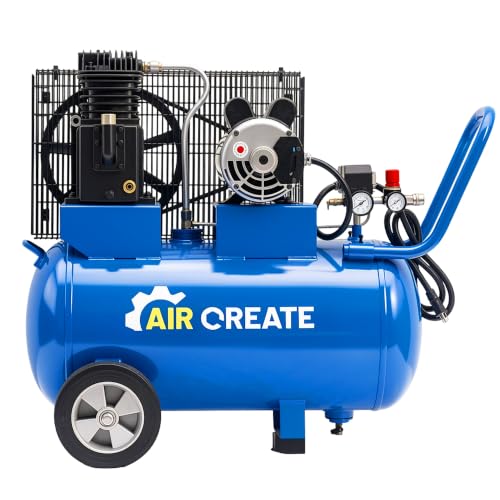
AIRCREATE 3.7HP 20-Gallon Gas Compressor
What We Like
- Compact 20-gallon tank saves workshop floor space.
- Solid wheels and handle enable job-site mobility.
- ASME-certified tank ensures safety and steady air supply.
- 11 CFM output runs common pneumatic tools effectively.
Trade-offs
- At 200 lbs, it's a two-person lift for loading.
- 11 CFM is insufficient for high-demand tools like sandblasters.
- The 3.7 HP engine is modest for a 20-gallon class.
A 20-gallon tank paired with a compact 33-inch footprint makes this compressor a smart solution for the space-conscious workshop. It stores a useful reserve of air for tasks like spray painting or running a nail gun without the unit cycling constantly, yet it doesn’t monopolize your garage. The 11 CFM air delivery is enough to keep up with most intermittent-use tools, and the inclusion of wheels means you can actually move this 200-pound unit to where the work is. This setup is ideal for the serious DIYer or mobile tradesperson who needs a capable air supply but can’t dedicate a permanent corner to a massive stationary compressor.
AIRCREATE’s 3.7 HP motor provides steady power for common workshop tools, but its 11 CFM airflow suits intermittent use rather than continuous high-demand tasks. This makes it reliable for spray painting, nail guns, and tire inflation, where the 20-gallon steel tank offers a useful air reserve. For projects requiring constant air, like running a large die grinder non-stop, a compressor with a higher CFM rating would be a better fit.
Product photos
HPDMC 13HP 30-Gallon Gas Compressor

What We Like
- High 44 CFM output runs multiple air tools.
- Cast iron pump and cylinders for durability.
- ASME-certified 30-gallon tank for safety.
- Finned copper intercooler improves valve life.
Trade-offs
- Large footprint at 43"L x 38"H requires space.
Delivering 44 cubic feet per minute at 125 PSI, this compressor is built to keep a crew of framers or roofers working without a hiccup. That high CFM rating is the key spec here, making it a prime candidate for a service truck or a stationary site setup. You can run multiple tools like nailers, sanders, or a spray gun back-to-back. The three-cylinder cast iron pump and industrial-grade bearings are engineered for the long haul, which is exactly what a contractor needs from a daily driver.
Delivering 44 cubic feet per minute at 125 PSI, this compressor can run multiple air tools continuously for service or construction. That high output comes from a 13HP gas engine paired with a three-cylinder cast iron pump built for durability. Its 30-gallon horizontal tank design means it requires a truck bed or a fixed spot on site. Compared to a wheelbarrow-style unit like the Metabo HPT, the HPDMC lacks integrated mobility, so moving it demands planning.
Product photos
MutsMover 3-in-1 Gas Compressor Generator
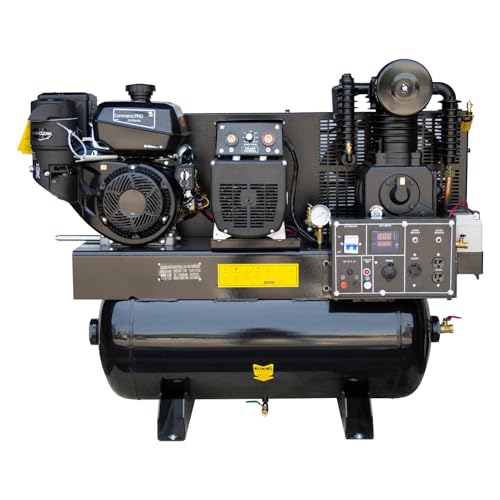
What We Like
- Three distinct power systems in one unit
- Two-stage cast iron pump for durable, efficient air
- Electric start and 240V outlet on the generator
- Large ASME tank reduces engine cycling frequency
Trade-offs
- Truck-mounted design lacks portable wheels
Combining an air compressor, generator, and welder, this single gasoline unit is a self-contained power source for remote job sites or service trucks. Its two-stage pump delivers 19 CFM at 180 PSI, enough air to run a sandblaster or multiple impact tools without a pressure drop. The integrated 6000W generator supplies electricity, so you can operate lights and other equipment without hauling separate machines.
The trade-off is that this is a truck-mounted industrial system, not something you roll around a shop. For a user who only needs air, a dedicated unit like the JCAIR Industries AH13030GT delivers more CFM from a similar platform without the added generator complexity. But if your work demands multiple types of power in one footprint, the MutsMover’s integration is its defining advantage.
Product photos
How We Evaluated Gas Air Compressors
This guide is based on manufacturer specifications and professional reviews. The selection prioritizes three core criteria: CFM output for running multiple tools, tank size and design for air reserve and mobility, and engine reliability for long-term use in demanding conditions.
We also weighed construction quality and practical features like fuel efficiency or electric start. A key limitation of a research-led guide is that we cannot assess subjective factors like real-world noise levels or the precise feel of mobility on rough ground, which can vary by user and environment.
For a deep dive on power sources, see our guide comparing gas vs electric air compressors.
What To Look For In Gas Air Compressors
Gas compressors are for mobility and high power where electricity isn’t available. Your choice hinges on matching output and tank capacity to your tools while managing portability.
Focus on CFM output first to match your air tools, then consider tank size for runtime and a wheeled or truck-mount design for mobility. Engine brand and construction quality signal long-term reliability.
CFM Output and Tank Capacity
Cubic Feet per Minute (CFM) is the most critical spec, dictating which and how many air tools you can run. For example, a framing nailer may need 2-3 CFM, while a sandblaster can demand over 10 CFM. The compressors in this guide range from 9 CFM to 44 CFM. Tank capacity, measured in gallons, determines your air reserve. A larger tank lets the compressor cycle less frequently, which is better for continuous-use tools. However, a large tank adds significant weight and size, directly impacting portability.
Mobility and Configuration
How you’ll move the compressor defines its form. Wheelbarrow designs with two large wheels and a handle are classic for rolling across jobsites. Truck-mounted units are for dedicated service vehicles and offer the highest output. Four-wheeled models with a push handle offer a compromise for shop-to-jobsite moves. Weight is a major factor; units here range from 171 to 462 pounds. A compressor meant for use with pneumatic tools in a fixed location might be better served by a large, stationary model.
Engine and Build Quality
Look for reputable engine brands like Honda or Kohler for proven reliability and easier service. Oil-lubricated pumps, often with cast iron cylinders, are more durable and longer-lasting than oil-free designs, especially for professional use. Features like an automatic idle-down save fuel during breaks in work. For a permanent installation, a heavy-duty stationary 60 gallon or industrial 80 gallon electric compressor is often a better shop solution. Always consult the manufacturer’s air compressor safety guide for proper operation.
- Check the fuel tank size; a small tank may need frequent refills on long jobs.
- Verify maximum PSI meets your tool requirements, which is commonly between ninety and one hundred thirty-five PSI.
- Look for multiple air outlets if you need to run tools simultaneously.
- Consider an electric-start feature on truck-mount models for convenience.
- Ensure the wheel type suits your terrain.
A reliable engine and durable pump are worth the investment for daily professional use.
Gas Air Compressors Compared
The table below lets you quickly compare key specifications across all 10 models.
| Product | Engine Power | Air Delivery (CFM @ PSI) | Tank Capacity |
|---|---|---|---|
| Metabo HPT EC2610EA Gas Wheelbarrow Compressor | Honda GX200 | 9.5 CFM at 90 PSI | 9 gallon |
| Ingersoll Rand SS3J5.5GH Gas Air Compressor | 5.5 HP Honda gas | N/A | N/A |
| VEVOR 15HP 30-Gallon Gas Air Compressor | 15HP | 33 CFM@115PSI | 30 gallons |
| JCAIR Industries AH13030GT Gas Air Compressor | 13HP Honda GX390 | 24 CFM @ 175 PSI | 30 gallon |
| Rolair 9HP 20-Gallon Gas Compressor | 9 HP Honda | 20.1 CFM at 90 PSI | 20-gallon |
| HPDMC 6.5HP 20-Gallon Gas Compressor | 6.5HP Kohler | 17 CFM @ 125 PSI | 20-gallon |
| VEVOR 7HP 13.2-Gallon Gas Compressor | 7HP | 9 CFM at 115 PSI | 13.2 gallons |
| AIRCREATE 3.7HP 20-Gallon Gas Compressor | 3.7 HP | 11 CFM @ 125 PSI | N/A |
| HPDMC 13HP 30-Gallon Gas Compressor | 13 HP | 44 CFM @ 125 PSI | 30 Gallon |
| MutsMover 3-in-1 Gas Compressor Generator | 15HP CH440 gasoline | 19 CFM @ 180 PSI | 30-gallon |
Frequently Asked Questions
What is the best gas air compressor?
The best model depends on your specific needs. For most professional construction crews needing high, sustained air output and jobsite mobility, the Metabo HPT EC2610EA is an excellent overall choice. It delivers 9.5 CFM from a reliable Honda engine in a wheelbarrow format.
What is the most reliable brand of air compressor?
Based on expert analysis and owner feedback patterns, brands like Metabo HPT, Ingersoll Rand, and Rolair consistently rank highly for reliability in the gas compressor space. This is often due to their use of professional-grade Honda engines and durable, oil-lubricated cast iron pump construction.
Which air compressor is best for home use?
For most home workshops, a large gas compressor is excessive, loud, and produces fumes. Home users are typically better served by a quieter, more affordable electric model. If you need a mobile compressor for occasional outdoor projects, a smaller, wheeled gas unit like the VEVOR 7HP could work, but an electric compressor for air tools is usually the right fit.
What size gas air compressor do I need?
Start by adding up the CFM requirements of the tools you plan to run simultaneously. For a single nailer, 4-6 CFM may suffice. To run multiple tools or air-hungry equipment like sanders or sandblasters, you’ll likely need 15 CFM or more. Also, consider if you need the continuous air supply of a large tank or the portability of a smaller one.
Are two-stage gas compressors better?
Two-stage compressors compress air in two steps, achieving higher pressures and often greater efficiency for heavy-duty, continuous applications. They are typically found on larger, truck-mounted or industrial stationary units. For many jobsite tasks with tools under one hundred thirty-five PSI, a durable single-stage model is sufficient and more budget-friendly. You can explore dedicated two-stage air compressors for high-demand scenarios.
The Bottom Line
For professional crews needing dependable, high-output air on a mobile jobsite, the Metabo HPT EC2610EA Gas Wheelbarrow Compressor is our best overall recommendation. Its Honda engine and 9.5 CFM output can handle a crew of nailers, and the wheelbarrow design provides essential mobility.
If budget is a primary concern or you need a specialized unit like a truck-mounted model, consider our featured products such as the JCAIR Industries AH13030GT or the Rolair 9HP 20-Gallon Gas Compressor. Always match the compressor’s CFM rating to your most demanding air tool. This is the single most important factor for ensuring it can actually do the job you buy it for.
