
How Brushless Motors Work in Power Tools: Key Components
This post contains affiliate links. As an Amazon Associate, we earn from qualifying purchases.
Brushless motors in power tools replace physical brushes and a commutator with an electronic controller that precisely times power delivery to the motor’s windings. This controller uses rotor position feedback, often from Hall sensors, to energize the stator’s coils in sequence, creating a rotating magnetic field that spins the permanent magnet rotor. The result is more power from the same battery, longer runtime, and no brush wear.
That electronic handoff, from sensor to controller to winding, is where the real engineering lives. It’s why a modern cordless drill feels unstoppable driving lag bolts, while an old brushed model bogs down and smokes. The controller isn’t just a switch; it’s a feedback loop that matches power output to the load on the bit, all happening thousands of times a second. This process is a key part of how brushless motors work in power tools.
What follows is a breakdown of that process, the measurable specs that define it, and the trade-offs you won’t find on the box when you compare a how brushless motors work in power tools. The controller’s communication with the battery, the ongoing challenge of low-speed smoothness, and the typical failure points in a brushless tool will be explained.
Key Takeaways
- The electronic controller replaces brushes, using sensors and software to sequence power to the motor windings for maximum efficiency.
- Brushless motors deliver more power and longer runtime from the same battery because they waste less energy as heat and sparking.
- A common control scheme called trapezoidal control is presented by some sources as a highly efficient solution, while others note it can cause torque ripple, a jerky, pulsing feel, at low speeds as a trade-off for its high-speed efficiency.
- When a brushless tool fails, the controller or its MOSFETs usually fail first; the motor itself is often still good.
- Identifying a true brushless tool means looking for three-phase power input on the motor and a dedicated controller board, not just marketing labels.
How a Brushless Motor Actually Spins
Forget the stator and rotor for a second. The core of a brushless motor is a three-way conversation central to how brushless motors work in power tools. A sensor says, “The rotor is here.” The controller hears that and says, “Send power to winding A and C, but not B.” The battery delivers. That sequence repeats, over and over, to spin the tool.
In a brushed motor, spinning copper contacts called brushes physically slide against a commutator on the rotor, making and breaking the circuit to flip the magnetic field. It works, but it’s messy. You get sparks, friction, wear, and a lot of wasted energy as heat. A brushless motor flips the script: the permanent magnets are on the spinning rotor, and the copper windings are on the stationary stator. To spin it, you don’t move a contact; you electronically “move” the magnetic field by energizing the windings in a precise circle.
The most common way to know where the rotor is uses three tiny Hall-effect sensors mounted inside the motor. As the magnet rotor spins past, each sensor sends a high or low signal to the controller. The controller reads this three-bit code, knows the exact position, and fires the correct pair of windings. More advanced “sensorless” controllers, like the one described in US Patent 12671355, can deduce position by analyzing the current in the motor phases, offering an alternative to Hall sensors.
The controller uses rotor position feedback, from Hall sensors or current sensing, to determine which pair of the three stator windings to energize next, creating a precise, rotating magnetic field that pulls the permanent magnet rotor.
The Controller Is the Brain (And Its Spec Sheet)
If the motor is the muscle, the controller is the nervous system. It’s a compact circuit board, often no bigger than a credit card, packed with a microcontroller, gate drivers, and a bank of MOSFETs, the solid-state switches that actually pulse power to the motor.
Take the Texas Instruments TIDA-00772 reference design. It’s a real blueprint for a power tool motor drive. Its specs tell you what a modern controller is capable of:
- Peak Current: Its design can deliver 60 amps to the motor windings for one second to power through a stall.
- Efficiency: Operates at >98%, meaning almost all the battery’s energy goes to the work, not heat.
In this design, they have an incredibly low resistance of 1.8 milliohms when switched on. Low resistance is everything here, it’s the difference between a component that sips power and one that turns it into waste heat.
The controller also acts as a bodyguard. It monitors for a blocked rotor (stall) and will cut power in a cycle-by-cycle fashion to protect the MOSFETs and motor. It watches the battery voltage, stopping the tool if the voltage sags too low. This protection is why you can lean on a modern brushless drill without the magic smoke escaping.
Brushed vs. Brushless: Where the Rubber Meets the Road
This isn’t an academic difference. It changes what the tool feels like in your hand and how long it lasts in your kit.
| Aspect | Brushed Motor | Brushless Motor | Impact on the User |
|---|---|---|---|
| Commutation | Physical brushes & commutator. | Electronic controller. | No brush wear, no sparking, longer life. |
| Efficiency | Typically 65-75%. | Often >85%, with designs like the TIDA-00772 exceeding 98%. | Longer runtime per charge, less heat in the hand. |
| Maintenance | Brushes must be replaced periodically. | No user-serviceable brushes. | No planned downtime for replacing brushes. |
| Power Control | Basic, linked to trigger pull. | Intelligent, adjusts power based on load. | Prevents bogging down, provides more consistent torque. |
| Failure Mode | Gradual power loss from worn brushes. | Sudden failure, usually controller or MOSFET. | Tool stops working entirely but motor is often salvageable. |
The efficiency gap is the real story. If a brushed motor is 70% efficient, 30% of your battery’s energy is lost as heat and sparking at the brushes. In a 98%-efficient brushless system, only 2% is lost. That energy goes back into the work, which is why a brushless drill can feel stronger and last longer on the same lithium-ion batteries.
I used to think cordless tools lacked power. A modern brushless driver changed my mind after driving hundreds of lag bolts on a single charge. The lack of brush friction meant all the battery’s effort went to twisting the fastener, not making sparks inside the motor. You’ll find that extra efficiency translates directly to less fatigue on long jobs.
The Trapezoidal Trade-Off: Torque Ripple vs. Efficiency
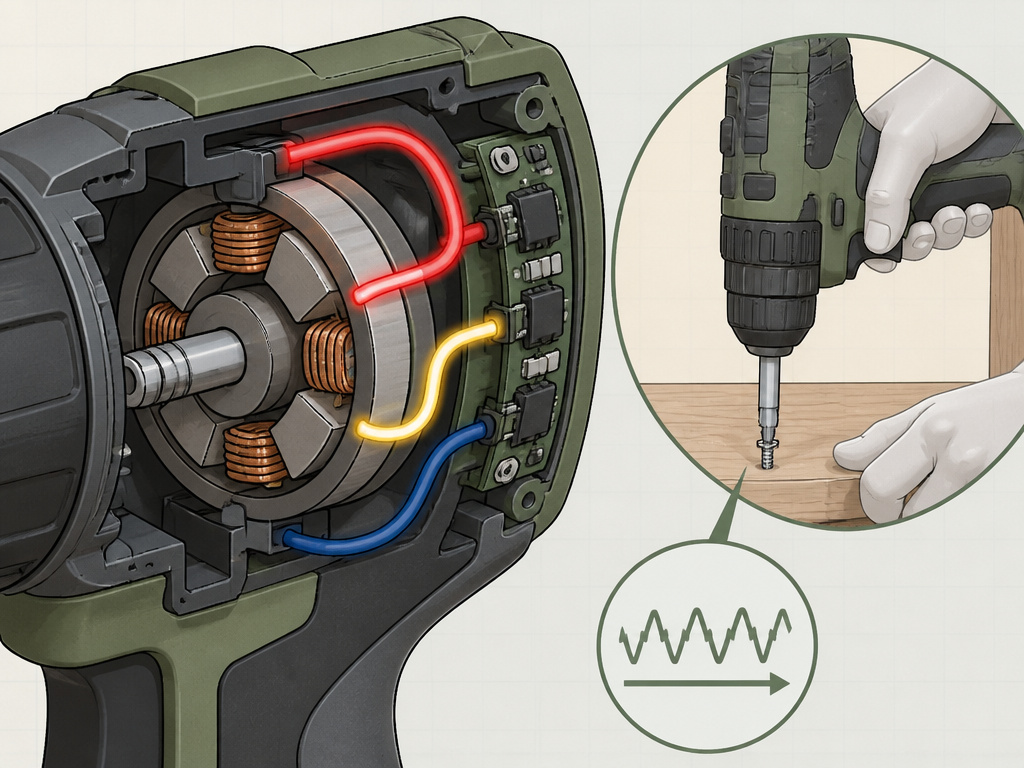
Here’s where the spec sheet gets interesting, and where sources genuinely disagree on the best approach. The TIDA-00772 design uses sensor-based trapezoidal control. It’s a proven, efficient method. But US Patent 12671355 points out its flaw: at low speeds, it can cause torque ripple.
Think of trapezoidal control like turning a six-cylinder engine by firing two cylinders at a time in a set order. It works, but between each firing, there’s a tiny dip in power. At high RPMs, you don’t feel it. At low speeds, like when you’re carefully starting a screw or using a variable-speed setting, that dip feels like a subtle pulsing or jerkiness in the tool.
The patent notes that in trapezoidal control, “at least one phase of the motor is not energized at any given time, which limits the total power input.” For maximum smoothness and power at all speeds, more advanced schemes like field-oriented control (FOC) keep all three phases actively working together. The trade-off? FOC requires more processing power and complex software.
Where this goes sideways: Assuming “brushless” means perfectly smooth at all speeds. Trapezoidal-controlled tools, while efficient, can exhibit a jerky, pulsing feel during precise, low-RPM work, which is a deal-breaker for fine woodworking or delicate fastening.
This is a perfect example of why you can’t judge a tool by the “brushless” label alone.
What Breaks and How to Spot a True Brushless Tool
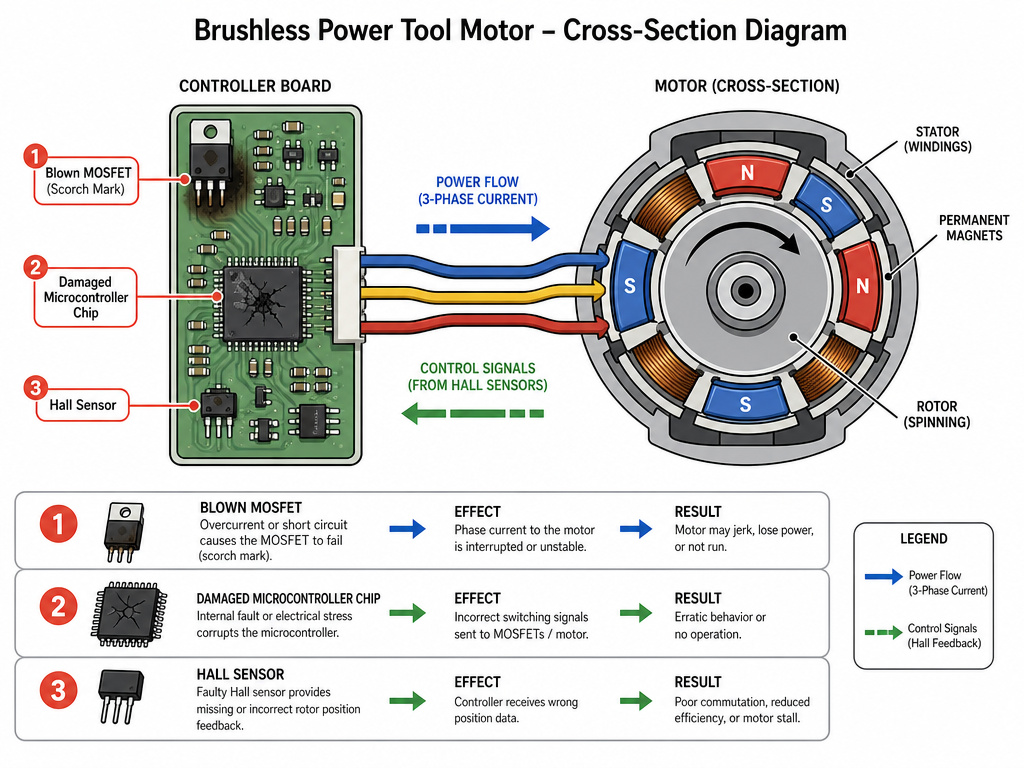
The “no maintenance” line has a catch. Brushless motors don’t wear out from use; they tend to fail from a single event. That event is usually in the controller.
Common Failure Points:
- MOSFETs: These solid-state switches handle all the motor’s current. A voltage spike from a bad battery, a direct short, or severe overheating can blow them instantly. You’ll usually get a pop, a puff of smoke, and a completely dead tool.
- Controller IC/Microcontroller: If the brain fries, the motor won’t get any instructions. This can happen from water ingress or the same electrical faults that kill MOSFETs.
- Hall Sensors: Less common, but if a sensor dies, the controller gets lost. The motor may jitter, pulse, or refuse to start.
The motor itself, the magnets and windings, is incredibly robust. It has no wearing parts. If your brushless tool dies, a technician can replace the controller board and bring it back to life. This is different from a brushed tool, where gradual decline from brush wear is the expected failure mode.
Easy to miss: A tool that sparks isn’t necessarily brushed. A failing controller or a short in the windings can cause a sparking power tool, but it’s a fault, not a design feature.
How do you know you’re getting a real brushless motor? Look past the marketing.
- Check the Spec Sheet or Manual: It should explicitly say “brushless motor” or “BLDC motor.” Descriptions like “high-efficiency” or “advanced motor” are red flags.
- Look at the Motor: A true three-phase brushless motor will have three thick wires (one for each phase) running from the controller to the motor body. A brushed motor typically has two.
- Listen and Feel: A brushless tool under light load is often nearly silent. A brushed tool will have a distinct electrical buzzing from the brushes.
Brushless Motors in the Real World: Applications and Limitations
The benefits make brushless the go-to for any cordless tool where runtime, power, or durability is critical. That’s why you see them in nearly every category now: from brushless drills and impacts to saws, grinders, and outdoor power equipment.
But they’re not a magic bullet. Their performance is tied to the health of the supporting electronics and the battery. A weak or old battery can’t deliver the clean, high current the controller demands, leading to poor performance. They’re also more sensitive to environmental extremes.
And there’s the repair factor. Fixing a brushed motor is often a simple matter of replacing carbon brushes. Diagnosing and replacing a cooked controller board requires schematic diagrams, specialty tools, and component-level skill. For the average user, a major controller failure often means a new tool.
| Tool Type | Why Brushless Wins | Potential Limitation |
|---|---|---|
| Drill/Driver | Sustained high torque, long runtime for driving many fasteners. | Low-speed smoothness varies by control scheme. |
| Circular Saw | Maintains blade speed under load in thick material. | High peak current demands can stress battery packs. |
| Angle Grinder | Runs cooler, no brush dust to contaminate worksite. | Vibration-heavy use can fatigue solder joints on controller. |
| Blower/Trimmer | Maximizes run-time for yard work. | Can be sensitive to moisture and debris ingress. |
Frequently Asked Questions
What are the downsides of a brushless motor?
The main downsides are cost and repairability. Brushless tools are more expensive upfront due to the complex controller. When they fail, it’s often the controller that goes, which is harder and more expensive to fix than simply replacing brushes on a brushed motor. Some control schemes can also cause a slight pulsating feel at very low speeds.
Are brushless motors really better?
For cordless power tools, yes, overwhelmingly so. They deliver more usable power from the same battery, run significantly longer, generate less heat, and require no brush maintenance. For corded tools, where infinite power is available from the wall, the efficiency gains are less critical, but the durability and lack of maintenance are still major benefits.
How can I tell if my power tool is brushless?
The surefire way is to check the official spec sheet or user manual, it will state “brushless.” Visually, if you can see the motor, look for three thick power wires running into it (for a three-phase brushless motor) instead of two. Many brands also label their brushless tool lines distinctly (e.g., DeWalt XR, Milwaukee M18 FUEL).
Why is my brushless tool sparking?
True brushless motor should not spark in normal operation. If you see sparks, it indicates a fault. Common causes are a failing controller, damaged motor windings shorting out, or debris inside the motor housing causing an arc. This is a problem that needs diagnosis, unlike the normal, constant sparking of a brushed motor.
Before You Go
The move to brushless isn’t just marketing; it’s a fundamental shift from mechanical to digital power delivery. That shift gives you more work per charge and a tougher tool, but it also ties the tool’s life to a small, sophisticated circuit board.
Don’t get lost in peak power claims or voltage wars. The real spec to look for is efficiency, the percentage of battery energy that makes it to the bit. And remember, “brushless” covers a range of performance. For fine, controlled work, the choice of control scheme (trapezoidal vs. Field-oriented) matters as much as the motor itself.
If you’re comparing tools and the power tool specs are a blur of jargon, focus on this: a high-efficiency brushless motor paired with a high-quality battery will outperform anything with brushes. For 95% of jobs, that’s the only metric you need.
