
Brushless vs Brushed Power Tools: Which Is Worth It?
This post contains affiliate links. As an Amazon Associate, we earn from qualifying purchases.
Brushless vs brushed power tools comes down to a simple mechanical trade-off: a brushed motor uses physical carbon brushes to transfer electricity, creating friction and wear, while a brushless motor uses an electronic controller for contactless operation, trading higher upfront cost for more efficiency, longer runtime, and less maintenance. For a weekend DIYer, a brushed tool from a major brand is often the better value. For anyone using tools weekly or professionally, brushless is the smarter long-term investment.
That mechanical difference at the heart of the brushless vs brushed power tools question dictates everything else: how long the tool runs, how hot it gets, how often it needs service, and how much you pay for it. The specs you see on the box, runtime percentages, torque ratings, are all downstream from that one engineering choice.
What follows is a breakdown of how each motor actually works in the context of brushless vs brushed power tools, the real numbers behind the marketing claims, and a clear guide on which type of user each one serves. We’ll also look at where the manufacturer promises don’t always line up with owner experiences.
Key Takeaways
- The core difference is physical contact: brushed motors use wearing carbon brushes, while brushless motors use an electronic controller, eliminating that friction source.
- Runtime claims vary wildly: DeWalt claims its brushless impact driver offers 57% longer runtime versus its own brushed tools, but an owner reported a competing brushless model (Makita) outperforming the DeWalt brushless model.
- Efficiency gains are real but debated: Sources disagree on the exact figures; IBT Industrial Solutions cites brushless efficiency at 85–90% versus 75–80% for brushed, while Jiangsu Borui Tools states 80–90% for brushless versus 60–75% for brushed, and The Good Home Daily states brushless motors are up to 50% more efficient.
- Motor lifespan is a theoretical win: Industrial data from IBT Industrial Solutions shows brushless motors lasting 10,000–100,000 hours vs. 1,000–8,000 hours for brushed, while Jiangsu Borui Tools offers a tighter, tool-specific range of 10,000–30,000 hours for brushless, but most DIY tools fail from other causes long before the motor quits.
- Choose brushed for light, infrequent use and brushless for weekly professional work, where its cooler operation and stability under load justify the premium.
The Core Difference: How Each Motor Works
A brushed motor is a wonderfully simple, century-old design. Inside, spring-loaded blocks of carbon, the brushes, press against a spinning copper ring called a commutator. This physical contact transfers electricity to create the magnetic field that turns the motor. Every time you pull the trigger, those brushes are dragging, sparking slightly, and wearing down.
A brushed DC motor’s operation hinges on the friction between carbon brushes and a rotating commutator to sequentially energize electromagnets and produce rotation. This mechanical commutation is the source of its inherent inefficiency and wear.
A brushless motor replaces that mechanical dance with an electronic one. There are no brushes and no commutator. Instead, a circuit board inside the tool acts as the conductor, using sensors to precisely energize the motor’s magnets in sequence. Nothing touches. The absence of that friction is why everything changes.
Where this goes sideways: Assuming “brushless” automatically means “better build quality.” It’s a component, not a build quality tier. You can find a well-built brushed tool from a major brand and a cheaply made brushless tool from an unknown importer. Judge the whole tool, chuck, battery platform, ergonomics, not just the motor type.
The Physical Feel of Each
You can hear and feel the difference. A brushed motor under load has a distinct, gritty whine, the sound of electricity arcing across the commutator. The tool body gets warm to the touch after a short period of continuous drilling. A brushless motor is quieter, more of a high-pitched hum, and the housing stays noticeably cooler because less energy is wasted as heat. That cooler operation isn’t just a comfort feature; it’s a direct indicator of higher efficiency, as less battery power is being converted into waste heat.
Performance Face-Off: Power, Runtime & Efficiency
We will look at the details. When DeWalt launched its DCF895 brushless impact driver, they claimed it provided “57% longer runtime vs. Their latest generation brushed impact drivers.” That’s a comparison against their own older tech. More boldly, they claimed “up to 150% more runtime vs. Competitors’ latest impact drivers.”
Here’s the rub: an owner on ToolGuyd contradicted that last claim directly, stating they got “about 50% more screws with my old Makita brushless than the new DeWalt brushless.” This isn’t just nitpicking, it shows that competitive runtime claims are often marketing estimates, not universal truths. You should read them as directional indicators, not precise measurements.
The Efficiency Numbers Behind Runtime
Longer runtime stems from greater efficiency. Without brushes dragging, more of the battery’s energy goes to the chuck instead of being lost as heat and spark. But how much more?
| Efficiency Source | Brushed Motor Efficiency | Brushless Motor Efficiency | Notes |
|---|---|---|---|
| IBT Industrial Solutions | 75–80% | 85–90% | Broad industrial DC motor figures. |
| Jiangsu Borui Tools | 60–75% | 80–90% | Power tool-specific rating ranges. |
| The Good Home Daily | — | “Up to 50% more efficient” | General comparison claim. |
The table shows a clear consensus on direction but disagreement on exact magnitude. IBT’s figures are the most conservative, showing a 5–15 percentage point gain. Jiangsu Borui’s range suggests a larger jump. Treat all such figures as proof of an advantage, not a purchase guarantee.
Why the efficiency matters beyond runtime: That saved energy translates directly into the tool’s behavior under load. A brushed motor, when it hits a knot in wood, will try to push through by drawing more current, heating up more, and sometimes stalling. A brushless motor’s controller can sense the increased load and deliver a more intelligent burst of torque, often powering through more smoothly. This is why for applications demanding stable torque, like driving long screws or using a hole saw, brushless motors are the default recommendation.
Lifespan & Durability: Theory vs. Practice
Matco states brushes in brushed motors typically need replacing every 50 to 60 hours of use. That’s the predictable, scheduled maintenance. The primary failure mode for a brushed motor is the wearing down of these carbon brushes. When you see a sparking power tool, that’s often the first sign of worn carbon brushes.
Brushless motors, having no such wear parts, promise a much longer theoretical life. IBT Industrial Solutions cites industrial figures of 1,000 to 8,000 hours for brushed motors versus 10,000 to 100,000 hours for brushless. Jiangsu Borui Tools offers a tighter, tool-specific range: brushed motors under heavy use may need service after 1,000–5,000 hours, while quality brushless motors are rated for 10,000–30,000 hours.
Common mistake: Choosing a tool based solely on theoretical motor lifespan. Most DIY tools are retired because the battery platform dies, the chuck breaks, or the tool gets dropped, long before the motor wears out.
The Repair Reality
This is the most practical differentiator. Replacing carbon brushes is among the easiest repairs you can do on a power tool. A guide to replacing carbon brushes walks you through a simple job with an inexpensive part. It’s a feature, not a bug.
A brushless motor has no such user-serviceable wear part. Its point of failure is the electronic controller. If that board fries from a power surge, moisture, or physical damage, the repair is almost never cost-effective. Lowe’s notes this explicitly, stating the electronics make brushless motors “more vulnerable to harsh operating conditions.” You don’t fix it; you replace the tool.
So, the durability argument isn’t just about what lasts longer, it’s about what’s cheaper to keep running. For a professional who can’t afford downtime, the brushless motor’s reliability is key. For a DIYer who doesn’t mind a simple repair every few years, the brushed motor’s serviceability is a genuine advantage.
Cost Analysis: Upfront Price vs. Total Ownership
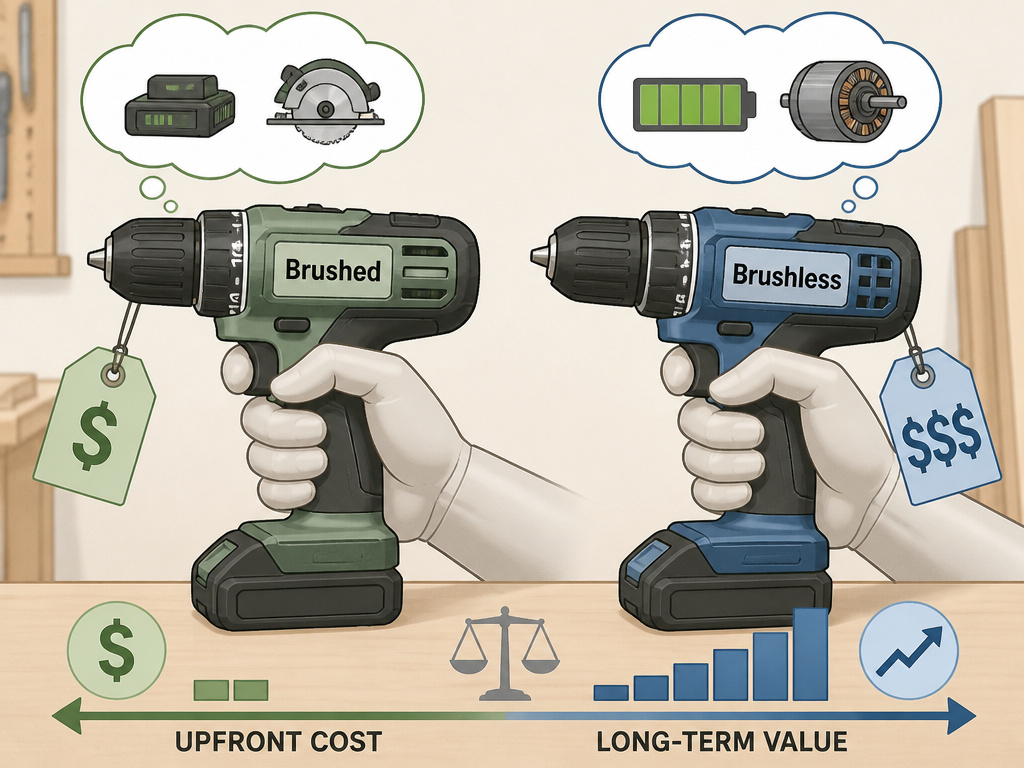
The price gap at the checkout is the most concrete difference. You pay more for brushless. The question is what you’re buying with that premium.
- Longer runtime per charge: You’ll make fewer trips to the charger. For a contractor, that’s productivity time saved.
- More power and control: The intelligent delivery means better performance in demanding materials.
- Less maintenance: No scheduled brush replacements.
- Cooler, quieter operation: Cooler, quieter operation.
Ideal Power Tools recommends brushless for professional contractors whose livelihood depends on their tools. They recommend brushed for DIYers or homeowners who use a drill a few times a month for light tasks. That’s a solid, simple rule of thumb.
When the Math Flips for a DIYer
Consider a typical situation. Say you need a drill and an impact driver. You could buy a premium brushless combo kit. Or, you could buy a capable brushed combo kit and use the money you saved to add an extra tool or battery. For infrequent use, the second option often delivers more practical value. The DIY Tool Review puts it bluntly: for a weekend DIYer, “a brushed tool plus a spare battery beats a brushless tool with a flat one.”
This is especially true when you’re building out your first kit. The ecosystem choice, 12V vs 18V platforms, brand commitment, is often more important than the motor inside your first drill. Your future tool purchases will be dictated by the battery platform you choose today.
The Right Tool for the Job: Brushed vs Brushless Recommendations
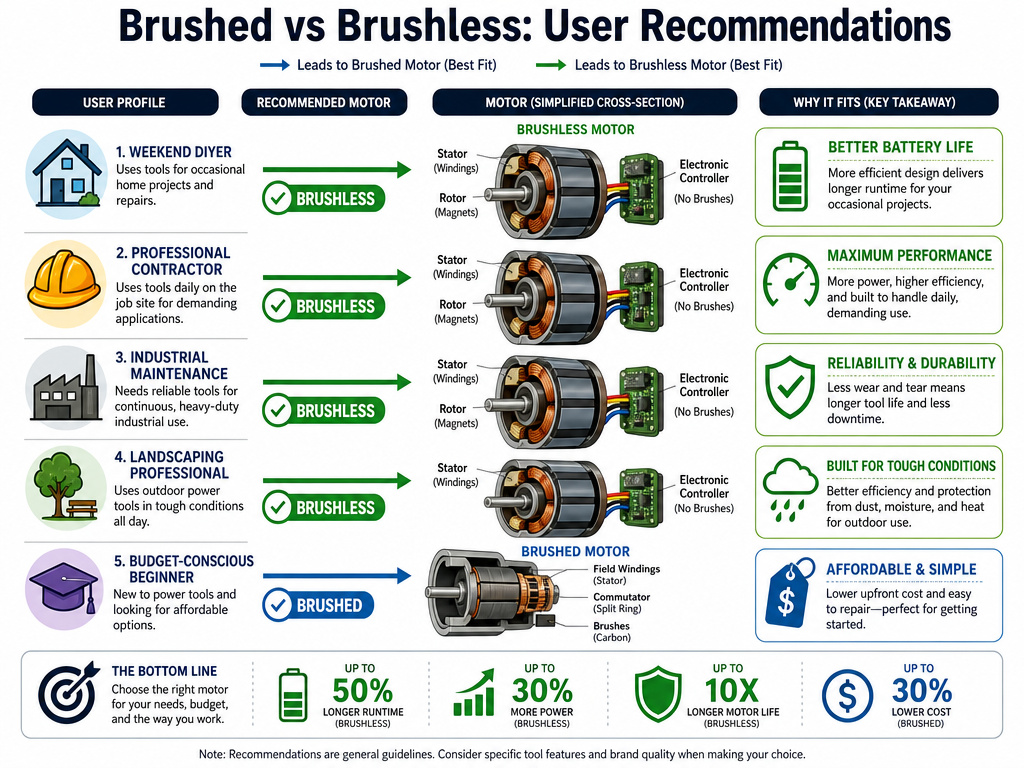
This isn’t about good vs. Bad. It’s about matching the technology to the task frequency and intensity. The following table breaks it down by user profile.
| User Profile | Recommended Motor | Why It Fits | Tool Example |
|---|---|---|---|
| Weekend DIYer | Brushed | Cost-effective; sufficient power for occasional tasks; easy/cheap to repair. | Entry-level drill/driver combo kit. |
| Frequent DIYer / Home Renovator | Brushless | Better runtime for longer projects; handles tougher materials. | Mid-range brushless drill & impact driver. |
| Professional Contractor | Brushless | Reliability is critical; runtime equals productivity; built for all-day use. | Pro-grade brushless kit (e.g., DeWalt XR, Milwaukee Fuel). |
| Price-Sensitive Buyer / Student | Brushed | Maximizes tool count on a tight budget; light-duty use is fine. | Basic brushed drill for light-duty use. |
| User in Extreme Conditions | Context Dependent | Brushless runs cooler, but its electronics are vulnerable to dust/moisture. | Consult tool’s IP rating; sealed brushed tools may be more robust. |
The Corded Exception
All this talk of runtime assumes a cordless tool. The cordless vs corded debate is a separate layer. If you’re considering a corded tool, the efficiency and runtime advantages of brushless vanish. You have unlimited power from the wall. Here, a brushed motor is often perfectly fine and keeps the cost significantly lower. The motor choice only becomes a critical differentiator in the cordless world, where battery energy is a finite resource.
Frequently Asked Questions
Is brushless worth the extra money?
It depends entirely on your use. For a professional or someone undertaking weekly projects: absolutely. The performance and time savings justify the cost. For someone who drills a handful of holes a year: no, a brushed tool from a major brand will last for a long time and serve you perfectly.
What are the downsides of a brushless motor?
The two main downsides are higher upfront cost and more expensive, complex repairs. If the electronic controller fails, the tool is often a write-off. Brushed motors are simpler and cheaper to fix.
Do brushless tools work with the same batteries as brushed tools?
Yes, within the same brand and voltage platform. A DeWalt 20V MAX battery will work in both a brushed and a brushless DeWalt 20V tool. The motor type doesn’t affect how lithium-ion batteries work or their physical compatibility.
Can you tell if a tool is brushless by looking at it?
Usually not. Some brands label their brushless tools with specific sub-brand names (like DeWalt’s “XR” or Milwaukee’s “Fuel”), but the only sure way is to check the technical specifications on the box or the manufacturer’s website.
My brushed tool is sparking inside. Is it broken?
Not necessarily. Some sparking at the brushes is normal, especially under load. Visible sparks or a burning smell indicate excessive wear and that it’s time for a brush replacement guide.
Before You Go
The clearest signal to ignore the motor debate altogether is if you find yourself using a tool less than once a month. In that case, buy the best value kit you can find from a major brand and don’t look back. The tool will age out from obsolescence long before the motor wears down.
For everyone else, let the job dictate the tech. If your project list has “build a deck” or “renovate a kitchen” on it, the efficiency and stamina of brushless will pay dividends in sweat and time saved. If you’re assembling furniture and hanging shelves, channel your budget into getting a solid drill-driver combo with two batteries, not into chasing a motor spec you’ll never fully use.
Ultimately, the best tool is the one that gets the job done and stays out of the repair shop. Sometimes that’s the advanced, efficient brushless motor. Often, for most people in their own homes, it’s the simple, repairable brushed one that’s been doing the job just fine for years.
