
How to Cut Cast Iron Pipe With a Reciprocating Saw
This post contains affiliate links. As an Amazon Associate, we earn from qualifying purchases.
To cut cast iron pipe with a reciprocating saw, secure the pipe, mark the line with chalk or crayon, and use a carbide-tipped or diamond blade. Apply slow, steady pressure and let the blade do the work; forcing it causes overheating and dulling. A clean cut on a 4-inch pipe takes 1-2 minutes with the right blade.
The real question isn’t if you can cut it, but how to do it without burning through three blades in the process. Cast iron is brittle, not just hard, and that changes the technique. This is the core of how to cut cast iron pipe with a reciprocating saw.
What follows is the specifics the manuals skip. We’ll walk through blade choice, where the experts genuinely disagree on how to cut cast iron pipe with a reciprocating saw, how to set up so the pipe doesn’t move, and the hand-pressure that keeps the cut straight. You’ll also see where a reciprocating saw wins over a grinder and where you should just grab a hacksaw instead.
Key Takeaways
- Use a carbide-tipped or diamond blade; general metal-cutting blades dull almost immediately against cast iron.
- Secure the pipe with a pipe vise or heavy-duty C-clamp, a 3-inch pipe can weigh 10 pounds per foot and will shift.
- Sources disagree on how to mark the cut line: AT Improvements recommends using a crayon or chalk, as pencil and pen typically don’t show up well, while Nanjing Jinmeida Tools Co., Ltd. (JMD) advises marking with a pencil or marking pen.
- Put plastic sheeting underneath the work area; even drained pipes often have residual drips that stain.
Why Cast Iron Is a Different Beast
Cast iron isn’t steel. Hit steel with a blade and it shears. Hit cast iron and it crumbles. That crumbling action is what grinds down a standard bi-metal blade in seconds. The material is granular, almost like a very hard sandstone held together with metal.
This granular structure is why blades designed for abrasion work best when learning how to cut cast iron pipe with a reciprocating saw. They grind through the iron particles instead of trying to slice them. A blade that works on steel conduit will scream, smoke, and die on cast iron sewer pipe. You need the right teeth, or the right grit.
A carbide-tipped or diamond-edge blade is preferred for cutting cast iron pipes. These specialized blades minimize the risk of chipping or damaging the pipe during the cutting process.
The other factor is vibration. A loose pipe will chatter against the blade, amplifying the saw’s natural shaking and making a clean line impossible. That’s why every step before the trigger pull matters more than the saw’s power.
The Blade Debate: Carbide vs. Diamond
Here’s where you’ll find conflicting advice. Some sources swear by one type, others by another. It’s not marketing; it’s different experiences with different pipes and conditions.
| Blade Type | Best For | Reported Performance | Source |
|---|---|---|---|
| Carbide-Tipped | General cutting, newer pipe | Cuts through the brittle surface “without a problem.” | Nanjing Jinmeida Tools Co., Ltd. (JMD), AT Improvements |
| Diamond Grit | Tough jobs, multiple cuts, tight spaces | Cut two 4-inch pipes without noticeable dulling; faster than carbide grit. | Family Handyman (Lenox 9-inch blade) |
| Carbide Grit | Compromise on cost and wear | Good abrasion resistance, often cheaper than diamond. | General consensus among manufacturers |
The Family Handyman test is telling. They used a Lenox 9-inch diamond reciprocating saw blade on two 4-inch pipes and reported no noticeable dulling or breaking. That’s a strong data point for diamond’s durability. These blades cost $10-20 each.
Carbide-tipped blades are the more common recommendation. AT Improvements and Metalscut4u.com both point to them as the suitable choice. Their teeth are harder than the cast iron, so they chip and crush the material rather than rub against it.
So which do you pick? For a one-time cut on a residential drain line, a carbide-tipped blade is perfectly adequate and easier to find. If you’re facing a whole house replumb with dozens of cuts, or working in a cramped space where blade changes are a nightmare, the diamond blade’s longevity is worth the extra few dollars. Don’t overthink it, just don’t use a plain metal-cutting blade.
The Non-Negotiable Setup: Safety and Securing
Skipping this step turns a simple cut into a dangerous, messy job. Cast iron pipe is heavy; for example, 3-inch diameter cast iron pipe can weigh as much as 10 pounds per linear foot. An unsupported section can drop, pinch your blade, or swing into something.
Your first move is always to unplug the saw before installing the blade or making any other adjustments.
Next, secure the pipe. The research is unanimous on this.
- For horizontal pipes: Use a pipe vise or a heavy-duty C-clamp to anchor it to a stable work surface. If you’re cutting in place, use a hanger strap or similar support before and after the cut segment. AT Improvements recommends a support at least every 5 feet of pipe run.
- For vertical pipes: A riser clamp is the proper tool to prevent the upper section from sliding down.
Wear gloves and safety glasses. Cast iron throws off sharp, hot fragments. Cover the floor below with plastic sheeting, even if you think the pipe is dry, there’s often sludge or condensation that will drip.
The 5-Step Reciprocating Saw Process
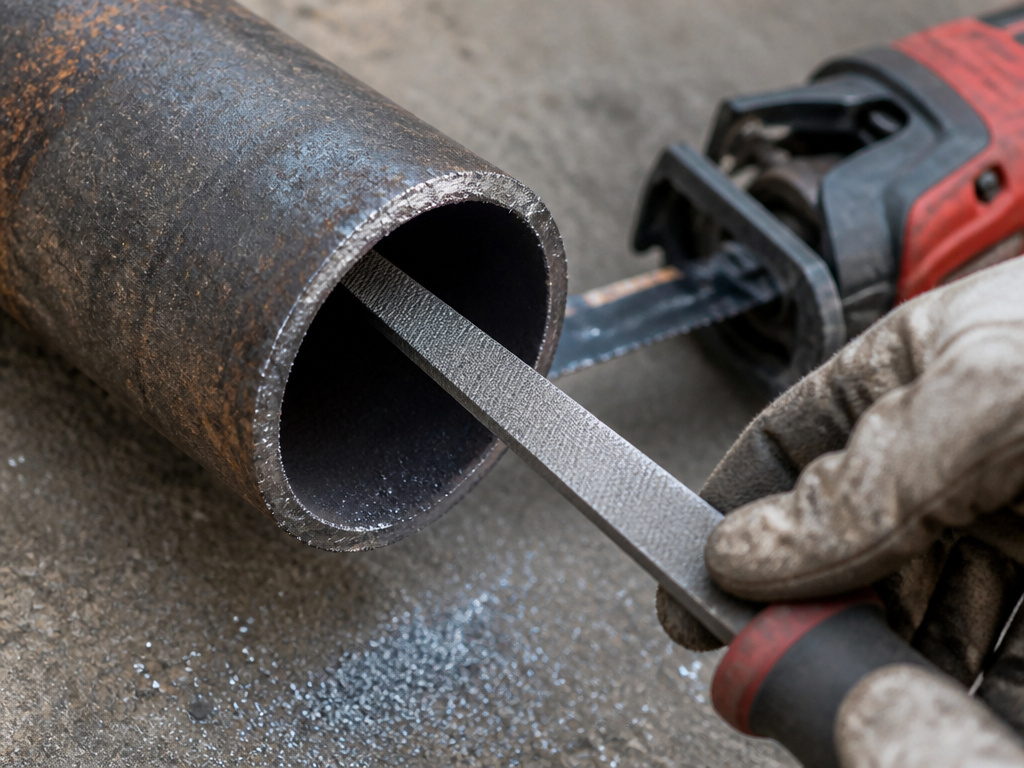
This is where theory meets the pipe. The goal is a square cut with minimal burrs, ready for a Fernco coupling or hub connection.
1. Mark the Line (The Right Way)
Forget the pencil. On the dark, often rusty surface of cast iron, a pencil or pen mark is invisible. AT Improvements recommends a crayon or chalk. Make a bold line.
To mark a perfect circle around the pipe, wrap a piece of paper or yarn around it, keep it even, and trace along the edge. This ensures your cut is square, which is critical for the seal later.
2. Start the Cut Without the “Walk”
The teeth of a reciprocating saw blade want to bounce off the curved, hard surface. To prevent this, some pros use a hacksaw to cut a small starter notch or groove along the line. This gives the reciprocating saw blade a track to sit in. It’s an optional step, but it makes the first two seconds much easier.
3. Use the Right Pressure
Squeeze the trigger and let the blade reach full speed before contacting the pipe. Guide the blade slowly along the marked line. The key phrase from the sources is “slow, steady pressure.”
Common mistake: Pushing too hard. This overheats the blade, glazes the teeth or diamond grit, and drastically shortens its life. It also increases vibration, leading to a rougher cut. Let the tool do the work.
If the blade drags or the motor bogs, you might be pushing. Ease up. Some guides suggest lubricating the blade to minimize friction, though this is more common with continuous cutting operations.
4. Manage the Cut
Cutting through cast iron pipe with a reciprocating saw will likely take 1-2 minutes, depending on condition. You’ll feel and hear the difference as you cut. It’s a gritty, grinding sound, not a ringing whine.
If you’re cutting in a tight space, a crawl space or between joists, the reciprocating saw’s advantage is its head can get where an angle grinder can’t. Handheld tools like reciprocating saws are suitable for smaller, more accessible cuts or tight spaces.
5. Finish the Edge
When the pipe separates, you’ll have a burr on the inner and outer edge. This isn’t optional cleanup; a sharp burr can damage a rubber coupling seal or cut your hand.
Use a metal file or a rotary tool with a grinding bit to knock down the burr. Aim for a smooth edge you can run your glove over without catching. A clean edge is a professional edge.
How It Compares to Other Tools
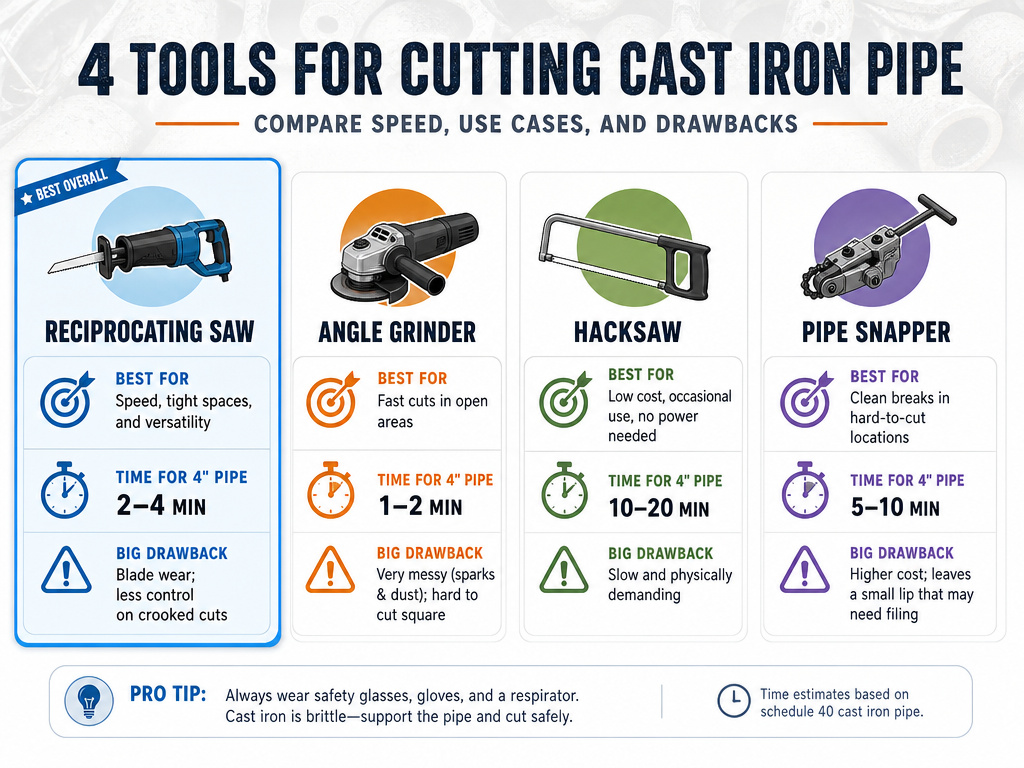
You have options. The reciprocating saw isn’t the only tool for the job, and it’s not always the best.
| Tool | Best For | Time for 4″ Pipe | Big Drawback |
|---|---|---|---|
| Reciprocating Saw | Tight spaces, in-place cuts, DIYers | 1-2 minutes | Blade wear, vibration |
| Angle Grinder | Open areas, fastest cut, pros | < 1 minute | Sparks, requires space, wheel wear |
| Hacksaw | Single cut, no power, minimal burr | 10-15 minutes | Extreme physical effort |
| Pipe Snapper | Clean, open, new pipe | Seconds | Useless in mud/cramped spaces; chain gums up |
For cutting cast iron pipe in crawl spaces, under concrete, or in dirt, a pipe snapper (swirl pipe cutter) is less effective as the chain gets gummed up with mud and crud. That’s a huge practical limitation the tool catalogs don’t show.
According to AT Improvements, cutting cast iron with a hacksaw will likely take 10-15 minutes, depending on condition.
Troubleshooting a Bad Cut
Even with the right setup, things can go sideways. Here’s what to check.
- The blade is smoking or glowing: You’re pushing too hard or the blade is done. Stop immediately, let it cool, and replace it.
- The cut is wandering off the line: You didn’t secure the pipe well enough, or you didn’t start with a guide notch. Stop, reclamp, and try to steer back to the line with very light pressure.
- The saw is vibrating wildly: The pipe is likely suspended and ringing like a bell. Add more support directly under the cut area to dampen the vibration.
- The blade seems to stop cutting:
Where this goes sideways: Using a worn-out blade. A dull blade requires more force, heats up more, and is more likely to bend or snap. Change it early.
Frequently Asked Questions
Can you really cut cast iron with a reciprocating saw?
Yes, absolutely. It’s a standard method for plumbers and DIYers, especially when the pipe is in a location where larger tools like grinders won’t fit. The critical factor is using a blade designed for the material, carbide-tipped or diamond.
What is the best Sawzall blade for cutting cast iron pipe?
Sources disagree, but the choice is between carbide-tipped blades and diamond grit blades. Carbide-tipped is the most commonly recommended and is sufficient for most jobs. Diamond blades, like the Lenox 9-inch model noted in the research, offer longer life for multiple cuts.
How do you prevent the blade from breaking?
Avoid bending the blade by letting the saw’s reciprocating motion do the work. Don’t twist or pry with the blade. Ensure the pipe is firmly secured so it can’t shift and pinch the blade. Using the correct blade length for the pipe diameter also helps.
Is a corded or corded reciprocating saw better for this?
Do you need to lubricate the blade when cutting?
It’s not typically necessary for a one-off cut. However, if you are making many consecutive cuts and notice increased drag or heat, applying a little cutting oil to the blade can reduce friction and extend its life. The JMD source lists this as a troubleshooting step if the blade is dragging.
The Bottom Line
For cutting cast iron pipe in place, especially in the tight spots under sinks, in crawl spaces, or between joists, a reciprocating saw is the right tool. The job comes down to three things: a carbide or diamond blade, a pipe that doesn’t move, and the patience to use slow, steady pressure.
Remember the weight. Support any horizontal pipe every five feet. And mark your line with something you can actually see. That two-minute cut starts with ten minutes of setup. Skip the setup, and you’ll spend an hour fixing a bad cut or replacing broken blades.
If you have a clean, accessible section of pipe on a workbench, an angle grinder is faster. But for the real-world, awkward positions where cast iron pipe always seems to live, the reciprocating saw is the tool that gets the call.
