
How to Use a Rebar Cutter and Bender: Step-by-Step Guide
This post contains affiliate links. As an Amazon Associate, we earn from qualifying purchases.
To use a rebar cutter and bender, you match the tool to the rebar size and grade, set up on a stable surface with proper power, and follow a strict sequence: inspect, mark, position, and operate. For a manual MBC-16B1, that means cutting #5 (5/8”) Grade 60 rebar one bar at a time and bending 0-90° in a single motion. For a powered FASCUT FS-600, it requires a 110-120V outlet on a 20-amp circuit (or a 220-240V power source) and ensuring the bar rests flat on the bottom of the cutter opening.
That sequence, inspect, mark, position, operate, is where jobs go right or wrong before the handle moves. The difference between a clean 90-degree hook and a kinked, useless bar depends on whether you followed the specs printed in the manual that most people skim, which detail how to use a rebar cutter and bender.
What follows is the setup, safety, and step-by-step walkthrough for both manual and electric models, which is the core of how to use a rebar cutter and bender. This guide explains the maintenance needed to keep the tools working and the single calculation for bend placement that avoids wasting steel.
Key Takeaways
- Always match the tool to the rebar grade and size; the MBC-16B1 manual cutter/bender is rated for #5 (5/8”) Grade 60 rebar maximum.
- For powered units like the FASCUT FS-600, ensure your circuit has a 20-amp breaker and use a 12-gauge extension cord to prevent motor burnout.
- Cut one bar at a time and never attempt to use both cutting slots on a manual tool simultaneously, as this can cause serious injury.
- Lubricate all moving parts periodically and, for hydraulic units, replace the oil every year or 200 hours to maintain performance.
- When bending, only bend straight bars once; attempting a second bend on already-curved steel can break the tool’s bending pin.
Safety First: The Non-Negotiables
This isn’t a drill you can fumble. A rebar cutter is a focused metal-shearing press, and a bender is a controlled fracture machine. Your first job is to not get hurt.
The MBC-16B1 manual states the baseline: use work gloves and safety glasses at all times. For electric models, additional personal protective equipment like hearing protection may be advisable due to motor noise. Steel-toed boots aren’t overkill when you’re handling 20-foot lengths of #5 bar.
Before you start: The two biggest hazards are flying metal and electrical overload. A short cut piece can launch with enough force to break skin (the FASCUT manual explicitly warns against this). An under-gauge extension cord on a 110V circuit will cause voltage drop, overheating the motor until it fails, often silently, until the next time you need it.
Your work area needs to be clear, stable, and dry. If you’re using a generator for a portable unit like the FASCUT FS-600, you must disable the idle-down feature so the engine runs at operating speed when turning on the rebar cutter. The motor needs full operating voltage the instant you hit the button, or it strains.
Tool Types: Manual Lever vs. Electric/Hydraulic
You have two broad paths when learning how to use a rebar cutter and bender, and your choice dictates your speed, effort, and setup complexity.
Manual bender/cutters, like the MBC-16B1, are simple levers. They are all about mechanical advantage. There’s no motor to burn out, no hydraulic oil to change. Their limits are physical: the MBC-16B1 maxes out at cutting and bending #5 (5/8”) Grade 60 rebar. You provide the muscle, and the tool provides the guided force. They’re perfect for small jobs, remote sites with no power, or as a reliable backup.
Electric/hydraulic combo tools, like the FASCUT FS-600, do the work for you. Press a button, the hydraulic ram pushes, and the bend is done in about three seconds. This speed comes with complexity. They demand specific power: 110-120V on a 20-amp circuit minimum, or 220-240V wiring. They have hydraulic fluid that needs annual changes, filters, and more moving parts to maintain.
| Tool Type | Best For | Key Limitation | Power Requirement |
|---|---|---|---|
| Manual (e.g., MBC-16B1) | Small batches, remote work, DIY | Max #5 (5/8″) bar, requires user strength | None |
| Electric/Hydraulic (e.g., FASCUT FS-600) | Production bending, repeated cuts | Requires 20-amp circuit, hydraulic maintenance | 110-120V / 20A or 220-240V |
The choice often comes down to volume. Bending fifty identical stirrups? Go electric. Making a dozen cuts for a patio? The manual tool is faster to set up and won’t complain about your generator.
The Critical Setup: Power and Inspection
You can’t skip this. A powered rebar tool is a hungry appliance, and it will break your electrical system if you don’t feed it properly.
For a 110-120V tool like the FASCUT FS-600, the manual is unambiguous: plug into a circuit with no less than a 20-amp breaker. When you need an extension cord, never use less than 12-gauge wire. That’s thick, heavy-duty cord. A flimsy 16-gauge cord from a lamp will cause a voltage drop. The motor draws more current to compensate, heats up, and the insulation on its windings cooks. The failure isn’t always dramatic, sometimes the tool just gets weaker until it won’t start.
The part nobody mentions: In cold weather, hydraulic oil thickens. If you don’t, the pump strains against the viscous fluid, and you’ll hear a labored groaning that’s a sure sign of unnecessary wear.
Inspect the tool every time. For cutters, check that the blades are tight and the cutting edges aren’t chipped. For benders, ensure all pins, rollers, and dies are secure and the correct size for the bar you’re about to bend. A loose bolt here turns into a catastrophic failure mid-bend.
How to Cut Rebar: The Two-Slot Rule
Whether manual or electric, the principle is the same: one clean shear. The devil is in the positioning.
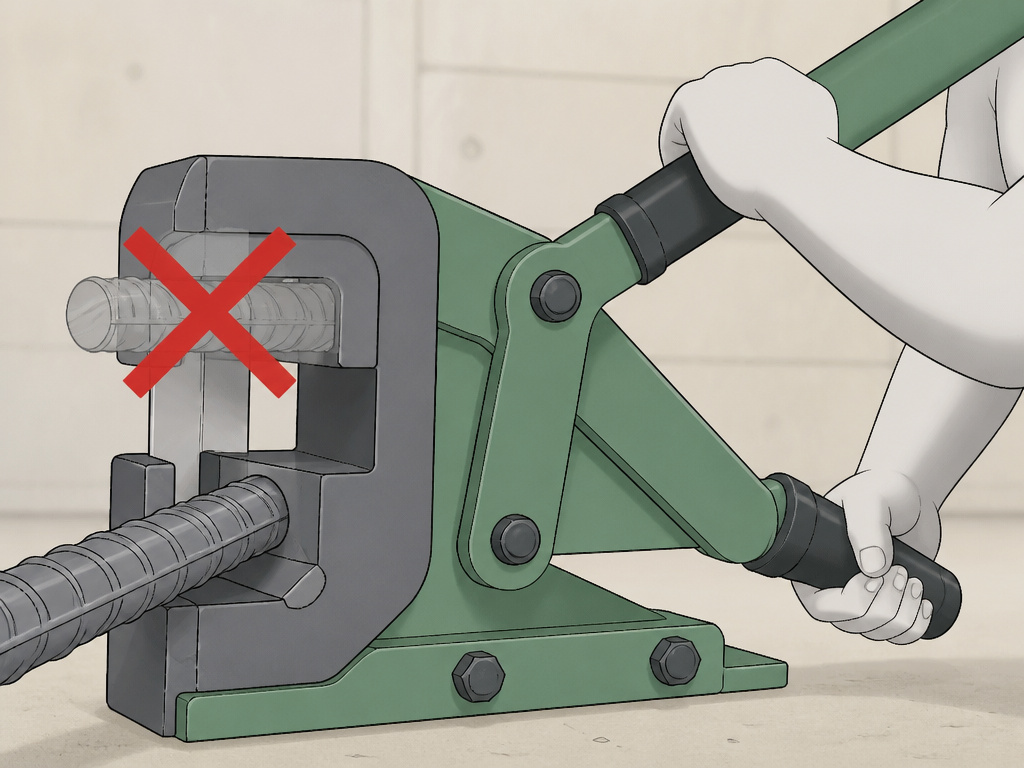
On a manual MBC-16B1, you have two cutting slots, but you must cut single bars only and not use both slots simultaneously. You must cut single bars only, using one slot at a time. Seat the bar fully into the slot so the opening in both blades is aligned, ensuring a clean cut much like the technique for a metal chop saw. Then, with a firm, steady push, drive the handle down. The cut should feel like a solid thunk, not a gritty crush.
Where this goes sideways: Trying to cut two bars at once by putting one in each slot. The MBC-16B1 manual forbids this: “Do not attempt to use both cutting slots simultaneously.” The force required would be immense, and the uneven pressure could snap the tool’s frame or cause the handle to kick back violently.
For electric cutters like the FASCUT, the rule is about placement: the bar must rest on the bottom of the cutter opening. Don’t let it ride up on the corner of the blade. And never cut very short pieces, under a few inches. The cut piece can become a projectile. If you need short lengths, cut a long piece first, then trim it down while it’s still held securely, perhaps using a tool like a reciprocating saw with the right blades for thick metal.
How to Bend Rebar: Rollers, Angles, and the One-Bend Law
Bending is where you shape the skeleton of your concrete. Getting it right means understanding your tool’s geometry.
With a manual bender, mechanical advantage is the principle. Insert the bar against the bending pin or form, and pull the handle in a smooth, continuous arc. The MBC-16B1 can achieve 0-90° in a single bend and up to 180° in two steps.
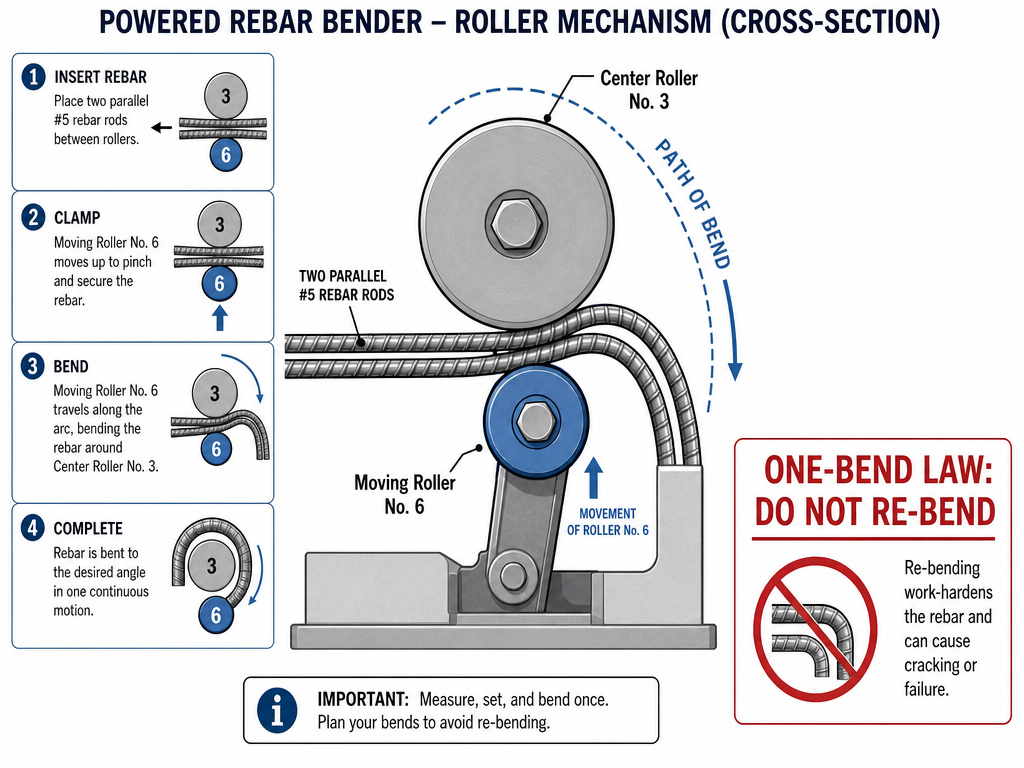
Powered benders use a different system. A tool like the BN Products DBD-25H uses a set of interchangeable center rollers and moving rollers. The combination determines the bend radius and how many bars you can bend at once. For example, the BN Products DBD-25H manual specifies that for 5/8” (16mm) #5 Grade 60 rebar, you can use Center Roller No. 3 and Moving Roller No. 6 to bend 2 pieces simultaneously, while the MBC-16B1 manual lists #5 (5/8″) as its maximum bending capacity for a single bar.
| Bar Size (# / inches) | Center Roller | Moving Roller | Max Pieces per Bend |
|---|---|---|---|
| #8 / 1″ | No. 7 | No. 1 | 1 |
| #5 / 5/8″ | No. 3 | No. 6 | 2 |
| #4 / 1/2″ | No. 2 | No. 8 | 3 |
Table based on the BN Products DBD-25H manual for Grade 60 rebar.
The FASCUT FS-600 manual states: only bend straight bars once. Do not take a bent bar, reposition the rollers, and try to bend it again. The metal is already work-hardened at the bend point, and the concentrated stress will likely break the tool’s bending pin or damage the rollers.
Troubleshooting: Cuts, Bends, and Hydraulic Groans
Things will go wrong. Here’s how to diagnose the common issues before they waste your day.
- Incomplete or Ragged Cut: Dull blades. On a manual tool, you’ll feel a gritty, crushing resistance instead of a clean shear. Replace the blade set. On a powered cutter, check that the blade bolts are tight, loose blades can twist and shatter.
- Bar Slipping or Kinking During Bend: Wrong roller size or mispositioned bar. The bar must lay perfectly flat on the machine surface before the bend starts. If it’s cocked at an angle, it will fly out or kink.
- Excessive Springback: You’re likely bending steel harder than Grade 60. Both the BN Products and FASCUT manuals warn not to bend material harder than Grade 60 or 600N/mm². The tool’s geometry is calculated for that yield strength. Harder steel will fight back to its original shape.
- Slow or Weak Hydraulic Action: Check the oil. The FASCUT manual recommends maintaining the hydraulic system, but the fact sheet does not specify a 200-hour interval. Old, contaminated oil makes the pump sluggish. Also, check for leaks around fittings and cylinder seals.
A telltale sound to listen for: a high-pitched whine from a hydraulic pump that usually means it’s starving for oil or the fluid is too cold. That’s your cue to stop and investigate.
Maintenance: The 200-Hour Service
A rebar tool isn’t a hammer you throw in a box. Its longevity is a direct function of care.
The maintenance schedule splits into two lists:
After Every Use:
- Brush off metal filings and dust.
- Check for loose bolts, especially on cutter blades and roller pins.
- Wipe down the tool to prevent rust.
Scheduled Service (Per Manual Specs):
- Periodically lubricate all moving parts. (MBC-16B1 manual).
- Replace hydraulic oil every year or 200 hours. (FASCUT manual implication).
- Inspect blades and replace when cutting becomes difficult. (MBC-16B1 manual).
This isn’t busywork. A dry pivot point on a manual bender increases the force you need, encouraging bad form. Dirty hydraulic oil carries metal shavings that score the cylinder walls, leading to permanent power loss.
Measuring and marking rebar for bends/cuts
Accurate marking is the first step to avoiding wasted material. Start by laying your straight rebar flat on a stable surface. Use a tape measure and a permanent marker or soapstone to clearly indicate where a cut or the center point of a bend should be. Always consult your project plans for exact dimensions. When preparing for a cut, ensure the bar will rest on the bottom of the cutter opening as specified in your machine’s manual. For bends, remember that some machines can only bend a straight bar once, so your mark must be precise the first time.
Setting the bending angle
The process for setting the bending angle depends on your specific machine. Manual benders often rely on a physical stop or visual alignment. Check your tool’s manual for its bending range; some can achieve a single bend up to 90 degrees, while more complex shapes require multiple steps. Always ensure the bar is positioned flat on the machine’s surface between the rollers before starting the bend. Do not attempt to bend steel harder than Grade 60 rebar, as this exceeds the capacity of most tools.
Frequently Asked Questions
What safety gear do I absolutely need?
You need safety glasses and work gloves as a minimum, per the MBC-16B1 manual. For powered tools, add hearing protection. Steel-toed boots and long sleeves are strongly recommended to protect against sharp ends and flying debris.
Can I cut or bend more than one piece of rebar at a time?
It depends entirely on your tool’s rating. The manual MBC-16B1 can only cut one bar at a time. The powered BN Products DBD-25H can bend multiple bars simultaneously, for example, two pieces of #5 (5/8″) rebar, but only if you use the correct roller combination specified in its chart. Never exceed the manual’s stated capacity.
What’s the difference between Grade 40 and Grade 60 rebar?
Grade 60 rebar has a higher yield strength (60,000 psi) than Grade 40 (40,000 psi). It’s stronger but also harder to bend. Most tools, like the FASCUT FS-600, are rated for Grade 40 or Grade 60 rebar. Crucially, you must not bend steel harder than Grade 60, as it can damage the tool.
Why did my bending pin break?
The FASCUT manual lists three likely causes: using the wrong roller/die configuration, attempting to bend an already-bent bar a second time, or trying to bend steel harder than Grade 60 rebar. Always bend straight bars only once.
Can I use a generator to power a rebar cutter?
Yes, but with strict rules. For the FASCUT FS-600, the generator must be 5000 watts or larger, and you must disable the idle-down feature so the engine runs at full operating speed when the tool starts. This prevents the motor from stalling or burning out due to low voltage.
Before You Go
The one step that decides your success happens before you touch the tool: reading the manual for your specific model. The capacity for the MBC-16B1 is the engineering limit of its castings. The 20-amp circuit requirement for the FASCUT is the minimum to keep its motor alive.
Match the tool to the job. For a few dozen cuts and bends, a manual tool is simpler and foolproof. For production work, the electric tool pays for itself in saved time and effort, but you inherit the duty of maintaining its hydraulic system, a trade-off also considered when choosing among the best steel chop saws. Whichever you use, respect the numbers in the spec sheet. They’re not marketing copy; they’re the line between a finished project and a broken tool.
