
How to Use a Tire Inflator With an Air Compressor
This post contains affiliate links. As an Amazon Associate, we earn from qualifying purchases.
To use a tire inflator with an air compressor, you connect the inflator hose to the tire’s valve stem, power on the compressor, and monitor the pressure gauge. The exact procedure and its accuracy depend on your specific model, some require you to turn the compressor off to check pressure, while others let you release a trigger on the inflator gun mid-flow for a reading. You must also keep the vehicle engine running, fully extend the power cord, and operate the compressor upright.
That distinction between checking methods isn’t academic. It’s the difference between hitting your tire’s recommended pressure on the first try and bouncing between under- and over-inflation for ten frustrating minutes. The process varies because air moving at high velocity inside the hose creates turbulence that throws off a gauge’s reading, a physical fact that each manufacturer handles differently.
What follows is the universal sequence every model follows, the specific safety rules buried in their manuals, and the troubleshooting fixes for when the air won’t go where it’s supposed to.
Key Takeaways
- Always keep your vehicle’s engine running while the compressor is on. The VIAIR 00082/88P SXS and VIAIR 450P-RV Automatic manuals mandate this to prevent draining your battery.
- Whether you can trust the gauge during active airflow depends on the model. The VIAIR 00082/88P SXS manual states the gauge cannot provide accurate readings during inflation and must be turned off to check, while the Michelin 12V Compressor Micro 62001 manual indicates the display shows increasing pressure during inflation.
- Uncoil and fully extend the power cord. Both VIAIR manuals explicitly warn that a coiled cord will overheat, presenting a fire hazard.
- Operate the compressor upright. Tilting or laying the unit on its side, as warned in the VIAIR 00082 manual, can cause motor damage and void your warranty.
- Cool the compressor before storing it. The VIAIR 450P-RV manual is clear: a hot compressor sealed in a carry bag can melt components and is a burn risk.
The 5-Step Inflation Sequence (Every Model)
The core steps for how to use a tire inflator with an air compressor are the same whether you’re using a compact VIAIR 00082 or a programmable Michelin 62003. The devil is in the pauses and checks.
Step 1: Park Safely and Prepare the Compressor.
Find level ground, set your parking brake, and turn the vehicle ignition to the “On” position. Start the engine. Uncoil the compressor’s power cord completely and plug it into your vehicle’s 12V outlet (cigarette lighter) or attach the provided alligator clamps directly to the battery terminals. Uncoil the air hose as well. For models like the VIAIR 450P-RV, ensure the air filter is installed on the compressor’s intake port before you begin.
Where this goes sideways: Plugging in with a coiled power cord. The VIAIR 00082/88P SXS manual warns this leads to overheating. The VIAIR 00082/88P SXS manual warns that a coiled power cord will overheat.
Step 2: Set Your Target Pressure.
Check your vehicle’s recommended tire pressure, usually on a sticker inside the driver’s door jamb or in the owner’s manual. On a basic inflator, you’ll just remember this number. On a digital model like the Michelin 62003, you use the +/- buttons to set the target PSI on the display. The unit will remember this setting and automatically shut off when it’s reached.
Step 3: Connect and Get a Baseline Reading.
Firmly press the inflator’s chuck onto the tire valve stem, or screw on the threaded connector until it’s hand-tight. A proper seal is silent; a hiss means air is escaping. Before you turn anything on, the display or gauge should show the tire’s current pressure. If it reads “0.0” or “ERR”, there’s a connection issue. The Michelin 62001 manual advises disconnecting, waiting five seconds, and holding the reset button.
Step 4: Inflate and Check. The Right Way.
Turn the compressor on. You’ll hear the motor spin up. Here’s where models diverge on checking pressure.
- VIAIR 00082/88P SXS Method: Inflate for a short period, then turn the compressor off. The gauge will settle and show the true tire pressure. Repeat this cycle, on, off, check, until you hit your target.
- Michelin / VIAIR 450P-RV Method: Inflate continuously. To check, simply release the trigger on the inflation gun. The gauge on the gun will settle to an accurate reading without shutting off the compressor. Pull the trigger again to resume.
Technical Snippet: The discrepancy in checking methods stems from air velocity. A gauge measures pressure at a single point in a moving stream, where turbulence creates false highs or lows. Stopping the flow (by turning off the compressor or releasing a gun trigger) allows the air in the hose to equalize with the tire, giving a stable, accurate reading. This is a physical limitation, not a gauge defect.
Step 5: Disconnect, Cool, and Store.
Once at the correct pressure, turn the compressor off. Unscrew or pull the chuck straight off the valve stem, a sideways pull can damage the valve core. For units with an inflation gun like the VIAIR 450P-RV, you must then pull the trigger to release all trapped air pressure from the hose before disconnecting it. Finally, let the compressor cool down completely, it will be too hot to touch for several minutes, before placing it back in its storage bag.
The Gear You Actually Need
You don’t need much beyond the inflator kit, but skipping one item breaks the process.
| Tool / Item | Purpose | What Happens If You Skip It |
|---|---|---|
| Tire Inflator with Hose | Delivers air from compressor to tire valve. | You cannot connect the two systems. A mismatched hose (under 200 PSI rating) can burst under heat and pressure. |
| Vehicle Power Source (12V) | Provides electricity to run the compressor motor. | The compressor will not start. Direct battery connection is more reliable than a cigarette lighter socket for high-draw models. |
| Accurate Tire Pressure Gauge | Verifies final tire pressure independently. | You rely solely on the inflator’s gauge, which the VIAIR 00082 manual states is inaccurate during flow, leading to chronic over- or under-inflation. |
| Thread Seal Tape (Teflon) | Seals threaded connections on extension hoses (if used). | Small air leaks at connections will slow inflation drastically and can prevent you from reaching target pressure. |
The inflator itself is the main piece for how to use a tire inflator with an air compressor. For most home jobs, a model like the VIAIR 00082/88P SXS is a solid default. It’s a portable compressor designed for vehicle use. If you want a set-and-forget option with a digital readout, the Michelin High-Power Tyre Inflator 62003 is worth a look.
Your vehicle’s own 12V system is the power source. Most compressors draw significant current, the VIAIR 00082 pulls up to 20 Amps, which is why every manual insists the engine must be running. Otherwise, you risk draining your battery flat in under ten minutes.
A standalone, accurate tire gauge is essential. It’s your final arbiter. The Michelin 62001 claims an accuracy of +/- 1 PSI up to 50 PSI, which is good, but cross-checking with a known-quality gauge catches any drift. This is the step that turns a guess into a precise result.
How to Troubleshoot a Poor Seal or Air Leak
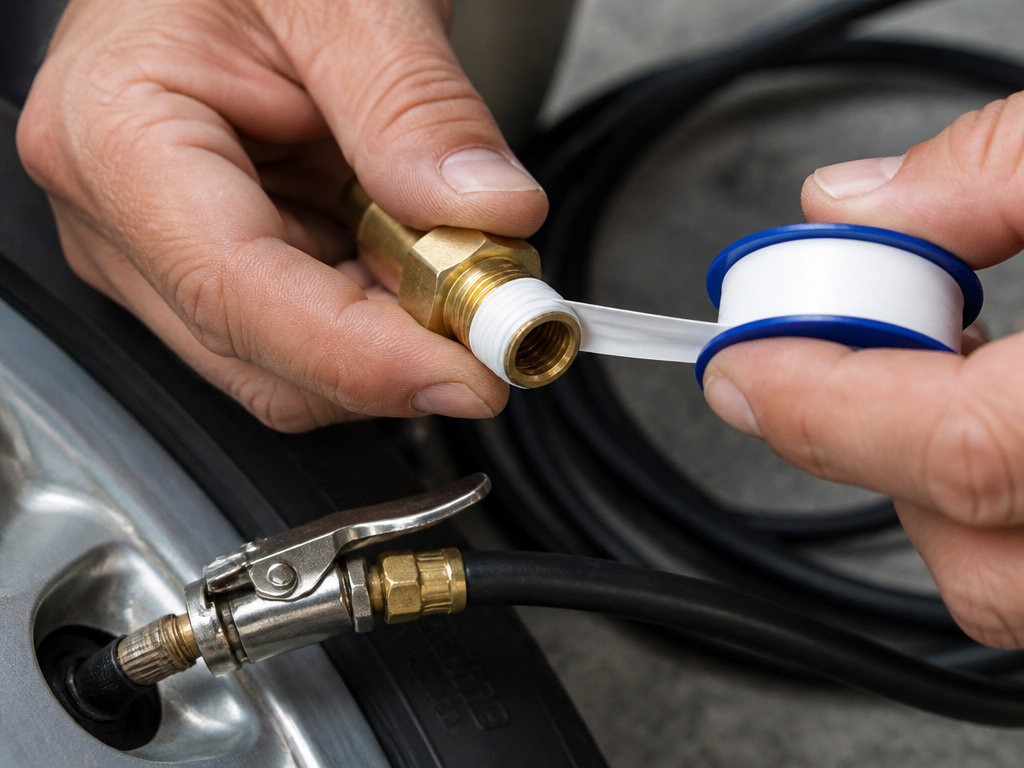
A hissing connection means air is escaping faster than the compressor can add it. You’ll spin the motor but see little to no pressure rise on the gauge. Three things usually cause it.
First, check the valve stem core. The tiny pin inside the valve stem must be depressed by the inflator chuck to let air in. If the core is damaged or loose, it will leak. Tighten it gently with a valve core tool, a cheap key you should have in your glove box. Over-tightening will shear the soft brass threads.
Second, inspect the inflator chuck. The rubber seal inside the chuck can wear flat or tear. If it looks cracked or hardened, replace it. A good seal should make firm, silent contact. If your chuck uses a screw-on connector, ensure it’s threaded all the way down. Cross-threading it will cause a massive leak.
Third, examine your hose connections. If you’re using an extension hose, every threaded junction is a potential leak. Apply a couple of wraps of thread seal tape (Teflon tape) to the male threads before connecting. Do not over-tighten; hand-tight plus a quarter-turn with a wrench is sufficient. A leak here will feel like a constant, soft hiss from the fitting, not the valve stem.
Easy to miss: A leak can also be inside the hose itself from a puncture. Submerge sections of the hose in water (with the compressor off and pressure released) to look for tell-tale bubbles. A pinhole leak renders the hose useless for inflation.
If you’ve checked all three and the hiss persists, the tire itself might have a separate puncture. That’s a different problem. For a healthy tire, a proper seal is silent and the pressure gauge will climb steadily.
Setting the Compressor’s Regulator for Tire Inflation
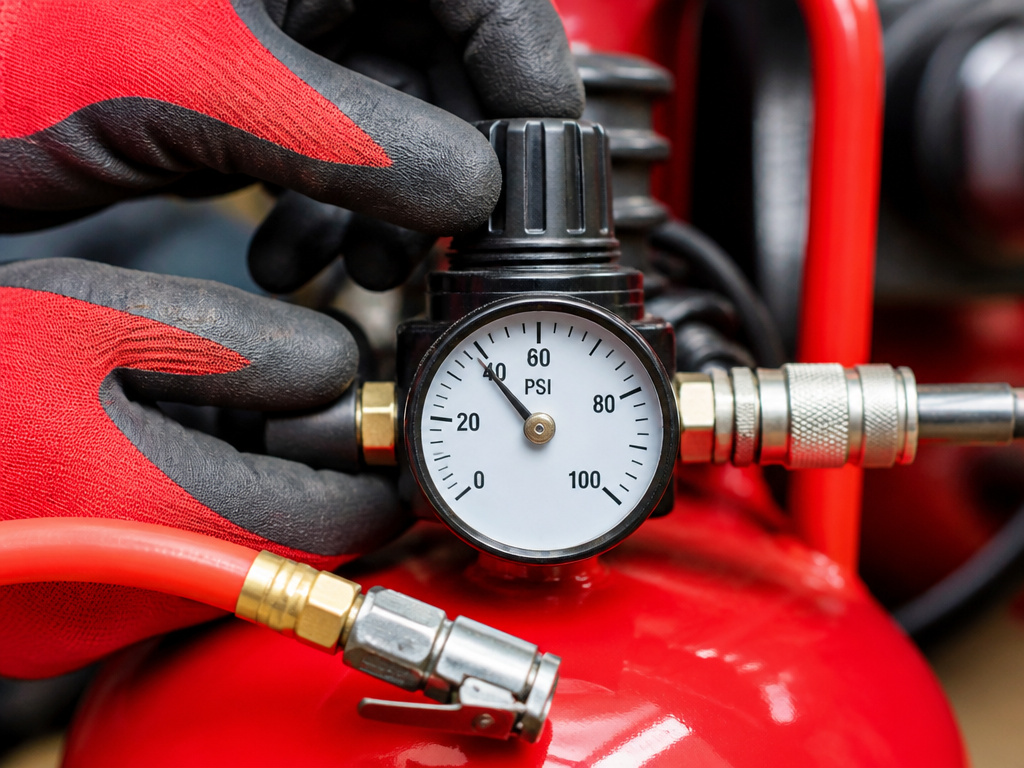
Many standalone air compressors have a regulator knob that controls the output pressure going to your hose, which is a key part of how to use a tire inflator with an air compressor. For tire inflation, you set this once and forget it.
For a standalone air compressor with a regulator, consult its manual for the correct procedure to set the output pressure for tire inflation.
This does two things. First, it protects your tire from a dangerous over-pressure surge if you accidentally hold the inflator on too long. Second, it ensures a smoother, more controlled fill. The compressor will work to maintain tank pressure, but only 35 PSI will ever reach your tire valve.
Dedicated tire inflators have different maximum working pressures; for example, the VIAIR 00082/88P SXS has a max working pressure of 120 PSI, while the Michelin High-Power Tyre Inflator 62003 is rated for car tires up to 50 PSI. But if you’re using a general-purpose shop compressor, taking this 30-second step prevents a blowout.
Real-World Time Estimates for Different Tires
How long should this take? It’s not guesswork. The flow rate (CFM) of your compressor and the volume of the tire dictate the timeline.
The VIAIR 00082/88P SXS serves as a benchmark. Its manual lists a flow rate of 1.97 CFM at 0 PSI. In practice, as pressure in the tire builds, the flow slows. Filling time depends on the compressor’s flow rate and the tire’s volume; as pressure builds, the flow slows.
The Michelin 12V Compressor Micro 62001 draws less power (6A). Inflating a completely flat tire is a different ballgame, it can take twice as long, and you must be careful to seat the tire bead properly on the rim, a job better suited to a high-volume air compressor.
Common mistake: Running the compressor over its duty cycle. The VIAIR 00082/88P SXS has a max duty cycle of 25 minutes at 30 PSI at 72°F. If you’re filling four large truck tires on a hot day, you might push past that. The motor will overheat, the thermal protector will cut power, and you’ll wait 30 minutes for it to cool and reset. Plan your work in chunks.
For a bicycle tire, even a low-flow compressor is overkill. You’ll hit 100 PSI in under a minute, so use short, controlled bursts to avoid blowing the tube. Our guide on how to inflate a bike tire covers the nuances for two-wheelers.
Post-Inflation Steps Most People Skip
You’ve hit the correct pressure. The job isn’t done. What you do next determines your tool’s lifespan and safety.
Cool the compressor. The VIAIR 450P-RV manual is adamant: “Make sure to cool the compressor down before storing it back in the carry bag.” The compressor will be hot. Let it cool down completely before storing. Storing it hot warps plastic, melts bag liners, and is a fire hazard.
Release hose pressure. For systems with an inflation gun, you must bleed the hose. Turn the compressor off, leave the gun connected to the hose, and pull the trigger until you hear no more air escaping. This relieves strain on the hose and gun seals. For simple chucks, disconnect from the valve stem.
Check and clean the air filter. If your model has one, like the VIAIR 450P-RV, inspect the foam inlet filter. A clogged filter “will drastically reduce compressor flow rate,” as the manual states. Regularly clean dust and dirt from the compressor’s air filter as per the manual.
Neatly coil the cords and hose. Avoid tight kinks in the air hose, which can create weak points. Loosely coil the power cord. This isn’t just about being tidy; it prevents internal wire breaks and hose cracks that show up six months later as mysterious leaks or power failures.
Storing your gear correctly means it works the next time you have a flat. It’s the difference between a tool that lasts a season and one that lasts a decade.
Differences between a tire inflator and an air compressor
While the terms are often used interchangeably, a dedicated tire inflator is a tool built specifically for tires, often with a built-in pressure gauge and preset functions. A general-purpose air compressor is a more powerful machine that supplies compressed air for many tasks, from powering tools to inflating large objects. To use it for tires, you need to connect a separate tire inflation hose and gauge. The key practical difference is in the operation: with a basic compressor, you may need to turn the unit off to get an accurate pressure reading, while some digital inflators show pressure live. Always check your specific unit’s manual for the correct checking method.
Inflating bike vs. Car tires
The main difference when inflating bike versus car tires is the required pressure. Bicycle tires, especially road bike tires, need a much higher pressure than typical car tires. Some inflators have a maximum pressure rating for car tires that is lower than what a bike tire requires, so you must check your inflator’s capabilities first. The process is similar: connect the hose securely to the valve stem. However, due to the smaller volume of a bike tire, pressure increases very quickly. You must check the pressure more frequently to avoid over-inflation. Always check the pressure when the inflator is off or the trigger is released, as readings during active inflation can be inaccurate.
Frequently Asked Questions
Can I use a portable tire inflator as an air compressor?
Not really. A portable tire inflator is designed for one job: moving air into a closed volume like a tire or ball. An air compressor stores pressurized air in a tank and can power a wide range of pneumatic tools, nailers, impact wrenches, spray guns. The portable inflator vs air compressor debate hinges on this fundamental difference in capability.
How do I know if my inflator’s gauge is accurate?
Cross-check it with a standalone, high-quality tire gauge you trust. Inflate a tire to your target pressure using the inflator, then immediately check it with the standalone gauge. If they’re within 1-2 PSI, your inflator is reasonably accurate. The Michelin 62001 manual claims +/- 1 PSI accuracy up to 50 PSI, which is a good benchmark.
Why won’t my compressor fill the tire past a certain pressure?
First, check for leaks as described in the troubleshooting section. If there’s no leak, you may have hit the compressor’s maximum working pressure. The VIAIR 00082/88P SXS has a Max. Working Pressure of 120 PSI. If you’re trying to fill a tire to, say, 100 PSI, the compressor will struggle and may not reach it, especially if the ambient temperature is high or the unit is overheating.
Is it safe to leave the compressor plugged in while checking pressure?
For models that require you to turn the compressor off to check pressure (like the VIAIR 00082), yes. You’re following the manual’s procedure. For models with an inflation gun, you leave it running and just release the trigger. The key is to never leave a running compressor unattended, the VIAIR 450P-RV manual explicitly states, “This product should never be left unattended during use.”
How long does it take to fill a completely flat car tire?
Much longer than you’d think. From 0 PSI, the compressor is fighting to both seat the tire bead on the rim and then fill the entire volume. Filling a completely flat tire takes significantly longer than topping up a tire and can test the compressor’s duty cycle. This is a severe test of the compressor’s duty cycle, and you risk overheating it. For a true flat, a more powerful home air compressor with a larger tank is a better tool for the job.
Before You Go
The single most important rule is also the simplest: read your specific model’s manual. The VIAIR and Michelin manuals disagree on the correct way to check pressure mid-fill, and your unit’s method is the only one that matters for your results. Blindly following a generic YouTube tutorial can lead to inaccurate pressure and motor strain.
If you only do one thing, make it this: after you finish, feel the compressor’s body. If it’s too hot to hold your hand against for five seconds, it’s not ready to be boxed up. Let it cool on the garage floor while you put your other tools away. That heat is the enemy of the motor’s longevity, and respecting it is what separates a casual user from someone who gets a decade of service from their gear.
For most drivers topping up tires seasonally, a dedicated portable tire inflator is the faster, simpler choice. But when you need the versatility to air up after a day off-road or handle multiple large tires, pairing a robust inflator with a capable air compressor is the right tool for the job. Just remember the cord needs to be straight, the engine needs to be running, and the gauge only tells the truth when the air is still.
