
How to Use Cordless Electric Scissors: Step-by-Step Guide
This post contains affiliate links. As an Amazon Associate, we earn from qualifying purchases.
To use cordless electric scissors, press the safety lock, then squeeze the trigger while guiding the material into the blades at a steady pace, never force it. Always cut material at or below the tool’s rated capacity, which varies by model, and secure your workpiece to prevent movement.
That “rated capacity” clause is where most new users go wrong on the first cut. You see a motorized tool and assume it’s a universal cutter, but forcing thick leather through a head designed for paper gums the blades and drains the battery in two minutes flat. This isn’t a normal pair of scissors you can muscle through a tough spot, which is why learning how to use cordless electric scissors correctly is essential.
What follows: the exact how to use cordless electric scissors sequence from first charge to clean cuts, the crucial safety rules three different manuals disagree on, and the specific technique changes for fabric, cardboard, and the one material you should never touch.
Key Takeaways
- Charge within the 50°F–104°F (10°C–40°C) range specified by manuals; charging a hot battery from extended use shortens its lifespan.
- Secure your workpiece firmly before cutting, movement causes jagged edges and increases the risk of the blades snagging on skin or clothing.
- Match your cutting speed to the material: push fabric slowly to prevent fraying, but maintain a confident, steady pace on cardboard to avoid jams.
- Let the tool do the work, if you feel the motor straining or hear a change in pitch, you’re forcing it and risk damaging the gears.
- Store the tool fully charged and disconnected in a cool, dry place; a lithium-ion battery left dead in a cold garage is a common killer.
Safety First: The Rules Three Manuals Don’t Agree On
Every power tool manual has a safety section. For cordless electric scissors, those sections contain specific, legally-mandated warnings, and they don’t always line up. Treating one brand’s advice as universal can leave you unprotected.
The most glaring discrepancy in the how to use cordless electric scissors guides is who can use the tool. The BLACK+DECKER BCSC115 manual states it “can be used by children aged from 8 years and above under supervision.” In contrast, the Black Sharp Model E-S02 says it’s “not destined to be used by children under 10 years old,” and the Kogan Cordless Electric Scissors manual restricts use to adults, allowing “young people under 16 years of age” only under supervision. The takeaway? You must read your tool’s manual and follow its specific age guidance. You must read your tool’s manual and follow its age guidance to the letter.
Another critical split is on exposure to moisture. Most models, like the BLACK+DECKER, warn “do not expose the appliance to rain or wet conditions.” However, the Bataviastore JBJ-XG01 manual explicitly lists its tool as “suitable for cutting wet wallpaper.” This is a specific disagreement among sources. Unless your manual explicitly permits it, assume water and electricity don’t mix.
Before you start: ALWAYS wear gloves when handling sheet metal or other materials with sharp edges, and always wear safety shoes to protect your feet from debris. Firmly secure the piece you are cutting to prevent movement. NEVER have any part of your body near the blades.
| Safety Rule | BLACK+DECKER BCSC115 | Black Sharp E-S02 | Kogan Cordless Scissors |
|---|---|---|---|
| Minimum User Age | 8+ with supervision | 10+ with supervision | 16+ with supervision |
| Wet Material Use | Not permitted | Not specified | Not specified |
| Storage Charge State | Store fully charged | Charge every 6 months if unused | Not specified |
| Max Charge Time | Not specified | 3-4 hours | Max 5 hours |
The vibration and noise numbers are in the manual for a reason. The BLACK+DECKER BCSC115 has a hand-arm vibration value of 3.1 m/s² and a sound power level of 87 dB(A). The Bataviastore model measures higher vibration at 6.40 m/s² and lower noise at 81.45 dB(A). You might not feel or notice the difference on a single project, but over years of use, lower vibration means less fatigue. It’s a spec worth checking if you’ll use the tool frequently.
Charging: Where Manuals Disagree (And Why It Matters)
You’d think plugging in a USB-C cable is straightforward. It is, until you read the fine print. The charging instructions across different brands aren’t just suggestions, they’re designed to preserve the lithium-ion battery, which every manual notes has a finite lifespan.
The Black Sharp Model E-S02 states a full charge takes 3-4 hours. The Kogan model says 3-5 hours and adds a crucial warning: “never charge for more than 5 hours at a time.” This spread highlights a key point: you must use the charger that came with your tool and follow its specific timing. Using a fast phone charger on a tool not designed for it can overheat the battery.
The most often-overlooked rule is temperature. The Black Sharp manual is explicit: “Charge the battery at room temperature of 50°F to 104°F (10°C-40°C).” This isn’t about comfort. Charging a cold battery stresses its chemistry, and charging a hot one is worse. If the scissors become warm after extended use, let them cool down before plugging them in. That single habit can stretch the typical 2-3 year / 300-500 cycle battery lifespan.
I’ve seen more than one client bring in a cordless tool with a dead battery because they stored it fully discharged in a cold garage. It’s a common killer of good tools. The lithium-ion cells inside can’t recover from a deep freeze at zero charge.
Where should you store it? The BLACK+DECKER manual says to “store the fully charged tool disconnected from the charger in a cool, dry place.” The Black Sharp manual advises to “charge the battery every six months” if it won’t be used. Both are right. The goal is to avoid a completely depleted state. A cool, dry shelf beats a damp toolbox every time.
The 5-Step Cutting Technique (Without Jams or Fraying)
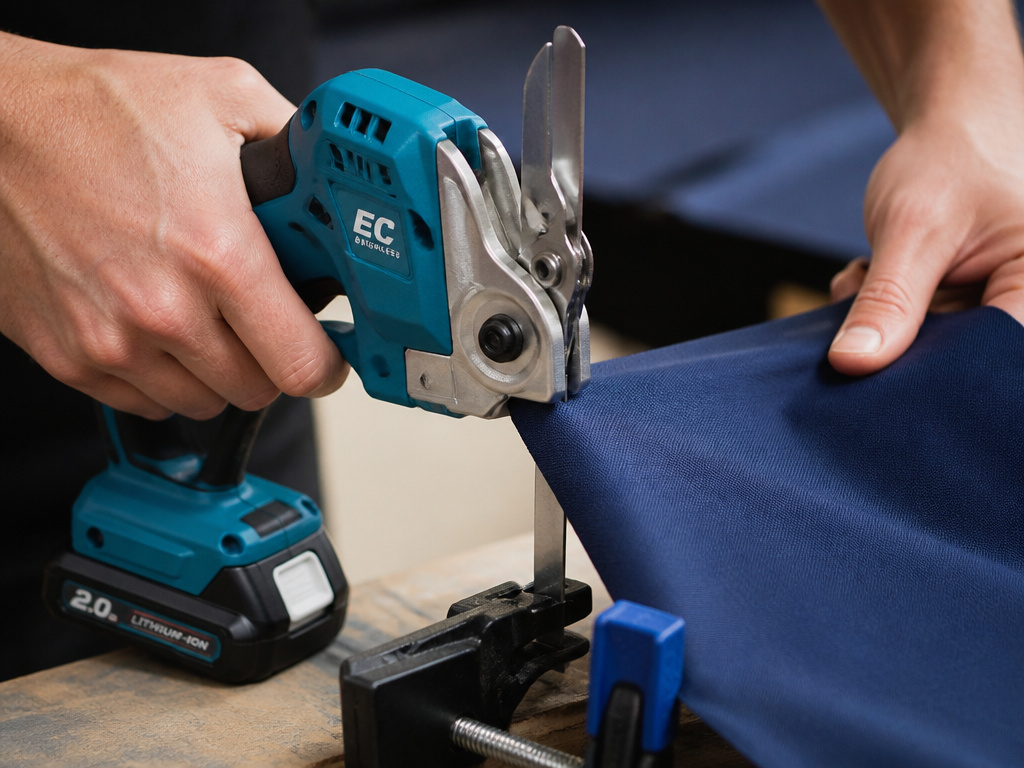
Operating the tool is simple: disengage the safety lock, squeeze the trigger. The real skill is in the guide hand and the feed speed. A proper cut feels smooth; the motor hums steadily. A bad cut binds, jams, and produces a burnt-plastic smell from overworked gears.
Here is the sequence that works for most materials, from paper to light-gauge sheet metal.
- Secure the Material. This is the step every video tutorial speeds through. Use clamps, weights, or your free hand well behind the cut line to hold the workpiece taut. Any slippage creates a jagged edge. For sheet metal, this step is mandatory; the BLACK+DECKER manual requires it to prevent serious injury.
- Position the Blades Upright. The BLACK+DECKER BCSC115 manual specifically says “use shears upright.” Tilting the head can cause the cut material to curl back toward you, especially with metal or stiff plastic.
- Start the Motor Before Contact. Get the blades up to full speed, 10,000 min⁻¹ for the BLACK+DECKER, 11,000/min for the Black Sharp, before they touch the material. Engaging a static blade is a sure way to fray fabric or tear paper.
- Guide, Don’t Push. Place the material between the open blades and gently close the handles to start the cut. Your job is to guide the workpiece through at a consistent speed. If you feel resistance, you’re going too fast for the material.
- Finish the Cut and Release. Once the cut is complete, release the trigger before withdrawing the scissors to avoid snagging. For long cuts, stop, release the trigger, reposition your guide hand, and start again.
Where this goes sideways: Trying to cut a curve too tightly. These are straight-line cutters. Forcing a sharp turn pinches the blades, stalls the motor, and can permanently misalign the cutting head. For curves, cut a series of small straight facets or switch to manual snips.
What does a cut with a steady, medium-pitch whir sound like? A steady, medium-pitch whir. A straining motor drops in pitch and develops a gritty, grinding undertone. That sound means stop. You’re either cutting something too thick or pushing too fast.
Material-Specific Tips: Fabric, Cardboard, and the 0.3 mm Limit
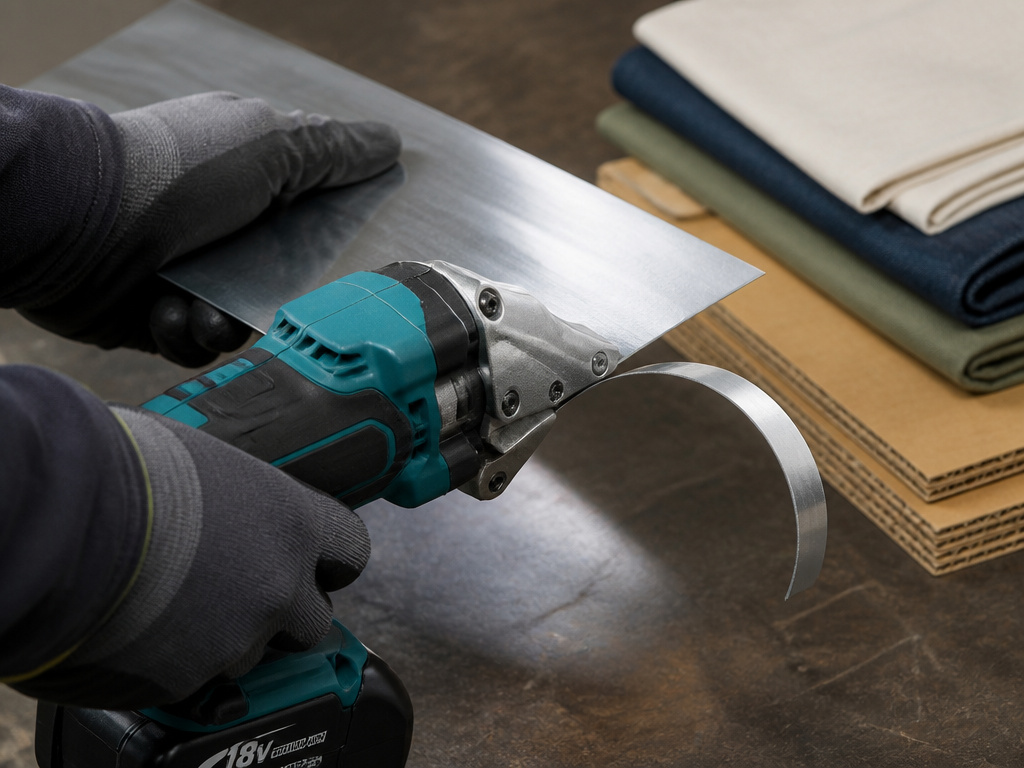
Not all cuts are created equal. The technique that gives you a clean edge on cotton duck will jam instantly on corrugated cardboard. It comes down to fiber structure and blade engagement.
For Fabric (Cotton, Polyester, Canvas):
- Speed: Slow and steady. A fast feed pulls threads and causes fraying.
- Tip: Use a fresh, clean blade. Fabric glue and residue gum up the mechanism faster than anything else.
- Tool Pick: If fabric is your primary material, look for a model specifically noted for it, like those covered in our guide to the best electric scissors for fabric. They often have finer blade profiles.
For Cardboard & Corrugated Material:
- Speed: Confident and consistent. Hesitation causes the cardboard to compress, which jams the blades.
- Tip: For thick cardboard, score the line first with a utility knife if precision is critical. The electric scissors excel at quick breakdowns.
- Tool Pick: For serious volume, a model with higher no-load speed may be beneficial. Our review of the best scissors for cardboard compares these performance specs.
For Paper, Plastic Film, and Sheet Metal (up to 0.3 mm):
- Speed: Moderate. These materials offer little resistance, so the tool can zip through.
- Critical Safety Reminder: When cutting any metal, even thin 0.3 mm sheet metal, ALWAYS wear gloves. The cut edges are microscopically serrated and sharper than a traditional shear cut.
- Direction: The BLACK+DECKER manual advises to “cut material so scrap curl is to the right.” This directs the sharp, curling waste away from your body and work area.
The Kogan Cordless Electric Scissors lists a “max cutting size: 6mm,” while the BLACK+DECKER BCSC115 specifies “maximum thickness of sheet metal cut is 0.3 mm.” These aren’t typos. The Kogan is designed for softer materials like fabric, PVC, and carpet. The BLACK+DECKER’s rating is for rigid, dense metal. Pushing a 5mm-thick rubber mat through the BLACK+DECKER will burn out the motor. Always respect the rated capacity in your manual.
Maintenance & Troubleshooting: Beyond the Manual
Manufacturer manuals cover basic care: keep screws tight, don’t immerse in water, don’t use damaged. Real-world maintenance involves anticipating wear and knowing when to stop.
Blade Care:
- Cleaning: After each use, especially with adhesive-backed materials or fabric with stabilizer, wipe the blades with a dry cloth. Buildup reduces cutting efficiency.
- Sharpening: Most cordless electric scissors have non-removable blades. They don’t need traditional sharpening. If cuts are tearing instead of slicing, the issue is often misalignment from a drop or jam, not dullness.
Battery Lifespan Management:
The Black Sharp manual provides the clearest data: “The typical lifespan of a 3.6V Lithium-Ion battery is about two to three years, or 300 to 500 charge cycles, whichever comes first.” This aging is irreversible.
- Do not charge if the tool case is cracked or damaged.
- Do not use a tool or charger that has been dropped or damaged.
- For long-term health, follow the general principles of good cordless power tool maintenance: avoid full discharges, store at room temperature, and use the correct charger.
Common Problems & Fixes:
| Problem | Likely Cause | Immediate Action |
|---|---|---|
| Motor runs but doesn’t cut | Worn or gummed-up blades | Clean blades thoroughly; inspect for debris. |
| Tool jams mid-cut | Material too thick or feed speed too fast | Stop, reverse to release material, check manual for capacity. |
| Battery won’t charge | Overheated battery, faulty charger, or dead cell | Let tool cool for 1 hour; try a different outlet; battery may be end-of-life. |
| Uneven, ragged cuts | Material not secured, blunt force used | Re-clamp workpiece, ensure you’re guiding, not forcing. |
Parts of Cordless Electric Scissors
Identifying the main parts of your cordless electric scissors helps you operate them safely and effectively. The primary components are the motor housing, which contains the battery and the switch, and the cutting head with its moving blades. The housing typically has insulated gripping surfaces for safe handling. Many models include a frontal LED light to illuminate your work area. You’ll also find a battery level indicator, often with colored lights to show remaining charge. Always check that all screws on the tool are tight before use, and never place anything into the motor housing openings.
Frequently Asked Questions
Are cordless electric scissors worth it?
For anyone who cuts fabric, cardboard, or sheet materials regularly, absolutely. They save significant time and hand fatigue versus manual shears. For occasional, single-curve cuts, traditional scissors are simpler. Their value is in volume and repetition.
What are the best cordless electric scissors?
The “best” depends entirely on your primary material. For general craft and fabric, the Black Sharp Model E-S02 has a no-load speed of 11000/min and a 2000 mAh battery. For cutting light gauge sheet metal, the BLACK+DECKER BCSC115 is rated for a maximum thickness of 0.3 mm. We break down the top models for every task in our dedicated guide to the best cordless electric scissors.
Can I cut wire or string with them?
No. Never attempt to cut wire, cable, or string. The thin, flexible strands can wrap around the drive shaft and gears, causing immediate and catastrophic damage. These are shears for sheet materials only.
Why does my cut edge look frayed or torn?
You are either pushing the material through too quickly, using blades gummed with residue, or cutting a material thicker than the tool’s rated capacity. Slow down, clean the blades, and verify the material thickness.
How do I dispose of the tool when the battery dies?
Do not throw it in household trash. Lithium-ion batteries require special disposal. Many hardware stores or electronics retailers have battery recycling drop-offs. Contact your local waste management authority for guidance.
Before You Go
One rule overrides all others: if your material thickness is even a millimeter over the limit stated in your manual, stop. That’s the line between a useful tool and a broken one. These scissors are specialized instruments, not universal crushers.
Match the tool to the job from the start. If you’re a quilter, buy a model recommended for fabric. If you break down boxes daily, get one engineered for cardboard. Trying to make a light-duty model handle heavy-duty work is how you burn through two tools in the time one should last. Get that right, and the rest is just following the steps, secure, guide, and let the motor sing.
