
HVLP vs LVLP Spray Gun: Which Should You Buy?
This post contains affiliate links. As an Amazon Associate, we earn from qualifying purchases.
*An HVLP spray gun uses a high volume of air at low pressure (10-30 CFM) for smoother application on larger surfaces, while an LVLP gun uses a lower air volume (5-18 CFM) for finer atomization on detail work; sources disagree on the specific operating pressures.* For most DIYers, an electric HVLP sprayer is the simpler choice; for professionals with a compressor, LVLP offers controlled atomization with less air demand.
That’s the textbook answer. The real-world choice, though, comes down to the compressor already sitting in your garage and the specific finish you’re chasing. This isn’t about which technology is “better”, it’s about which one turns your air supply and your skill level into a coat of paint without turning your shop into a fog bank. Understanding the hvlp vs lvlp spray gun distinction is key to this practical decision.
What follows is a breakdown of the specs that actually matter, where the manufacturers’ numbers get fuzzy, and a clear path to picking the gun that won’t leave you underpowered or overspraying half your material onto the floor.
Key Takeaways
- LVLP guns need less air volume, as low as 5 CFM, making them compatible with smaller, homeowner-grade air compressors that would choke an HVLP gun.
- Transfer efficiency for modern guns varies by source: Prowin Tools states HVLP is 60-65% and LVLP is up to 70-80%, while AIMS Industrial states HVLP is 65-80% and LVLP is 70-80%.
- For spraying clear coats and thin finishes, an LVLP gun’s finer atomization is the professional’s choice, but a well-tuned HVLP gun can do the job.
- An electric HVLP sprayer eliminates the compressor question entirely and is the most beginner-friendly route for furniture or fence projects.
- Always match your spray gun’s CFM requirement to your compressor’s sustained CFM output, not its peak rating, to avoid pressure drop mid-spray.
The Core Difference: Air Volume vs. Air Pressure
Look at the business end of the gun. The air cap on an HVLP model has bigger holes. It’s designed to move a lot of air, a high volume, but at a gentle, low pressure. Think of a wide, soft breeze. This high air volume is what shepherds the paint to the surface with less bounce-back, which is where the efficiency gain comes from.
An LVLP cap has smaller holes. It moves a lower volume of air, but often at a slightly higher pressure at the cap (though still “low” compared to old conventional guns). This creates a faster, tighter airstream that shreds the paint into finer particles. The result is a finish that can flow out smoother, which is why LVLP gets tagged as a “clear coat gun.”
HVLP atomizes paint using a high volume of air at the nozzle (10-30 CFM), producing a softer spray pattern with less velocity. LVLP atomizes using a lower air volume (5-18 CFM) often at a marginally higher pressure, yielding a finer mist ideal for high-gloss finishes.
The confusion in the hvlp vs lvlp spray gun specs starts with the pressure numbers. Sources disagree on operating pressure: Prowin Tools states HVLP operates at 35–60 PSI and LVLP at 10-30 PSI, while AIMS Industrial states both HVLP and LVLP operate at about 10 psi at the cap. This isn’t a contradiction, it’s a measurement point. The first number is the line pressure at the gun’s inlet; the second is the cap pressure where the work happens. For you, the cap pressure is what matters for finish quality, and both technologies keep it low to reduce overspray.
Air Compressor Requirements: The Make-or-Break Spec
This is where your choice is often made for you. Your compressor’s CFM (cubic feet per minute) output is the ceiling. If your gun needs more air than your compressor can deliver continuously, the pressure will drop, the atomization will go to pieces, and you’ll get a rough, textured finish often called “orange peel.”
The numbers from manufacturers show a clear divide, but also some disagreement worth noting.
| Spray Gun Type | Typical CFM Demand (Source Range) | Minimum Sustained Compressor CFM | Operating Pressure (At Cap) |
|---|---|---|---|
| HVLP | 8-30 CFM (Toolnerds: 8-15; Prowin/AIMS: 10-30) | 15-35 CFM | ~10 PSI |
| LVLP | 5-18 CFM (Toolnerds: ~5; Prowin: 5-18; Generic gun: 3.5-3.9 @ 30 PSI) | 12 CFM | 10-30 PSI |
Where this goes sideways: Buying an LVLP gun because it “works on a small compressor” without checking the sustained CFM. A compressor that peaks at 6 CFM but only sustains 4 CFM will still stall with a 5 CFM gun.
The research on the hvlp vs lvlp spray gun question shows LVLP has a clear advantage if your air supply is limited. A tool like the generic LVLP gun noted by Toolnerds needs only 3.5 to 3.9 CFM at 30 PSI. Meanwhile, an HVLP gun can demand 10-30 CFM, which often requires a larger compressor. The lower air demand of LVLP makes it compatible with smaller compressors, while HVLP often requires a larger air supply.
For a deep dive on matching tools to air supply, our guide on choosing the right air compressor for auto body work walks through the calculations.
Finish Quality and Best Uses: Where Each Gun Excels
The “best for” labels get thrown around loosely. The truth is, a skilled painter can lay down a flawless clear coat with an HVLP gun, and an LVLP gun can spray primer. But each has a natural habitat where it requires less fight from the operator.
HVLP is your workhorse for broader coverage.
- Best For: Furniture, cabinets, fences, walls, and interior trim. It’s the go-to for latex paints, lacquers, stains, and single-stage coatings.
- Why: The higher air volume produces a wider, softer fan pattern. It’s more forgiving on distance and speed, which is why sources like Lematec Tools and KM Coating call it “beginner-friendly.” You cover more square feet per pass with less worry about runs. If you’re considering an airless vs HVLP paint sprayer for a big fence, HVLP is the middle ground between the finicky detail of LVLP and the brute speed of airless.
LVLP is your precision instrument for finish coats.
- Best For: Automotive base coats, clear coats, fine furniture finishing, and any project where a glass-smooth, high-gloss finish is the goal.
- Why: The lower air volume and finer atomization put more paint material in suspension, allowing it to flow out and self-level better on vertical panels. This is why forums are filled with users asking if LVLP is better for clear coat, the answer, from experience, is usually yes. It’s the tool for the final act.
The materials themselves matter. LVLP guns are not suited for highly viscous materials like epoxies or roof coatings. They excel with thin materials: varnish, clear coats, urethanes, and enamels. HVLP can handle slightly thicker stuff but often requires thinning, especially with heavier latex paints.
Suitability for Beginners vs. Professionals
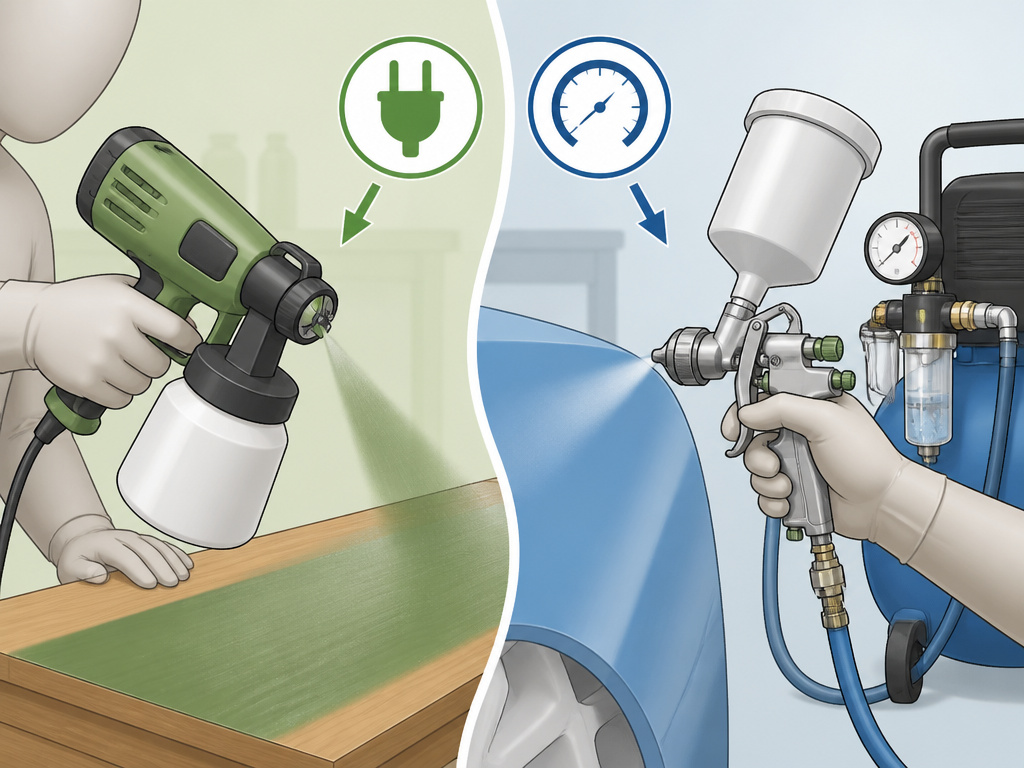
The consensus online is clear, but it’s more nuanced than “HVLP for newbies, LVLP for pros.”
- HVLP is labeled “perfect for inexperienced users” (KM Coating) and “very beginner-friendly when using an electric HVLP sprayer” (HYCHIKA). This is true. An electric HVLP unit removes the compressor from the equation, letting you focus on technique. The learning curve is about trigger control and overlap, not air system diagnostics.
- LVLP is “more appropriate for professionals” (KM Coating) and “better for users who understand compressor setup” (HYCHIKA). This is also true. To get that perfect LVLP finish, you need a clean, consistent air supply with proper moisture filtration. The gun is less forgiving of poor technique or fluctuating pressure.
My stance? If you’re a weekend warrior painting a shed or refurbishing a table, don’t overcomplicate it. An electric HVLP sprayer is a legitimate, get-it-done tool. If you’re a hobbyist stepping into automotive touch-up with a compressor, an affordable LVLP gun can be a worthy investment to learn on. The “pro” label means it demands more from your setup, not that you aren’t allowed to use it.
Specific Gun Comparisons and What to Look For
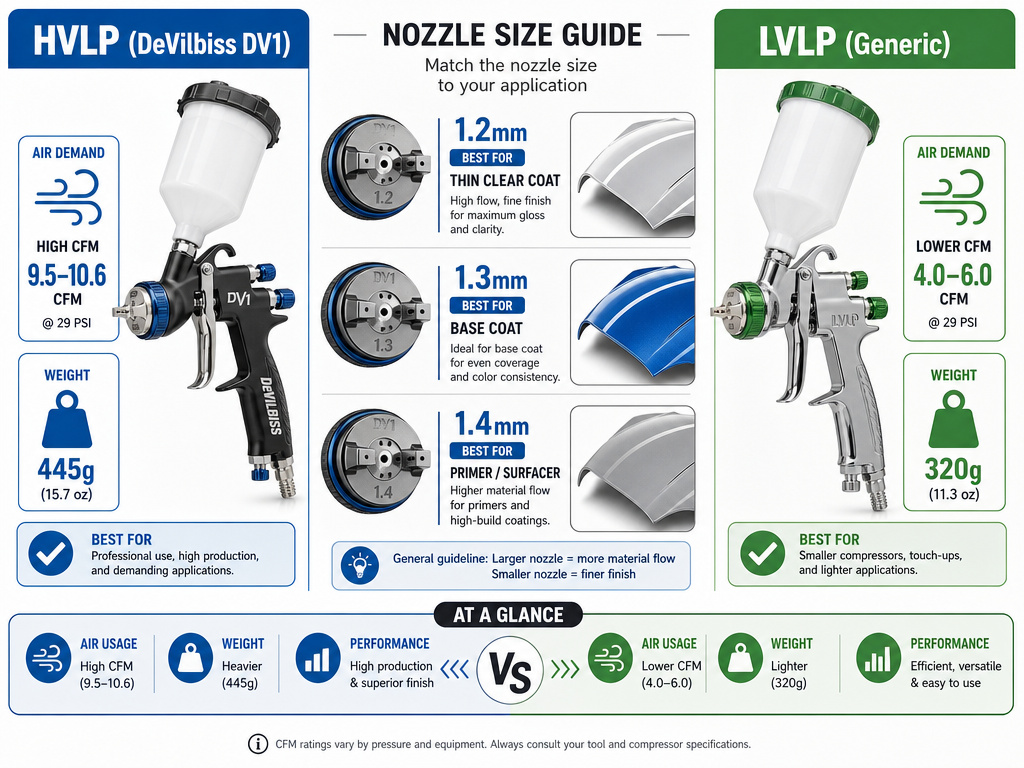
Beyond the HVLP vs. LVLP categories, specific models tell the real story. Looking at high-end options highlights what you’re paying for.
| Model | Type | Air Consumption | Nozzle Sizes | Weight | Best For |
|---|---|---|---|---|---|
| DeVilbiss DV1 | HVLP | ~270–300 L/min (~9.5-10.6 CFM) | 1.2, 1.3, 1.4 mm | ~445 g | Professional automotive finishing; known for consistent fan pattern. |
| Iwata WS400 | HVLP | ~230–260 L/min (~8.1-9.2 CFM) | 1.2, 1.3, 1.4 mm | ~380 g | Detail work and fine finishes; lighter for reduced fatigue. |
These guns are benchmarks. Notice the CFM is on the lower end for HVLP, but the build quality and precision machining ensure every bit of that air is used efficiently. For a professional, that consistency is worth the price. For a DIYer, a generic LVLP gun with a 1.3 or 1.4 mm tip can handle many clear coat and base coat jobs.
The nozzle size is your tool for material viscosity. A 1.2mm tip is for very thin stains and clear coats. A 1.4mm tip can handle unthinned primer or heavier base coats. Most kits come with multiple tips, use them. Before you start any project, understanding using an HVLP spray gun or its LVLP counterpart is time well spent.
Cost, Value, and Making Your Choice
You can spend $50 or $500. The difference isn’t just in the finish; it’s in the consistency, durability, and ease of cleaning.
Don’t forget the system cost. An LVLP gun might be cheaper, but if you need to buy a new compressor to run it, the total cost increases significantly. Conversely, an electric HVLP sprayer seems like a single purchase, but you’re locked into that platform.
Here’s the decision tree:
- Do you already own a capable air compressor? Check its sustained CFM output at 40 PSI.
- If it’s under 10 CFM, look at LVLP guns.
- If it’s over 15 CFM, you can choose either. Let project type guide you.
- Is this a one-time project or occasional use? An electric HVLP sprayer is the simplest, most cost-effective path. No compressor needed.
- Are you spraying mostly clear coats or automotive finishes? Lean towards LVLP for its finer atomization.
- Are you painting large, flat surfaces like fences or cabinets? HVLP (pneumatic or electric) will be faster and more forgiving.
For automotive work, ensuring you have the right compressor for painting a car is a critical first step before the gun ever leaves the box.
Which spray gun is better for environmental compliance?
Both HVLP and LVLP guns are designed to meet environmental regulations by reducing overspray and wasted material compared to conventional spray guns. The key metric is transfer efficiency, which measures how much paint actually lands on your workpiece. Higher efficiency means less paint becomes airborne particulate or hazardous waste. Transfer efficiency varies: Prowin Tools states LVLP (70-80%) is higher than HVLP (60-65%), while AIMS Industrial shows both have high and overlapping ranges (HVLP 65-80%, LVLP 70-80%). This directly translates to less material consumption and lower emissions for the same job, making a strong case for LVLP in settings with strict environmental oversight. For any user, choosing a high-efficiency gun is a practical step toward compliant and cleaner spraying.
Frequently Asked Questions
Can you paint a car with an LVLP spray gun?
Absolutely. In many professional circles, LVLP is the preferred choice for automotive base coats and clear coats because of its fine atomization and efficient material use. It lays down a smooth, flow-out finish that reduces the need for extensive sanding and polishing. Just ensure your compressor can deliver the required CFM consistently.
Which is better, LVLP or HVLP spray gun?
Neither is universally better. LVLP is better for achieving ultra-smooth finishes on detailed work like cars or furniture and for shops with smaller compressors. HVLP is better for broader coverage on projects like cabinets or fences, and it’s simpler to start with if you opt for an electric model. The “better” gun is the one that matches your air supply and your project goals.
Does Harbor Freight sell an LVLP spray gun?
Harbor Freight typically sells tools under its Chicago Pneumatic and Central Pneumatic brands. While they offer several HVLP spray guns, dedicated LVLP models are less common in their lineup. You’re more likely to find LVLP-specific guns from specialty automotive tool suppliers or online retailers. Always check the technical specs for CFM requirements.
What size compressor do I need for an HVLP gun?
You need a compressor that can deliver a sustained CFM output greater than the gun’s requirement. For most HVLP guns, this means a compressor that can sustain at least 15-35 CFM, which often requires a large stationary compressor. Smaller compressors will struggle, leading to pressure drops and a poor finish. Our review of the best air compressor paint sprayers covers compatible setups.
The Bottom Line
Stop looking for a winner. Start matching a tool to your constraints. If you have a small garage compressor, the LVLP’s lower air demand is your friend. If you’re starting from scratch with no air system, an electric HVLP sprayer gets you painting this weekend.
For the majority of home DIY, furniture, fences, interior doors, the path of least resistance is an electric HVLP gun. It works. For the hobbyist moving into automotive or fine woodworking finishes, a dedicated LVLP gun is the logical upgrade. It’s not about stepping up to a “pro” tool; it’s about choosing the right nozzle and air stream for the job in front of you. Your compressor’s spec sheet has the first and final say. Listen to it.
