
Impact Driver Bits vs Regular Bits: Which Should You Buy?
This post contains affiliate links. As an Amazon Associate, we earn from qualifying purchases.
Impact driver bits and regular bits look similar, but their engineering is completely different. Impact bits are built to flex and absorb high-torque hammer blows, using a specialized torsion zone and shock-resistant steel.
That’s the short answer, but the real cost includes project delay, the potential injury from flying metal, and the money wasted on bits that die after ten screws. Getting this right means understanding the steel, the shank, and the job you’re actually doing, which often comes down to the choice between impact driver bits vs regular bits.
This guide walks through the physical differences you can see, the test data that proves why they matter, and the clear rules for when to use each, which often comes down to the impact driver bits vs regular bits question. By the end, you’ll be able to spot an impact-rated bit across the aisle and know exactly which one to grab for decking, cabinets, or that stubborn automotive bolt.
Key Takeaways
- Impact bits have a torsion zone, a narrowed, flexible neck that acts like a spring to absorb shock. Regular bits are rigid from shank to tip.
- Using a regular bit in an impact driver is a documented safety risk for sustained work; bits can fracture and send fragments flying.
- Round-shank bits need an adapter, which introduces spin-out and shear risks under heavy load.
- In a lag bolt test, impact bits had a 95% success rate with zero breaks, while standard bits snapped 3 out of 10 times driving the same fastener.
- Match the bit to the tool’s action: Use impact bits for driving (lag screws, decking, framing). Use regular bits for drilling (pilot holes, countersinks) and precision work in a drill/driver.
What You’re Actually Holding: Material and Design
Open two packs off the shelf and they look nearly identical. Both have a 1/4-inch hex shank. Both come in Phillips, Torx, and square drive. The difference is in the steel recipe and a hidden flex point.
Regular bits are typically harder than impact bits. This extra hardness helps the tip maintain a crisp edge and grip under the steady, constant force of a drill/driver or hand tool. It’s an advantage for precision.
Impact bits trade some of that raw hardness for toughness, the ability to bend slightly and spring back instead of cracking. Manufacturers achieve this through specific heat treatments and alloy mixes. The IRWIN Impact Performance Series bits, for example, are made from heavy-duty, cold-forged, high-grade steel and boast a black oxide finish that resists corrosion. Bosch uses premium high-speed steel (HSS-G) in its PRO Metal Impact Twist Drill Bit, ground for strength and heat resistance.
The most telltale feature, though, is the torsion zone. Look at the bit just below the tip. Many impact bits have a deliberately narrowed neck. Under the hammering pulses of an impact driver, this section twists minutely, absorbing the peak forces before they reach the driving edges. Brands like Milwaukee (SHOCKZONE), DeWalt (MAX Impact, FLEXTORQ), and Bosch (Impact Tough) all incorporate this design.
A regular bit lacks this flex zone. It’s rigid from the hex shank all the way to the tip. Under impact forces, that rigidity becomes a liability, the shock has nowhere to go, so the bit takes the full brunt. The result is predictable: chipping, a rounded-over tip, or a clean snap.
| Design Feature | Impact Bit | Regular Bit | Why It Matters |
|---|---|---|---|
| Steel Treatment | Tougher, shock-resistant | Harder, wear-resistant | Tough steel flexes; hard steel cracks under impact. |
| Torsion Zone | Present (narrowed neck) | Absent | Absorbs hammer pulses, reduces breakage. |
| Primary Use | Impact drivers | Drill/drivers, hand tools | Mismatching tools drastically shortens bit life. |
| Common Markings | “Impact Ready,” “Shockwave,” “Torsion” | Often unmarked or “S2,” “HSS” | Look for the label on the bit or package. |
The Shank Is Non-Negotiable: Why Only Hex Fits
This is the simplest rule and the easiest to get wrong. An impact driver’s collet is a spring-loaded, quick-change sleeve designed for one thing: a 1/4-inch hex shank. It has a detent ball that snaps into a groove on the hex shank, locking the bit in place under load. A round shank, like those on traditional twist drill bits or spade bits, has no flats for the collet to grip and no groove for the detent ball. It simply won’t seat.
Can you work around it? Technically, yes. A hex-to-3-jaw chuck adapter allows you to use round-shank bits. But this is a compromise with real limits.
Where this goes sideways: Under heavy load, the smooth round shank can spin loose inside the adapter’s jaws. You’ll hear a chattering sound as the bit stops biting. Worse, the bit can shear at the thin flute neck. This isn’t a maybe, it’s a documented failure mode.
The adapter has its place, drilling a few small pilot holes in softwood at low speed. For driving lag bolts, running long deck screws, or any serious work, it’s a shortcut that costs you time and bits. If your project needs round-shank bits, the right answer is to grab a drill/driver with a three-jaw chuck.
Can You Use Regular Bits in an Impact Driver? (And Should You?)
The question, especially when you compare impact driver bits vs regular bits, concerns safety and cost. Here, the sources in our research don’t fully agree, and that’s a crucial point to understand.
One stance, from Eldorado Tools, is pragmatic: “Yes, but they will not last long… For a few screws it is fine. For daily use, switch to impact bits.” This allows for occasional, very light use, hanging a picture hook, assembling a small kit.
The other stance, from PowerToolsToday, is stricter: “Never use standard (non-impact-rated) bits in an impact driver for sustained work, they can fracture and send fragments flying at high speed.” This emphasizes the real, physical hazard of bit failure under impact forces.
Before you start: If you must use a regular bit in an impact driver for a non-sustained task, follow these rules. Wear safety glasses. Inspect the bit for any cracks or chips first. Use the lightest trigger pressure possible and stop at the first sign of cam-out or a rounded tip. Understand this is a temporary hack, not a practice.
The disagreement itself is useful. It frames the risk spectrum. For a couple of screws in drywall, you might get away with it. For a deck, a fence, or a day of framing, you are gambling with your safety and your project’s timeline. The practical advice that emerges is to use bits engineered for the tool for any meaningful work, though sources disagree on the acceptability of occasional, very light use.
The Real-World Test: 3 Snaps vs. 0 Breaks
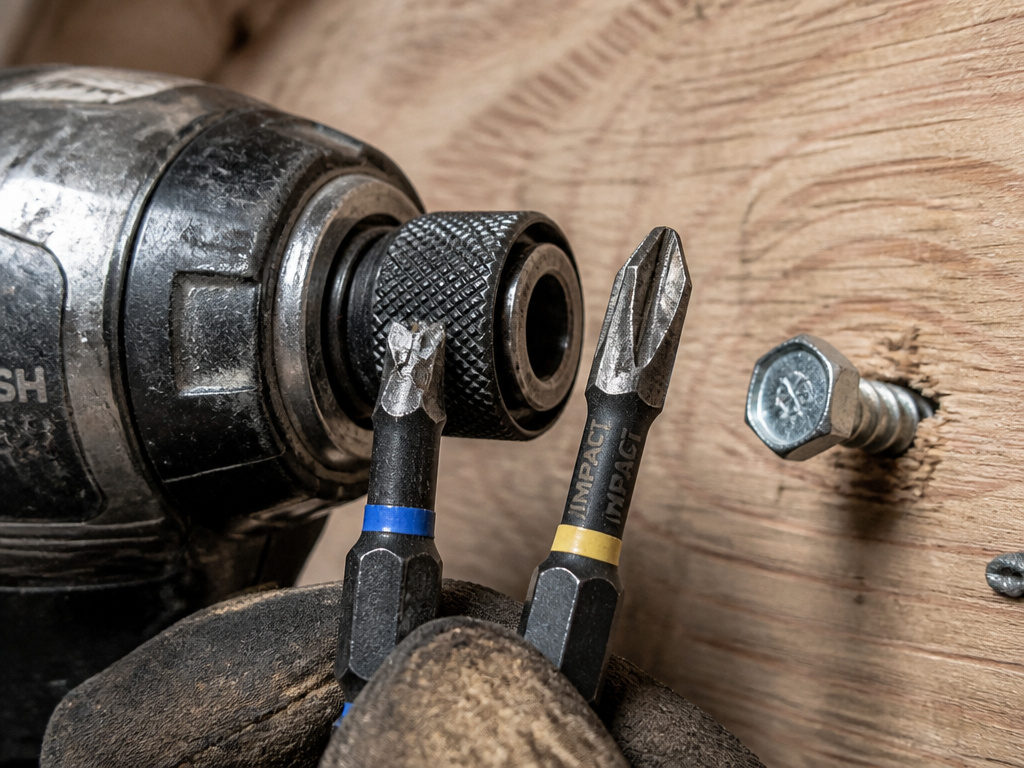
Spec sheets are one thing. What happens on the job site? A 2025 test by ToolsRadar put both bit types through a brutal, realistic scenario. They used a DeWalt Atomic 20V Impact Driver (2,000 in-lbs of torque, 3,200 impacts per minute) to drive 1/4×3″ lag bolts into Douglas Fir.
The results were stark.
- Impact Bits (Bosch Impact Tough): 0 breaks. A 95% success rate.
- Standard Bits (Irwin Marathon): 3 out of 10 snaps. A 70% success rate.
Think about that for a second. In a single test run, you’d have a 30% chance of a bit snapping halfway through your job. You’d be left with a broken bit stub jammed in your driver, a half-driven lag bolt, and a ruined piece of wood. The math on cost-per-screw becomes painfully clear. The “cheaper” standard bits become expensive fast when they fail 3 out of 10 times.
This test isolates the variable: it’s the bit, not the tool or the user. When subjected to the same high-torque impacts, the impact-rated construction wins outright.
Impact Bits vs Regular Bits: Which Job Is Which?
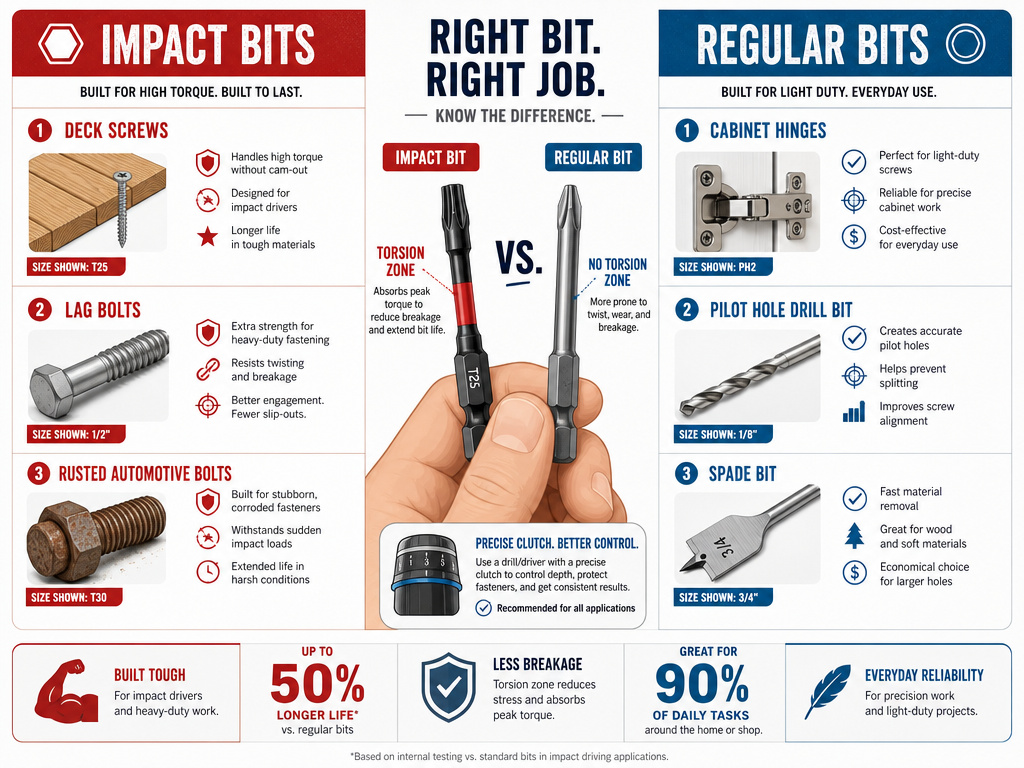
Choosing the right bit involves matching the bit’s design to the tool’s action and the task’s demands. The best choice depends on the type of work you’re doing.
Reach for Impact Bits when you are:
- Driving long screws or lag bolts into framing lumber.
- Building a deck, fence, or pergola where you’ll sink hundreds of fasteners.
- Working with steel studs or other hard materials.
- Doing automotive work where rusted, stubborn bolts need shock to break free.
- Using an impact driver daily. They are more cost-effective per screw.
Reach for Regular Bits when you are:
- Drilling pilot holes, countersinks, or using step bits. Precision pilot work needs the steady rotation of a drill/driver.
- Doing assembly work, cabinets, trim, or paneling. A drill/driver’s clutch provides the gentle, controlled stop you need.
- Working with small screws in electronics or appliances.
- Using spade bits, hole saws, or large-diameter twist bits. These require a drill/driver’s three-jaw chuck.
| Job Type | Recommended Tool | Bit Type | Reason |
|---|---|---|---|
| Driving 3″ Lag Bolts | Impact Driver | Impact Bit | Standard bits snap under high torque (3/10 failure rate). |
| Installing Cabinet Hinges | Drill/Driver | Regular Bit | Clutch prevents overtightening; impact driver is too aggressive. |
| Drilling a 1″ Hole with Spade Bit | Drill/Driver | Round-shank Bit | Requires a 3-jaw chuck; impact driver lacks control and can damage bit. |
| Assembling DIY Furniture | Drill/Driver | Regular Bit | Prevents stripping soft screw heads in particleboard. |
| Building a Deck | Impact Driver | Impact Bit | Handles high volume and tough material; torsion zone extends life. |
A Quick Guide to Bit Types and Sizes
Once you’ve matched the bit category to the tool, you need the right tip for the fastener. Using a #2 Phillips on a T25 screw is a fast track to a stripped head and a lot of frustration.
- Phillips (#2, #3): The most common. Use #2 for most wood screws (#6–#10). Use #3 for larger lag and structural screws. #1 is for tiny electronics.
- Torx (T15, T20, T25): Far superior to Phillips for high-torque driving as they resist cam-out. T20 is the standard for decking and construction screws. T25 is for structural screws. T15 is common for cabinet hardware.
- Square Drive: Common in furniture and some construction. Sizes run #0, #1, #2, #3.
Buying Recommendations: What to Look For
You don’t need to buy the most expensive set, but you should buy with purpose. Avoid the giant, no-name packs of 200 bits for $20. They are almost universally made from poor-quality steel that will crumble under real impact forces.
- Named Torsion Technology: Look for Milwaukee SHOCKWAVE, DeWalt FLEXTORQ, or Bosch Impact Tough. These aren’t just marketing terms; they refer to a specific, engineered flex zone.
- Material Claims: “Cold-forged steel” (like IRWIN’s), “S2 modified steel,” or “HSS-G” indicate a better alloy mix for shock resistance.
- Finish: A black oxide or similar coating fights corrosion and can reduce friction.
- The Right Mix: Get a set that matches your most common tasks. If you build decks, prioritize Torx (T20, T25). For general carpentry, a mix of #2 Phillips and square drive is essential.
Remember, impact bits work perfectly fine in standard drill/drivers, as discussed in our guide to impact screwdriver bits. There’s no downside. If you want to simplify your kit, buying only impact-rated bits for all your driving work is a perfectly valid strategy. They’ll last longer in your impact driver and work just as well in your drill.
What bits fit an impact driver?
Impact drivers accept only 1/4-inch hex-shank bits due to their collet design. This means round-shank drill bits won’t fit directly. While you can use a hex-to-three-jaw chuck adapter to fit round bits, it’s a risky shortcut under heavy load. The bit can spin loose in the adapter’s jaws or shear at the flute neck. For sustained driving, always use bits with an impact-rated hex shank designed to lock securely into the tool.
When not to use an impact driver
Impact drivers excel at brute force but lack finesse. The hammering action is loud and can be overkill for delicate tasks. Precision work like countersinks, pilot holes, or using step bits requires clean speed control without pounding, which is better suited for a standard drill/driver. Similarly, driving small screws for assembly, cabinets, or trim often needs a gentler touch to avoid damaging the material or the fastener head.
Do impact-rated bits really last longer?
Testing shows a clear durability gap. In one test driving lag bolts into wood, impact-rated bits had a high success rate with no breaks. Standard bits from the same test snapped multiple times under the same conditions. While a regular bit might work for a few screws, the sustained hammering of an impact driver will quickly chip or shatter it. For daily use or heavy-duty tasks like decking and framing, impact-rated bits are the cost-effective and safer choice.
Frequently Asked Questions
Can I use regular drill bits in an impact driver?
You can use a hex-to-3-jaw chuck adapter, but only for light-duty drilling (small pilot holes in softwood).
What is the difference between an impact driver and a drill?
This is the core of the bit compatibility issue. A drill (or drill/driver) provides steady, continuous rotational force, ideal for drilling holes and driving screws with the help of a clutch. An impact driver adds concussive hammering blows to the rotation, delivering extremely high torque for driving large fasteners. This hammering action is what destroys bits not designed for it.
Are impact driver bits the same as regular drill bits?
No. While they may look similar, impact driver bits are engineered differently. They are made from tougher, more shock-resistant steel and often feature a torsion zone (a flexible neck) to absorb impacts. Regular bits are harder and more brittle, optimized for the steady force of a drill.
Do impact bits last longer?
In an impact driver, absolutely. Test data shows impact bits can last many times longer than standard bits under the same punishing conditions. In a standard drill/driver, an impact bit will work fine, and there’s zero downside to using impact bits everywhere.
How do I know when to replace a bit?
Inspect bits before each use. Replace any bit with a rounded, chipped, or cracked tip. A worn Phillips bit will cam-out and strip screw heads. A worn Torx bit will feel loose in the fastener. If the tip has turned blue from overheating, the steel has been weakened and is more likely to fail.
The Bottom Line
Stop looking at the price per bit and start looking at the cost per screw driven successfully. A box of cheap bits that snap under load is more expensive than a set of impact-rated bits that finish the job.
The rule is mechanical, not philosophical: match the bit’s design to the tool’s action. Use impact bits for impact drivers, they flex, absorb shock, and survive. Use regular bits for drill/drivers, they stay hard, stay sharp, and provide control. Trying to swap them is how you end up with a bag of broken bits and a half-finished project.
That combination, the right bit in the right tool, used correctly, is what turns a frustrating struggle into clean, efficient work.
