
Impact Wrench vs Torque Wrench: Key Differences Explained
This post contains affiliate links. As an Amazon Associate, we earn from qualifying purchases.
An impact wrench is for speed and loosening fasteners with high, repeated blows, while a torque wrench is for precision, applying a smooth, controlled pull to tighten a fastener to a specific, measured value. For most jobs, you use the impact wrench first and finish with the torque wrench.
That gap between speed and precision is the whole story. The wrong tool at the wrong step costs money, time, and safety. An impact wrench delivers hundreds of foot-pounds in seconds, but its final stopping point is a guess. A torque wrench delivers its value with a click, guaranteeing the clamp force on the joint matches the spec on the page. Understanding the difference between an impact wrench vs torque wrench is therefore critical.
What follows is the deep cut on each tool, the specific numbers that define their jobs, and the one workflow that gets you professional results without the shop overhead.
Key Takeaways
- Never use an impact wrench for final torque. Sources disagree on the exact accuracy, with ShunTool noting it may be ±20% or more, while others simply describe it as ‘Low’.
- Follow the recommended workflow. Use the impact wrench to bring the fastener to within roughly one-half to one full turn of joint contact, then apply final torque with a calibrated torque wrench.
- A 1/2-inch square drive impact wrench covers the majority of automotive work (700–1,500 ft-lb), while a click-type micrometer torque wrench (with a typical range of 20 in-lb to 250 ft-lb) handles much final tightening.
- Impact wrenches need daily care. If you use a pneumatic model all day, oil it at least twice daily and clean it at the end of a hard work day to prevent internal failure.
- Torque wrench calibration is essential. For critical electrical work per Industrial Monitor Direct, a Type I Class A wrench needs re-calibration every 2,500 cycles or 6 months. Auto Median recommends annual calibration or after 5,000 cycles for general use.
How They Work: Hammers vs. Measured Force
The core mechanism tells you everything about the tool’s purpose.
An impact wrench is a power tool. Its motor, powered by air, electricity, or a battery, spins a weighted hammer inside a housing. A clutch releases that kinetic energy in sudden, sharp rotational blows against an anvil connected to the socket. This hammer and anvil system converts speed into tremendous, pulsing torque.
A pneumatic impact wrench’s hammer strikes at a very high frequency. You hear this as a rapid, deafening BRRRRT that drops to a dull thunk-thunk-thunk as the fastener seats. That sound shift is your cue to stop and switch tools.
A torque wrench is a measuring instrument. Whether it’s a click-type, beam, or digital model, its job is to measure applied rotational force. You pull smoothly on the handle. Inside, a calibrated spring or strain gauge deflects until a threshold is reached, then it clicks, beeps, or points to a number on a scale. The force stops the moment the measurement is complete. There’s no hammering, no bursts. Just a steady, silent increase in tension until the tool signals it’s done.
When to Use Each Tool (The Simple Rule)
Choosing wrong in the impact wrench vs torque wrench question wastes effort and breaks parts. The rule is simple, but the reasons matter.
Use the impact wrench for:
- Breaking loose seized or rusted fasteners. Its hammering action is uniquely good at overcoming corrosion and friction.
- Running down fasteners over long distances. Spinning a lug nut from finger-tight to near-contact is tedious with a ratchet; an impact does it in two seconds.
- Disassembly. Anywhere you need speed and power to remove components, the impact is your first grab.
Use the torque wrench for:
- The final tightening pass on any specified joint. This includes lug nuts, cylinder heads, intake manifolds, suspension components, and any critical engine or frame bolt.
- Precision assembly work. Any task where the workshop manual, engineering drawing, or manufacturer specifies a torque value (e.g., “75 ft-lb”).
- Safety-critical and liability-sensitive connections. If a failure could cause injury or significant damage, the torque wrench is your only legal and practical choice.
The workflow that respects both tools is called the two-step method. Use the impact wrench to bring the fastener to within roughly one-half to one full turn of joint contact, then apply the final torque with a calibrated torque wrench. The impact does the heavy, fast work; the torque wrench delivers the controlled, measured finish. This is the standard on any professional shop floor.
Impact Wrench Torque Accuracy: The ±20% Reality
Here’s where the marketing gloss meets the bench. An impact wrench is not a precision instrument.
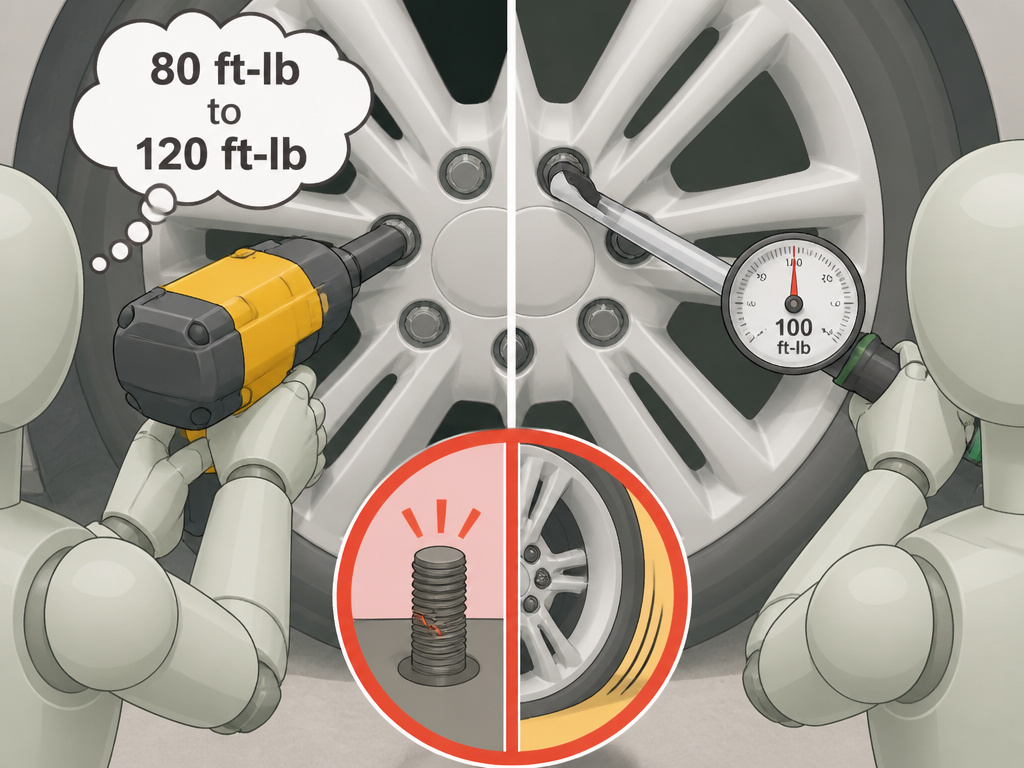
ShunTool notes impact wrenches may have a torque accuracy of +/- 20% or more. On a lug nut spec’d for 100 ft-lb, that means your impact could stop anywhere between 80 ft-lb and 120 ft-lb. Under-torque leads to a wheel loosening; over-torque stretches the stud, which can snap later.
The advertised “maximum torque” is often part of the problem. Industrial Monitor Direct points out that maximum torque figures for cordless tools are commonly quoted as ‘breakaway’ torque, the force to loosen a stuck fastener. Breakaway torque can be 20-30% higher than the recommended tightening range. A tool rated for 1,000 ft-lb breakaway might only deliver 700-800 ft-lb reliably for tightening.
| Drive Size | Typical Max Torque Range (ft-lb) | Best For |
|---|---|---|
| 1/4″ hex (Impact Driver) | 150 – 250 | Lag bolts, self-tappers, small fasteners |
| 3/8″ square | 200 – 450 | Conduit fittings, small motor terminations |
| 1/2″ square | 700 – 1,500 | Panel board lugs, automotive lug nuts, large motor work |
| 3/4″ square | 1,200 – 2,000 | Pole bases, flywheel bolts, structural fasteners |
| 1″ square | 2,000 – 3,000+ | Steel building bolts, substation structural |
For changing car tires, the 1/2-inch impact wrench is the recommended size. It offers the best balance of power and control for lug nuts. A 3/4″ or 1″ model is overkill for passenger vehicles and increases the risk of damage.
Torque Wrench Types and Their Precision
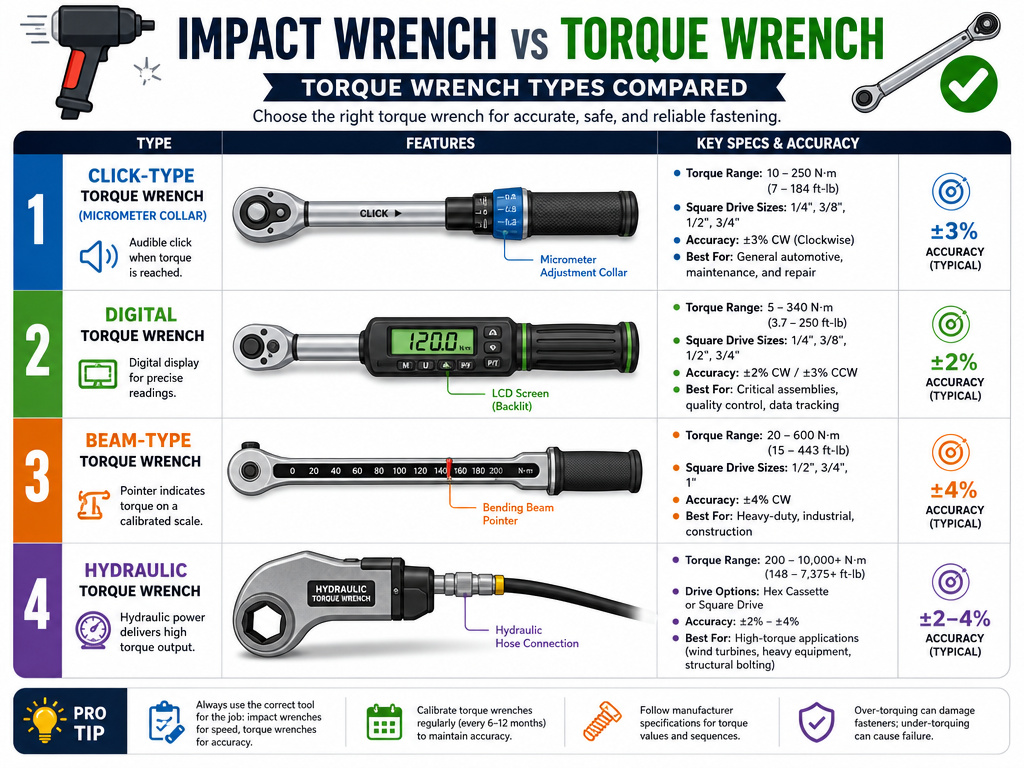
When you need a number, you need the right type of torque wrench. They’re categorized by their mechanism and accuracy class under standards like ISO 6789-1:2017.
Click-type (Micrometer): The classic “click” wrench. You set a collar to the desired torque, pull until it clicks and slips. Typical range: 20 in-lb to 250 ft-lb. It’s the default for most automotive final torque work.
Digital: Has an LCD screen and often beeps or vibrates at the set torque. Can log data. Typical range: 10 in-lb to 1,000 ft-lb. Digital torque wrenches offer high accuracy.
Beam-type: A simple, low-cost design with a pointer that moves along a fixed scale as the beam bends. No click. Typical range: 0 in-lb to 600 ft-lb. Accuracy depends entirely on the operator reading the scale correctly.
Hydraulic: For industrial-scale torque. A hydraulic cylinder applies force; pressure is calibrated to torque. Typical range: 150 ft-lb to 25,000 ft-lb.
Where sources disagree: Fine Power Tools claims hydraulic torque wrenches “can also work as impact wrenches,” while Industrial Monitor Direct describes them strictly as slow, steady, pressure-based tools with no impact function. For definitive final torque, treat them as precision instruments, not impact replacements.
For a torque wrench accurate to ±4% throughout the entire 40-250 ft.-lb. Torque range, a 1/2″ drive click-type wrench is the workhorse. That level of precision is a world away from the low accuracy in an impact wrench vs torque wrench comparison.
Can You Use an Impact Wrench as a Torque Wrench?
No. Not for the final value.
Some modern impact wrenches have “smart” features. The Milwaukee OneKey app allows setting a target torque, and the tool stops based on motor current monitoring. Independent testing shows its stop torque repeatability is in the ±10% to ±15% range.
That’s better than a basic impact, but it’s not a calibrated instrument. Industrial Monitor Direct is blunt: this is not accepted for critical joints in most plant procedures. The tool stops on an estimate, not a measurement. For a 10% clamp-force band on a joint, the torque spread must be inside ±5% of target. That’s the domain of the torque wrench, not the smart impact.
To be clear. These modes are for production assembly where speed and “good enough” repeatability matter, like running down hundreds of similar bolts on a frame. For the one set of lug nuts on your car that keep the wheel on at 70 mph, “good enough” isn’t a spec you want to trust.
Keeping Your Tools Honest: Maintenance and Calibration
A neglected tool is a dangerous tool. The care routines for these wrenches are different, but both are non-optional.
Impact Wrench Maintenance:
If you use a pneumatic impact wrench all day, oil it at least twice a day. Clean it at the end of each shift. Worn motor brushes are a common failure point in electric models. Always use impact-rated sockets; a chrome socket can shatter under the hammering blows. For air tools, the Ingersoll-Rand manual specifies using an air line lubricator, clean, dry air at 90 psig maximum, and their No. 115-1LB grease for the external hammer-case fitting.
Torque Wrench Calibration:
This is where the sources show a clear difference in standards, and you must know which world you’re in.
| Environment / Standard | Recommended Calibration Interval | Notes |
|---|---|---|
| Critical Electrical Work (Industrial Monitor Direct) | Every 2,500 cycles or 6 months (Type I Class A) | Follows ISO 6789-1 and plant quality plans. |
| General Automotive / DIY (Auto Median) | Annually or after 5,000 cycles | A common recommendation for non-critical shop use. |
| After Any Abuse | Immediately | If the wrench is dropped, over-loaded, or used as a breaker bar. |
Common mistake: Storing a click-type torque wrench with the spring compressed. Always wind the setting back to the scale’s lowest value after use. Leaving it set at 150 ft-lb for months on the wall weakens the spring and ruins calibration.
The 2,500-cycle/6-month rule is the industrial safety net. For the home mechanic doing a few oil changes a year, the annual check is probably fine. But if you’re working on anything where a loose or broken bolt could hurt someone, err on the side of the stricter schedule. A calibrated wrench is a precision device; an uncalibrated one is a fancy ratchet that lies to you.
Operator Fatigue and Vibration
Impact wrenches, especially pneumatic models, generate significant vibration and noise during operation. Hearing protection is required for pneumatic impacts exceeding 85 dBA at the operator’s position. Always wear appropriate personal protective equipment, such as eye and hearing protection.
Frequently Asked Questions
Can I use a torque wrench to loosen bolts?
No. Never use a torque wrench to break loose a fastener. The sudden shock load can damage the internal calibration mechanism. Use a breaker bar or your impact wrench for loosening. The torque wrench is for final tightening only.
What size impact wrench do I need for lug nuts?
For passenger cars and light trucks, a 1/2-inch square drive impact wrench is the standard. It typically delivers 700–1,500 ft-lb, which is ample for lug nuts. A 3/8-inch model (200-450 ft-lb) can work but may struggle with over-torqued or rusty lugs.
How accurate are torque sticks for impact wrenches?
Torque sticks are torsion bars that fit between your impact wrench and socket, designed to flex at a specific torque. They are not a substitute for a final check with a calibrated torque wrench. Consider them a “pre-torque” aid at best.
Do I need both an impact wrench and a torque wrench?
For serious automotive or mechanical work, yes. They are complementary tools. The impact wrench saves immense time and effort on removal and running fasteners down. The torque wrench ensures safety, reliability, and adherence to specifications on the final tighten. Trying to get by with just one will compromise either your efficiency or your safety.
The Bottom Line
Buy the 1/2-inch impact wrench for the grunt work. Buy the 1/2-inch click-type torque wrench for the final say. Use the first to get the fastener 95% of the way there, and the second to deliver the exact pound-foot called for in the manual.
That’s the professional split. The impact wrench is your powerhouse, the torque wrench your accountant. One makes the job fast, the other makes it right. And on anything that rolls, flies, or holds something heavy over someone’s head, “right” is the only metric that counts. Don’t overthink it, that’s the workflow that works.
