
How Does an Impact Wrench Work? Step-by-Step
This post contains affiliate links. As an Amazon Associate, we earn from qualifying purchases.
An impact wrench works by using a hammer-and-anvil mechanism to convert the motor’s constant rotational force into powerful, high-speed impacts that break bolts loose. The motor spins a heavy hammer inside a cage; the hammer compresses a spring, builds kinetic energy, and then slams into an anvil connected to the socket, delivering a powerful burst of torque.
That’s the simple answer, and it’s what every top-ranking page tells you. It’s also incomplete. To understand its limits, you must know how does an impact wrench work, specifically how it stores and releases angular momentum. This is what dictates when it works, when it fails, and which fasteners it should never touch.
What follows is a breakdown of the internal physics, the concrete specs from manufacturer manuals, and the one rule from service centers that stops your wrench from burning out its clutch in three months when you misuse the answer to how does an impact wrench work.
Key Takeaways
- The hammer-and-anvil clutch transforms smooth rotation into high-torque impacts.
- Impact-rated sockets are mandatory; hand-tool sockets shatter under repeated impact, flying at over 4,500 RPM.
- Air pressure limits aren’t universal; some models like the Husky HSTC4140 cap at 90 PSI, while the Husky Stubby runs at 115 PSI, exceeding the printed spec voids the warranty.
- Never impact for more than five seconds after a bolt seats; the Chicago Pneumatic manual warns this causes “excessive wear and possible damage” to the mechanism.
- Clean, dry, lubricated air is essential; water in the line, per Ingersoll Rand’s 1150 manual, “will cause damage to the tool.”
The Hammer-and-Anvil Mechanism in Detail
We’ll open one up. Inside every impact wrench, from a modest Husky to a professional Ingersoll Rand 261 series, is a kinetic energy trap. It starts with a motor, air-driven vanes or an electric rotor, spinning a heavy steel cylinder called the hammer cage. Inside that cage, two weighted hammers on pins sit poised.
As the cage spins, centrifugal force throws the hammers outward. They don’t just fling free; they ride a cammed track. On each rotation, they’re forced back against a heavy coil spring. That’s the energy storage phase: the motor’s work gets converted into spring tension.
The hammer compresses against its spring for roughly half a revolution, storing kinetic energy. When it clears the cam’s high point, the spring unloads, accelerating the hammer into a direct, square strike on the anvil’s lugs. This impact transfers the stored energy into a sudden, massive rotational force on the socket.
That’s the “impact” in impact wrench, which is the core of how does an impact wrench work. The motor keeps spinning, the hammers keep cycling, load, strike, load, strike, delivering a rapid series of concussive blows, often over 1,000 times per minute. This is why an impact wrench can zip off a lug nut a human couldn’t budge with a long breaker bar. It’s not about steady force; it’s about overwhelming the friction with sharp, focused impulses.
Breakaway Torque vs. Fastening Torque
This mechanism excels at breakaway torque, the high initial force needed to overcome a stuck fastener’s static friction. Once the bolt starts moving, the required fastening torque is much lower. That’s the secret to its speed. It rapidly overcomes the high breakaway torque. The rest of the spinning is just running the fastener down.
Where this goes sideways: the wrench has no idea when to stop. It will keep hammering long after the bolt is tight, which is why manuals like the one for the Husky HSTC4140 explicitly state “impacting for longer than five seconds after a bolt is seated will cause excessive wear and damage.” You feel the difference, the sound changes from a rapid brrrrt-brrrt to a higher-pitched tat-tat-tat as the hammer starts free-spinning against the anvil with nowhere to put its energy. That’s the sound of your clutch wearing itself flat.
Air-Powered vs. Cordless (Electric): The Core Difference
The hammer mechanism is the same. The power source changes everything. The truth is, a lot of brand wars are fought over specs that don’t matter at the socket. The real choice is about your air compressor and your tolerance for noise.
| Type | Power Source | Typical Max Torque | Key Advantage | Key Limitation |
|---|---|---|---|---|
| Pneumatic | Compressed Air | Husky 1″ Stubby: 1,180 ft-lb | Higher sustained power, lighter tool, simpler internals | Needs a large compressor (8+ CFM), loud, requires hose |
| Cordless | Battery | Ingersoll Rand W5153P-C1D2: 295 ft-lb (reverse) | Ultimate portability, no hoses, quieter operation | Lower peak torque, expensive batteries, weight in hand |
The cordless vs pneumatic decision often involves factors beyond peak power. It’s about logistics. Do you have a 60-gallon compressor plumbed to your shop ceiling? Go pneumatic. The Husky Stubby’s 8.75 CFM air consumption is a non-issue. Working in a driveway or on a job site with no power? The 20V cordless wrench from Ingersoll Rand is your only sane option.
The feel is different. A pneumatic tool has a distinct exhaust note. A cordless impact screams, a high-pitched electronic whine under the impacts. The vibration is sharper, too. For high-volume, sustained use, a pneumatic tool may be preferred, while a cordless tool offers convenience for mobile tasks.
When Not to Use an Impact Wrench (And What to Use Instead)
This is the section most guides skip, and it’s how you break things. An impact wrench is a blunt instrument. It’s for high-torque, non-precision work on robust fasteners.
Do not use an impact wrench on:
- Precision torque applications: Wheel lug nuts are a classic use, but final torque is often set with a torque wrench for precision. The Ingersoll Rand cordless manual bluntly states: “Impact wrenches are not torque wrenches.”
- Soft materials (aluminum, plastic): The impacts will gall threads or crack castings.
- Small fasteners (under 8mm): You risk snapping the bolt or stripping threads.
- Situations requiring feel: Installing a delicate bearing race or a thermostat housing. You need the feedback of a hand ratchet.
- Regular chrome sockets: This deserves its own warning.
Common mistake: Using a standard hand-tool socket on an impact wrench. The rapid hammering can cause standard sockets to crack or shatter, creating a safety hazard. Always use impact-rated sockets marked “FOR USE WITH IMPACT WRENCHES.”
What should you use instead? For precision, a torque wrench. For small or soft fasteners, a hand ratchet or a precision torque screwdriver. Understanding the difference between impact and torque wrenches is a safety fundamental, not an academic point.
Step-by-Step Setup and First Use
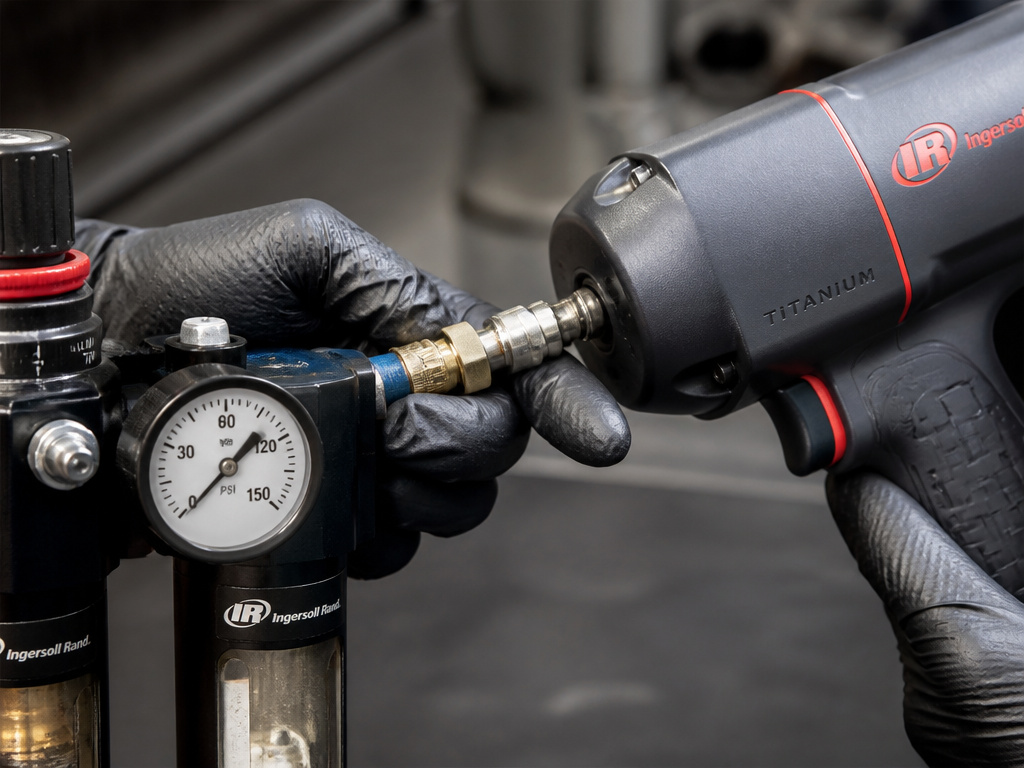
Before you connect air or a battery, you need the right foundation. Skipping these steps can lead to poor tool performance or failure.
1. Gather Your Kit:
- Impact wrench (obviously)
- Impact-rated socket set
- Air compressor capable of your tool’s CFM or charged battery
- ½-inch air hose (the minimum for the Husky 1 in. Stubby) or ⅜-inch hose (recommended for tools like the Husky HSTC4140 and an Unnamed 3/4″ model).
- In-line filter/regulator/lubricator (FRL unit) for air tools
- Safety glasses and hearing protection (the Chicago Pneumatic CP7748TL emits 94.3 dB(A))
2. Prepare the Air Supply (For Pneumatic Tools):
Connect your FRL unit as close to the tool as possible. Set the regulator to your tool’s specified pressure. Here’s where manufacturers disagree: the Husky HSTC4140 and an Unnamed 3/4″ model specify a maximum of 90 PSI, while the Husky Stubby manual lists a working pressure of 115 PSI. Follow your tool’s manual. Open the drain valve on your compressor tank daily, water in the line is a death sentence for the air motor.
3. Lubricate (For Pneumatic Tools):
Fill the FRL lubricator with SAE #10 oil and set it to two drops per minute, per the Chicago Pneumatic CP7748TL manual. Some tools, like the Husky HSTC4140, have an internal oil reservoir requiring SAE 30 weight oil every 40 hours. Know your system.
4. Attach Socket and Test:
Press an impact socket onto the anvil until it clicks (for a detent pin) or twists (for a hog ring). Give the trigger a short burst in a safe direction. Listen for the distinct, solid impact rhythm. If it just whirs, the mechanism isn’t engaging, a sign of low air pressure or a worn clutch.
For a deeper dive on pneumatic specifics, our guide on using an air impact wrench covers hose sizing and pressure tuning in detail.
Maintenance Routines: Air vs. Electric
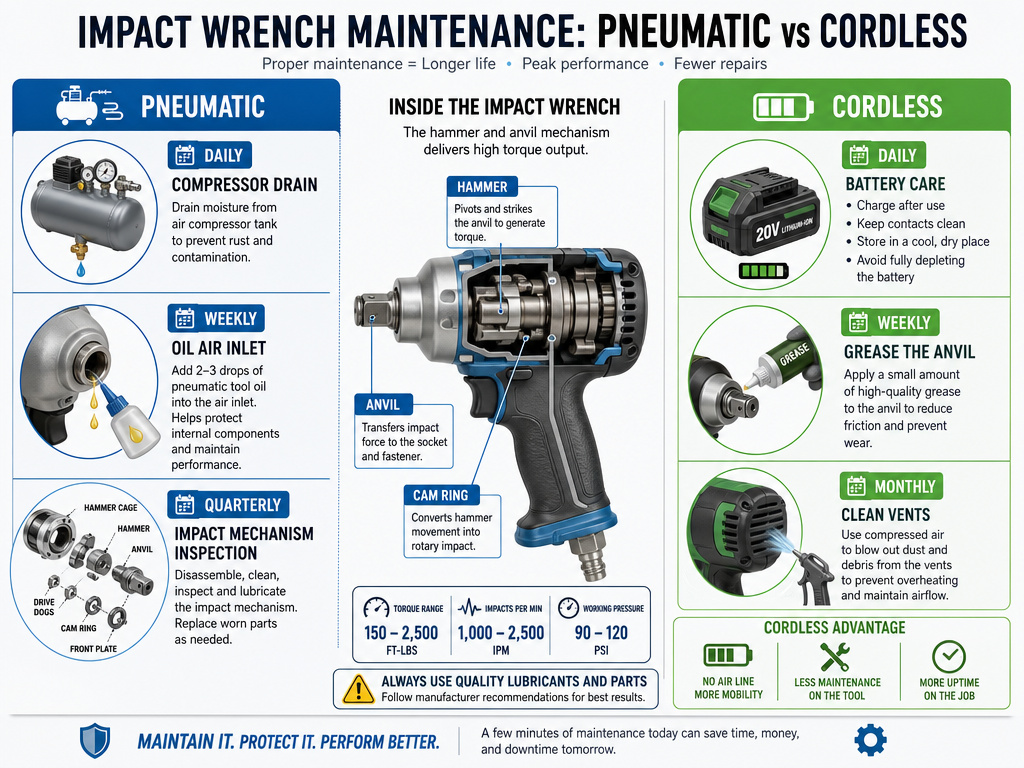
A well-maintained impact wrench has a long service life, while neglect leads to premature failure. The routines are different.
Pneumatic Maintenance:
- Daily: Drain compressor, check FRL oil level.
- Weekly: Add a few drops of oil directly into the air inlet, run the tool for 30 seconds to coat internals (especially before extended storage).
- Every 3 Months (for daily use): This comes straight from the Chicago Pneumatic manual: “Disassemble and inspect the tool every three 3 months if the tool is used every day. Replace damaged or worn parts.” This is for professional shop use.
- Troubleshooting: If the tool “impacts rapidly but will not remove bolts,” the manual points to a worn impact mechanism. Time for a rebuild kit.
Cordless Maintenance:
- Battery Care: Keep contacts clean. Store batteries in a climate-controlled space.
- Mechanical Lubrication: The Ingersoll Rand cordless manual is specific: remove the hammer case to apply grease to the anvil and impact mechanism “evenly and sparingly.” Over-greasing causes sluggish operation.
- Cleaning: Blow out dust from vents with compressed air after use.
Whether you choose a cordless or pneumatic impact wrench, this maintenance schedule is what separates a reliable tool from a paperweight.
Choosing the Right Drive Size for Your Job
The square drive on the anvil, ¼”, ⅜”, ½”, ¾”, 1″, isn’t just about socket compatibility. It’s a torque class indicator.
| Drive Size | Typical Max Torque | Best For | Example Tool |
|---|---|---|---|
| ¼” | Low (for small fasteners) | Automotive interior, electronics, light assembly | Compact cordless impact drivers |
| ⅜” | Medium (100-400 ft-lb) | General automotive, suspension, mid-size machinery | Husky HSTC4140 (550 ft.lb.) |
| ½” | High (400-1,200 ft-lb) | Truck/SUV lug nuts, frame bolts, most construction tasks | Ingersoll Rand 2906P1 (350 ft.lb.), Husky Stubby (1,180 ft-lb.) |
| ¾” & 1″ | Very High (750+ ft-lb) | Heavy equipment, industrial machinery, large structural bolts | Unnamed ¾” model (750 ft.lb.) |
½” drive is a common choice for home garage and automotive work. It strikes the balance between raw power and a manageable tool size (the Husky HSTC4140 is only 7.5 inches long). Stepping down to ⅜” saves weight but caps your capability. Stepping up to ¾” or 1″ drive typically requires a higher-capacity air supply and is intended for heavier applications than standard automotive work.
If you’re weighing this against a similar tool, our comparison of an impact driver vs impact wrench explains why a driver’s ¼” hex shank is built for screws, not bolts.
Frequently Asked Questions
What’s the difference between an impact wrench and an impact driver?
An impact driver uses a similar hammer mechanism but is designed for driving screws and lags into wood. It has a ¼” hex collet for screw bits, delivers high rotational speed with moderate torque, and is typically smaller. An impact wrench is built for bolts, has a square drive for sockets, and delivers much higher torque at lower speeds. The impact driver mechanism is a scaled-down, higher-RPM version of the same idea.
Can I use regular sockets on my impact wrench?
No. You must use impact-rated sockets. They are made from a softer, more ductile chrome-molybdenum steel that flexes under impact instead of shattering. Regular chrome-vanadium hand-tool sockets are hardened and brittle; the hammering will crack them, creating a serious safety hazard. Always check the socket labeling.
How much air pressure does my impact wrench need?
Check your manual. There is no universal standard. For example, the Husky HSTC4140 ½” Impact Wrench specifies a maximum air pressure of 90 PSI. Conversely, the Husky 1 in. Stubby lists a working pressure of 115 PSI. Exceeding your model’s specified pressure risks injury and voids the warranty.
Why does my impact wrench hammer but not turn the bolt?
You’re likely experiencing “clutch slip.” The hammer is striking the anvil, but the anvil isn’t transferring that energy to the socket. Causes include: a worn hammer and anvil (the lugs are rounded off), insufficient air pressure/CFM, or using an undersized hose that restricts airflow. For a tool used daily, the three-month inspection interval exists to catch this wear before it strands you.
Is an impact wrench better than a torque wrench?
They are complementary tools, not competitors. An impact wrench is for speed and breaking loose stubborn fasteners. A torque wrench is for precision, ensuring a fastener is tightened to an exact specification (e.g., cylinder head bolts, wheel lug nuts). You use the impact to remove and run down the fastener, then finish with the torque wrench. Using an impact for final torque is a guess that can lead to failed parts.
The Bottom Line
An impact wrench isn’t magic. It’s a clever mechanical workaround that trades smooth rotation for concussive force. That force makes short work of frozen bolts but demands respect: respect for the right sockets, the right air pressure, and the right application.
An important rule from several manuals is to avoid impacting for more than five seconds after a bolt is seated to prevent damage. Once the bolt is seated and the sound changes, you have five seconds of grace before you’re grinding metal on metal. Count it out. Your clutch will last years longer.
For everything else, the hum of a well-lubricated motor, the solid thunk of a hammer strike, the satisfaction of a lug nut spinning free, that’s why the tool exists. Just know when to put it down and reach for the torque wrench instead.
