
Oscillating Tool vs Reciprocating Saw: Blade Life and Cost
This post contains affiliate links. As an Amazon Associate, we earn from qualifying purchases.
An oscillating tool runs a blade through a tiny 3°-4° arc at 10,000-22,000 oscillations per minute (OPM) for precision work in tight spaces. A reciprocating saw drives a blade through a full 1″-1.25″ stroke at 2,300-3,000 strokes per minute (SPM) for raw demolition power. For most homeowners tackling a mix of repair and demo, a reciprocating saw is the better first buy.
That gap between a fraction of an inch and over an inch of blade travel is the whole story. One tool is built for control where a mistake costs you trim. The other is built for speed where stopping means another hour of labor.
What follows is the spec sheet that proves it, a direct comparison of how each tool handles common materials, and the one budget rule that decides which one you should buy first.
Key Takeaways
- An oscillating tool’s 3°-4° oscillation arc makes it the only tool that can cut flush to a surface without damaging it.
- A reciprocating saw’s 1″+ stroke length clears sawdust from the kerf aggressively, which is why it’s the default for fast demolition.
- For indoor finish work like trimming door casings, the oscillating tool’s lower vibration and precision make it safer and cleaner.
- If your budget forces a choice, buy the reciprocating saw first for its broader demolition power; add the oscillating tool later for detail work.
- Most serious DIYers and contractors end up owning both, using the reciprocating saw for rough work and the oscillating tool to refine it.
The Mechanical Difference: OPM vs. SPM
Forget “power” or “versatility” as abstract ideas. The real difference is in two numbers you can measure: Oscillations Per Minute (OPM) and Strokes Per Minute (SPM). These aren’t marketing terms. They’re physical descriptions of how each tool moves, and they dictate every job each one can and cannot do.
Oscillating tools operate between 10,000 and 22,000 OPM, moving the blade side-to-side through a 3° to 4° arc. Reciprocating saws operate between 2,300 and 3,000 SPM, driving the blade back-and-forth through a 1″ to 1.25″ full stroke length.
Think of it like a pen. An oscillating tool moves the tip so fast and so slightly that it can etch a fine line. A reciprocating saw moves the entire pen back and forth a full inch, scribbling wildly. The first is for detail. The second is for removal.
This mechanical reality behind the oscillating tool vs reciprocating saw explains the sensory experience of using each tool. An oscillating tool produces a high-pitched whir with a gritty, buzzing feel in your hand, it’s working hard, but in a tiny space. A reciprocating saw delivers a deeper, throaty roar and a pronounced forward-and-back thump you feel in your shoulders. That thump is power, but it’s also a lack of finesse.
| Specification | Oscillating Tool | Reciprocating Saw |
|---|---|---|
| Primary Motion | Side-to-side oscillation | Back-and-forth stroke |
| Speed Range | 10,000 – 22,000 OPM | 2,300 – 3,000 SPM |
| Movement Distance | 3° – 4° arc (fraction of an inch) | 1″ – 1.25″ full stroke |
| Best Described As | Precision etching | Aggressive chopping |
What Is an Oscillating Tool Best For?
In the oscillating tool vs reciprocating saw debate, the oscillating tool is your problem-solver for jobs where other tools are too big, too crude, or too dangerous to the surrounding finish. Its slim profile and tiny arc let it operate in a world other tools can’t reach.
Flush Cutting. This is its signature move. Need to trim a door jamb after installing new flooring? An oscillating tool can slide right in and cut the wood flush to the floor without scratching the tile. The same goes for cutting off a pipe flush to a wall or trimming molding in place.
Sanding and Scraping. Swap the blade for a sanding pad or a scraper, and it becomes a detail sander. It’s perfect for removing old paint from a window sill, adhesive residue from a subfloor, or surface rust from a metal bracket. The tool gets into corners a palm sander can’t touch.
Grout Removal. A dedicated grout blade turns the oscillating multi-tool into the fastest way to remove old, cracked grout between tiles without chipping the tile itself.
Precision Plunge Cuts. Starting a cut in the middle of a piece of drywall, undercutting trim for wiring, or cutting out a section of carpet, these are all plunge cuts. The oscillating tool can start them neatly without a pilot hole.
Where this goes sideways: Trying to use an oscillating tool for heavy demolition. It can cut a 2×4, but it will take a minute and burn through a blade. It lacks the stroke length to clear material, so the blade gums up and overheats.
For these detail tasks, the right blade is everything. A full guide on oscillating tool blade types breaks down the choices, but for most wood and drywall work, a bi-metal universal blade is the place to start.
What Is a Reciprocating Saw Best For?
The reciprocating saw is a demolition engine. Its long stroke is designed for one thing: moving material out of the way as fast as possible. It’s the tool you reach for when the goal is to make something gone, not pretty.
Demolition and Remodeling. Cutting through walls, ripping out old framing, removing siding, or taking down a deck, if it’s nailed together, a recip saw will tear it apart. It powers through nails embedded in wood without missing a beat.
Pruning and Limb Removal. With a long, coarse-tooth pruning blade, a reciprocating saw becomes a powerful tool for cutting tree limbs and brush. It’s often faster than a hand saw and more maneuverable than a chainsaw for overhead work.
Cutting Metal Pipes and Conduit. Need to cut through a galvanized pipe or a piece of steel conduit? A reciprocating saw with a metal-cutting blade slices through it in seconds. It’s a staple for plumbers and electricians.
Rough Openings. When framing a wall, cutting out rough openings for windows and doors is a recip saw’s job. It’s fast and powerful enough to handle the thick, nail-ridden lumber.
The key to using one well is understanding its safety profile. That long, aggressive stroke means it can grab and kick, and it throws chips violently. You need space and a secure grip. Our guide on reciprocating saw techniques covers the essential stance and control.
Oscillating Tool vs. Reciprocating Saw: Side-by-Side on Common Jobs
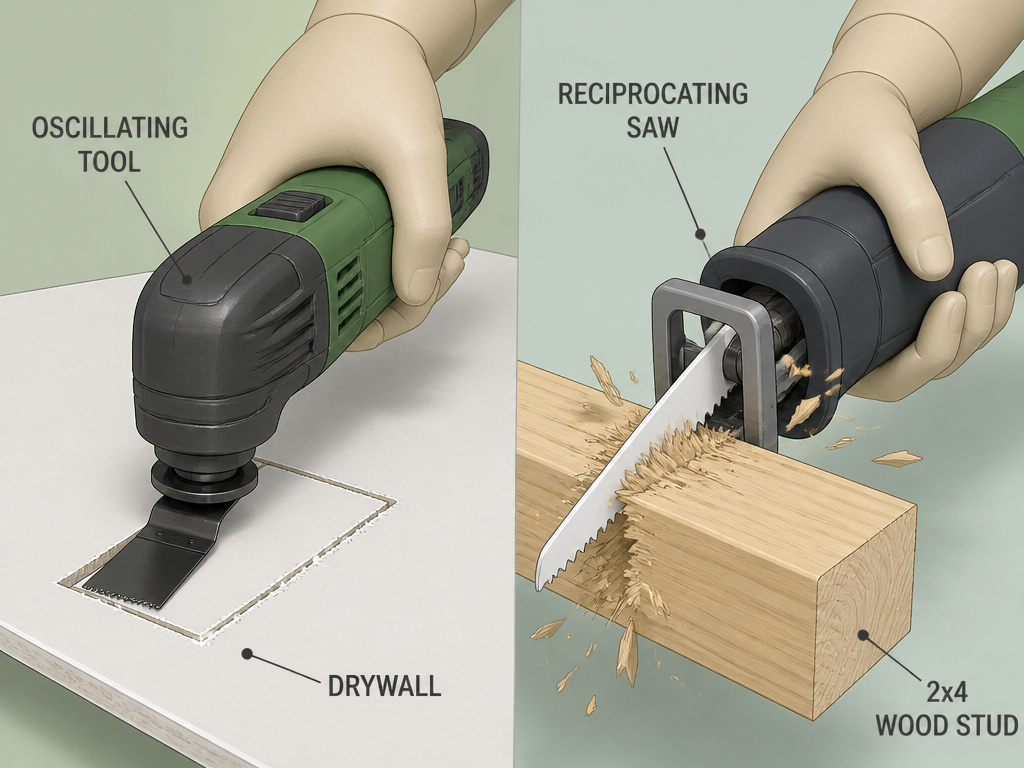
To be specific. Which tool do you actually pick up? The answer isn’t about the tool category; it’s about the specific outcome you need on a specific material.
| Job & Material | Oscillating Tool Performance | Reciprocating Saw Performance | Which Wins? |
|---|---|---|---|
| Cutting a 2×4 | Possible with a wood blade. Slow. Clean, precise cut. | Fast. Rough, splintered cut. | Reciprocating Saw for speed. Oscillating tool only if the cut must be perfect in-place. |
| Cutting a Metal Pipe (1/2″ thick) | Can do small cuts with metal blade. Slower, more control. Blade wears quickly on thick stock. | Fast and easy with bi-metal blade. Standard tool for plumbers. | Reciprocating Saw for anything beyond thin sheet metal. |
| Flush-Cutting a Door Jamb | Excellent. Slides under trim, cuts flush to floor without damage. Its defining job. | Impossible. The shoe and blade guard prevent getting flush. Will damage floor. | Oscillating Tool, no contest. |
| Removing Grout | Excellent with grout blade. Fast, controlled, minimal tile risk. | Impossible. Far too aggressive, would shatter tiles. | Oscillating Tool, only tool for the job. |
| Demolishing a Wooden Wall | Can cut small sections. Impractical for whole wall—too slow, blades overheat. | Excellent. Rips through studs, plaster, and nails quickly. The right tool. | Reciprocating Saw, by a massive margin. |
| Making a Plunge Cut in Drywall | Excellent. Starts cut neatly in middle of sheet for outlet or repair. | Poor. Will tear and shatter drywall. Hard to start without an edge. | Oscillating Tool for any precision drywall work. |
This table shows why they aren’t rivals. They’re specialists. Trying to swap them leads to frustration, broken tools, or ruined workpieces.
Corded vs. Cordless: A Consideration for Each Tool
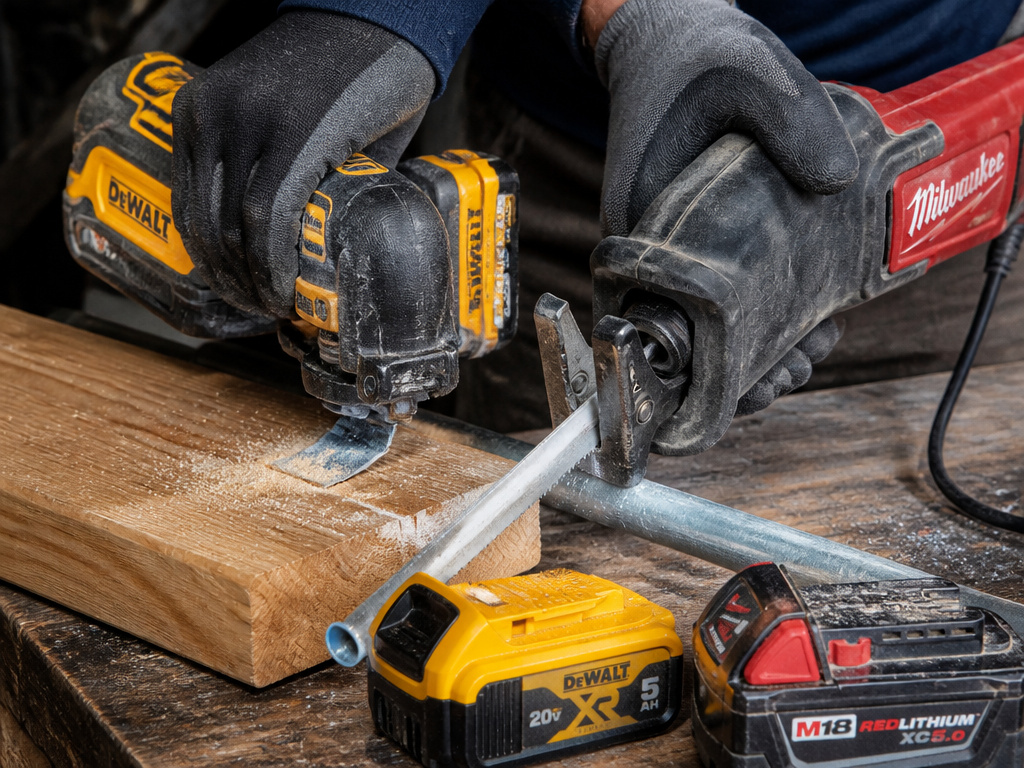
Your power source choice matters, and it impacts each tool differently based on its core use.
The runtime required for detail work is well within the capacity of a modern battery. A model like the DeWalt DCS356C1 exemplifies this: it’s a brushless cordless tool with a 3-speed selector and tool-free changes, built for portable, all-day detail work.
For a reciprocating saw, the decision is tougher. Cordless offers incredible freedom for pruning, overhead work, or demo in a basement with no outlets. However, continuous, heavy demolition can drain batteries. If you’re ripping out a whole deck or cutting metal all day, a corded recip saw like the Skil 9206-02 guarantees unlimited power. For most DIYers, a cordless model on a shared battery platform (like the Milwaukee M18 SAWZALL) is a great compromise.
Which Tool Should You Buy First?
Budget tip: If you can only buy one tool right now, buy the reciprocating saw for its broad demolition power. Add the oscillating tool later for detail work.
This advice from the field recognizes a hard truth: you can manage detail work slowly with hand tools, but you cannot replicate the raw power of a recip saw. If a project demands tearing something out, you need that power. If you’re staring at a bathroom remodel, you need the reciprocating saw to rip out the old framing and tile backer. You can clean up the door jambs with a hand saw until you buy the oscillating tool next year.
The calculus flips if your projects are exclusively fine repair and renovation, no demolition at all. If you’re only installing trim, repairing floors, and doing tile work, the oscillating tool is your daily driver. But that’s a rare scenario for most homeowners.
Most people who do this work regularly end up with both. The workflow is simple: the reciprocating saw does the heavy lifting, and the oscillating tool comes in behind it to clean, trim, and perfect. That’s how you save time and protect the finishes you want to keep.
Noise and Vibration Levels
An oscillating tool generally operates with lower vibration than a reciprocating saw, which makes it more comfortable for extended use on tasks like sanding or making precision cuts. This lower vibration is partly due to its smaller, high-speed oscillating motion. In contrast, a reciprocating saw’s long, powerful stroke generates more aggressive vibration and typically more noise, which is a trade-off for its fast material removal. For indoor finish work where control and user comfort are priorities, the oscillating tool’s lower vibration is a significant advantage.
Blade Life and Cost of Accessories
Blade life and accessory costs differ significantly between these tools. Oscillating tool blades are smaller and can wear out quickly, especially when used on hard materials like metal or nails. Their specialized design for tasks like flush cutting or grout removal means you’ll need a variety of blades, which can add up. Reciprocating saw blades are larger and more robust, built to withstand the abuse of demolition work, but they are still consumable items. For both tools, using the correct blade for the material is the most practical way to extend life and manage ongoing costs.
Frequently Asked Questions
Is an oscillating tool the same as a reciprocating saw?
No. They are fundamentally different tools. An oscillating tool moves a blade side-to-side in a tiny arc for precision work. A reciprocating saw moves a blade back-and-forth in a long stroke for demolition. They are built for opposite ends of the precision-versus-power spectrum. For a look at another common comparison, see our guide on oscillating tools versus rotary tools.
Can you cut a 2×4 with an oscillating tool?
Yes, but you shouldn’t if you have another option. It can be done with a wood-cutting blade, but it will be slow (over a minute), hard on the blade, and the motor will get very hot. It’s a last-resort method for a single, in-place cut where no other saw can fit. For regular lumber cutting, a reciprocating saw or circular saw is the right tool.
What should you not do with a reciprocating saw?
Do not use it for precision finish work. Do not try to make flush cuts against a surface you want to keep, you will damage it. Do not use it without eye protection and gloves, it throws sharp chips violently. Do not force a dull blade; it will overheat and can snap.
Can an oscillating tool cut metal?
Yes, with a metal-cutting blade. It’s best suited for thin sheet metal, small bolts, or nails. For cutting through thick metal pipe or stock, a reciprocating saw with a bi-metal blade or an angle grinder is a much faster and more effective choice. The right blade makes all the difference, which is why we review the top reciprocating saw blades separately.
Should I buy both an oscillating tool and a reciprocating saw?
If you do both demolition/remodeling and fine repair/finish work, then yes, owning both is highly recommended. They are complementary, not overlapping. Most contractors and serious DIYers have both for this reason. If you’re starting a tool collection, see our picks for the top reciprocating saws and the top oscillating tools to guide your first purchases.
The Bottom Line
Stop looking for one tool to rule them all. The oscillating tool vs reciprocating saw question has a clear answer: they are different tools for different jobs. Let the work dictate the tool.
If you’re opening up a wall, start with the reciprocating saw. If you’re trimming out the new door in that wall, finish with the oscillating tool. That’s the professional workflow because it’s the only one that makes sense. Buy for the work you have in front of you, and trust that the specs, the 3° arc and the 1″ stroke, tell you everything you need to know about what each one can do.
