
Paper vs Plastic Collated Nails: Which Should You Buy?
This post contains affiliate links. As an Amazon Associate, we earn from qualifying purchases.
Paper collated nails are held together by a paper tape strip at a 30–34 degree angle, while plastic collated nails use a plastic strip at a 20–21 degree angle. The choice isn’t about which material is better, but which one your nailer is designed to use, mixing them causes jams and misfires. Paper strips often hold more nails and leave no plastic debris, but plastic strips handle moisture better and are commonly paired with full-round heads in 21-degree systems, which are often required by building codes.
The angle printed on your nailer’s magazine or in its manual is the starting point for the paper vs plastic collated nails decision. That number locks you into a collation type, and from there you pick the nail length, shank, and finish for the job. Trying to swap a paper strip into a 21-degree plastic nailer, or vice versa, is a fast route to a frustrating afternoon.
What follows is a breakdown of the real-world differences in the paper vs plastic collated nails debate, covering jamming, capacity, code compliance, and the maintenance quirks each type brings. By the end, you’ll know exactly what to look for on the box and how to match it to your gun and your project.
Key Takeaways
- Match the collation angle on the nail strip to your nailer’s specification, 21-degree for plastic, 30–34 degree for paper, or you will cause a jam.
- Check local building codes before buying; many jurisdictions require full-round head nails for structural connections, which are common in plastic collation but also available in paper.
- An anecdotal source notes paper strips can hold about 10 more nails per strip than plastic, which could mean less time reloading on a big framing job.
- Always use Hot-Dip Galvanized (HDG) or Stainless Steel nails with modern treated lumber (like ACQ); electro-galvanized nails will corrode and fail.
- Clean your nailer regularly if you use plastic collation; the strips can shatter on impact and leave small debris that leads to feeding problems.
The #1 Rule That Decides Everything
Your nailer is built for one angle. The SENCO F-35XP is designed for 30–34 degree paper-tape nails. The SENCO F-35FRHXP is built for 20°–21° plastic-collated nails. The DEWALT DW325PT is a 30-degree paper nailer, and the DW325PL is a 21-degree plastic model. These are not suggestions.
The magazine, feed mechanism, and driver blade are all engineered around a specific strip geometry. Forcing the wrong collation type bends the strip, misaligns the nails, and either jams the tool or causes a misfire where the nail doesn’t seat properly.
I learned this the hard way on a shed project. I had a box of 21-degree plastic nails left over and tried to run them through my older 30-degree paper nailer because “a nail is a nail.” The first strip fed crooked, the second jammed solid, and I spent twenty minutes prying plastic shards out of the magazine with needle-nose pliers. The time I “saved” by not buying the right nails was wasted three times over.
That’s the physical reality. The strip angle is a hard mechanical limit.
Paper vs Plastic Collated Nails: Which Should You Choose?
Once your nailer’s angle dictates the collation type, the decision shifts to the practical trade-offs: capacity, debris, moisture handling, and the all-important nail head.
| Requirement / Scenario | Typical Winner | Key Reason & Caveat |
|---|---|---|
| Maximizing time between reloads | Paper | Paper strips often hold more nails. The SENCO F-35XP holds 60 paper nails, while the SENCO F-35FRHXP holds 35 plastic nails. |
| Working in damp conditions or a humid garage | Plastic | Paper tape swells and softens with moisture, leading to feed jams. Plastic is less moisture-sensitive. |
| Avoiding jobsite debris | Paper | Paper tape biodegrades and doesn’t leave plastic fragments shooting from the tool. |
| Structural framing per building codes | Plastic (often) | Full-round heads are commonly required for structural connections, and 21-degree plastic systems typically use them. |
| Finish or trim work | Paper | The paper web accepts paint and stain without residue and leaves nothing in the joint. |
| High-volume, high-speed production | Compare capacities | Check your specific nailer: the DEWALT DW325PT holds up to 92 paper nails, the DW325PL holds up to 64 plastic. |
The “nail head” column is critical. This is where the building code rubber meets the road. A full-round head provides maximum holding power and is often mandated for structural framing. A clipped-head (where a segment of the round head is trimmed off) allows more nails to be packed onto a strip but is banned for structural work in many areas.
Full-round heads are often found in 21-degree plastic systems, but they are also available in other types. Some paper-collated systems, like Paslode’s RoundDrive, use an offset full-round head to fit on the strip. So you can get code-compliant heads in paper, but you have to look for them.
Can You Use Paper Nails in a Plastic Nailer (or Vice Versa)?
The short answer is almost always no. The longer answer is that it depends on your nailer’s specific engineering, and assuming compatibility is a great way to break something.
The confusion is understandable. A user named David once asked online if he could use his spare 21-degree paper nails in his Bostitch F21PL, a plastic-collated nailer. The site owner, Todd Fratzel, replied simply: “Afraid not.” DEWALT’s own guidance is more nuanced, stating that some pneumatic nailers can use different collation types, but you must verify the nail angle, gauge, and length.
Common mistake: Assuming same-angle nails are interchangeable. A 21-degree paper strip and a 21-degree plastic strip have different thicknesses and flexibility. The magazine rails and feed pawls are calibrated for one.
Before you try a swap, check your nailer’s manual. Look for a list of “compatible fasteners” or “approved collation.” If it doesn’t explicitly list both paper and plastic, stick with what the tool was designed for. The risk isn’t just a jam, it’s accelerated wear on the feed mechanism that leads to a costly repair.
The Jamming Debate: Paper or Plastic for Reliability?
Here’s where real users disagree with manufacturer marketing. Patrick Talano, a Market Manager for Paslode, has written that paper collated nails are less likely to jam, thus improving crew productivity. It’s a compelling claim for paper.
Then there’s Rob, a commenter on a construction blog. He states his crew “never have any real problems with them [plastic collated nails] on the construction site as far as jambs go.” He prefers plastic, stating the head on plastic collated nails is generally larger, though sources disagree on head size comparisons between collation types.
Patrick Talano, a Paslode Market Manager, states paper collated nails are less likely to jam, improving crew productivity. Rob, a commenter, states his crew never has real jamming problems with plastic collated nails on site.
The jamming factor often comes down to environmental conditions and maintenance, not an inherent flaw in the material. Paper jammed in my humid garage. Plastic strips can soften and warp in a hot truck cab, also causing jams. A well-maintained nailer running the strips it was designed for will be reliable with either type.
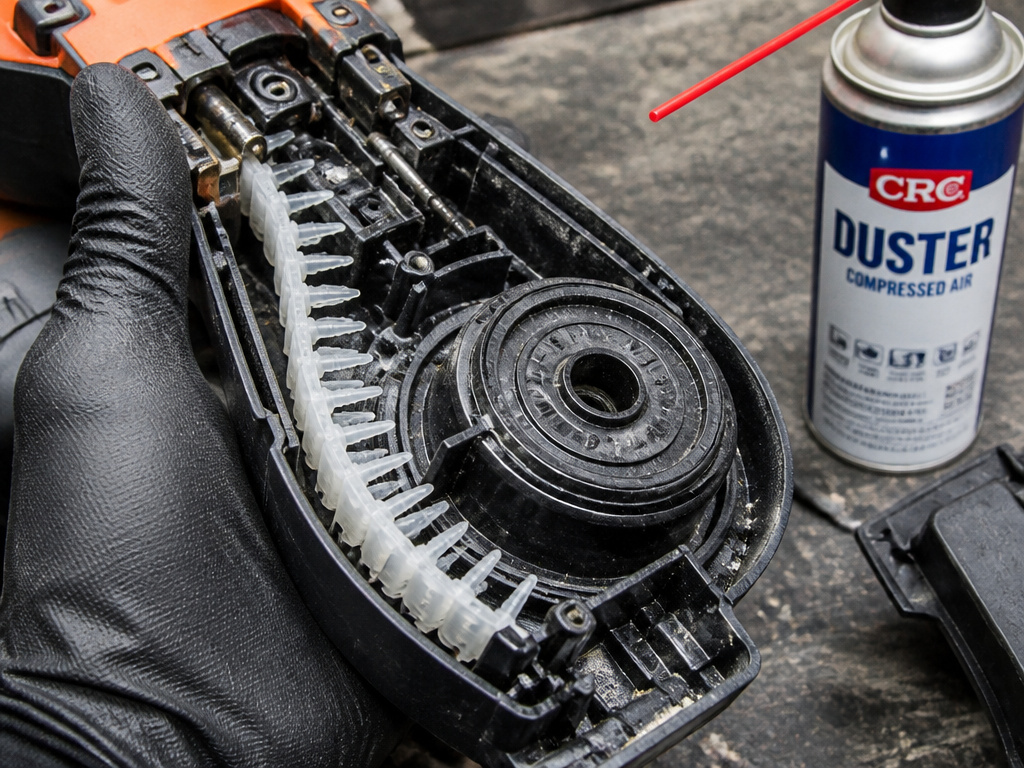
Where this goes sideways: Not cleaning a plastic-collated nailer. The plastic can shatter on impact, leaving tiny fragments inside the magazine. After a few thousand nails, that debris builds up and causes consistent feeding problems. A five-minute clean-out with compressed air fixes it.
The productivity boost from paper that Patrick Talano cites might come from capacity, not just reliability. Rob notes that paper strips “hold about 10 more nails per strip.” Less downtime walking back to the nail box adds up over a day.
Nail Finish and Coating: The Real Decider for Longevity
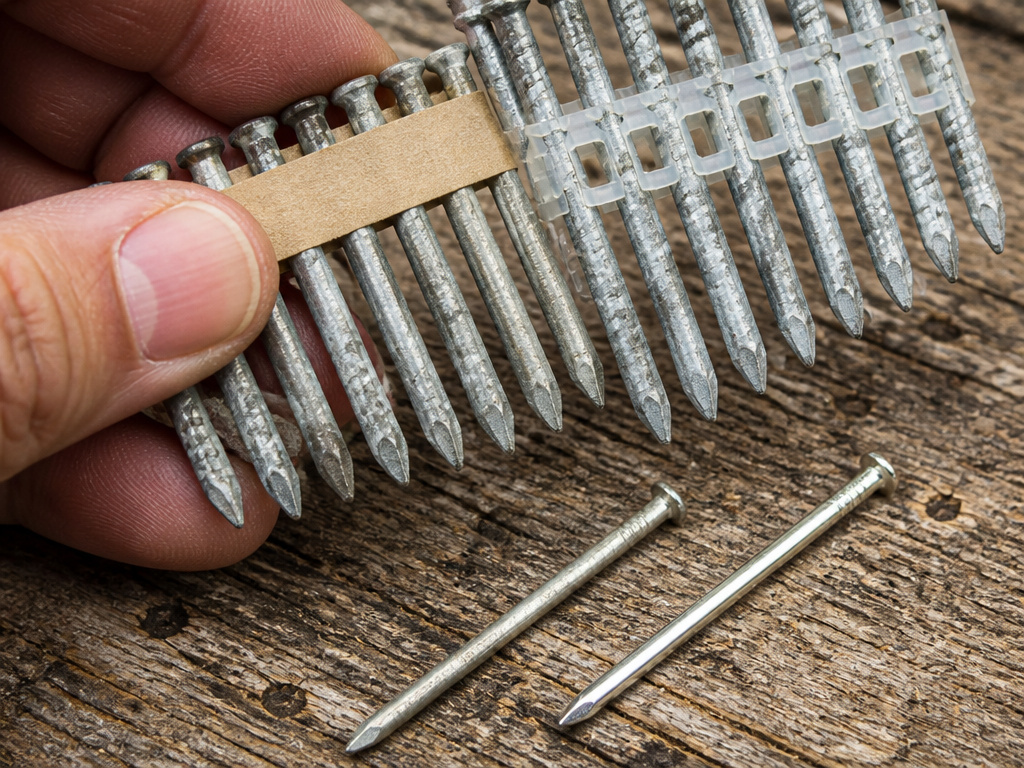
The collation debate is front-end. The nail’s finish decides whether your project stands for decades or starts to fail in a couple of years. This choice is independent of paper vs. Plastic, you can get any finish on either strip type.
For framing nails, the finish is your armor against corrosion. Get this wrong, and you’ll see rust streaks bleeding through your paint or siding within a year.
- Bright (Uncoated): For interior, non-structural work only. It will rust fast if it gets wet.
- Electro-Galvanized (EG): Has a thin zinc coating. Do not use with modern treated lumber like ACQ, it will corrode and fail.
- Hot-Dip Galvanized (HDG): The thick, durable zinc coating is the industry standard for treated lumber and exterior work. This is your default for outdoor framing.
- Stainless Steel (SS): The ultimate corrosion resistance for coastal areas or projects with cedar or redwood.
The rule is non-negotiable: Always use Hot-Dip Galvanized (HDG) or Stainless Steel with treated wood. An electro-galvanized nail might look similar in the box, but it lacks the protective mass to handle the corrosive chemicals in modern pressure-treated lumber. The difference shows up as catastrophic failure in under two years.
Framing Nailer Compatibility and Modern Tools
The conversation used to be purely about pneumatic nailers. Today, the rise of cordless framing nailers adds another layer. Brands like Milwaukee, DEWALT, and Makita make powerful cordless guns, but they are often designed for a specific collation system.
If you’re considering switching to a cordless platform, your existing stock of nails might not make the jump with you. A cordless Milwaukee nailer might be optimized for a particular plastic collation, locking you into that ecosystem. Before you buy, check the compatible fasteners list just as you would for a pneumatic tool.
This also touches on the coil vs stick nailers debate. Coil nailers hold a huge number of nails but are a different tool category altogether. For high-volume sheathing, a coil nailer is the productivity king, but it doesn’t use paper or plastic strips, it uses a wound coil of nails.
How to choose based on local nail availability
Your choice may come down to what you can actually find on the shelf. Nailers are built for a specific nail angle and collation. A 30-degree paper nailer cannot use 21-degree plastic strips, and vice-versa. Before committing to a system, check what your local suppliers consistently stock. Some regions or stores may heavily favor one type over the other. Running out of nails for a critical job because your chosen type is back-ordered is a major frustration. Your project timeline often depends on this simple factor of supply.
Is plastic or paper collation cheaper to buy
However, the overall cost picture involves more than just the nail strip. Buying bulk nails by the pound is always cheaper than buying collated strips, but that requires a different type of nailer. When comparing collated options, plastic often has the lower price. Remember to factor in the cost of your nailer itself, as models designed for different collation are priced separately. The cheaper nail type won’t save money if it requires you to buy a new tool.
Do paper or plastic collated nails hold better
Holding power is influenced by the nail’s finish and head style, not just the collation. Plastic-collated nails often feature a full round head, which provides maximum holding power and is often required by building codes. The key is to select the correct nail coating for your material: use only hot-dip galvanized or stainless steel nails with treated lumber. A clean, properly coated nail with the right head will hold best.
Frequently Asked Questions
Which is better, plastic or paper collated nails?
Neither is universally better. Plastic collated nails (typically 21-degree) are common, often have full-round heads for code compliance, and handle moisture well. Paper collated nails (typically 30-34 degree) often hold more nails per strip, leave no plastic debris, and are preferred for finish work. Your nailer’s specified angle determines which one you must use.
Can you use paper collated nails in a plastic collated framing nailer?
Generally, no. Unless your nailer’s manual explicitly states it is compatible with both collation types, you should only use the strip material it was designed for. The different thickness and flexibility of paper vs. Plastic will cause feeding issues and jams.
What do plastic collated nails mean?
Plastic collated nails are framing nails held together in a straight strip by a thin plastic web. The strip is usually angled at 20-21 degrees to fit the magazine of a specific nail gun. The plastic shatters away from the nail when it is fired.
What type of nails are best for framing walls?
For framing walls, you need nails that meet local building codes, which often mandate full-round head nails for structural connections. Hot-Dip Galvanized (HDG) coating is also recommended for longevity, especially if the lumber is treated. This often leads to choosing 21-degree plastic-collated, HDG, full-round head nails, but always verify the specific nail head types and nail materials required for your project.
Before You Go
Your nailer’s manual is the final authority. Find the page that lists compatible fasteners, it will give you the exact angle, nail length range, shank diameter, and head type. That list is your shopping list.
If you’re buying a new nailer, consider what’s available at your local supplier. A fantastic gun is useless if you can’t find the strips it needs on a Saturday afternoon. For most general framing, a 21-degree plastic-collated nailer paired with Hot-Dip Galvanized, full-round head nails is a safe, widely supported choice. For trim, cabinets, or any finished work where debris matters, a 30-degree paper nailer is worth the hunt.
And whatever you choose, wear your safety glasses. That plastic collation shatters like a tiny grenade.
