
Penny Nail Sizes Explained: Official Specs and Modern Use
This post contains affiliate links. As an Amazon Associate, we earn from qualifying purchases.
The penny (d) system for nail sizing is officially obsolete for engineering construction, per the USDA Forest Service and the National Design Specification. For a 6d nail, that means a length of 2 inches, but the diameter can be 0.113 inches for a common nail, 0.099 inches for a box nail, or 0.120 inches for a threaded nail, the penny number alone doesn’t tell you which. Modern standards require specifying nails by length and diameter in inches or millimeters.
That gap between the penny chart and the spec sheet is where projects go sideways. A box nail and a common nail share the same “8d” label, but the box nail’s smaller diameter splits fine trim while the common nail’s thicker shank holds framing. For a clear guide, see penny nail sizes explained. Mix them up based on the penny size alone, and you’re fixing splits or rebuilding a wobbly corner.
What follows: the official tables from the USDA and ASTM, the one mistake every DIYer makes with sinker nails, and how to read a modern nail box so you never grab the wrong diameter again.
Key Takeaways
- The USDA Forest Service states penny sizes are obsolete and recommends specifying by length and diameter, while Senco notes the system is still commonly used but professionals are increasingly referring to length to avoid confusion. The National Design Specification introduced this requirement for engineered construction in its 1986 edition.
- An 8d common nail is 2.5 inches long and 0.131 inches in diameter, but an 8d box nail is the same length with a 0.113-inch diameter, using the wrong type splits wood or loses holding power.
- Cement-coated nails like sinkers are 1/8 inch shorter and have a smaller diameter than common nails of the same penny size. Using a chart that doesn’t account for this leaves your nails proud of the surface.
- For collated nails used in nail guns, many brands omit the penny size entirely and list only length and gauge. Relying on “d” for nail gun nails is a fast way to jam your tool.
- The ASTM F1667 standard allows a tolerance of ±3/32 inch on length for nails over 2-1/2 inches and ±0.004 inches on diameter for diameters 0.076 inches and larger, so two “identical” 16d nails from different batches can differ.
The USDA Forest Service’s Official Penny Chart
The chart you find online is a simplification. The one that matters is Table 8–1 from the USDA Forest Service’s General Technical Report. It lists the exact dimensions for bright common wire nails, the baseline from which all other nail types deviate.
Bright common wire nail, 6d: 50.8 mm (2 in.) length, 2.87 mm (0.113 in.) diameter. Bright common wire nail, 8d: 63.5 mm (2-1/2 in.) length, 3.33 mm (0.131 in.) diameter. Bright common wire nail, 10d: 76.2 mm (3 in.) length, 3.76 mm (0.148 in.) diameter. Bright common wire nail, 16d: 88.9 mm (3-1/2 in.) length, 4.11 mm (0.162 in.) diameter.
This is the non-commodity core of the penny system. Those four sizes, 6d, 8d, 10d, 16d, are among the most commonly used in construction. The report also includes a line most guides skip: “International nail producers sometimes do not adhere to the dimensions of Table 8–1.” A 16d nail from an overseas manufacturer might not match the USDA’s 3.5-inch length and 0.162-inch diameter. The penny label isn’t a guarantee.
Which is why the report’s next sentence is the load-bearing wall: “Thus penny sizes, although still widely used, are obsolete. Specifying nail sizes by length and diameter dimensions is recommended.” The authority that publishes the definitive table also tells you to stop using the system the table defines. That’s the tension every modern carpenter works inside.
Why Diameter Matters More Than Penny Size
Penny size loosely tracks length. Diameter decides whether the nail holds or splits the wood. Get this wrong and your project fails at the cellular level.
A common nail is the default. Its diameter is sized to maximize holding power in standard framing lumber without causing splits. A box nail is designed for thinner material and hardwood. Its shank is smaller. The National Design Specification notes that box nails have a smaller shank diameter than common nails of equivalent pennyweight. For a 10d nail, that’s a drop from 0.148 inches to 0.128 inches.
Drive a 10d common nail into oak trim, and you’ll hear a sharp crack before the head is flush. The wood fibers can’t displace around the thicker shank. Switch to a 10d box nail, and it sinks in with a solid thud and no split. The penny size was the same. The outcome wasn’t.
The same logic applies to sinker nails and threaded nails. The USDA report notes that cement-coated nails such as coolers, sinkers, and coated box nails are slightly shorter (3.2 mm (1/8 in.)) and of smaller diameter than common nails of the same penny size. An 8d sinker isn’t 2.5 inches long; it’s 2.375 inches. If your plan calls for a 2.5-inch nail and you grab an 8d sinker from the bucket, it will be short.
| Nail Type (8d) | Length (inches) | Diameter (inches) | When It’s the Right Choice |
|---|---|---|---|
| Common | 2.500 | 0.131 | General framing, attaching studs to plates. |
| Box | 2.500 | 0.113 | Hardwood trim, cabinet face frames, thinner stock. |
| Sinker | 2.375 | 0.113 | Framing with a nail gun where slightly shorter length prevents blow-through. |
| Threaded (Helical/Annular) | 2.500 | 0.120 | Decking, subfloor, siding—where withdrawal resistance is critical. |
The table isn’t academic. It’s the difference between a tight joint and a call back.
The “Denarius” Origin Story (And Why It’s a Red Herring)
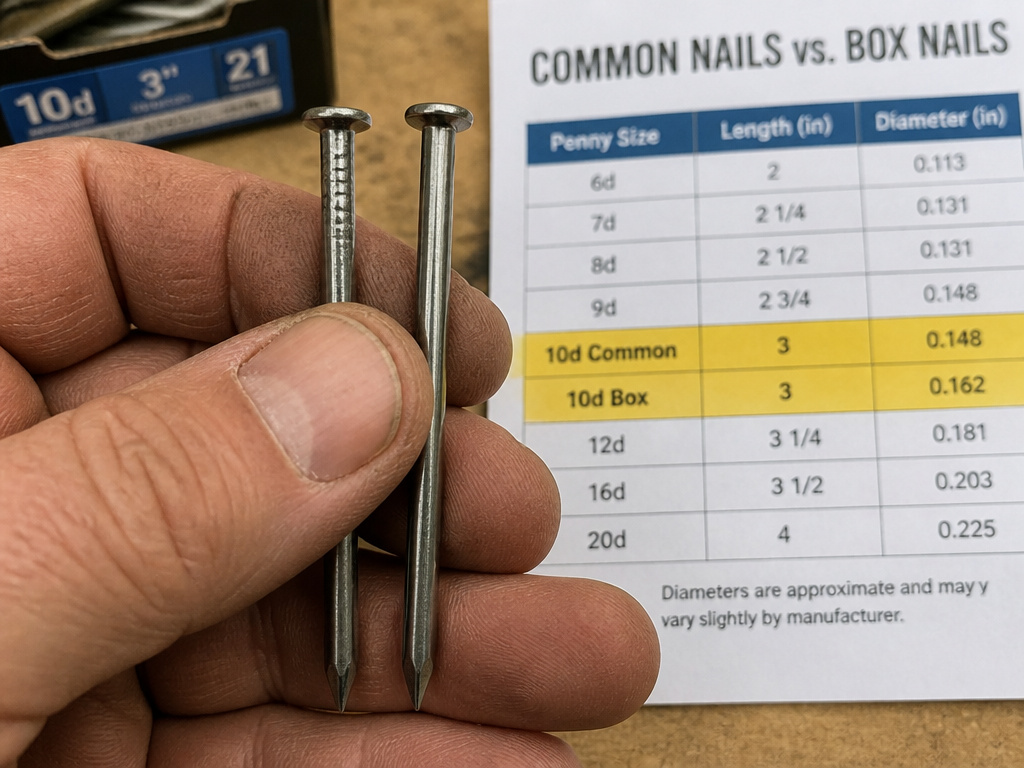
Most articles spend three paragraphs on 15th-century England. Here’s the short version: the “d” stands for denarius, a Roman penny. In medieval England, nails were sold by the hundred (or 120), and the price in pennies became the size label. A hundred 2-inch nails cost 6 pence, so they were 6-penny nails, or 6d.
That history is interesting. It’s also irrelevant to buying nails today. Senco, a major nail manufacturer, notes that while penny size is still commonly used, it is growing more common for pros to simply refer to the length of the nail to avoid confusion. The historical system doesn’t help you understand why a 10d common nail has a 0.148-inch diameter while a 10d box nail is 0.128 inches.
The origin story becomes a red herring when you compare a penny nail sizes explained guide that’s the only explanation offered. It tells you where the name came from, not how to choose a nail. The real question isn’t “What does ‘d’ mean?” It’s “What are the ASTM F1667 tolerances for this 16d common nail I’m holding, and does its diameter match the 0.162 inches on the Simpson Strong-Tie spec sheet?”
Focus on the spec, not the etymology.
Reading a Modern Nail Box
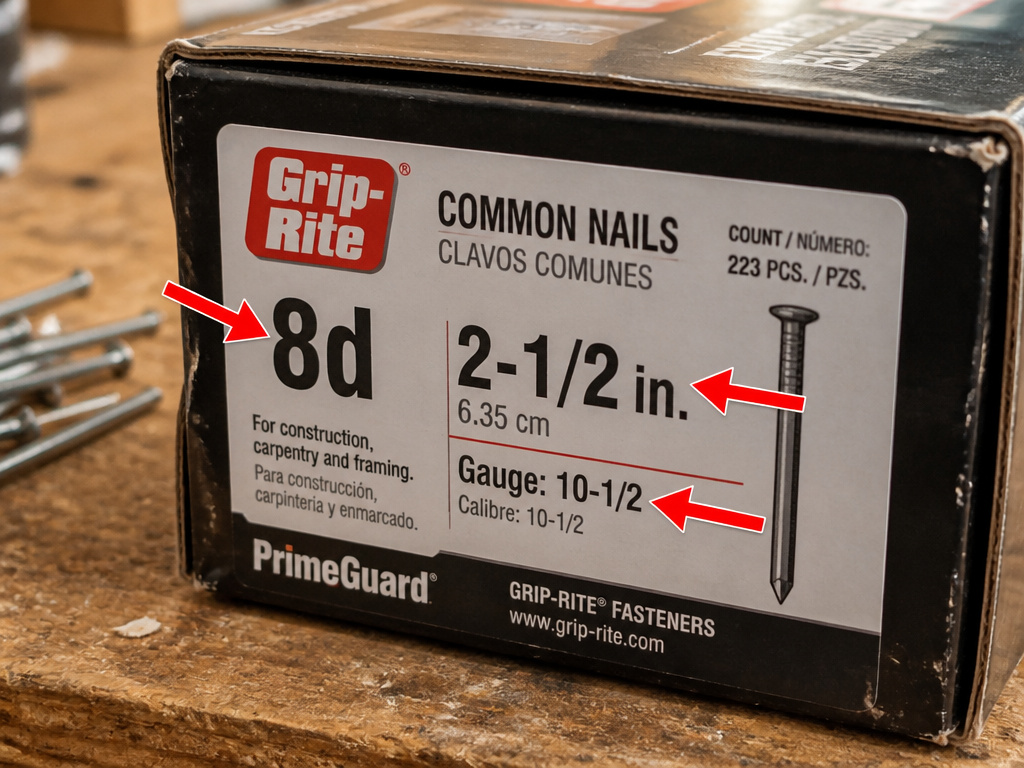
Forget the penny chart for a second. Look at a box of Grip-Rite or Maze nails. The label is a masterclass in mixed messaging.
You’ll see “8d” in big letters. Right next to it, often in bigger letters: “2-1/2 in.” Below that, you might see “Gauge: 10-1/2” or “Diameter: .131 in.” Some boxes for collated nails, the strips for nail guns, drop the “d” entirely. They just say “2-1/2″ Framing Nails” and list the gauge.
This is the transition the USDA recommends, happening in real time on store shelves. The penny size is a legacy cue for older carpenters. The length and diameter are the actionable information.
Where this goes sideways: Buying sinker nails for a project that specifies common nail length. The box says “8d Sinker.” The length says “2-3/8 in.” If you need the full 2.5-inch penetration of an 8d common, you’ll come up short by 1/8 inch. The joint loses strength.
Here’s how to decode a box in three seconds:
- Find the length in inches. That’s the essential number.
- Find the diameter or gauge. Diameter in inches is best. Gauge is a reverse scale (lower gauge = thicker nail). A 10d common is 9-gauge, 0.148″.
- Ignore the penny size unless it’s the only thing the plans call for. If the plans say “16d common,” you’re looking for a nail that is 3.5 inches long and 0.162 inches in diameter. The “16d” on the box is just a confirmation.
{{IMG: Close-up photo of a modern nail box label with arrows pointing to length (2-1/2 in.), penny size (8d), and gauge (10-1/4)}
Nail Tolerances: Why Two “Identical” Nails Aren’t
Even when you specify length and diameter, there’s a built-in margin of error. The ASTM F1667 fastener specification defines the allowable tolerances for manufactured nails.
For shank diameter:
- ±0.002 inches for diameters smaller than 0.076 inches.
- ±0.004 inches for diameters 0.076 inches and larger.
This means a 16d common nail (nominally 3.5 inches long, 0.162 inches in diameter) could legally be as short as 3.4375 inches or as long as 3.5625 inches. Its diameter could range from 0.158 to 0.166 inches. That’s a meaningful variation.
In practice, many quality manufacturers hold tolerances tighter than the ASTM minimums. But if you’re buying budget nails and wondering why some sink deeper than others in the same row, the ASTM standard explains it. They’re all “16d common,” but they live within a tolerance band.
Penny Sizes for Nail Guns and Collated Nails
The penny system breaks down completely here. As Senco points out, some nail packaging – particularly collated nails – no longer includes penny size at all.
Nail gun manuals typically specify nails by length and diameter, not by penny size. The magazine is designed for a specific nail length and shank thickness. A “2-1/2 inch framing nail” might be the equivalent of an 8d common, but it could also be a sinker style at 2.375 inches. Trying to force a 2.5-inch common nail into a magazine designed for 2.375-inch sinkers is a direct path to a jam.
For finish nailers, gauge and length are the dominant metrics, not penny size. The “d” designation has vanished. This is the pure length-and-diameter system in action, and it eliminates the confusion the penny system introduces.
| Application | Typical Penny Equivalent | What You’ll Actually See on the Box |
|---|---|---|
| Framing Nailer | 8d, 10d, 16d | “2-1/2″ Framing Nails”, “3-1/2″ Framing Nails” |
| Finish Nailer | 6d, 8d | “16-Gauge 2″ Finish Nails”, “16-Gauge 2-1/2″ Finish Nails” |
| Brad Nailer | 3d, 4d | “18-Gauge 1-1/4″ Brads” |
If you manage a mixed fleet of nail guns, our guide on nail gun types and uses covers which gun drives which nail.
Common Mistakes and How to Avoid Them
The penny system’s ambiguity, even with penny nail sizes explained, creates predictable errors. You’ve probably made one.
Mixing nail types in the same magazine. This is my own blind spot. I once loaded a strip of galvanized 8d sinkers into a magazine that still had a few bright common 8d nails at the back. The diameter difference was enough to cause a jam. The gun jammed solid on the third trigger pull. The drive piston couldn’t handle the minute change in shank thickness. Now I empty the magazine completely before switching nail types.
Using common nails where box nails are needed. The plans for a built-in bookshelf called for “8d nails.” I used 8d common nails in the hardwood face frame. Three splits later, I switched to 8d box nails. The project finished clean. The penny size was right. The nail type was wrong.
Ignoring coating for exterior work. The penny size says nothing about material. Using bright common nails (uncoated steel) on a fence or deck will produce rust streaks within a season. The correct nail for exterior framing is a hot-dipped galvanized or stainless-steel nail of the required length and diameter. The “d” is the least important part of the description.
For structural work, the right length is critical. Our article on nails for framing details the length and diameter requirements for wall framing, which often means a 3.5-inch nail, not just a “16d.”
Penny Size to Length Conversion Chart
Standard charts for penny sizes reference the dimensions for bright common wire nails. For the most common sizes, a 6d nail is 2 inches long, an 8d is 2.5 inches, a 10d is 3 inches, and a 16d is 3.5 inches. These lengths are the baseline, but they are not universal. Other nail types, like cement-coated sinkers or threaded nails, are often shorter and have a smaller diameter than a common nail of the same penny size. Also, international producers sometimes do not follow these traditional dimensions. For critical work, always verify the actual length and diameter printed on the nail packaging, as the penny size alone is not a precise specification.
Frequently Asked Questions
What are the different sizes of penny nails?
The most common penny sizes are 6d (2 inches),, 8d (2.5 inches),, 10d (3 inches),, and 16d (3.5 inches). Sizes go up to 60d (6 inches). The USDA Forest Service provides a full table of exact lengths and diameters for common, box, and threaded nails.
What is bigger, 8 or 16 penny nails?
16d nail is bigger. A 16d common nail is 3.5 inches long and 0.162 inches in diameter. An 8d common nail is 2.5 inches long and 0.131 inches in diameter. The higher the penny number, the longer and generally thicker the nail.
Are 16d and 16 penny nails the same?
Yes. The “d” is the abbreviation for “penny,” from the old Roman coin denarius. “16d” and “16 penny” refer to the same nail size, a common nail that is 3.5 inches long.
How big is a 20 penny nail?
20d bright common wire nail is 101.6 mm (4 inches) long and has a diameter of 4.88 mm (0.192 inches), according to the USDA Forest Service table. Cement-coated 20d nails, like sinkers, are typically 1/8 inch shorter.
Should I use penny size or length?
Use length and diameter. The USDA Forest Service, ASTM, and the National Design Specification all recommend specifying nails by length and diameter dimensions because the penny system is obsolete and imprecise. Modern nail packaging emphasizes length in inches.
The Bottom Line
Stop memorizing the penny chart. Start reading the nail box.
The USDA’s table is the definitive reference, but its own authors tell you to move on. The future is on the label: “2-1/2 in. .131 in. Dia.” That’s all you need. The “8d” is a courtesy to tradition, like the “PRESS PLAY” icon on a streaming service.
When your project plans call for a penny size, translate it immediately. “16d common” becomes “3.5-inch nail, 0.162-inch diameter.” That translation step is what prevents splits, jams, and weak joints. It’s the difference between working with a historical shorthand and working with a physical object that has exact dimensions.
For your next trip to the hardware store, ignore the big “8d” on the box. Find the length. Check the diameter or gauge. That’s how you buy the right nail. The rest is history.
