
Cordless Power Tools Pros and Cons: How to Choose
This post contains affiliate links. As an Amazon Associate, we earn from qualifying purchases.
Cordless power tools trade unlimited runtime for total freedom from the wall. You gain unmatched portability and speed in exchange for managing battery life, dealing with performance limits under heavy load, and accepting a higher initial cost with a maintenance schedule tied to cell chemistry.
That freedom has a real cost, and it’s not just the price tag. It’s a whole system of power management you now own. Considering cordless power tools pros and cons, the real question is whether that system fits the work you do.
What follows is a breakdown of the core tradeoffs in the cordless power tools pros and cons, mobility vs power, upfront cost vs long-term investment, and the quiet maintenance rules that keep a cordless system running for years. We’ll ground everything in the specific specs that manufacturers print in their manuals, because the marketing hype around cordless tools often blurs the physical limits of battery tech.
Key Takeaways
- Cordless tools win on mobility and setup speed, but even high-voltage models can’t match the sustained raw power of a corded tool under constant, heavy load.
- The true cost isn’t the tool; it’s the battery platform. A single battery and charger often costs as much as a basic corded tool, locking you into an ecosystem.
- Battery care is essential. Store them between -4°F and +122°F, charge them between 32°F and 95°F, and never leave them in a hot car.
- For a workshop anchor tool you’ll use for hours, corded is often the smarter, simpler buy. For everything else, cordless.
- Brushless motors extend runtime and tool life in cordless tools, but they’re a premium upgrade.
The Corded vs Cordless Power & Performance Gap
To be direct. A cordless tool will never pull as much continuous power from the air as a corded tool pulls from a wall outlet. Physics wins every time. This isn’t about a spec sheet’s “peak power” number. It’s about what happens when you lean into a cut or drive a lag bolt into dense timber for the tenth time in a row.
The voltage rating tells only part of the story. A Bosch GOP18V-40 oscillating tool has a no-load speed range of 10,000–20,000/min. A corded equivalent can sustain its top speed and torque indefinitely, where the cordless tool’s performance curve will dip as the battery discharges, a drop you feel as reduced cutting speed or stall risk.
The gap shows up in the numbers. An 18V cordless shear, like the Bosch GSC18V-16E, is rated for cutting 16-gauge steel sheet. A corded shear in the same class might handle 14-gauge or thicker. It’s not that the cordless tool is bad, it’s perfectly capable for its intended use. But its ceiling is lower because the battery can only deliver so many amps before it needs a break.
You feel this most in high-demand applications: a cordless circular saw bogging down in wet lumber, a cordless angle grinder slowing as you work through a weld, a cordless drill hammer struggling with core drilling in concrete. The tool works. It just asks for patience.
The flip side is equally real. For 90% of tasks around a house, hanging shelves, assembling furniture, trimming deck boards, installing flooring, a modern cordless tool has more than enough power. And it does it without you tripping over an extension cord or searching for an outlet.
Brushless vs Brushed in a Cordless World
This internal motor choice matters more for cordless tools than corded ones. A brushless motor is more efficient, so it draws less battery for the same work. It also generates less heat and has no physical brushes to wear out.
Does that mean you must buy brushless? No.
A high-quality brushed motor in a tool from a brand like Makita or DeWalt will last for years of DIY use. The runtime difference might mean swapping a battery 20 minutes sooner on a big job. For a professional using the tool all day, the efficiency gains of a brushless motor can be significant. For a weekend warrior, they rarely justify the price jump. If your budget is tight, a solid brushed tool from a brand like Makita or DeWalt is a smarter buy than a cheap, no-name brushless model.
Mobility & Convenience: The Undisputed Win
This is the reason cordless tools dominate the market. The ability to grab a drill and walk to the far corner of your yard, climb a ladder, or work in a finished room without dragging a cord changes how you work. It changes how you approach projects.
A setup that used to take ten minutes, unraveling an extension cord, finding a grounded outlet, ensuring the cord path is safe, now takes ten seconds. That reduction in friction means you’re more likely to tackle the small, annoying jobs you’d otherwise put off.
The safety benefit is tangible, too. No cord means no tripping hazard. No cord means you’re not accidentally cutting through your own power source with a saw. It’s a cleaner, simpler work environment.
Where this goes sideways: Assuming all cordless tools are equally portable. A 12V drill is a dream for overhead work. An 18V hammer drill with a 5.0Ah battery is a wrist-weight after twenty minutes. The 12V vs 18V decision is a balance of power and portability. Match the tool voltage and battery size to the job’s physical demands.
Cordless Battery Longevity & Maintenance Rules
The battery isn’t an accessory. It’s the fuel tank, engine, and exhaust system rolled into one. Treat it like a consumable, because it is. Every manual spells out the rules, but most people skip reading them. Here’s what the manufacturers actually say.
First, temperature is everything. Bosch states its general lithium-ion batteries should only be operated and stored between -4°F and +122°F. You should only charge them between 32°F and 95°F, though some tools like the Bosch IXO recommend a narrower range starting at 41°F. Leave a battery in a car on a summer day, and you’ve likely cooked it. Performance drops below freezing, too, the Bosch IXO manual specifically notes limited power under 32°F.
| Battery Care Rule | Typical Spec Range | Risk If Ignored |
|---|---|---|
| Operating/Storage Temp | -4°F to +122°F (-20°C to +50°C) | Permanent capacity loss, internal damage, fire risk in extreme cases. |
| Charging Temp | 32°F to 95°F (0°C to +35°C) | Slow/incomplete charge, cell damage, reduced cycle life. |
| Charging Source | NRTL-certified adapter (e.g., UL) | Electric shock, fire, tool/battery damage. |
Second, use an NRTL-certified 5V power adapter and USB cable. That cheap USB brick from a gas station is a gamble. The Bosch IXO requires an NRTL-certified 5V power adapter and USB cable. Using anything else voids warranties and risks fire or shock.
Third, understand the lifespan. A “substantial drop in operating time per charge,” as Bosch puts it, means the battery is dying. It’s not a defect; it’s chemistry. Plan to replace batteries when you notice a substantial drop in operating time per charge. This is the single biggest long-term cost of owning cordless tools, and it’s why thinking about battery adapters or third-party options becomes tempting later on.
Common mistake: Leaving batteries plugged into the tool in storage. This can lead to a slow, deep discharge that permanently damages cells. Store batteries at a 40-60% charge in a cool, dry place, separate from the tools.
Cost Analysis: Initial Outlay vs Long-Term Investment
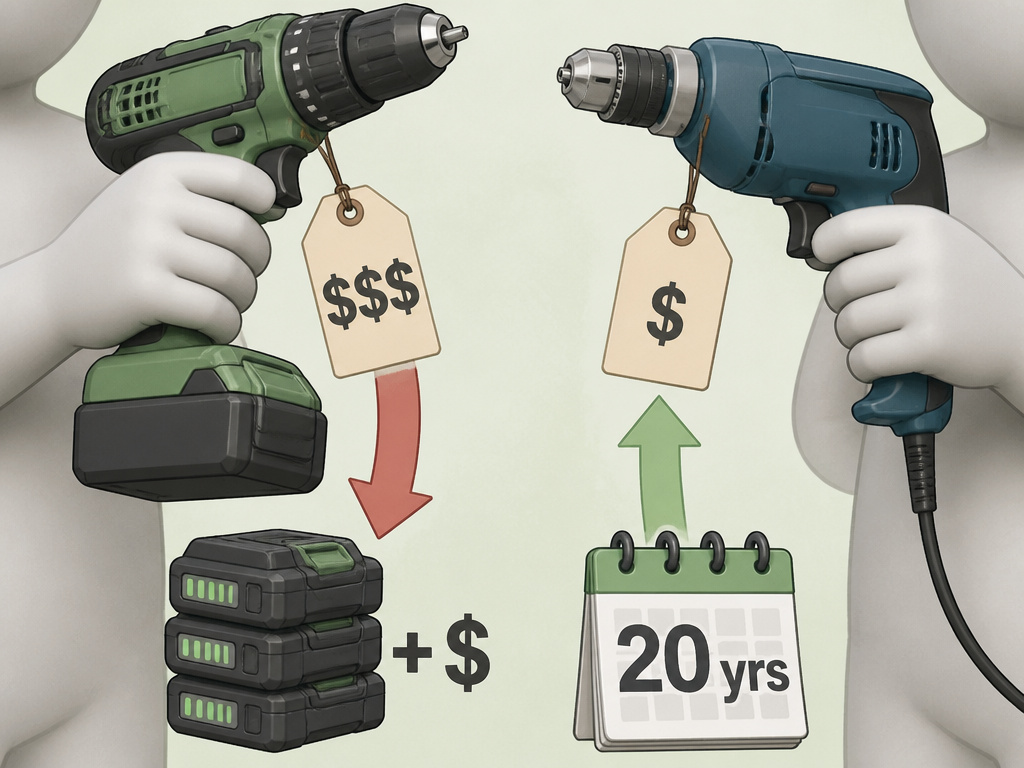
A cordless drill kit costs more than a corded drill. Everyone knows that. The real math is in what happens next.
For example, you buy a mid-range 18V cordless drill kit with two batteries and a charger. A comparable corded drill is typically less expensive. The cordless system starts $120 in the hole.
But that’s not the full picture. You’ve also bought into a cordless tool platform. Your next tool can be a “bare tool” that uses the same batteries.
The long-term cost curve is where opinions split. The corded tool, barring motor failure, could last 20 years with basic maintenance. The cordless tool’s lifespan is yoked to its battery, a consumable you’ll replace every few years. Over a decade, you will likely need to purchase replacement batteries, which adds to the long-term cost. That closes the initial cost gap.
The cordless power tools pros and cons equation changes completely for professionals. Time saved by not managing cords translates directly to money earned. The higher upfront cost of a robust cordless tool platform is an investment in efficiency.
For the DIYer, the choice is about convenience tax versus simplicity. Are you willing to pay more upfront and deal with battery care for the freedom cordless offers? Or do you prefer the one-and-done simplicity and lower lifetime cost of corded tools? There’s no universal answer, only the right one for your garage and your projects.
When a Bare Tool Beats a Kit
Manufacturers push combo kits because they lock you into their battery system. Often, it isn’t.
Kits bundle a high-demand tool (a drill) with a low-demand tool (a flashlight) and mid-size batteries. You end up with batteries that are wrong for both: too heavy for the drill, too weak for a saw. Buying a bare tool and choosing your own battery size is almost always smarter. Want a lightweight drill for cabinet work? Pair it with a compact 2.0Ah battery. Need a grinder for cutting rebar? That demands a high-output battery with a 5.0Ah or larger capacity.
Choosing Based on Task: DIY vs Pro, Stationary vs Mobile
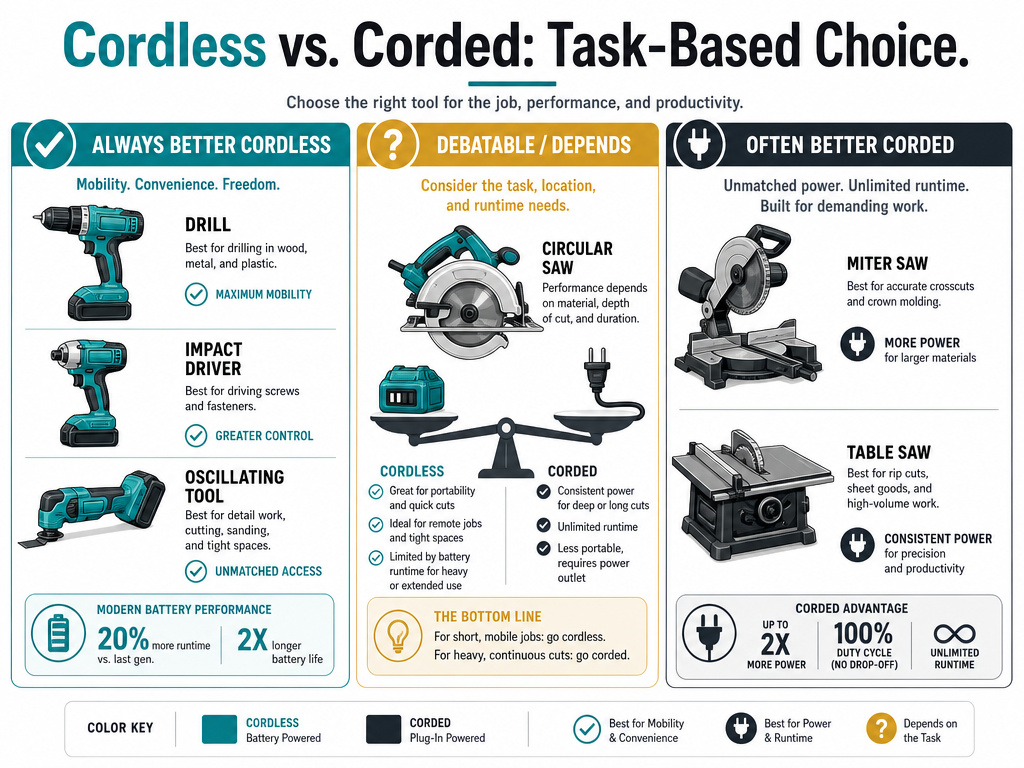
Your project list dictates your tool needs. Break it down by tool type.
Always Better Cordless:
- Drills/Drivers: The quintessential cordless tool. The convenience is unbeatable.
- Impact Drivers: Their quick burst of torque is perfect for driving long screws, and they’re almost exclusively a cordless category now.
- Oscillating Multi-Tools: Used in tight spaces where a cord is a constant nuisance.
- Jobsite Lights: Obvious win.
- Small Sanders (Detail): Maneuverability is key.
Debatable / Depends on Use:
- Circular Saws: For a few cuts on a deck, cordless is fantastic. For ripping sheets of plywood all day, a corded saw’s sustained power is better. The debate between a cordless circular saw and a corded one hinges entirely on the scale of your work.
- Reciprocating Saws: Great for pruning or quick demo. For tearing out a whole wall, corded still reigns.
- Angle Grinders: Cordless is fine for cutting a few bolts or light polishing. For extended metalwork or masonry, you need a cord.
Often Better Corded:
- Miter Saws: They’re stationary workshop anchors. Why pay for batteries you’ll never use?
- Table Saws & Band Saws: Same logic. They live in one place.
- Air Compressors: While not a direct comparison, they highlight the “stationary powerhouse” category.
- High-Demand Grinders & Sanders: Floor sanders, large-angle grinders, and belt sanders suck power. Corded is the reliable choice.
This isn’t a strict rulebook. It’s a framework. If you only build one bookshelf a year, a cordless circular saw is a luxury that might be worth it for the sheer ease. If you’re framing a shed, rent a corded saw for the weekend and save your battery for the drill.
Safety, Warranty & Platform Lock-In
Cordless and corded tools share core safety rules: wear ANSI Z87.1 safety goggles, avoid loose clothing, keep bystanders clear. Cordless tools remove the cord tripping hazard but add a new one: the battery.
- Thermal Runaway: A damaged or improperly charged lithium-ion battery can overheat and catch fire. This is why charging temperature and certified chargers matter.
- Swappable Parts: NEVER use a battery pack to power cordless tools from other manufacturers. The IKEA TRIXIG manual shouts this. Voltages might match, but the communication pins and discharge curves won’t, risking tool or battery damage.
- Disposal: You can’t toss these in the trash. Bosch, and all responsible brands, mandate that lithium-ion batteries “must be collected, recycled, or disposed of in an environmentally sound manner.”
Warranties highlight another difference. Tools and batteries are often covered separately. Bosch warranties its portable and benchtop power tools for one year from purchase, while Senco warrants its cordless tools for two years. Senco warrants its cordless tools for two years, but the batteries and chargers only for one. The battery, the most failure-prone part, has the shortest coverage.
Platform lock-in is the hidden cost. Choosing DeWalt over Makita isn’t just about a drill. It’s about committing to their battery shape, voltage, and charger for the next decade. Before you buy your first kit, look at each brand’s full lineup. Do they have the other tools you’ll eventually need? Is their battery compatibility logical across voltages? Your first tool purchase is a long-term relationship.
Are cordless tools safer from trip hazards?
Removing the cord eliminates a major job-site trip hazard. You don’t have to manage a cable running across a walkway or draped over a ladder, which significantly reduces the risk of a sudden yank or a fall. However, cordless tools introduce different safety considerations. You must use the manufacturer-approved charger and cable, as using non-certified charging accessories may cause shock or fire. Batteries also have specific temperature limits for charging and storage, and they must be collected, recycled, or disposed of properly, not thrown in household waste. Both types require the same core personal protective equipment, like wearing ANSI Z87.1 safety goggles.
Frequently Asked Questions
Are cordless power tools better than corded power tools?
“Better” is the wrong word. They’re different. Cordless tools are better at providing freedom of movement and quick setup. Corded tools are better at delivering sustained, maximum power indefinitely. For most all-day, high-demand workshop tasks, corded is still king. For virtually everything else, modern cordless tools are not just adequate, they’re preferred.
What is considered the best cordless tool brand?
There is no single “best.” It depends on your needs. Milwaukee is renowned for sheer power and durability, appealing to tradespeople. Makita is praised for ergonomics and a vast 18V platform. DeWalt strikes a balance with wide availability and a strong reputation. For a deep dive, our comparison of cordless vs corded tools explores these ecosystems in detail.
Is it bad to leave batteries in power tools?
Yes, for long-term storage. It can lead to a slow parasitic drain that deep discharges the battery, damaging its cells. When you’re done for the day, pull the battery out and store it separately in a cool, dry place. The manual for every major brand advises this.
How long do cordless power tool batteries last?
For service life, expect to replace the battery when a substantial drop in operating time per charge occurs. Runtime per charge varies wildly. A 2.0Ah battery will provide less runtime than a higher-capacity battery, with the exact duration depending on the tool and task. Understanding battery power and runtime is key to planning your work.
Is it worth paying extra for brushless motors?
For a professional who uses tools daily, absolutely. The increased efficiency and longevity justify the cost. For a DIYer, it’s a nice-to-have upgrade, not a necessity. A well-made brushed motor from a reputable brand will last for years of typical home use. The money might be better spent on a higher-capacity battery or a better-quality bare tool.
The Bottom Line
The fact is. Cordless tools have won the convenience war. For most people, most of the time, they are the right choice. The freedom they provide changes how you work, almost always for the better.
But they come with a system, a system of batteries, chargers, temperature management, and eventual replacement costs. That system is the real purchase.
Before you buy, audit your projects. If your work is mostly mobile, finish-based, or involves lots of small tasks, go cordless. Start with a drill/driver kit from a major brand, then expand consciously with bare tools. If your work is stationary, power-intensive, or happens in a dedicated shop, lean on corded tools for your anchors. You can always add a cordless drill for convenience.
One final, essential rule: respect the battery. Its care and feeding are now part of your job. Do that, and a modern cordless system will be a reliable partner for years. Forget it, and you’ll be buying replacements sooner than you planned.
