
Power Tool Electrical SAFETY Guide
This post contains affiliate links. As an Amazon Associate, we earn from qualifying purchases.
Follow the manufacturer’s electrical safety rules to prevent shock and fire. Power tool plugs must match the outlet, never modify the plug or use adapters with grounded tools. Avoid wet conditions, and if damp work is unavoidable, use a GFCI or RCD-protected supply. Always disconnect the plug before any adjustment or accessory change. For outdoor use or long runs, select an extension cord with the correct wire gauge (AWG) for your tool’s amperage and length.
That’s the short answer. It’s distilled from the safety warnings in manuals from DeWalt, Bosch, and other major brands and aligns with any standard power tool electrical safety guide. They all say the same core things because electricity doesn’t care about the brand on your drill.
The real world is where the rules from a power tool electrical safety guide get tested. A cord gets yanked, a outlet doesn’t match, you’re in a damp garage. The manuals are written for those moments. What follows breaks down each rule, explains the why behind the wire gauge charts, and gives you a clear action plan for when things go wrong.
Here’s the path: we start with your first touchpoint, the plug and outlet, then move through the environment, personal protection, and the specific gear that keeps you safe. By the end, you’ll know which rules are absolute and how to apply them in your shop.
Key Takeaways
- Never modify a plug or use an adapter on a three-prong (grounded) tool, this defeats the critical safety ground wire and invites shock.
- Disconnect the plug before any adjustment, a tool “turned off” can still start if the switch is bumped, leading to immediate, serious injury.
- Use a GFCI (North America) or RCD (Europe/Aus/NZ) outlet for any damp-location work; these devices cut power in milliseconds if a fault is detected.
- Match your extension cord gauge (AWG) to the tool’s amperage and cord length, an undersized cord overheats, damages the tool, and creates a fire hazard.
- ANSI Z87.1 safety glasses are not optional, everyday eyeglasses shatter on impact; certified safety glasses are engineered to withstand a direct hit.
The Plug and Outlet: Your First Line of Defense
Look at the plug on your drill or saw. That shape is your first, and most ignored, safety feature.
Power tool plugs must match the outlet. Never modify the plug in any way. Do not use any adapter plugs with earthed (grounded) power tools. Unmodified plugs and matching outlets will reduce risk of electric shock.
. DeWalt DWD210G Instruction Manual, Bosch JS572 Manual
That warning appears verbatim in nearly every manual for a reason. A three-prong plug has a dedicated ground pin that provides a safe path for stray electricity to travel if a live wire inside the tool touches the metal housing. If you break off that pin or use a cheater adapter to fit a two-slot outlet, you eliminate that path. Now, if that internal fault occurs, the metal case becomes live. Touch it while you’re grounded, maybe by leaning on a metal workbench or standing on a concrete floor, and you complete the circuit.
My rule about unplugging before any blade or bit change came from a near-miss with a corded circular saw. The saw was off, I figured it was safe to loosen the blade bolt. My elbow bumped the trigger. The blade spun a full revolution before I jerked my hand back. It was off. It was also still plugged in. The switch is a mechanical part that can fail or be bumped. The plug is the only guarantee.
Here’s how to identify what you’re working with:
| Plug Type | Safety System | Identification | Never, Ever… |
|---|---|---|---|
| 3-Prong (North America) | Grounded | Round ground pin below two flat blades. Tool housing is metal. | Modify the plug, use a “cheater” adapter, or force it into a 2-slot outlet. |
| 2-Prong (North America) / Marked “Double Insulated” | Double Insulated | Two flat blades only. Tool housing is often plastic and bears a square-in-a-square symbol (⬜). | Assume it’s safe for wet work—double insulation protects against internal faults, not water intrusion. |
A damaged plug is a hard stop. Cracks, bent pins, or melted plastic mean the plug has been stressed or overheated. This is a sign of a deeper problem, like a short or a poor connection. Replacing the plug is a fix, but first, you need to understand the cause of sparking at the power tool connection. That sparking is what damages the plug.
Work Environment: Avoiding the Invisible Hazard
Electricity and water are a fatal combination. The rule is simple: “Do not expose power tools to rain or wet conditions.” But “wet” includes more than a downpour.
Think about a damp basement floor, morning dew on a deck, or even high humidity in a non-climate-controlled garage. Moisture can creep into the motor housing or switch, creating a path for current to escape. This is where one of the most critical safety devices comes in: the Ground Fault Circuit Interrupter (GFCI) in North America, or the Residual Current Device (RCD) elsewhere.
If operating a power tool in a damp location is unavoidable, use a ground fault circuit interrupter (GFCI) protected supply.
. DeWalt, Bosch, Skil Manuals (North American versions)
If operating a power tool in a damp location is unavoidable, use a residual current device (RCD) protected supply.
. Bosch GSS 140 A Manual (International version)
The names differ, but the function is identical. These devices monitor the current flowing out to the tool and back. If an imbalance is detected, indicating current is leaking, possibly through you, the GFCI/RCD cuts all power. This is faster than the time it takes for that current to disrupt your heart rhythm.
Where this goes sideways: Assuming a regular outlet in a garage or outdoor receptacle is GFCI-protected. Often, it’s not. You must test it. Every GFCI outlet has a “Test” and “Reset” button. Press “Test”, the outlet should go dead. Press “Reset” to restore power. If this doesn’t happen, you need a portable GFCI adapter or to have an electrician install proper GFCI outlets for power tools.
The other environmental rule is about what you’re touching. “Avoid body contact with earthed or grounded surfaces such as pipes, radiators, ranges and refrigerators.” If you are providing a path to ground (leaning on a metal sink pipe) and your tool faults, the electricity will use you as the easiest route. Keep your work area dry and your contact with grounded metal to a minimum.
Personal Protective Equipment (PPE): The Gear You Wear
Safety glasses are the most violated rule in the shop. I get it. They fog up. They get scratched. But here’s the manufacturer mandate, and it’s non-negotiable:
ALWAYS use safety glasses. Everyday eyeglasses are NOT safety glasses. ALWAYS WEAR CERTIFIED SAFETY EQUIPMENT: ANSI Z87.1 eye protection (CAN/CSA Z94.3).
. DeWalt DWD210G Instruction Manual
ANSI Z87.1 is a performance standard, not a suggestion. Glasses with ANSI Z87.1 certification are tested to meet impact resistance standards. Your prescription glasses or cheap sunglasses will shatter on a far smaller impact, driving plastic and glass into your eyes. For grinding, cutting masonry, or using a hammer drill, a full face shield worn over safety glasses is the only appropriate protection. It stops not just the primary projectile but the cloud of debris that follows.
Hearing and respiratory protection are the other two pillars. Manuals cite ANSI S12.6 (S3.19) hearing protection and NIOSH/OSHA/MSHA respiratory protection. This means:
- Hearing: Use earmuffs or plugs rated for the noise level. Use hearing protection appropriate for the noise level of your tool. Without protection, that causes damage in minutes.
- Lungs: Dust from wood, drywall, and especially concrete (silica) is a chronic health hazard. A basic dust mask (NIOSH N95) works for sanding wood; for cutting concrete, you need a sealed respirator with P100 filters.
PPE is a system. It doesn’t make you invincible, but it dramatically raises the threshold for an accident becoming a life-altering injury. It works in tandem with the fundamental power tool safety rules of a clean workspace and secure workpiece.
Extension Cords: The Gauge is the Guard
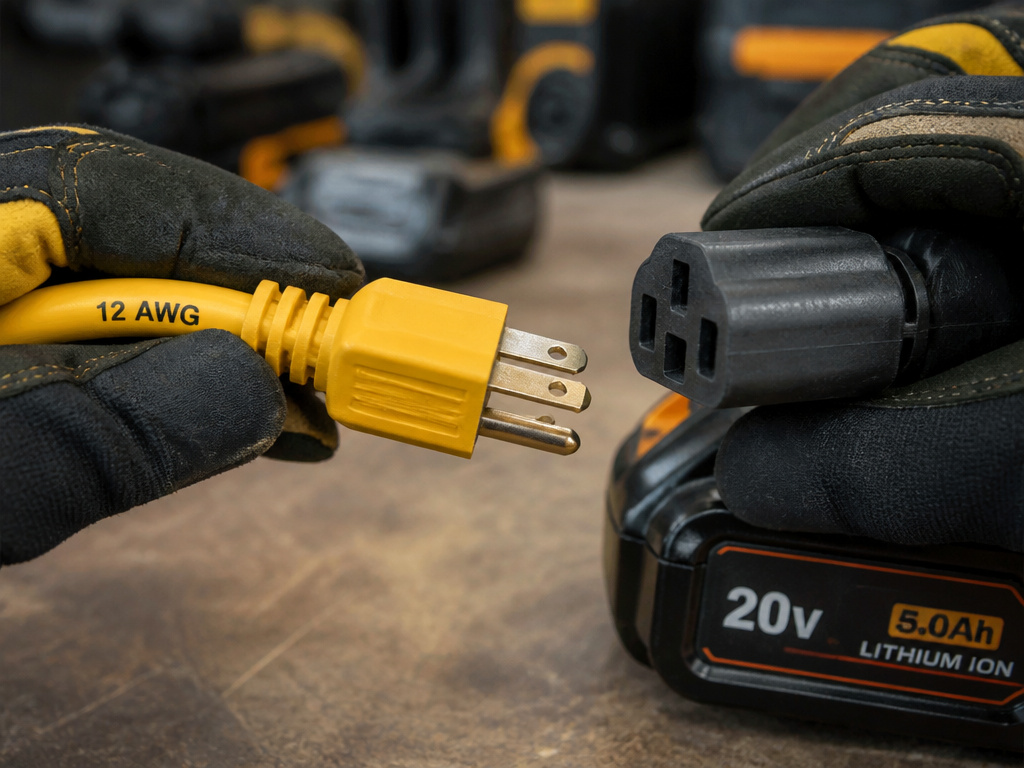
An extension cord is not just a length of wire. It’s a resistor. The longer the cord and the thinner the wire inside, the more it resists the flow of electricity. This causes a voltage drop. Your tool doesn’t get the power it needs, so the motor strains, overheats, and can burn out. More dangerously, the cord itself overheats, melting its insulation and creating a fire or shock risk.
Manufacturer manuals all state: “When operating a power tool outdoors, use an extension cord suitable for outdoor use.” The “suitable” part is where people guess wrong. It’s about the wire gauge, marked as AWG (American Wire Gauge).
The smaller the gauge number of the wire, the greater the capacity of the cable. An undersized cord will cause a drop in line voltage resulting in loss of power and overheating.
. DeWalt DWD210G Instruction Manual
DeWalt’s manual provides a clear table. Here’s the distilled version for common 120V tools:
| Tool Amperage | Cord Length: 50 ft (15.2 m) | Cord Length: 100 ft (30.5 m) | Risk if Undersized |
|---|---|---|---|
| 0–6 A (Small drills, orbital sanders) | 16 AWG | 16 AWG | Slow operation, motor warmth. |
| 6–10 A (Circular saws, larger drills) | 16 AWG | 14 AWG | Significant power loss, motor overheating, tripped breakers. |
| 10–12 A (Heavy-duty saws, grinders) | 16 AWG | 14 AWG | Severe voltage drop, burnt motor windings, melted cord plug. |
| 12–16 A (High-power grinders, miter saws) | 12 AWG | Not Recommended | Extreme overheating, fire hazard, immediate tool damage. |
Feel the cord after 10 minutes of heavy use. If it’s warm to the touch, it’s undersized. You should be using a heavy-duty extension cord with a lower AWG number. For any grounded tool (three-prong), the extension cord must also be three-wire with a grounding pin. Don’t daisy-chain two cords; the voltage drop compounds. If you need 100 feet, buy a single 100-foot cord of the proper gauge. For a deep dive on matching numbers to your tools, our guide on extension cords breaks it down.
Tool Inspection and Maintenance: Before You Pull the Trigger
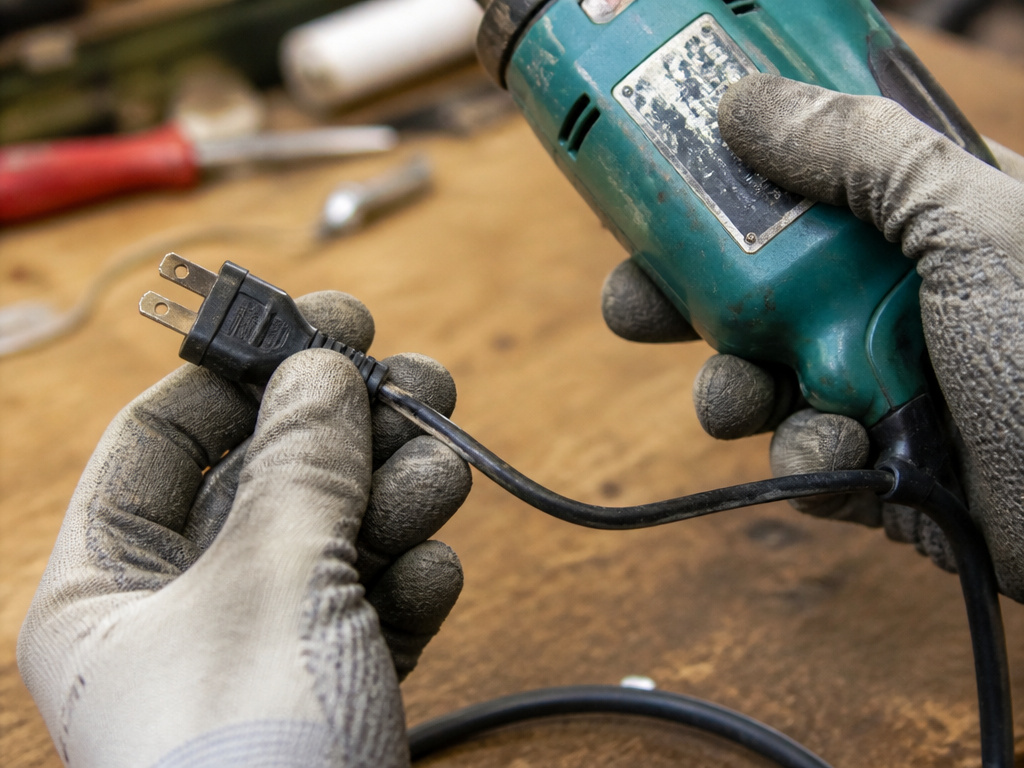
A quick pre-use check takes 30 seconds and catches most failures before they become emergencies. This habit is as important as any safety rule.
The Visual Once-Over:
- Cord and Plug: Look for cuts, cracks, or fraying along the entire cord. Check the plug for cracks, bent pins, or discoloration from heat. A frayed power cord is not something to tape up; it requires replacing the power tool cord.
- Housing: Look for cracks, especially near strain points like the cord entrance or handle.
- Switch: Does it turn on and off crisply, without sticking? A sticky switch can indicate internal contamination.
- Vents: Are the air intake and exhaust vents clear of sawdust and debris? Blocked vents are the fastest way to cause a power tool to overheat.
The Non-Negotiable Action: “Disconnect the plug from the power source before making any adjustments, changing accessories, or storing power tools.” Every manual says this. It’s the only way to ensure the tool is de-energized. This applies to cleaning, too. For internal dust, use dry compressed air. Never use solvents like gasoline or ammonia-based cleaners on plastic housings, they can cause cracks and weaken the material, as noted in the Bosch 1772-6 manual.
For maintenance like brush replacement, the Bosch manual gives a timeline: “Brushes should be examined every two to six months.” If your tool starts sparking excessively inside the housing or loses power, that’s a sign. “Bearings should be replaced after approximately 300-400 hours of operation.” Unless you’re a professional, you likely won’t hit that mark, but it shows that even robust tools have wearable parts. Have your tool serviced by a qualified repair person using identical replacement parts. A mismatched part can compromise the tool’s entire safety design.
Grounded vs. Double-Insulated Tools
Not all tools need a three-prong plug. Understanding the difference tells you what you’re responsible for.
- Grounded Tools (3-Prong): These have metal housings. The third, round pin is a ground wire that connects internally to the metal casing. If a live wire touches the casing, the current safely flows to ground through this wire, tripping the breaker. Your safety depends on that ground connection being intact, hence the absolute ban on modifying the plug.
- Double-Insulated Tools (2-Prong): These have non-conductive plastic housings and extra internal insulation barriers. There is no path for electricity to reach the outside of the tool, so no ground wire is needed. They are marked with the “square within a square” symbol (⬜).
Which should you use?
For most corded tools in a home shop, a double-insulated model is simpler, you don’t have to worry about the outlet’s ground being functional. However, for high-power, high-heat tools like large angle grinders or table saws, a grounded metal housing is often part of the heat dissipation system. The choice is often made for you by the tool type. The key is to never compromise the safety system that’s there.
Emergency Response: When Something Goes Wrong
Even with perfect habits, faults happen. Here’s the step-by-step for the two worst-case electrical scenarios.
Scenario 1: Tool is Shocking or Feels “Tingly”
- Let go. Your muscles may contract. Try to fall or twist away from the tool.
- Do not touch the tool or the person. You could become part of the circuit.
- Disconnect the power. Run to the breaker box and turn off the circuit, or unplug the tool from a distant outlet if you can do so safely without touching the cord near the tool.
- Once power is confirmed OFF, you can move the tool. Tag it “DO NOT USE.”
- Check the person. If they are unconscious or not breathing, call emergency services immediately and begin CPR if trained.
Scenario 2: Tool is Dropped in Water or Soaked
- Do not reach into the water.
- Go to the breaker box and turn off the circuit powering the outlet.
- Once the power is off, unplug the tool from the outlet.
- Remove the tool from the water.
- Do not test it. Set it aside in a dry, warm place for at least a week to fully dry out internally. Even then, consider it potentially compromised. Water can corrode internal connections, leading to future failure. It likely needs professional inspection.
The goal is to break the circuit without becoming part of it. Speed is critical, but so is your own safety. Never grab a smoking or sparking tool; disconnect the power first.
How to safely handle power tool batteries
The real world is where battery safety gets tested. A charger gets left plugged in, a battery sits in a hot truck, you notice a crack. The manuals are written for those moments. Your action plan starts with regular inspection. Check batteries for physical damage like cracks, leaks, or swelling before each use. Always use the charger designed for your specific battery pack; using an incorrect charger can lead to overheating or failure. For storage, keep batteries in a cool, dry place away from metal objects that could short the terminals. Disconnect the battery from the tool or charger when not in active use.
Frequently Asked Questions
What are the OSHA requirements for power tool electrical safety?
OSHA regulations (like 29 CFR 1926.302 for construction) codify the manufacturer rules. They require tools to be used with their guards and safety devices intact, to be maintained in safe condition, and to be used with GFCI protection on all 120V, single-phase, 15- and 20-ampere receptacles on construction sites. For the home user, treating OSHA rules as a baseline is a smart practice.
What type of outlet does OSHA require for power tools?
On worksites, OSHA requires ground-fault circuit interrupter (GFCI) protection for all 120-volt, single-phase, 15- and 20-ampere outlet receptacles. This can be a GFCI breaker in the panel or a GFCI receptacle. At home, your garage, basement, and outdoor outlets should be GFCI-protected by modern electrical code.
Can I use an indoor extension cord for my power tools outside?
No. You must use an extension cord rated for outdoor use (marked “W-A” or “W” on the jacket). Outdoor cords have a thicker, more water-resistant jacket. More importantly, you must select the correct gauge (AWG) for the tool’s amperage and the cord’s length to prevent overheating, as detailed in the extension cord guide.
How often should I inspect my power tool’s cord and plug?
Do a visual inspection before every use. Look for fraying, cuts, cracks in the plug, or any discoloration from heat. If you use the tool professionally, a more formal monthly inspection is wise. Any damage means the tool should be removed from service until the power cord is replaced.
What should I do if my power tool keeps tripping the GFCI outlet?
First, try the tool on a different, known-good GFCI circuit. If it still trips, the tool likely has a ground fault (moisture or damaged internal wiring). Stop using it. If it only trips on one outlet, the GFCI itself may be overly sensitive or failing. Unplug all tools and reset it. If it won’t reset, the outlet needs replacement by an electrician.
The Bottom Line
Electrical safety isn’t a set of isolated tips. It’s a chain, and the chain is only as strong as its weakest link. That link is often the simple, boring step we skip, checking the plug, hauling out the right extension cord, putting on the glasses.
The most critical rule is also the easiest to follow: disconnect the plug before you do anything but operate the tool. It’s the one action that renders a tool completely inert. Pair that with a correct extension cord and a GFCI outlet in any less-than-perfectly-dry environment, and you’ve covered the vast majority of shock risks.
The rest is about protecting yourself from the tool’s normal, violent function, with certified safety glasses, hearing protection, and a clear workspace, as outlined in a complete power tool electrical safety guide. Trust the manuals from DeWalt and Bosch. They aren’t written by lawyers to avoid lawsuits; they’re written by engineers who know exactly how their tools can fail. Your job is to never give that failure a path to you.
