
Regenerative Blower vs Centrifugal Blower: How to Choose
This post contains affiliate links. As an Amazon Associate, we earn from qualifying purchases.
A regenerative blower generates high pressure at a relatively low flow rate by recirculating air within its housing, while a centrifugal blower moves large volumes of air at lower pressure by accelerating air outward with a spinning impeller. Regenerative blowers excel in stable vacuum applications (like CNC workholding), whereas centrifugal blowers dominate high-volume airflow tasks (like industrial ventilation).
The distinction isn’t academic. Picking the wrong one in the regenerative blower vs centrifugal blower decision for your shop, machine, or process isn’t just inefficient, it can burn out motors, underperform, and cost you time and money on repairs. The pressure and flow numbers on a spec sheet tell the real story, and manufacturers don’t always agree on which blower can do what.
What follows: a breakdown of the physics, a side-by-side look at real models from MANVAC and Air Mech, the sensory cues that signal a problem, and a straightforward decision guide. By the end, you’ll be able to read a performance curve and match the right tool to the job.
Key Takeaways
- Match pressure to application: Use a regenerative blower for stable, high-pressure vacuum (250–460 mBar) like CNC clamping or pond aeration. Use a centrifugal blower for high-volume, lower-pressure airflow (e.g., 10 to 1200 mm WGP) for ventilation or cooling.
- Windings and bearings matter: Look for SKF bearings (as spec’d on MANVAC models) for 24/7 duty; cheaper components may overheat on continuous runs.
- Noise is a disputed spec: OEMs like MANVAC list “low noise,” while aggregators like Accio.com note a distinctive high-frequency whine from regenerative blowers; check dB(A) ratings if the environment is sensitive.
- Centrifugal blowers scale with stages: A single-stage centrifugal blower moves high volume at low pressure, while a multistage centrifugal blower (like Air Mech’s) can achieve elevated pressure ratios for demanding processes.
- The warranty tells a durability story: An 18-month warranty (like MANVAC’s) on a regenerative blower signals confidence in its 24-hour continuous duty life; shorter warranties often correlate with lighter-duty components.
The Core Difference: How Each Blower Creates Airflow
The working principle extends beyond a manual diagram to include audible feedback, motor draw, and the tool’s response under changing loads. Getting this wrong means buying a blower that screams when it should hum, or one that stalls when you need push.
A regenerative blower uses a single, multi-vane impeller spinning in a ring-shaped channel. Air enters the channel, is caught by the impeller blades, and is propelled forward. The key twist: the housing is shaped so the air loops back to the impeller inlet multiple times per rotation, receiving successive “kicks” that build pressure dramatically with each pass. This recirculation creates high pressure from a relatively compact, single-stage unit.
A centrifugal blower works more like a standard fan, but engineered for pressure. A motor spins an impeller with curved blades inside a scroll-shaped housing. Air is drawn axially into the eye of the impeller, accelerated radially outward by centrifugal force, and then discharged tangentially. The air makes one decisive pass from inlet to outlet, favoring volume over repeated compression.
The core point is this. That recirculation inside the regenerative blower is why it’s so good at maintaining a steady vacuum level, it’s constantly reinforcing the pressure. It’s also why it tends to run hotter. The air isn’t just moving through; it’s working in a tight, high-friction loop.
We can use real numbers from the source sheets. This isn’t “high pressure vs. Low pressure” in the abstract.
| Blower Type | Model Example | Pressure Capability | Airflow Range | Best-For Snapshot |
|---|---|---|---|---|
| Regenerative (Single-Stage) | MANVAC LD022H21R16 | 250 mBar (High Pressure) | 270 m³/h | Stable vacuum for CNC clamping, pneumatic conveying. |
| Regenerative (Double-Stage) | MANVAC 2MV 420 H36 | 440 mBar (Very High Pressure) | 150 m³/h | Applications needing even higher pressure than single-stage can provide. |
| Centrifugal (Low-Medium Pressure) | MANVAC CX-75A | 2.4 Kpa (Medium Pressure) | 13 m³/min | Machine cooling, laminating, localized exhaust. |
| Centrifugal (Medium-High Pressure) | MANVAC TB150-10 | 4 Kpa (Medium Pressure) | 60 m³/min | Industrial ventilation, high-volume fume extraction. |
The takeaway is in the units and the applications. Regenerative blower pressure is listed in mBar or inches of water, perfect for suction and holding. Centrifugal blower pressure is often in Kpa, geared for pushing air against system resistance in ducts or through filters. Choosing a blower starts with knowing whether you need to suck and hold or push and move.
Performance Deep Dive: Pressure, Flow, and Efficiency
You can’t just buy the biggest number. The relationship between pressure and flow is inverse for each blower type, and the “sweet spot” on its performance curve decides whether it will work or struggle in your setup.
A regenerative blower’s performance curve shows a steep drop in flow as system pressure increases. It wants to run at or near its designed pressure point. Stray too far, ask it for more flow by opening valves wide, and the pressure plummets. This is why they’re purpose-built for high-pressure, low-flow applications like vacuum chucks or aeration diffusers, where the resistance is consistent and high.
A centrifugal blower’s curve is generally flatter. It can move a large volume of air across a range of pressures, but its peak efficiency is usually at a lower pressure point. Sources disagree on their pressure capability: aggregator sites like Accio.com position them as low-pressure devices, while OEMs like Air Mech specifically market multistage centrifugal blowers for “elevated pressure ratios” in pneumatic conveying.
Where this goes sideways: Selecting a blower based only on free-air flow (CFM or m³/h). A centrifugal blower rated for 60 m³/min will deliver nowhere near that if your ductwork has three elbows and a filter. The system resistance, or “back-pressure,” kills the flow. Always consult the performance curve at your expected operating pressure.
Efficiency is another battleground. A regenerative blower can be more efficient than a piston compressor for specific low-flow, high-pressure jobs because it has fewer moving parts and no valves. But for moving huge volumes of air at low pressure, a centrifugal blower’s simpler, single-pass mechanism usually wins. The operating point on the curve dictates the winner.
This is why learning how to size a regenerative blower or any blower correctly is essential. It’s not about max specs; it’s about matching the blower’s happy zone to your system’s permanent resistance.
Noise, Heat, and The Sensory Reality
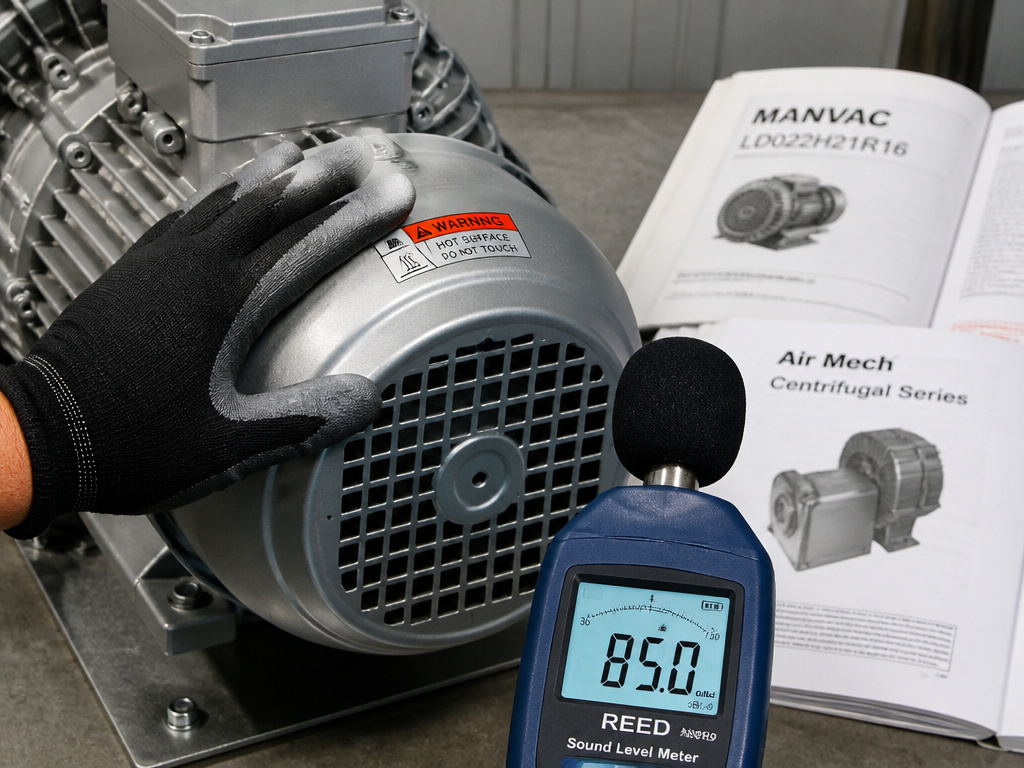
Spec sheets talk about dB(A). Reality gives you a sound, a smell, and a temperature you can feel with your hand. This is where trusting the manual gets you into trouble, because the sources openly disagree.
On noise: Accio.com states regenerative blowers often have a distinctive high-frequency whine due to the air recirculation and impeller design. Yet, MANVAC’s spec sheet for the LD022H21R16 lists “low noise” as a feature. Who’s right? Both can be. The OEM might measure noise at a distance in a test chamber, while the user hears the whine two feet away in a quiet workshop. Air Mech, meanwhile, claims its centrifugal blowers “stand out for quiet operation” compared to regenerative types. The only fix is to check the dB(A) specification and, if possible, listen to a unit running under load.
Heat generation is a direct consequence of the working principle. A regenerative blower’s recirculating air creates more internal friction. After continuous run time, the housing on a regenerative blower can become hot to the touch due to internal friction from air recirculation. This heat is a physical result of their design. Their specifications, including a running time of 24 hours non-stop, reflect that they are built to manage this thermal load. A centrifugal blower, moving air through in a single pass, typically runs cooler at the housing.
Here’s a sensory checklist you won’t get from a manual:
- Sound: A healthy regenerative blower has a steady, turbine-like whine. A rhythmic scraping or grinding means bearing wear, check those SKF bearings.
- Smell: The first sign of an overloaded motor or failing winding insulation is a faint ozone or burnt-wire smell, not smoke.
- Feel: Vibration should be minimal. Place your hand on the casing. A new, high-frequency buzz points to an imbalance in the impeller or a loose housing bolt.
These are the cues that let you head off a catastrophic failure. Running any blower, especially near its limits, requires respecting its thermal and acoustic personality.
Physical Build, Maintenance, and Durability
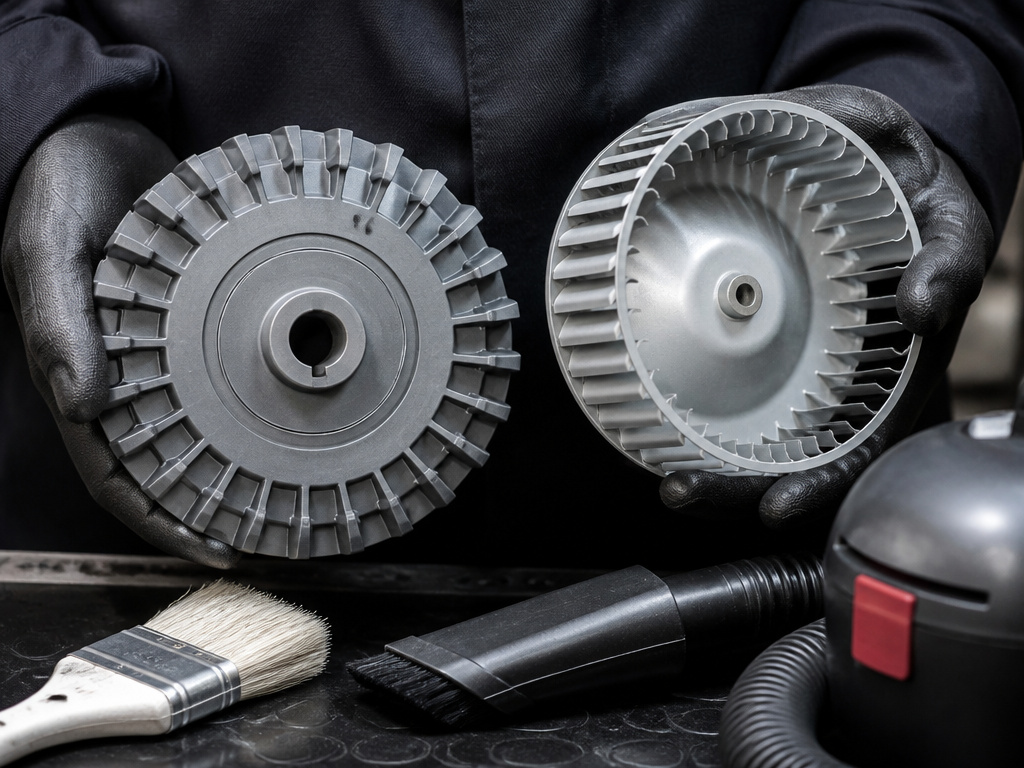
What’s inside the aluminum alloy casing determines whether your blower is a long-term asset or a disposable consumable. The differences here are stark and directly linked to the intended duty cycle.
Regenerative blowers, built for sustained pressure, often feature robust construction. The MANVAC single-stage spec sheet highlights SKF bearings. Copper windings handle heat better than aluminum, crucial for that 24-hour duty cycle. The 18-month warranty is a signal of that intended durability. The impeller is typically a single, precision-cast component designed to withstand the torsional stresses of recirculation.
Centrifugal blowers vary more by design. A lightweight radial blower like the MANVAC CX-75A uses an aluminum alloy impeller for the light weight and big volume its specs promise. A heavy-duty unit like the TB150-10, at 92 Kg, is built for heavy duty industrial environments. Adherence to standards like the API standard for centrifugal blower (cited by Air Mech) indicates a design meant for critical, continuous process work.
Maintenance diverges at the impeller. A regenerative blower’s tight-clearance, recirculating design makes it intolerant of dust or debris. A clog can cause immediate overheating and imbalance. Regular inlet filtration isn’t a suggestion; it’s mandatory.
Common mistake: Using a leaf blower or shop air to “clean” dust off a regenerative blower’s intake or cooler fins. You’re just forcing abrasive grit into the bearings and windings. Use a soft brush or vacuum.
Your maintenance schedule should be dictated by the blower’s job. The principles of how to maintain a regenerative blower, cleanliness, balance, and cooling, apply across the board, but the frequency changes with the dirtiness of the duty.
Head-to-Head: Choosing the Right Blower for Your Job
This is where we move from theory to your shop floor. The choice in the regenerative blower vs centrifugal blower question isn’t about which technology is “better.” It’s about which one maps its performance envelope onto your specific need. We can clarify this with a decision table.
| Your Application | Pressure Need | Flow Need | Likely Winner & Why |
|---|---|---|---|
| CNC Machine Vacuum Table | High, Stable Suction (200+ mBar) | Low (Enough for leaks) | Regenerative Blower. Maintains vacuum despite minor leaks; the recirculation design excels at steady-state suction. |
| Industrial Oven Ventilation | Low to Medium (Overcome duct loss) | Very High (Air changes per hour) | Centrifugal Blower (Multistage if needed). Optimized for moving massive air volumes; can be scaled with duct pressure. |
| Pond Aeration | Medium-High (To overcome water depth & diffuser resistance) | Medium | Regenerative Blower. Consistently cited for this duty; provides stable pressure to push air to the bottom of the pond. Using a regenerative blower for pond aeration is a classic application. |
| Pneumatic Conveying of Light Materials | Medium-High | Medium-High | It Depends. For dense-phase (low flow, high pressure), a double-stage regenerative blower like the MANVAC 2MV 420 H36. For dilute-phase, a high-volume centrifugal blower may suffice. |
| Machine Cooling / Fume Extraction | Very Low | High (Localized) | Centrifugal Blower (e.g., MANVAC CX-75A). Directs a high-velocity stream efficiently; doesn’t need high pressure. |
Now, the step that most guides skip: what happens when you’re between categories? You have two proven paths. First, you can overspec conservatively. If your calculation says you need 150 mBar for pond aeration, buy a regenerative blower rated for 250 mBar. The extra headroom means it runs cooler, quieter, and lasts longer. Second, you can consider staging. If a single-stage centrifugal blower won’t hit your pressure target, a multistage centrifugal blower (like those from Air Mech) or moving to a two-stage regenerative blower are your next logical steps. Understanding the single-stage vs two-stage regenerative blower choice is critical here.
The part nobody mentions: The electrical supply. A 7.5 kW centrifugal blower like the TB150-10 needs a solid 3-phase hookup. That 2.2 kW regenerative blower might run on single-phase 220V. Verify your shop’s electrical capacity before you fall in love with a spec.
Finally, remember that a blower is part of a system. Adding a filter, silencer, or long duct run changes the pressure it must work against. The blower you choose must be evaluated against the final system, not the ideal, open-air test condition.
Blower Inlet and Outlet Orientation
Regenerative and centrifugal blowers arrange their ports differently, which impacts your piping layout. This creates a compact footprint. This design is well-suited for ductwork. Always check the specific model’s dimensional drawing before finalizing your mounting plan to ensure the port alignment matches your system connections.
How Blowers Respond to Load Changes
A blower’s reaction to changing system resistance reveals its core character. For a process requiring consistent volume despite variable conditions, the centrifugal blower’s response must be carefully matched to the system.
Frequently Asked Questions
Can a centrifugal blower create a vacuum?
Yes, but with limitations. Centrifugal blowers are primarily designed for pressure. For efficient, stable vacuum duties, specially designed regenerative blowers or side-channel blowers are more effective, as they can maintain a stable vacuum level without overworking the motor.
Which blower type is more energy efficient?
It depends entirely on the operating point. Centrifugal blowers are generally more efficient for high-flow, low-pressure duties. Regenerative blowers can be more efficient for specific low-flow, high-pressure applications compared to other technologies like piston compressors. Always compare the performance curves at your specific required pressure and flow.
What are regenerative blowers used for?
They are ideal for applications requiring stable pressure or vacuum at moderate flow rates. Common uses include CNC machine vacuum chucks, pond aeration systems, pneumatic conveying of powders, and industrial vacuum hold-downs. MANVAC lists applications like paper cutters, pulverizing driers, and liquid-canning machines.
Are regenerative blowers louder than centrifugal blowers?
Sources disagree. Third-party analyses note regenerative blowers often have a distinctive high-frequency whine. Some OEMs, like MANVAC, advertise “low noise” on their models, while centrifugal blower manufacturers like Air Mech claim quieter operation. The only reliable method is to compare the dB(A) noise specification for the specific models you’re considering.
How do I choose between a blower and an air compressor?
This is a fundamental system choice. Blowers (both regenerative and centrifugal) move large volumes of air at relatively low pressure differentials. Air compressors store energy by squeezing air into a small volume at very high pressure (e.g., 100+ PSI). If your need is high-volume airflow or steady vacuum, a blower is correct. If you need high-pressure, intermittent power for tools or actuators, a compressor is the tool. We explore this in more depth in our article on the regenerative blower vs air compressor debate.
The Bottom Line
Let’s be real. Choosing between a regenerative and centrifugal blower involves matching a machine’s inherent strengths to your system’s specific demands. Ignore the marketing that claims one is universally quieter or more powerful. Look at the performance curve, touch the warranty, and listen to the actual sound of the unit under load.
One final, essential step: after you choose, protect your investment. Pair it with adequate filtration, provide clean and stable power, and respect its thermal limits. A blower isn’t just a fan; it’s a air-moving engine. Treat it like one, and it’ll outlast the machine it serves.
