
Roofing Nailer vs Framing Nailer: Which Should You Buy?
This post contains affiliate links. As an Amazon Associate, we earn from qualifying purchases.
A roofing nailer drives short, wide-headed nails for attaching shingles and roofing materials, while a framing nailer drives long, thick nails for structural wood construction like walls and rafters. They are not interchangeable, using a framing nailer on a roof will damage shingles, create leaks, and void warranties. The choice is dictated by the fastener: roofing nails are typically 1 to 1.5 inches long with a 3/8 to 7/16 inch head, while framing nails run 2 to 3.5 inches long.
The fastener specs are fixed requirements, but sources disagree on the exact numbers. The International Building Code mandates a minimum 3/8 inch diameter head and a 12 gauge shank for roofing nails, while GAF specifies heads from 3/8 to 7/16 inch and framingnailersguide.com cites a head diameter range of .148 to .200 inches. That conflict matters when you’re matching nails to a specific shingle manufacturer’s requirements, which always trump generic advice, a key consideration in the roofing nailer vs framing nailer discussion.
What follows is a breakdown of the nails, the tools, and the real-world consequences of mixing them up in a roofing nailer vs framing nailer scenario. By the end, you’ll know exactly which tool belongs in your hands for sheathing a wall versus sealing a roof.
Key Takeaways
- Never use a framing nailer for roofing shingles. The excessive power and wrong nail type will punch through and crack shingles, creating immediate leak points and voiding the material warranty.
- Roofing nail heads are wide for a reason. A large, flat head (with diameters cited by sources from a minimum of 3/8 inch up to 7/16 inch) presses down on the shingle tab to resist wind uplift without tearing through the material.
- Match the nail length to your roof assembly. Use the shortest approved nail that passes through all layers and achieves the required deck penetration, common lengths range from 1 to 1.5 inches, with 1 1/4 inches being a frequent choice.
- Framing nailers are for structure, roofing nailers are for skin. A framing nailer builds the bones of a house; a roofing nailer applies the waterproof outer layer. Their jobs don’t overlap.
- Jams are part of the deal with coil roofing nailers. Models like the Bostitch RN45B-1 have documented jam issues; keep the magazine clean and use straight, compatible nails to minimize downtime.
The Nails Tell the Story
The job is written in the metal. A roofing nail and a framing nail are different species engineered for opposing forces.
Roofing nails fight the weather. Their wide, flat heads, with diameters cited by different sources as ranging from a minimum of 3/8 inch up to 7/16 inch or .148 to .200 inches, act like tiny washers to clamp down on shingle tabs against wind uplift. The shank is thinner, with diameters typically ranging from .113 to .131 inches (approximately 12 gauge), to minimize splitting in the roof deck. They’re short, usually between 1 and 1.5 inches, because they only need to bite into the wood sheathing, not hold massive weight.
Framing nails fight gravity and shear. They are longer (2 to 3.5 inches) and thicker to penetrate deep into dimensional lumber, creating a rigid structural connection. The head is smaller, often described as “clipped” or round, because it’s meant to be driven flush or slightly below the wood surface, not to spread load on a thin material.
According to the International Building Code, roofing nails must have a minimum 12 gauge shank (approximately 0.109 inches) and a 3/8 inch diameter head. However, shingle manufacturer GAF specifies heads from 3/8 to 7/16 inch for its Timberline shingles, while other guides cite a head diameter range of .148 to .200 inches. Always defer to the roofing material manufacturer’s printed instructions.
Here’s where the confusion starts. If you grab a coil of SENCO’s standard 15-degree, 0.120-inch roofing nails, you’re holding a product designed for a roofing nailer’s magazine. A framing nailer’s magazine is built for a completely different collation, often 21 or 28-degree strips with a thicker shank. They won’t fit. Trying to force the wrong nail is a one-way ticket to a jammed tool and a stalled project.
| Specification | Roofing Nail | Framing Nail |
|---|---|---|
| Typical Length | 1 – 1.5 inches | 2 – 3.5 inches |
| Shank Diameter | 0.113 – 0.131 inches (approx. 12 gauge) | Thicker (varies by gauge) |
| Head Diameter | 3/8 – 7/16 inch (0.375 – 0.4375 in) | .177 – .250 inches (small, round/clipped) |
| Primary Material | Galvanized or stainless steel (corrosion-resistant) | Hardened steel (for strength) |
| Designed To Resist | Wind uplift, weather corrosion | Shear forces, structural load |
The Tools Themselves: Design and Grip
Hold one in each hand and the difference is physical. A framing nailer is bigger, heavier, and built to withstand the recoil of driving a 3.5-inch nail into dense lumber. Its nose is often jagged to grip the wood, which can leave marks. A roofing nailer is lighter and more compact, meant for all-day overhead work. It has a flat nose to sit flush against shingles without damaging them.
The magazine design gives away their purpose. Most roofing nailers use a 15-degree angled coil magazine that holds a continuous supply of nails, minimizing reloads on large roof planes. Most framing nailers use a straight or angled stick magazine. You can’t load a coil of roofing nails into a stick magazine, or vice versa.
Power sources differ, too. Pneumatic models are common for both, but cordless roofing nailers like the Milwaukee M18 FUEL 2909-20 are changing the game. That model can fire up to six nails per second and drive about 1,100 nails per charge. A cordless framing nailer exists, but it is designed for the higher power demands of structural framing.
Where this goes sideways: Using a framing nailer’s “bump fire” mode on a roof. The sequential trigger on a roofing nailer forces you to place the nose, pull the trigger, and reset, a safety rhythm. Bump firing a framing nailer on a steep pitch is how you put a nail through your foot or send the tool sliding off the roof.
Can You Use a Framing Nailer for Roofing?
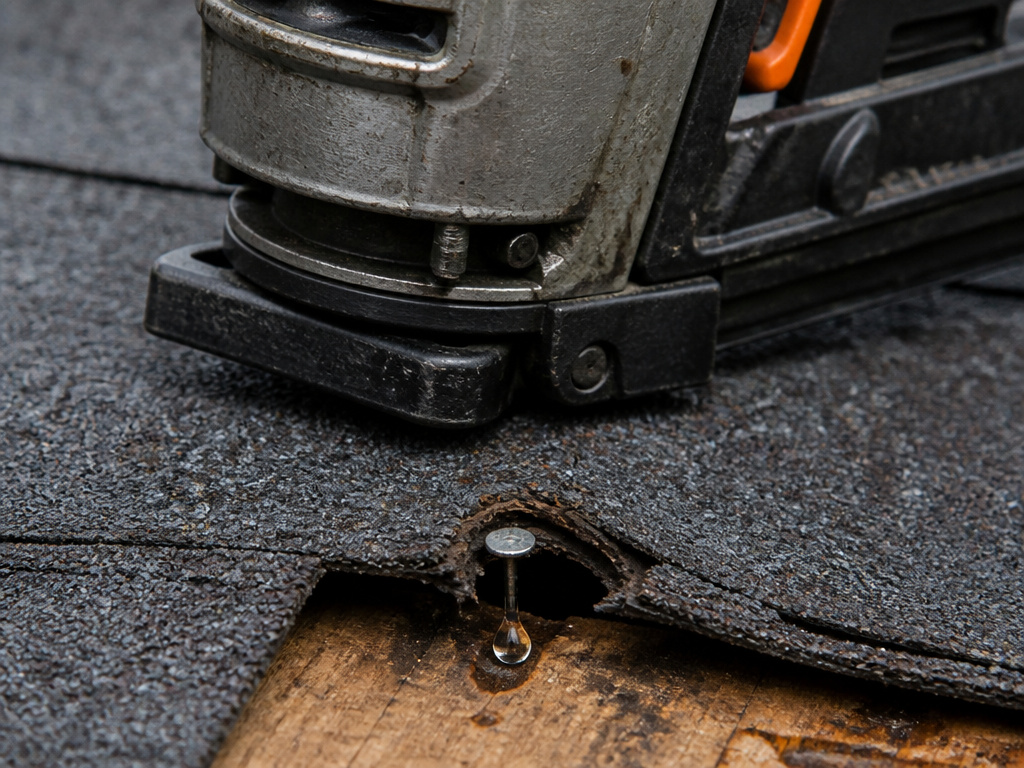
The short answer is no. The long answer is absolutely not, and here’s what breaks.
The power is wrong. A framing nailer delivers a heavy hammer blow to sink a long nail. On a typical shingle over plywood, that force doesn’t stop at the perfect depth. It punches through the shingle, creating a visible crater or a full puncture. Water follows that nail hole straight into your roof deck.
The nail is wrong. A framing nail’s small head can pull through the asphalt shingle over time, especially under wind stress. Its length is overkill, often protruding through the underside of the roof deck in a reroofing scenario. That exposed nail point inside your attic is a condensation magnet.
Finally, the warranty is void. Every shingle manufacturer’s installation instructions specify the type of nail and nailer to use. Deviate from that, and you’ve just invalidated the 25- or 30-year warranty on your most expensive home component. No contractor will take that risk, and neither should you.
When a Roofing Nailer Can’t Frame
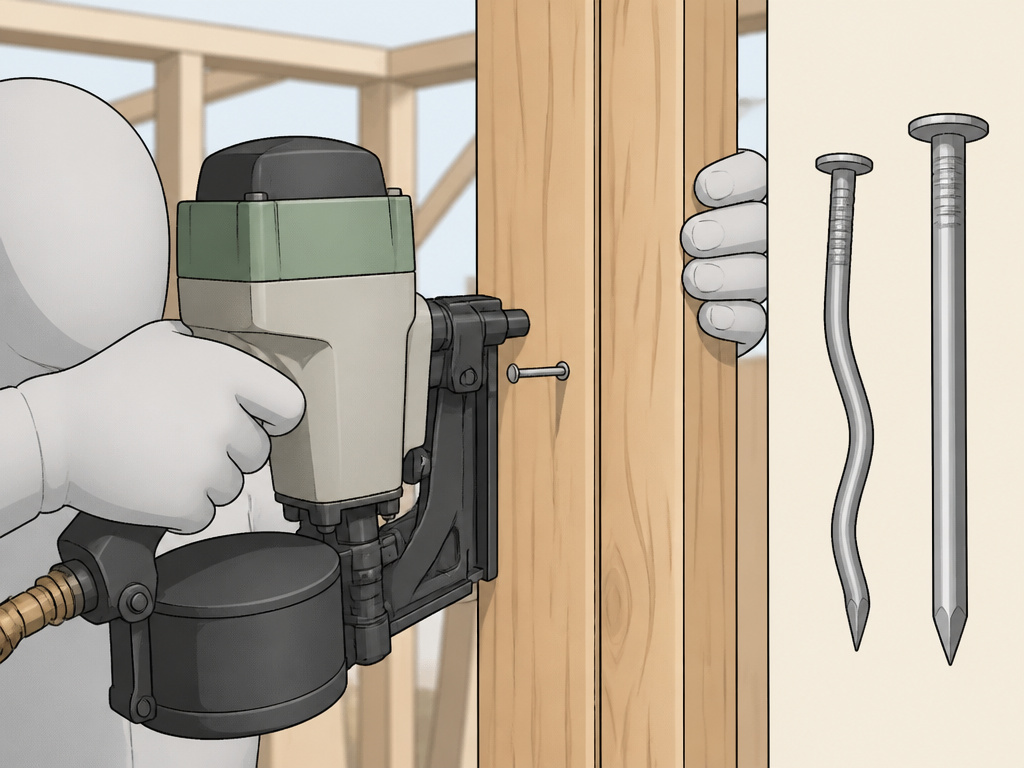
The reverse question is less common but worth nailing down. Could you use a roofing nailer for light framing, like a shed wall? Technically, it might shoot the nail, but it shouldn’t.
The tool isn’t powerful enough to fully sink a long framing nail, leading to shallow, weak connections. The thin shank of a roofing nail doesn’t have the shear strength for structural loads. You’d be building a liability. Roofing nailers are for approved exterior work like siding or fencing where the nail spec matches, not for holding up the walls of your house.
Making the Choice: What To Buy
Your project list decides. If you’re building a deck, framing a wall, or sheathing a roof before the underlayment goes on, you need a framing nailer. If you’re installing asphalt shingles, synthetic underlayment, or cedar shakes, you need a roofing nailer.
For a one-time roof repair, a DIYer might consider renting a pneumatic roofing nailer. For a pro, a cordless model like the Milwaukee or a reliable pneumatic workhorse like the Porter-Cable RN175 or SENCO RoofPro 445XP pays for itself in labor savings.
Common mistake: Buying a tool based on brand loyalty alone. It’s important to evaluate each tool category independently rather than relying on brand loyalty alone. Evaluate each tool category independently.
Safety and Setup Are Non-Negotiable
These are not toys. A nail gun injury happens in a fraction of a second.
- Wear safety glasses and hearing protection every time. A roofing nailer’s exhaust port can blast debris sideways.
- Use a harness and proper fall protection on any roof. This is the number one cause of serious injury in roofing work.
- Set your air pressure correctly. The SENCO RoofPro 445XP, for example, operates between 70 and 120 PSI. Start at the low end and test on scrap. Too much pressure buries the nail head; too little leaves it proud, ready to catch the wind.
- Disconnect the air supply before clearing a jam. This feels obvious until you’re frustrated on a hot roof. Make it a habit.
Dialing in the air pressure is critical. Using too much pressure can bury the nail head or damage material; too little can leave it proud. The same principle applies on a roof, test first.
Which nailer is heavier and harder to handle?
A framing nailer is bigger and stronger than a roofing nailer. This heavier, more powerful build is necessary for driving long nails into dense lumber for structural framing. In contrast, a roofing nailer is designed for speed and precision over large, sloped surfaces. Its coil magazine and flat nose are made for quick, flush placement of shingles. The ergonomics of each tool match its job: one for brute-force assembly, the other for rapid, repetitive fastening overhead.
Is a roofing nailer or framing nailer more expensive?
When you compare a roofing nailer vs framing nailer, the tools are designed for different purposes: roofing nailers for high-volume, precise shingle installation, and framing nailers for higher-power structural connections. Their designs reflect these distinct jobs. Using the correct tool, such as a roofing nailer for shingles, prevents damage that can create leaks and void warranties.
Frequently Asked Questions
Can a roofing nailer be used for framing?
No. A roofing nailer lacks the power and is designed for shorter, thinner nails. It cannot properly drive the long, thick nails required for structural framing, resulting in weak and unsafe connections.
What size nails does a roofing nailer use?
Common coil roofing nails range from 3/4 to 1 3/4 inches in length, with a shank diameter of 0.120 inches and a head diameter between 3/8 and 7/16 inch. Always use the length specified by your shingle manufacturer for your specific roof assembly.
Is a coil nailer the same as a roofing nailer?
Often, but not always. Most roofing nailers use a coil magazine, but there are also coil nailers designed for framing. The key identifier is the nail it accepts: a roofing nailer uses short, wide-headed nails; a coil framing nailer uses long, structural nails.
Why do roofers use nails instead of screws?
Nails have superior shear strength and flexibility, which is vital for a roof that moves slightly with temperature changes and wind. Screws are more brittle and can snap under these cyclical loads. A nail’s wide head also better secures the broad surface of a shingle.
What is the best roofing nailer for a DIYer?
For occasional use, a mid-range pneumatic model like the Porter-Cable RN175 offers a balance of reliability and value. For larger projects or if you dislike hoses, a cordless option like the Milwaukee M18 FUEL 2909-20 provides excellent convenience, though at a higher upfront cost.
Before You Go
One rule cuts through the noise: the fastener chooses the tool. If your material is an asphalt shingle, a roll of underlayment, or a piece of flashing, the only correct answer is a roofing nailer loaded with the exact nails the manufacturer requires. If you’re joining 2x4s or sheathing a wall, reach for the framing nailer.
Mixing them up isn’t a hack, it’s a costly mistake that compromises safety, performance, and warranty. Rent the right tool for the weekend or invest in it for the long haul. Your roof, and your peace of mind, aren’t worth the gamble.
