
Shop Vac Peak Horsepower Explained: How to Choose
This post contains affiliate links. As an Amazon Associate, we earn from qualifying purchases.
Shop vac peak horsepower (PHP) is a laboratory-tested, momentary motor-output figure used for consumer comparison, not the operational power the vacuum uses during cleaning. It is a misleading spec because it ignores airflow system efficiency. Real performance is measured by three numbers: cubic feet per minute (CFM) for airflow, sealed pressure (inches of water) for suction, and air watts for combined power.
That gap between a lab-tested peak and what reaches the end of the hose is where the entire marketing game is played. Shop vac peak horsepower explained is simply the PHP figure, which tells you what the motor might do in a perfect, frictionless world for a split second. It says nothing about the air it can actually move through a dirty filter and a 20-foot hose in your garage.
What follows is a breakdown of why PHP is a poor buying guide, the three specs that actually decide how well a vacuum works, and how to read a spec sheet to pick a tool with the right CFM and sealed pressure for sawdust, water, or drywall cleanup.
Key Takeaways
- Peak horsepower (PHP) is a marketing comparison tool, defined by Shop-Vac as a lab-measured motor output including inertial spin-up that does not equal operating power.
- For real cleaning power, compare CFM (airflow) and Sealed Pressure (suction); a unit with >75 inches of sealed pressure is in the high-performance tier.
- Air Watts combine airflow and suction into a single, more meaningful performance number, ask for this spec if the seller is serious.
- A 3.0 PHP model is adequate for a home garage, but a 5-gallon vac rated for 60 CFM (like the Model 2035000) will clear sawdust faster than a higher-PHP model moving less air.
- Hose diameter and filter condition significantly cut rated performance; a clean HEPA filter is essential for fine dust.
What Peak Horsepower (PHP) Actually Measures
The definition isn’t hidden. Shop-Vac Corporation prints it in their catalogs and spec sheets: “Peak Horsepower (PHP) is a term used in the wet-dry vacuum industry for consumer comparison purposes.” They go on to clarify it denotes motor output, including the motor’s inertial contribution, achieved in laboratory testing. The final clause is the one that matters: “In actual use, Shop-Vac motors do not operate at the peak horsepower shown.”
Think of it like a car engine’s maximum RPM redline. Your tachometer might show 8,000 RPM, but you never drive there. The engine can hit that number for an instant under perfect, unloaded conditions, but cruising at 70 mph uses a fraction of that spin. PHP is the vacuum motor’s redline, a theoretical maximum measured without the load of a hose, a filter, or any air to move.
Peak Horsepower (PHP) is a standardized term defined by Shop-Vac Corporation. It represents the horsepower output of a motor, including its inertial contribution, measured under specific laboratory conditions with no system load (hose, filter, etc.). It is expressly not the operational horsepower of the vacuum during use.
Where this goes sideways, especially before the shop vac peak horsepower explained, is assuming a higher PHP number means a stronger vacuum. It doesn’t. A motor’s strength is just one part of the system. As the analysis from Intervacdesign.com points out, suction depends on motor strength and the design of the entire airflow path. A poorly designed fan housing or a restrictive hose fitting can strangle a powerful motor, making a high-PHP unit pull less than a lower-rated competitor.
You’ll find this confusion on every retail box. The biggest number gets the boldest print. It sells. But it doesn’t clean.
The Three Numbers That Actually Matter
If PHP is the engine’s redline, then CFM, Sealed Pressure, and Air Watts are the horsepower, torque, and fuel efficiency you actually feel on the road. These are the specs that predict real-world results.
Cubic Feet per Minute (CFM) is maximum airflow. This is your vacuum’s ability to move volume, critical for picking up light, bulky debris like wood chips, leaves, or sawdust from a planer. A higher CFM clears a floor faster. CFM measures maximum airflow, which is critical for picking up light, bulky debris like wood chips or sawdust.
Sealed Pressure (SP), measured in inches of water lift, is pure suction strength. Imagine the vacuum pulling a solid column of water straight up a tube, the SP number is how many inches it can lift. This is the force that pulls wet plaster out of a crevice or lifts a flattened rag off the floor. Shop-Vac states that numbers greater than 75 inches are considered the high end for utility vacuums.
Air Watts (AW) is the most useful metric because it combines CFM and Sealed Pressure into a single measure of actual work done at the nozzle. It’s calculated from both airflow and suction. A higher air watts number generally means better overall cleaning performance, as it reflects how efficiently the motor’s power is converted into usable airflow.
| Performance Metric | What It Measures | Why It Matters | Good Benchmark (Shop-Vac) |
|---|---|---|---|
| Cubic Feet per Minute (CFM) | Maximum airflow volume | Clears loose, bulky debris fast | 90+ for workshop sawdust duty |
| Sealed Pressure (SP) | Suction strength (inches of water) | Lifts heavy/wet material, cleans carpets | >55 is standard; >75 is high-end |
| Air Watts (AW) | Combined airflow & suction (work done) | Best overall performance indicator | 150+ for general shop use |
The real-world impact is dramatic. Compare two models from Shop-Vac’s own lineup:
- Model 5989405 (8-gallon, 6.0 PHP): 75 CFM, 58″ SP, 155 AW.
- Model 5989505 (12-gallon, 5.5 PHP): 140 CFM, 70″ SP, 370 AW.
The “weaker” 5.5 PHP model has nearly double the airflow and more than double the air watts. It will clean circles around the higher-PHP model. This is why shopping by PHP alone is a mistake, a key point in any shop vac peak horsepower explained guide.
Is 3.5 HP Good? Cutting Through the Number Confusion
“Good” depends entirely on the job. A 2.0 PHP vac is fine for cleaning a car interior or sawdust around a miter saw. It’s useless for sucking up a gallon of spilled water or cleaning a gutted basement.
Be honest. The “People also ask” questions have direct answers if you ignore the PHP and look at the real specs.
- Is 3.5 peak HP good? For a general-purpose home garage vac, yes. A model like the Shop-Vac 5987000 (3.5 PHP, 65 CFM, 55″ SP, 150 AW) is a solid middle-ground workhorse. It can handle wet spills, dry debris, and occasional workshop messes.
- Is 4 HP strong for a shop vac? It can be, but check the CFM. The Shop-Vac 5987200 (4.5 PHP) delivers 130 CFM and 240 AW, making it strong for larger spaces. Grainger’s industrial buying guide recommends a minimum of 3 hp for larger spaces like maintenance shops, while Shop-Vac’s own models for comparable spaces often have higher Peak HP ratings (e.g., 4.5 or 5.5).
- What is a good peak HP for a shop vac? This is the wrong question. The right question is: “What’s a good CFM and sealed pressure for my jobs?”
Don’t overthink the PHP. Use it only to broadly separate the light-duty (1-2 PHP) vacuums from the medium-duty (3-4 PHP) and heavy-duty (5+ PHP) categories. Then, immediately look up the CFM and water lift on the manufacturer’s spec sheet.
Where to Find the Real Specs (And Why They’re Hidden)
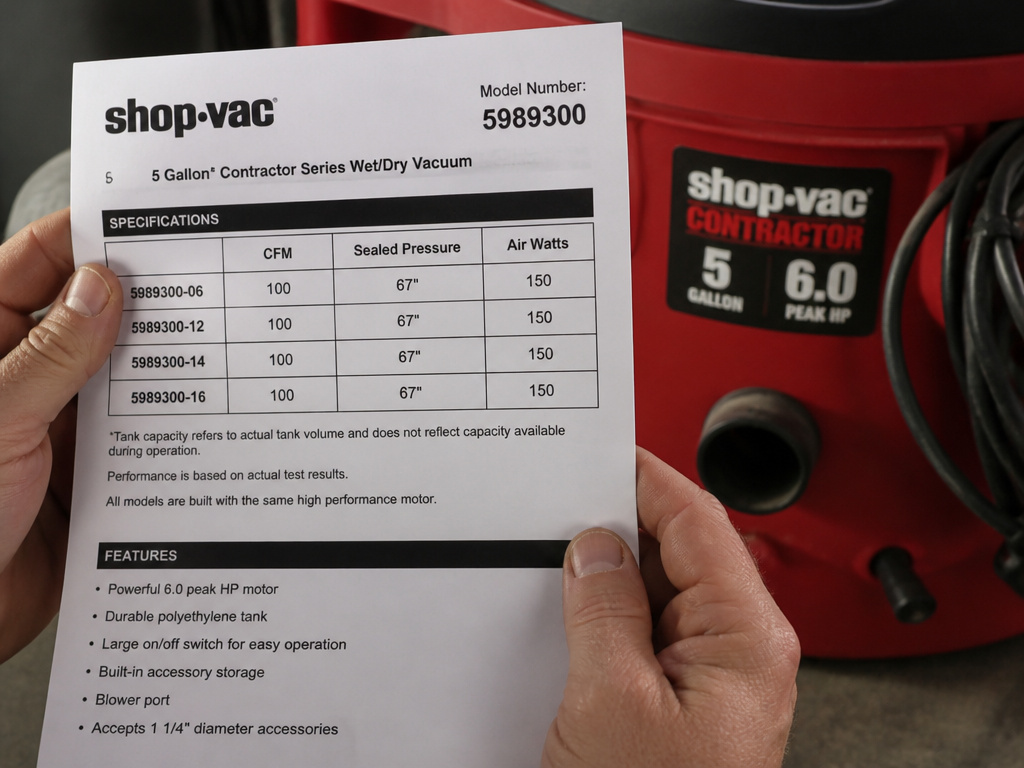
Manufacturers highlight PHP because it’s a big, simple number that sounds impressive. The useful specs are often buried. Here’s where to dig.
First, never rely on the retail box or Amazon title. The primary source is the official manufacturer specification sheet (PDF). For Shop-Vac, this is often hosted on distributor sites like WebstaurantStore or in their official catalog. You can also find performance data. CFM, Sealed Pressure, Air Watts, on the product pages of Shop-Vac’s own website, though you may need to scroll or click a “Specifications” tab.
If the specs aren’t listed on the sales page, search for the exact model number followed by “spec sheet PDF.” This step is required for an informed purchase.
Common mistake: Buying based on the horsepower listed in the online store title. The title might say “6.0 HP Shop Vac,” but the linked spec sheet could reveal a CFM of only 75, which is mediocre for that price point.
Second, note the testing standard. Legitimate specs will mention ASTM testing with a specific hose length and diameter (e.g., “ASTM tested with a 7 ft. Long x 1¼ in. Diameter hose”). This tells you the conditions under which the CFM and SP numbers were achieved. If no testing standard is mentioned, treat the numbers with skepticism.
As Intervacdesign.com bluntly advises, “Ask every supplier for air watts and water lift, and ask how they measured each one. If a seller will not put them in writing, treat the silence as an answer.”
How Your Setup Kills Rated Performance
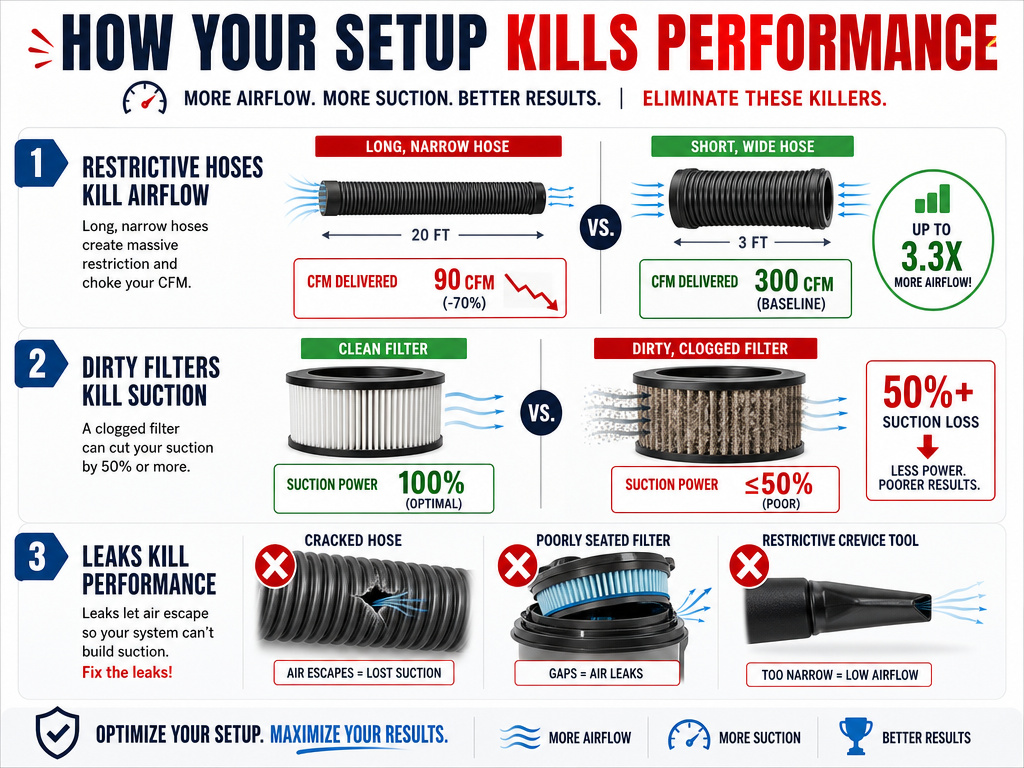
You can buy a vacuum with 140 CFM on the spec sheet and get 70 CFM at the nozzle. The drop happens in your shop. Every addition to the system adds resistance, which steals airflow and suction.
The biggest thieves are:
- The Hose: Length and diameter are critical. Shop-Vac notes that actual system load is determined by the hose. A longer hose kills performance. A narrower hose (like using a 1.25″ hose on a port designed for 2.5″) chokes it further. Always use the widest, shortest hose practical for the job.
- The Filter: This is the most important variable. A dirty filter can cut performance by more than half. For fine dust like drywall or sanding powder, a clogged standard filter will render any vacuum useless. This is why I insist on a HEPA filter for dust, it captures the fine particles instead of letting them blow back into the room or clog the filter media instantly.
- Leaks and Accessories: A poorly seated filter, a cracked hose, or an overly restrictive crevice tool all act as leaks or bottlenecks. The system is only as strong as its weakest point.
It catches 95% of the heavy debris in a separate bucket, so it never reaches the filter. Your filter stays clean, and suction stays strong for months instead of minutes. It’s the single best upgrade for any shop vac used for dry material.
Shop Vac vs. Dust Collector: Choosing the Right Tool
This is the core mistake I see: using a shop vac as a primary dust collector for stationary tools. They are different tools for different jobs.
A shop vac is designed for portable cleanup, with performance determined by both suction (sealed pressure) and airflow (CFM). It’s excellent for wet spills, cleaning out a car, or attaching to a handheld sander. It struggles with the massive, continuous airflow needed by a table saw or planer.
It moves huge amounts of air to capture chips and dust at the source on stationary power tools.
The part nobody mentions: Running a table saw with only a shop vac attached is a great way to fill the air with fine, hazardous dust and burn out the vac’s motor. The vac can’t move enough air to capture the dust cloud the saw creates.
For a workshop with stationary and handheld tools, you need both. Use a dust collector for your table saw, planer, and jointer. Use a HEPA-filtered shop vac for cleanup, handheld tools, and your miter saw. This two-stage approach is what the pros use.
Frequently Asked Questions
What’s the difference between peak HP and running HP?
Peak HP is a momentary maximum measured in a lab with no load. Running HP (or continuous duty HP) is the power the motor can sustain during actual use while moving air. Most consumer shop vacs only advertise peak HP, making the distinction academic and mostly useless for comparison.
Can I increase my shop vac’s horsepower?
No. Horsepower is a fixed characteristic of the motor. You can only improve performance by reducing system restrictions: use a shorter/wider hose, keep the filter clean, and ensure all connections are airtight. Adding a cyclonic separator preserves suction but doesn’t increase motor power.
Do more expensive shop vacs have more horsepower?
Not necessarily. A more expensive model might have a better filter system, a larger fan for higher CFM, a thermal-protected motor for longer life, or a stainless steel tank. The PHP rating may be similar to a cheaper model, but the real-world performance and durability are often superior. Always compare CFM and sealed pressure.
Why does my new 6.0 HP vac seem weaker than my old 4.0 HP one?
It likely is weaker where it counts. The old 4.0 HP model probably had a higher CFM or sealed pressure rating. Check the spec sheets. The new model’s “6.0 HP” rating is just a bigger marketing number on a less performative motor and airflow system. This is the heart of the horsepower deception.
Are air watts the best metric to compare?
Yes, for a single number, air watts are the most meaningful. They combine airflow and suction into a measure of actual work output. However, for specific tasks, it’s still best to look at CFM (for volume) and Sealed Pressure (for suction) individually. A vacuum with 200 air watts could achieve it with high CFM and low SP, or vice versa.
Before You Go
One rule cuts through the noise: ignore the peak horsepower number on the front of the box. Your next shop vac purchase should start and end with the manufacturer’s spec sheet. Find the CFM, Sealed Pressure, and Air Watts. Match them to your most common task, high CFM for sawdust, high Sealed Pressure for wet messes.
If you only do one thing, make it this: bookmark the product’s spec sheet PDF. When a deal seems too good to be true, that document holds the truth. A 5.5 HP vacuum with 140 CFM is a beast for cleanup. A 6.0 HP vacuum with 75 CFM is a dressed-up home unit. The horsepower number didn’t tell you that. The real specs always do.
