
Types of Air Compressors Explained: How to Choose
This post contains affiliate links. As an Amazon Associate, we earn from qualifying purchases.
An air compressor is a mechanical device that increases the pressure of a gas by reducing its volume. All air compressors fall into one of two categories: positive displacement, which traps and squeezes air in a chamber, and dynamic, which uses a high-speed impeller to accelerate air and convert velocity to pressure.
That split is the key to everything else. Positive displacement machines give you high pressure from a small package. Dynamic machines move huge volumes of air, but they need a lot of space and power to do it. This is the core distinction between the main types of air compressors explained.
What follows is a breakdown of the four main types of air compressors explained you’ll actually shop for: reciprocating, rotary screw, centrifugal, and axial. This guide explains where each type fits, which specifications matter most, and the common sizing mistake people make when choosing a compressor for their shop.
Key Takeaways
- Match the compressor to your tool’s continuous CFM demand, not the tank size. A die grinder needs a steady 4-6 CFM; a compressor that can’t deliver that will stall your work.
- Rotary screw compressors win for continuous, 24/7 operation. They can run at full load indefinitely, while a reciprocating unit would overheat and fail.
- For clean air applications (painting, instruments, breathing), specify an oil-free compressor. If you must use a lubricated type, the ANSI/ISA 7.0.01 standard requires lubricant removal equipment.
- The biggest energy waste in a shop isn’t leaks, it’s an oversized compressor running unloaded. An unloaded screw compressor still burns 15-35% of its full power while making no air.
The Four Main Types of Air Compressors
The two fundamental technologies, positive displacement and dynamic, dictate everything about a compressor’s size, cost, and best use in the types of air compressors explained. Think of it like cutting wood. A reciprocating saw (positive displacement) delivers powerful, discrete chops. A circular saw (dynamic) delivers a continuous, high-speed cut. You wouldn’t use one for the other’s job.
The CAGI compressed air handbook defines positive displacement compressors as machines that trap a specific volume of air in a chamber and then mechanically reduce that chamber’s size to increase pressure. Dynamic compressors, like centrifugal and axial types, use a rotating impeller to add velocity to the air, which is then converted to pressure in a diffuser section.
This distinction explains why you’ll never see a tiny centrifugal compressor for your nail gun, and why a massive reciprocating compressor for a factory is a bad idea. The physics set hard limits.
Reciprocating (Piston) Compressors: The Intermittent Workhorse
These are the tanks you see in every auto shop and garage. A piston moves up and down in a cylinder, drawing in air on the downstroke and compressing it on the upstroke. They’re simple, relatively cheap, and good for high pressure.
You’ll find them in two configurations: single-stage and two-stage. A single-stage unit compresses air to its final pressure in one shot, generally used for pressures of 70 psi to 135 psi. A two-stage compressor compresses air to an intermediate pressure, cools it, then compresses it again to a higher final pressure, which is more efficient for higher pressure demands.
Where this goes sideways: Running a reciprocating compressor like a screw compressor. For maximum service life, you must size it so your peak demand doesn’t exceed 75% to 80% of its full-rated output for more than 30 minutes at a time. Push it harder, and you’re looking at valve refurbishment or a full replacement in less than a year.
That duty cycle limit is the critical spec most DIY buyers miss. If your sanding job runs for 45 minutes straight, a reciprocating compressor sized for 100% of your tool’s CFM will cook itself. You need to buy a unit with a capacity that accounts for the duty cycle limit and your continuous CFM need.
| Reciprocating Compressor Specs & Uses | Typical Range | Best For | Watch Out For |
|---|---|---|---|
| Horsepower (HP) | <1 HP to >600 HP (DOE) | General purpose: <1 HP to ~30 HP (NRCan) | Don’t buy based on HP alone; CFM at PSI is king. |
| Pressure (PSI) | 70-135 PSI (single-stage), up to 175+ PSI (two-stage) | Auto shops, framing nailers, intermittent tool use | Two-stage is more efficient for high-pressure tools. |
| Duty Cycle | 60-80% for continuous demand | Short-burst tools: impacts, staplers, blow guns | Exceeding 80% for >30 min drastically shortens life. |
Rotary Screw Compressors: The Continuous Power Plant
Since the 1980s, rotary screw compressors have taken over industrial floors. Two helical rotors mesh together, trapping air in the pockets between them. As the rotors turn, the pocket volume shrinks, compressing the air along the length of the screws. It’s a smooth, continuous flow.
Their biggest advantage is right in the manual: they can run at full load continuously. A reciprocating compressor has to cycle on and off; a screw compressor just runs. That’s why they dominate in settings that need air 24/7, like plastics manufacturing or large body shops.
Common mistake: Assuming “oil-free” means maintenance-free. Oil-free screw compressors use timing gears to keep the rotors from touching, but they run hotter and often need two compression stages with intercoolers. They’re for when air purity is non-negotiable, not for convenience.
There’s a noted disagreement on their common size range. Sources disagree on the typical power range: the U.S. Department of Energy states they are most common from about 30 to 200 HP, while Natural Resources Canada cites a range from about 5 to 900 HP.
Dynamic Compressors: Centrifugal and Axial
When you need to move a massive volume of air, you step up to dynamic compression. These machines don’t have chambers. They use a high-speed impeller (like a fan) to fling air outward, converting velocity into pressure.
- Centrifugal Compressors: Air enters the center of a spinning impeller and is flung radially outward into a diffuser. They’re built for high volume at moderate pressure. You’ll find them in large water treatment plants, chemical processing, and for providing instrument air in refineries. They’re not for your garage.
- Axial Compressors: Air flows parallel to the axis of rotation, passing through multiple stages of rotating and stationary blades. These are the engines of jet aircraft and large gas turbines. They’re the most efficient design for moving enormous volumes but are incredibly complex and expensive.
The DOE compressed air sourcebook notes that dynamic compressors are typically reserved for applications exceeding 1,000 HP. For a home or even a large shop, you’re in positive displacement territory.
Oil-Lubricated vs. Oil-Free: It’s About Air Purity
This choice isn’t about maintenance; it’s about what’s in your air line. A lubricated compressor uses oil to seal, cool, and lubricate the compression chamber. An oil-free compressor uses alternative materials (like Teflon coatings) or water injection to achieve the same goal.
- Lubricated: More durable, quieter, longer lifespan. A modern oil-injected screw compressor keeps oil carryover remarkably low, under 3 mg/m³. But that’s still too much for some tasks.
- Oil-Free: Essential for specific applications. The air is guaranteed free of oil aerosols.
The rule is simple. If the air will contact a finished product (food, pharmaceuticals, painting) or go into a sensitive instrument or a person’s lungs, you need oil-free. The standard for instrument air, ANSI/ISA 7.0.01, is blunt: if you use a lubricated compressor, you must install lubricant removal equipment.
For breathing air, the guidance is even stricter. Use an oil-free compressor. Don’t try to filter the output of a lubricated one; the risk of petroleum contamination is too high.
Key Specifications and What They Actually Mean
Forget the marketing. These three specs decide whether a compressor will run your tool or just make noise.
- CFM (Cubic Feet per Minute): The volume of air delivered. You’ll see two ratings: Displacement CFM (theoretical pump output) and Delivered CFM (actual air you get at the outlet). Only care about Delivered CFM at the PSI your tool requires. A tool that needs a specific CFM at a required PSI will starve with a compressor that cannot deliver that CFM at the required pressure.
- PSI (Pounds per Square Inch): The pressure. Most shop tools run between 90 and 120 PSI. Ensure your compressor’s cut-out pressure is sufficiently above your tool’s requirement to allow for pressure drop in the lines.
- Duty Cycle: The percentage of time a compressor can run without overheating. This is the most critical spec for reciprocating compressors. A 50% duty cycle means it should run for half the time within a given period to avoid overheating. A rotary screw compressor can run at full load continuously.
The part nobody mentions: A compressor’s performance plummets in heat. A compressor’s performance can decrease in high ambient temperatures, so it’s wise to have a capacity margin. Always buy more CFM than you think you need.
How to Choose the Right Compressor Type for Your Shop
Stop looking at tanks first. Start with your tools. List every air tool you’ll use and find its continuous CFM requirement (not the average). The tool with the highest demand sets your baseline.
Then, apply this logic:
| Your Situation | Leading Contender | Why It Wins | First Alternative |
|---|---|---|---|
| Home Garage, weekend projects | Reciprocating, 60-80 gallon, two-stage | High pressure for impact wrenches, affordable, handles intermittent use perfectly. | Large portable (like a Rolair wheeled unit) if space is tight. |
| Small Professional Shop (auto, wood) | Rotary Screw, 5-20 HP, lubricated | Can keep up with a die grinder or sander all day, much quieter, 100% duty cycle. | Two large reciprocating compressors piped together for redundancy. |
| Large Industrial, 24/7 Operation | Rotary Screw (lubricated or oil-free), 30+ HP | Built for continuous run time, most energy-efficient at scale, minimal maintenance. | Centrifugal compressor for very high, steady volume demands. |
| Mobile Construction, no power | Gas-Powered Reciprocating, portable | Provides its own power, built for rugged transport, simple to service on-site. | — |
| Critical Air Purity (spray painting, lab) | Oil-Free Rotary Screw | Guarantees no oil contamination, meets ISO 8573-1 Class 0 standards for oil content. | Oil-Lubed Screw with triple filtration (less reliable long-term). |
The comparison of screw and piston types often comes down to runtime and noise. If your work is bursts of air, a piston is fine. If it’s a constant hum of sanders or grinders, the screw’s continuous output pays for itself.
Don’t forget the supporting system. A 100 kW compressor can pull 85 liters of water out of the air in an 8-hour shift. That water will end up in your tools without a dryer and filter at the regulator.
How Does a Rotary Vane Compressor Work?
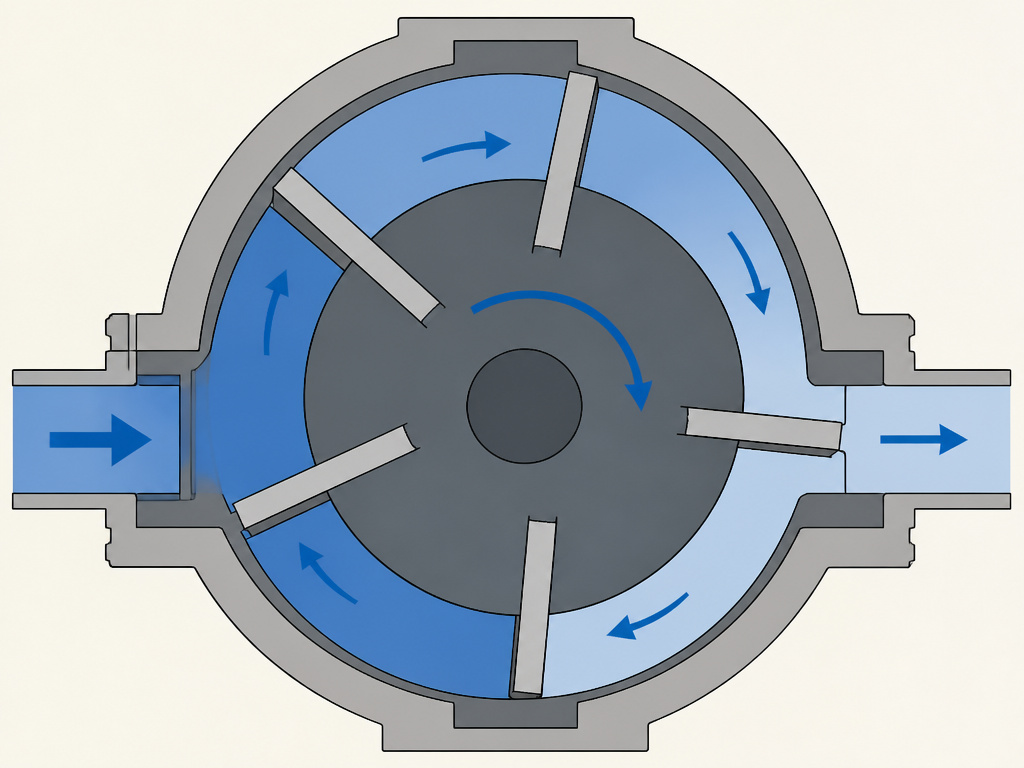
Rotary vane compressors are a type of positive displacement compressor known for their compact design. They are typically used for smaller applications where available floor space is a primary concern. In operation, a rotor with sliding vanes is mounted off-center inside a cylindrical housing. As the rotor spins, centrifugal force pushes the vanes against the housing wall, creating chambers that decrease in volume to compress the air. While they offer a simple and relatively quiet operation, they are generally not as efficient as rotary screw compressors. Their space-saving design makes them a practical choice for workshops or facilities with tight physical constraints.
What Is a Scroll Compressor Used For?
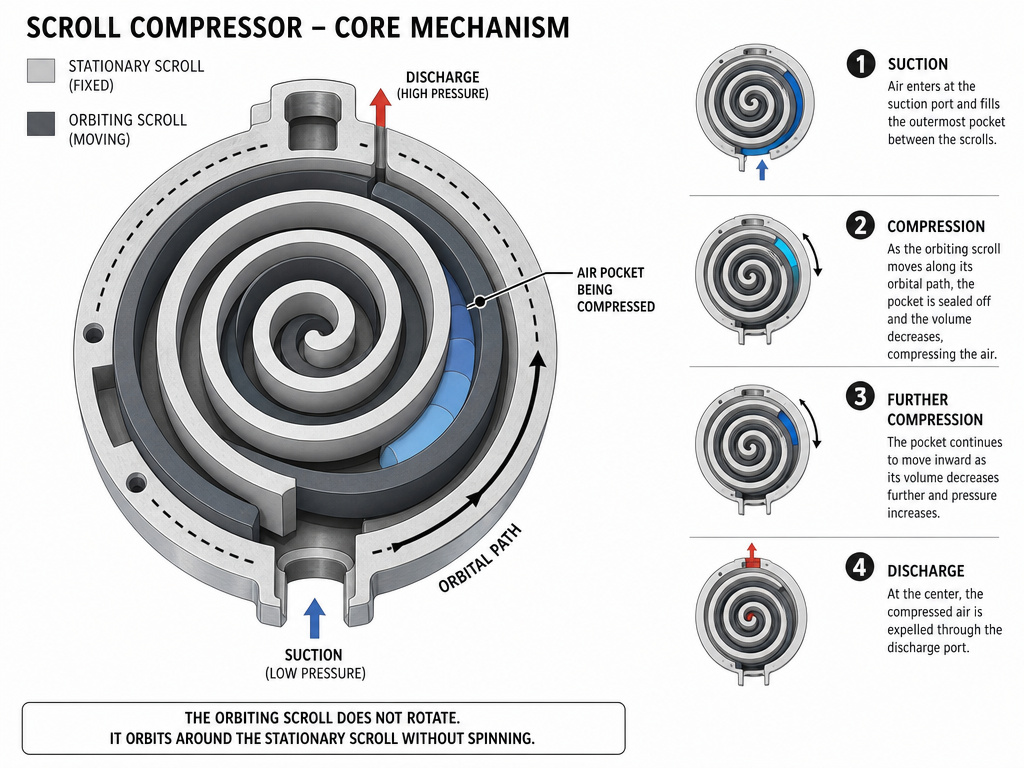
Scroll compressors operate using two interleaving spiral-shaped scrolls. One scroll remains stationary while the other orbits around it, trapping and compressing pockets of air between the spirals. This design is known for being very quiet and having few moving parts. However, scroll compressors are principally used in refrigeration and air conditioning applications. They are not commonly covered in general compressed air system guidance for industrial or shop use. For standard compressed air needs, other compressor types like reciprocating or rotary screw are typically the focus of selection and sizing discussions.
Frequently Asked Questions
What are the four main types of air compressors?
The four primary types are reciprocating (piston), rotary screw, centrifugal, and axial. Reciprocating and rotary screw are positive displacement compressors, common in workshops and industry. Centrifugal and axial are dynamic compressors, used for massive volume applications like chemical plants and jet engines.
What is the best type of air compressor to buy for a home garage?
For most home garages, a two-stage reciprocating compressor is often a good value. It provides the high pressure needed for tools like impact wrenches and can handle the intermittent use typical of DIY projects. Ensure its delivered CFM meets the demand of your most air-hungry tool.
What’s the difference between a single-stage and two-stage compressor?
Single-stage compressor compresses air from atmospheric pressure to its final pressure in one piston stroke. A two-stage compressor compresses air to an intermediate pressure, cools it via an intercooler, then compresses it again to a higher final pressure. Two-stage compression is more efficient, runs cooler, and is better for continuous high-pressure tasks.
Are oil-free compressors better than oil-lubricated ones?
Not necessarily “better”, they serve different purposes. Oil-lubricated compressors are generally more durable, quieter, and have a longer service life. Oil-free compressors are essential where air purity is critical (e.g., painting, food processing, breathing air) because they guarantee no oil contaminates the air stream. For general shop work, a lubricated model is often the more robust choice.
How important is air compressor tank size?
Tank size determines your air reservoir, not your compressor’s power. However, if your compressor’s pump cannot replenish the tank as fast as your tool uses air, the tank size is irrelevant. The pump’s CFM output is a critical factor alongside tank size.
Can I use a small compressor for painting?
You can, but you must be meticulous. Spray painting requires a steady, clean, and dry air supply. Any pulsation or moisture will ruin the finish. You need a compressor that can deliver continuous CFM above your spray gun’s requirement, coupled with appropriate air treatment equipment. For professional results in painting, an oil-free compressor is often specified to eliminate the risk of oil contamination.
Before You Go
One rule cuts through all the specs: your compressor is only as good as its weakest accessory. You can buy a perfect rotary screw unit, but if you connect it with undersized hose, skip the dryer, and never drain the tank, you’ll have wet, dirty, pulsating air that ruins tools and finishes. The compressor is the heart, but the filter, regulator, and dryer are the arteries, keep them clean.
Most shops are best served by either a large, two-stage reciprocating compressor or a small rotary screw. The choice hinges on your tolerance for noise and whether your work involves long, continuous runs of air.
Finally, understand that the basic mechanics of compression haven’t changed in a century. Newer controls and motors are more efficient, but air is still trapped or spun to raise its pressure. Buy for the steady CFM you need, plan for the water you’ll remove, and you’ll have a system that lasts for decades.
