
Types of Jigsaw Blades: Selection by Material
This post contains affiliate links. As an Amazon Associate, we earn from qualifying purchases.
Jigsaw blades fall into categories defined by their shank type, material, teeth per inch (TPI), and tooth geometry. The T-shank is the modern professional standard; U-shank fits older or budget saws. For material, choose High-Carbon Steel (HCS) for wood and plastic, High-Speed Steel (HSS) for metal, and Bi-Metal (BIM) for a durable mix. Match the TPI to your desired finish: A lower TPI cuts aggressively, leaving a rougher edge. Blades with 10–24 TPI produce markedly smoother cuts but at a slower pace.
That’s the quick answer. The real work starts when you pick up a blade and your saw, because the wrong choice doesn’t just cut poorly. It breaks, it burns the material, and it wears out your tool’s motor. Understanding the different types of jigsaw blades is key to making the right choice.
What follows is the map: the four blade materials, the TPI rule that decides finish versus speed, the specialty blades for laminate and curves, and the two settings (speed and pendulum) that most people get wrong on plastics and metal when using different types of jigsaw blades. By the end, you’ll read a blade’s code like a pro.
Key Takeaways
- The T-shank is widely considered the industry standard professional interface, it locks tighter and lasts longer. U-shank fits some professional and most consumer jigsaw brands, especially older models and bargain tools.
- Match blade material to your job: Sources offer different guidance: Wood Magazine recommends HCS for wood, while Dictum.com suggests HCS for soft wood and BIM for hardwood. Use HSS for metal, and BIM for a versatile, longer-lasting blade that handles both.
- For optimal cutting, ensure enough teeth are engaged. Bosch recommends always keeping 2–3 teeth in the material, while Baumarktwissen.eu advises at least two teeth should be embedded.
- For plastics and hard materials, switch off the pendulum action and reduce the motor speed to around half to prevent melting or blade damage.
- A dull blade sounds different, a high-pitched whine and visible smoke mean it’s time to change, regardless of the material.
The First Decision: Will It Fit Your Saw?
You have to get this right before anything else. It’s not just T-shank versus U-shank, some brands use proprietary systems that lock you into their ecosystem.
The T-shank won. It’s the modern standard because it slides in and locks with a lever, no tools needed. It also provides a tighter fit, which reduces wobble and vibration for a cleaner cut. Wikipedia calls it the “industry-standard professional interface.” Your newer DeWalt, Makita, or Bosch almost certainly uses it.
The fit isn’t as secure, which can translate to a rougher cut line.
Then there are the proprietary fittings. Makita has its own system for some models. If your saw didn’t come with a standard T-shank clamp, check the manual before you buy a 10-pack of blades online.
Common mistake: Forcing a T-shank blade into a U-shank saw (or vice versa). At best, it won’t lock. At worst, you’ll damage the tool’s blade clamp mechanism, which is a costly repair.
The 3 Core Blade Materials: HCS, HSS, and BIM
This is where the sources don’t always agree on the types of jigsaw blades, but the performance differences are real. The blade’s material decides what it can cut and how long it will last.
High-Carbon Steel (HCS) is the soft, flexible option. Dictum.com states it’s ideal for sawing soft wood, softer plastics, or fibreboard, while Wood Magazine recommends HCS for cutting wood, MDF, or plastic. The flexibility makes it great for scroll cutting, it can bend through tight curves without snapping. The trade-off is edge life. It dulls faster, especially in hardwoods or against abrasive materials like MDF.
High-Speed Steel (HSS) is harder and more heat-resistant. It’s for cutting harder materials such as metal, aluminium, and non-ferrous metal. That hardness comes with rigidity, which means HSS blades are more prone to breaking if you force a curve. Makita states their HSS blades last 5x longer than HCS blades.
Bi-Metal (BIM) is the hybrid. It combines a flexible HCS body with hard HSS teeth. This makes it ideal for working in hardwood, hard plastics, and metals. It’s the go-to for pros who need one blade to handle a mixed bag of materials on a job site. Bosch claims the life of their bimetal blades is two to ten times longer than pure HSS or HCS.
| Blade Material | Best For | Trade-Off | Lifespan Claim |
|---|---|---|---|
| HCS (High-Carbon Steel) | Soft wood, plastic, MDF, scrollwork | Dulls quickly on hard/abrasive materials | Shortest |
| HSS (High-Speed Steel) | Metal, aluminum, non-ferrous metal | Brittle; can snap on curves | 5x longer than HCS (Makita) |
| BIM (Bi-Metal) | Hardwood, plastic, metal, general purpose | More expensive upfront | 2–10x longer than HSS/HCS (Bosch) |
So, which one for cutting wood? The sources show the disagreement. Wood Magazine says choose HCS for wood. Dictum says HCS is for soft wood, but BIM is for hardwood. Sources also disagree on which material lasts longest: Makita says HSS lasts 5x longer than HCS, while Bosch claims its bimetal blades last 2–10x longer than pure HSS or HCS.
Bosch recommends always keeping 2–3 teeth in the material while cutting for optimal quality and speed. This rule connects directly to your next choice: teeth per inch.
Teeth Per Inch (TPI) and Tooth Geometry
TPI controls the cut’s aggression and finish. Tooth geometry, how the teeth are shaped and set, decides how cleanly it exits the material.
A lower TPI (6-10) means bigger, more aggressive teeth with more space between them. This clears chips fast, which is perfect for ripping through thick lumber. The cut will be quick but rough.
Blades with 10–24 TPI produce markedly smoother cuts but at a slower pace. They’re for finish work in wood, or for cutting metal where you need a clean edge. The smaller teeth take smaller bites.
You must match TPI to material thickness. Remember the 2–3 tooth rule. Cutting 1/2″ plywood with a 24 TPI blade means maybe 12 teeth are in the cut, that’s fine. Using that same blade on 1/8″ metal might only have one tooth engaged, which will snag, overheat, and dull instantly.
Tooth geometry adds another layer:
- Milled Teeth: Cut fast but leave a rougher edge. Good for construction lumber.
- Ground Teeth: Are sharper and aligned with the blade for a smoother cutline, but they cut slower and hotter.
- Side Set & Ground: For clean, fast cuts in wood and plastics.
- Wavy Set & Milled: For cutting metal and plastics.
The geometry is often printed right on the blade. A blade marked “T118A” isn’t just a model number; for Bosch, it tells you it’s for thin metals.
Blade Selection By Material
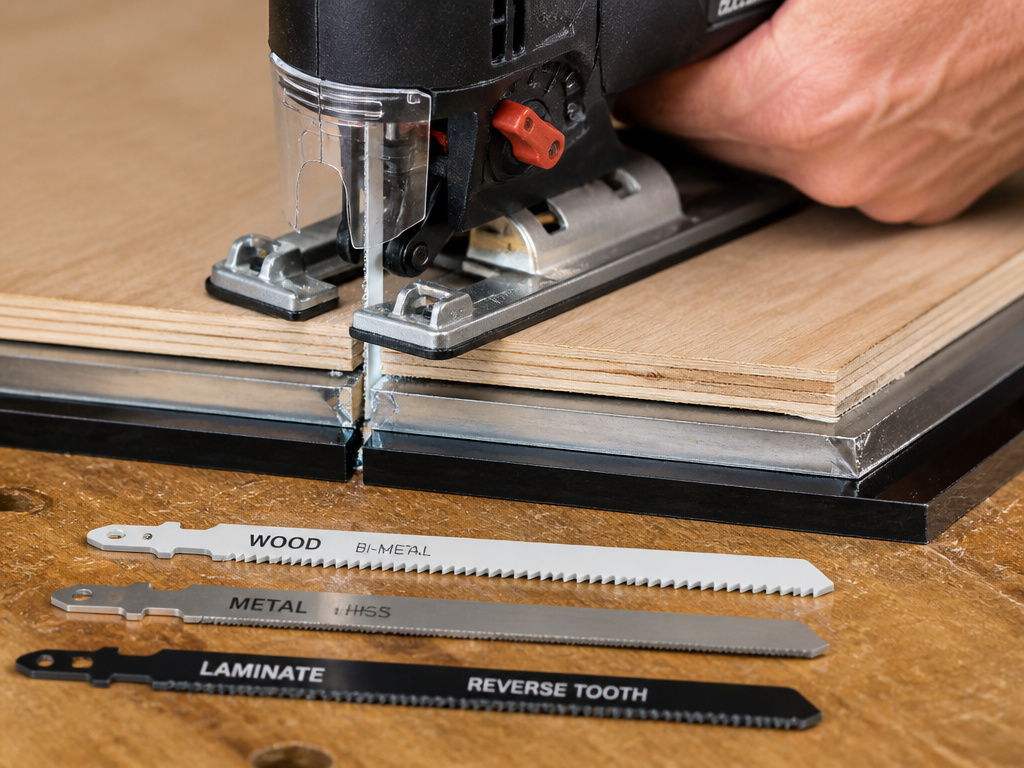
Here’s the decision tree. Forget generic “all-purpose” blades. Match the blade to the job.
Wood: For general construction (2x4s, plywood), a bi-metal blade with a lower TPI is your workhorse. For fine cuts in veneered plywood or to avoid top-side splintering, you need a reverse-tooth blade that cuts on the downstroke. For intricate curves, a narrow scroll blade is essential.
Metal: This is where HSS or BIM blades are mandatory. Use a blade with a higher TPI (within the 10–24 range) for thin sheet metal and a lower TPI for thicker stock. Always use cutting oil to cool the blade and increase its life. And for safety, plug your saw into a GFCI-protected outlet.
Plastics and Laminates: This is the easiest place to ruin a project. The friction heat melts plastic, welding the kerf shut behind the blade. The fix is in your saw’s settings: switch off the pendulum action and reduce the motor speed to around half maximum. Use a blade with fine, ground teeth. For laminate flooring, a dedicated blade like the Bosch T101BIF is worth it for splinter-free results.
Tough/Abrasive Materials: For cement board, fiberglass, or material with embedded nails, you step up to tungsten carbide (TC) or diamond-grit blades. These are for professionals cutting glass, granite, slate, or stainless steel. They’re expensive, but they’re the only thing that will last.
| Material | Blade Type | Key Setting | Pro Tip |
|---|---|---|---|
| Softwood / Plywood | BIM, 8-10 TPI | Pendulum: Medium/High | Use reverse-tooth blade for splinter-free top surface. |
| Metal (Sheet) | HSS/BIM, 18-24 TPI | Pendulum: Off | Use cutting oil and a GFCI outlet. |
| Plastic / Acrylic | HCS/BIM, Fine Tooth | Pendulum: Off, Speed: Low | Prevents melting and clogging. |
| Laminate Flooring | Specialty BIM (e.g., Bosch T101BIF) | Pendulum: Off | Designed for a clean, chip-free edge. |
| Tile / Cement Board | Tungsten Carbide Grit | Pendulum: Off, Speed: Medium | Let the grit do the work; don’t force it. |
Specialty Blades for Special Jobs
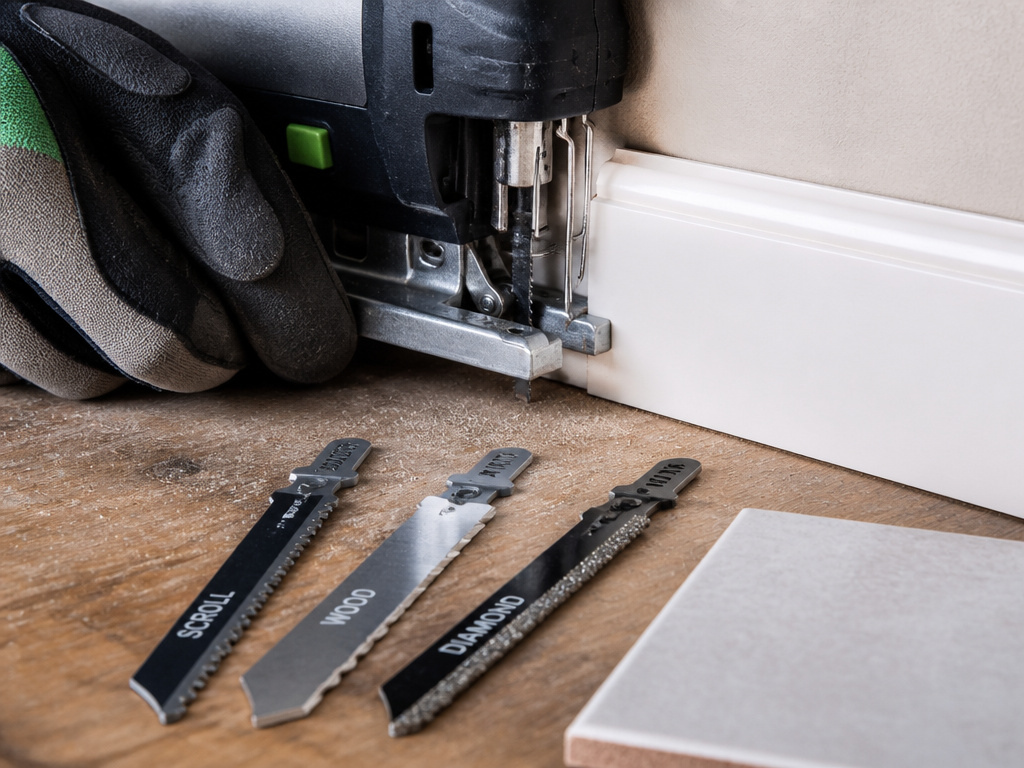
Sometimes you need a tool that does one thing perfectly. Jigsaw blades are no different.
Flush-Cut Blades have teeth that extend forward of the saw’s shoe. They let you cut right up against a wall or flush to a surface. Invaluable for trim work or cutting out outlet boxes in paneling.
Knife-Edge Blades have no traditional teeth; they’re a continuous sharp edge. They’re for soft materials like leather, cork, rubber, or foam insulation where a toothed blade would tear.
Scroll Blades are very narrow (often 1/4″ or less) to pivot tightly in intricate curves. They’re typically HCS for maximum flexibility.
Diamond-Grit Blades are essentially a strip of diamond-coated steel. They cut through ceramic tile, slate, and fiberglass. They create a huge amount of fine dust, wear a respirator.
The right specialty blade turns an impossible job into a five-minute task. Trying to cut laminate with a wood blade guarantees chipping. A flush-cut blade is the only way to trim that last bit of flooring under a cabinet.
Blade Length, Width, and Control
The physical dimensions of the blade affect stability and the type of cut you can make.
Length is straightforward. Your blade needs to be at least 1 inch longer than the thickness of your workpiece. To determine minimum blade length, add 1″ to the workpiece thickness. This ensures the teeth are still engaged at the top of the upstroke. For woodworking, common blade lengths include 75mm (3″), 105mm (4″), and 145mm (5-3/4″).
Width is the secret to control. A wide blade (over 1/2″) resists bending, giving you a straighter, more accurate cut in long lines. A narrow blade (1/4″ or less) is for curves. The narrower it is, the tighter the radius you can cut, but the more it will want to wander on a straight line.
Where this goes sideways: Using a narrow scroll blade for a long, straight cut. It will drift, guaranteed. You’ll fight it the whole way and the edge will be wavy. Match the blade width to the cut geometry.
Thickness matters too. A thicker blade is more rigid, aiding straight cuts, but it removes more material and cuts slower. A thin blade cuts faster and is more flexible for curves.
How to Know When a Blade is Dull
Blades don’t last forever. Using a dull blade is hard on your saw and gives terrible results. Here are the signs:
- It requires more force to push. The saw bogs down and you find yourself leaning into it.
- The cut quality degrades. You see more tear-out, burning along the edge (especially in wood and plastic), or a ragged, chewed-up finish on metal.
- It produces excess smoke. This is a dead giveaway. The blade is rubbing, not cutting.
- The sound changes. A sharp blade has a clean, crisp cutting sound. A dull blade has a higher-pitched whining or screaming noise.
A bi-metal blade might be salvageable for a different, softer material after it’s dulled on metal. But a burnt, blue-tinted HSS blade for metal is done. When in doubt, change it. A fresh blade is cheaper than the piece of material you’re about to ruin.
What is tooth set on a jigsaw blade?
The tooth set refers to how the teeth are shaped and positioned. A side set and milled tooth configuration is designed for fast, rougher cuts in wood and plastics. In contrast, a side set and ground tooth design is made for cleaner and faster cuts in the same materials. For precise, fine, and clean cuts in wood, use a ground and taper-ground tooth blade. These ground teeth produce a smoother cutline but cut slower and generate more heat. For cutting metals and plastics, a wavy set with milled teeth is the typical configuration.
What is a general purpose jigsaw blade?
A true multi-material blade is typically a bi-metal (BIM) construction. Select bimetal blades for cutting wood, metal, and laminates. They are ideal for working in hardwood, hard plastics, and metals. Bi-metal blades are known for their longer lifespan and prolonged job performance compared to other types. For general woodworking, high-carbon steel (HCS) blades are suitable for cutting wood, MDF, or plastic, and are ideal for soft wood and softer plastics. When using any blade, ensure at least two teeth are in the material at all times for optimal cutting.
Frequently Asked Questions
Do all jigsaw blades fit all jigsaws?
No. You must match the shank type (T-shank, U-shank, or proprietary) to your specific saw. Always check your tool’s manual or inspect the blade clamp. The T-shank is the most common modern standard.
What is the difference between T-shank and U-shank jigsaw blades?
T-shank blade has a T-shaped tang that slides into a tool-less lever clamp, providing a secure, wobble-free fit. A U-shank (or universal shank) has a U-shaped notch and is secured with a setscrew. T-shank is the professional standard; U-shank is common on older or budget saws.
What are the three main types of saw blades?
The three primary blade materials are High-Carbon Steel (HCS) for wood/plastic, High-Speed Steel (HSS) for metal, and Bi-Metal (BIM) for a durable combination. For shank types, the main two are T-shank and U-shank.
Can I use a wood blade to cut metal?
You should not. Wood blades (HCS) are too soft and will dull almost instantly on metal. The teeth are also the wrong geometry. You’ll ruin the blade, likely burn the metal, and put undue strain on your saw. Always use an HSS or BIM blade designed for metal.
What TPI is best for cutting plywood?
For clean cuts in plywood with minimal splintering, use a blade with a higher TPI (such as within the 10–24 range) and ground teeth. A reverse-tooth blade is even better, as it cuts on the downstroke to prevent splintering on the top, visible face of the plywood.
The Bottom Line
Choosing a jigsaw blade isn’t about grabbing the one that’s handy. It’s a matching game: material, thickness, desired finish, and your saw’s capability. A key rule for optimal cutting? Ensure enough teeth are engaged, Bosch recommends 2–3 teeth in the material. That simple check will prevent most burning, breaking, and rough results.
For most DIYers building up a kit, start with a pack of good-quality bi-metal blades in a mix of TPIs (like 10 and 14). They’ll handle 90% of what you throw at them, from plywood to PVC pipe, and they last. Your cuts will be cleaner, your saw will last longer, and you’ll spend less time sanding rough edges. That’s the whole point.
