
What Does Ah Mean on a Power Tool Battery? How to Choose
This post contains affiliate links. As an Amazon Associate, we earn from qualifying purchases.
Ah on a power tool battery stands for amp-hour, a unit that measures its electrical storage capacity. It tells you how much current the battery can deliver over one hour before it’s depleted. A higher Ah rating means a longer runtime, not more power. For example, a DeWALT 20V MAX 5.0Ah battery can theoretically deliver 5 amps of current for one hour, while a 2.0Ah battery from the same platform delivers 2 amps for one hour.
That definition is the starting line, not the finish. The real question isn’t just what does Ah mean on a power tool battery, it’s how that number translates to your drill stalling mid-hole or your saw finishing a cut. The difference between a 2.0Ah and a 5.0Ah battery isn’t just minutes on a clock; it’s the sustained voltage under load, the heat buildup in the cells, and the physical weight you’ll carry all day.
What follows: a breakdown of the fuel-tank analogy and where it leaks, a look at how cell configuration changes the game, manufacturer-specific rules for mixing and storing batteries, and the one spec (Wh) that often matters more than Ah alone.
Key Takeaways
- Ah measures capacity, not power. A higher Ah battery runs longer on a single charge but doesn’t make your tool more powerful, voltage does that.
- Runtime depends on the tool’s appetite. A hungry tool like a circular saw will drain a 2.0Ah battery much faster than a drill, which might run for over an hour.
- Manufacturers disagree on optimal storage charge. STIHL and DeWALT recommend 40%-60%, while Kincrome suggests a specific two-light indicator level for long-term storage.
- Mixing Ah ratings within a brand is usually safe for the tool, but using a vastly higher-capacity battery can void warranties if it’s not an official product.
- Watt-hours (Wh) give a truer energy picture across different voltage platforms, calculated by multiplying voltage (V) by amp-hours (Ah).
What Ah Measures: The Fuel Tank Analogy
Think of Ah as the size of your battery’s fuel tank. A 2.0Ah battery is a small gas can; a 5.0Ah is a five-gallon jerry can. Both can run the same engine (your tool), but the larger capacity lets you work longer before you need to recharge. This analogy is useful, but it breaks down in two places.
First, a fuel tank drains linearly. A battery doesn’t. Under heavy load, like a circular saw bogging down in wet lumber, the voltage sags, and the effective capacity drops. You might get 30 minutes of light drilling from a 5.0Ah pack but only 12 minutes of aggressive sawing. Second, fuel is inert. Battery cells wear out. Each charge cycle degrades them slightly, so a two-year-old 5.0Ah battery might only hold the energy of a new 4.0Ah pack.
A DeWALT 20V MAX 2.0Ah battery charges in 60 minutes on a standard 2A charger but in 30 minutes on a fast 8A charger. The 5.0Ah version needs 120 minutes on the standard charger and 60 minutes on the fast charger. Faster charging often means more heat, which can shorten overall cell lifespan if done repeatedly.
The unit itself, as defined in a DeWALT manual, is straightforward: Ah … Amp hours. It’s a measurement of electric charge. One amp-hour means the battery can supply one ampere of current for one hour. If your tool draws 2.5 amps (like many mid-torque drills on medium setting), a 5.0Ah battery should last about two hours in a perfect world.
Voltage vs. Ah: Power vs. Endurance
This is the most common confusion. Voltage (V) is the pressure behind the current. It determines how much force the motor can produce. Ah is the volume of current available. It determines how long that force can be sustained.
A 12V drill with a 5.0Ah battery has plenty of runtime but relatively low torque for driving large lag bolts. An 18V (nominal) drill with a 2.0Ah battery has higher potential torque but will quit faster under heavy use. They are different tools for different jobs. When comparing volts and amps, remember: voltage is the muscle, amp-hours are the stamina.
Here’s how they split the work:
| Specification | What It Controls | Real-World Effect | Analogy |
|---|---|---|---|
| Voltage (V) | Power & Torque | Ability to drive a large screw, cut thick material, or spin a blade fast. | The size of the engine. |
| Amp-hours (Ah) | Runtime & Capacity | How many screws you can drive or how many cuts you can make before recharge. | The size of the fuel tank. |
| Watt-hours (Wh) | Total Energy | Allows direct comparison between different voltage systems (e.g., 12V vs 20V). | The total miles you can drive on a tank. |
Watt-hours, calculated as Voltage x Amp-hours, is the spec that matters if you want to compare a 12V system to a 20V system on equal footing when you compare a what does ah mean on a power tool battery. A 12V 5.0Ah battery holds 60 Wh. An 18V (nominal) 3.0Ah battery holds 54 Wh, they’re in the same ballpark for total energy, even though their voltage and Ah are different.
The Real-World Impact of Ah on Runtime
Abstract numbers are useless without concrete examples. Your tool’s motor draws current (amps) based on the resistance it meets. Push a drill hard into dense wood, and the current draw spikes. Gently drive a small screw, and it sips power.
Here are the specifics. Based on common motor draws and the capacity options listed in the DeWALT 20V MAX spec sheet (1.5Ah to 8.0Ah), here’s what you can roughly expect:
| Tool Type | Typical Current Draw | 2.0Ah Battery Runtime | 5.0Ah Battery Runtime |
|---|---|---|---|
| Drill/Driver (Light Duty) | 2-3 A | ~40-60 min | ~100-150 min |
| Circular Saw (Cutting 2×4) | 15-20 A | ~6-8 min | ~15-20 min |
| Reciprocating Saw | 10-15 A | ~8-12 min | ~20-30 min |
| LED Work Light | 0.5 A | ~4 hours | ~10 hours |
These are estimates for new batteries under ideal temperatures. Cold weather can significantly reduce battery runtime. A battery that feels warm to the touch after heavy use is losing efficiency to heat, not just delivering power to the tool.
The runtime differences between batteries are not linear, which is a key nuance to the what does ah mean on a power tool battery question. A 5.0Ah battery doesn’t always last exactly 2.5 times longer than a 2.0Ah battery. High-drain tools stress cells, causing voltage to drop earlier in the discharge cycle. You might get only double the runtime from the larger pack when running a saw at full tilt.
Inside the Battery: How Cell Configuration Changes the Game
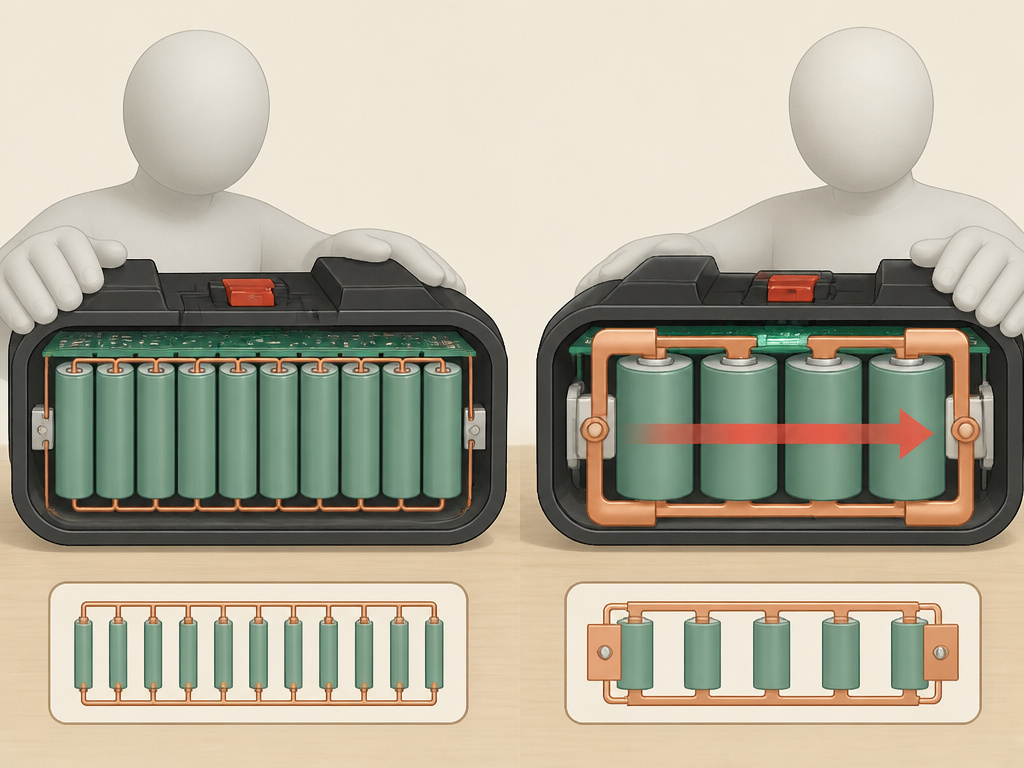
Two batteries can have the same Ah rating but behave differently. This is where cell configuration, how the individual lithium-ion cells are wired inside, comes in.
A 2.0Ah battery might use five 18650 cells, each rated at 2.0Ah, wired in parallel (positive to positive, negative to negative). This adds capacity. A 4.0Ah battery could use ten of the same 2.0Ah cells, also in parallel. Simple.
But a high-performance battery might use a different internal cell configuration to better deliver high current. This setup can deliver higher sustained current without overheating, which is why some 4.0Ah batteries are rated for “high-demand” tools while others aren’t. You can’t see this from the outside; you have to trust the brand’s labeling or dig into the spec sheet.
Where this goes sideways: Assuming two 4.0Ah batteries are interchangeable. One might use cheaper cells that sag under load, causing your tool to feel sluggish and overheat the battery pack, shortening its overall lifespan.
This is part of understanding how lithium-ion batteries work. The chemistry dictates the base performance, but the assembly dictates how that performance is delivered.
Can You Mix Different Ah Batteries in the Same Tool?
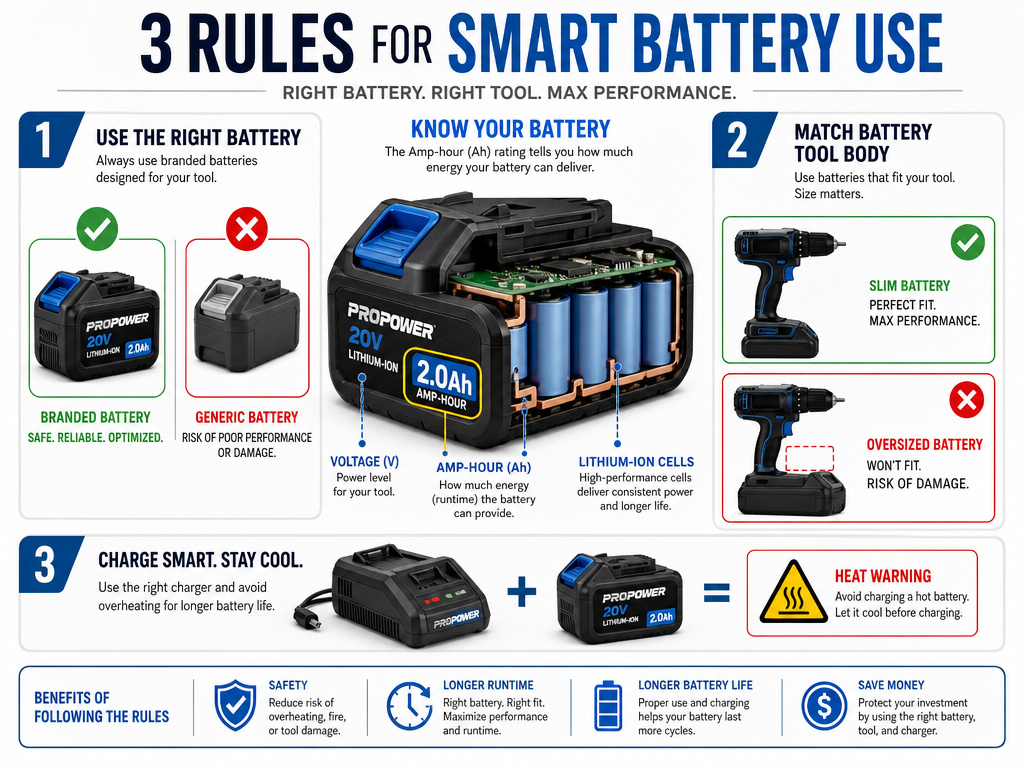
Yes, with caveats. Within the same voltage platform (e.g., all DeWALT 20V MAX batteries), the tool only cares about voltage. It will draw the current it needs until the battery is depleted. A drill doesn’t know if it’s powered by a 1.5Ah or an 8.0Ah battery; it just runs until the battery’s protection circuit says stop.
However, three critical rules apply:
- Use only brand-approved batteries. SKIL’s manual states clearly: “Use of chargers or battery packs not sold by SKIL will void the warranty.” Third-party or “compatible” batteries might have different voltage profiles or lack proper protection circuits, risking tool damage.
- Heed physical compatibility. Some compact tools are designed for slim 1.5Ah or 2.0Ah packs. A bulky 8.0Ah battery might not fit, or it could make the tool dangerously unbalanced.
- Understand the charger’s role. Fast chargers (like DeWALT’s 8A model) are designed for specific capacities. Charging a small 1.5Ah battery on a high-amperage charger can generate excessive heat.
The main trade-off is weight and cost. Putting a 5.0Ah battery on a small drill turns it into a wrist-heavy beast, often for no benefit if you’re just doing quick tasks. For most users, owning two or three mid-size batteries (like 3.0Ah or 4.0Ah) offers the best balance of runtime, weight, and cost, which is a key consideration when choosing batteries for a kit.
Beyond Ah: Watt-hours and Caring for Your Battery
Amp-hours tell part of the story. Watt-hours (Wh) tell the whole story for cross-platform comparison. As the DeWALT manual notes, Wh … Watt hours. You calculate it: Nominal Voltage (V) x Amp-hours (Ah) = Watt-hours (Wh).
The Wh rating accounts for both voltage and capacity, giving you a true measure of total energy. This is why an 18V 5.0Ah battery will vastly outlast a 12V 5.0Ah battery on similar tasks, it has more total energy to spend.
To protect that investment, follow manufacturer guidelines, which often conflict. For long-term storage: * STIHL & DeWALT: Store at 40%-60% charge. * Kincrome: Store with a charge state of 2 indicator lights (which their manual suggests corresponds to 25-50% charge) and recommends discharging to one light then charging back to two before long storage.
- Temperature: DeWALT says storage range is -4°F to 122°F (-20°C to 50°C); Milwaukee Tool says do not exceed 120°F (50°C); Kincrome recommends short-term storage below 27°C (80.6°F).
For charging:
- DeWALT: 50°F – 86°F (10°C – 30°C).
- SKIL: 39.2°F – 104°F (4°C – 40°C).
- Husqvarna: 5°C – 40°C (41°F – 104°F) for the charger ambient temperature.
Manufacturers provide different specific ranges, but the common advice is to avoid temperature extremes. Don’t charge a frozen battery or leave it baking in a truck. And never, as Milwaukee Tool warns, use oil or solvents to clean the pack, the plastic will become brittle and crack.
Frequently Asked Questions
Is a higher Ah battery always better?
No. Higher Ah means longer runtime but also more weight, more cost, and sometimes longer charge times. For a lightweight drill used overhead, a compact 2.0Ah battery is often “better” than a heavy 8.0Ah one. Match the capacity to the tool’s typical use and your tolerance for weight.
Can I use a 5.0Ah battery in a tool that came with a 2.0Ah?
Generally, yes, if it’s the same brand and voltage platform. The tool will run longer. Ensure the larger battery physically fits and doesn’t create a balance hazard. Refer to your tool’s manual to be certain.
Does a higher Ah battery charge slower?
Often, yes. A DeWALT 2.0Ah battery charges in 60 minutes on a standard charger, while a 5.0Ah takes 120 minutes. Fast chargers reduce but don’t eliminate this difference. Charge time depends on the charger’s output (amps) and the battery’s capacity (Ah).
What affects real-world battery runtime besides Ah?
Three major factors: tool load (high-drain tools cut runtime), battery age and health (old batteries hold less charge), and ambient temperature (cold temperatures temporarily reduce capacity, while heat accelerates permanent degradation). Understanding these factors affecting battery runtime is key to setting expectations.
The Bottom Line
Ah is a simple number that hides complex physics. It’s your best starting point for guessing runtime, but it’s not the whole manual. Once you know you need, say, 18V for the job, let Ah guide your choice based on how long you need to work between charges.
If you’re building a deck, spring for the 5.0Ah or 6.0Ah batteries for your saw and impact driver. If you’re just assembling furniture or doing light repairs, a couple of 2.0Ah or 3.0Ah batteries will be lighter, cheaper, and more than enough. And always check the Watt-hour rating if you’re comparing across different voltage brands, it’s the only way to compare total energy apples-to-apples.
Finally, treat the battery as part of the tool, not a disposable accessory. Follow the storage specs, use the official charger, and avoid deep discharges. That’s how you get the years of service the label promises, regardless of the Ah number stamped on the side.
