
What Is a High Speed Ratchet? Anatomy and RPM Explained
This post contains affiliate links. As an Amazon Associate, we earn from qualifying purchases.
A high speed ratchet is a power tool, either cordless like the Milwaukee M12 FUEL or pneumatic like the Ingersoll Rand 1211MAX-D4, designed to spin fasteners at high RPMs (450-625) for rapid installation and removal, not for high breakaway torque. Its compact head and ability to work in tight spaces make it a productivity tool for mechanics and technicians, distinct from the high-torque, hammering action of an impact wrench.
The distinction between speed and torque is the entire game when considering what is a high speed ratchet. A standard ratchet, even a powered one, might prioritize muscle. A high speed model trades raw twisting force for pure velocity. It’s for running a bolt down a long thread in seconds, not for breaking it loose. Get that wrong, and you burn out the motor or strip the fastener.
What follows is a breakdown of the specs that matter. RPM, torque, head size, and where these tools actually earn their keep. We’ll compare cordless to pneumatic, explain why they’re not impact wrenches, and name the situations where they save hours.
Key Takeaways
- High speed ratchets are speed tools, not torque tools; the Milwaukee M12 FUEL models spin at 0–450 RPM but max out at 35 ft-lbs.
- The primary benefit is access in tight spaces, thanks to a head profile as slim as 0.75 inches.
- For breaking loose stuck fasteners, you still need a breaker bar or impact wrench; a high speed ratchet is for the run-down and run-off.
- Cordless models offer unmatched portability, while pneumatic (air) models deliver higher sustained speed and often more torque.
- These are ratchet wrenches, not torque wrenches; always check critical final torque with a dedicated torque wrench.
What Does “High Speed” Actually Mean? RPM and Real-World Pace
Forget the generic “faster than a regular ratchet” line. The speed is quantified. The Milwaukee M12 FUEL high speed ratchets have a range of 0–450 RPM. A pneumatic model like the Ingersoll Rand 1211MAX-D4 has a free speed of 625 RPM. That’s the free speed, the maximum no-load spin rate.
A high speed ratchet’s primary function is to rapidly install or remove fasteners along their existing thread path. It uses a standard ratcheting square drive anvil (common sizes are 1/4″ and 3/8″) and is powered by an electric or pneumatic motor, distinguishing it from manual ratchets and impact wrenches.
That’s the pace change when you understand what is a high speed ratchet. You’re not patiently cranking; you’re pulling the trigger and the socket blurs. The sound is a continuous, high-pitched whir, not the brrrp-brrrp of an impact. That sound tells you it’s working correctly, a strained, lower grunt means you’re asking for more torque than it’s built to give.
The Anatomy of a High Speed Ratchet: More Than Just a Motor
It’s a clever repackaging of mechanics. The outside is simple: a head, a motor housing, a trigger, and a battery or air hose connection. The inside is where the design constraints show.
The head has to be tiny. Milwaukee lists a 0.75-inch head profile for its M12 FUEL 3/8″ high-speed ratchet (Cat. No. 2567-20). That’s the thickness. This allows the tool to fit into narrow spaces between engine blocks and frame rails, which a standard impact wrench’s bulky hammer mechanism cannot. Inside that head is a planetary gear set, the same basic reduction system used in drills, that takes the motor’s high rotation and turns it into the anvil’s spin. It’s a sealed system. The Milwaukee operator’s manual is explicit: the tool, battery pack, and charger should never be disassembled by the user. Repairs go to a service facility.
The motor in a cordless model is almost always brushless (Milwaukee calls theirs a POWERSTATE™ Brushless Motor). This isn’t marketing fluff. A brushless motor is more efficient, generates less heat, and lasts longer, which is critical when you’re asking a small tool to sustain high RPMs. The battery tech matters, too. These tools live on compact platforms like the M12™ system, balancing power and size.
High Speed vs. High Torque: The Critical Distinction
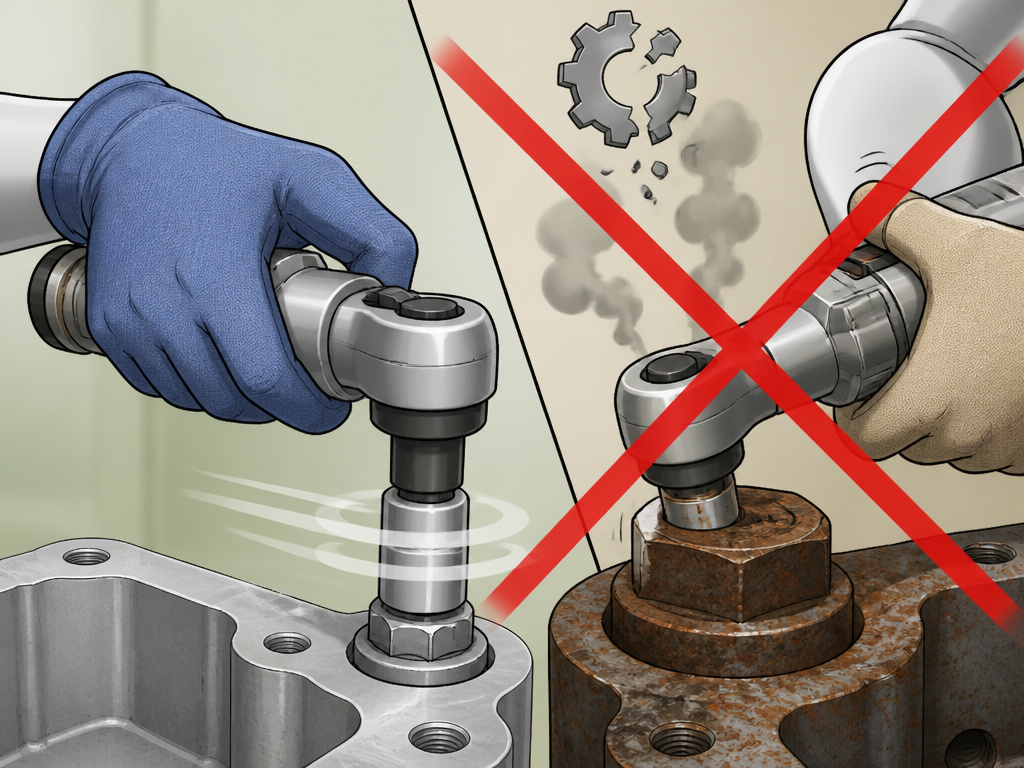
This is the most common point of confusion, and getting it wrong costs you money and broken tools.
A high speed ratchet is built for velocity. Its maximum torque is a fraction of an impact wrench’s. The Milwaukee M12 FUEL 3/8″ and 1/4″ models are rated for 35 ft-lbs max. An impact wrench of the same size might deliver 200 ft-lbs. The pneumatic Ingersoll Rand model claims 80 ft-lbs of nut busting torque, which is for a 1/2″ drive tool.
| Tool Type | Primary Function | Typical Max Torque | Mechanism | Best For |
|---|---|---|---|---|
| High Speed Ratchet | Rapidly spin fasteners on/off | 35–80 ft-lbs | Direct gear drive | Running down long threads, tight spaces |
| Impact Wrench | Loosen stuck fasteners, high-torque driving | 150–1000+ ft-lbs | Hammer and anvil | Lug nuts, suspension bolts, high-torque applications |
| Standard Power Ratchet | General fastener driving | 20–60 ft-lbs | Direct gear drive | General assembly, lower-speed work |
Where this goes sideways: Using a high speed ratchet to break loose a crank bolt. The motor will stall, the internal gears will shock load, and you’ll either strip the bolt or burn out the tool. The gear train isn’t designed for shock.
The mechanism difference is key. An impact wrench delivers torque through concussive, rotating blows. A high speed ratchet delivers smooth, continuous rotational force, just like a drill. It has no hammering action. This is why the safety guide for air ratchets explicitly states: Ratchet wrenches are not torque wrenches. Connections needing specific torque must be checked with a torque meter.
If you’re weighing a cordless ratchet vs impact wrench, remember: one is a speedster for accessibility, the other is a brute for force. They are companions, not substitutes.
Cordless vs. Pneumatic: The Power Source Showdown
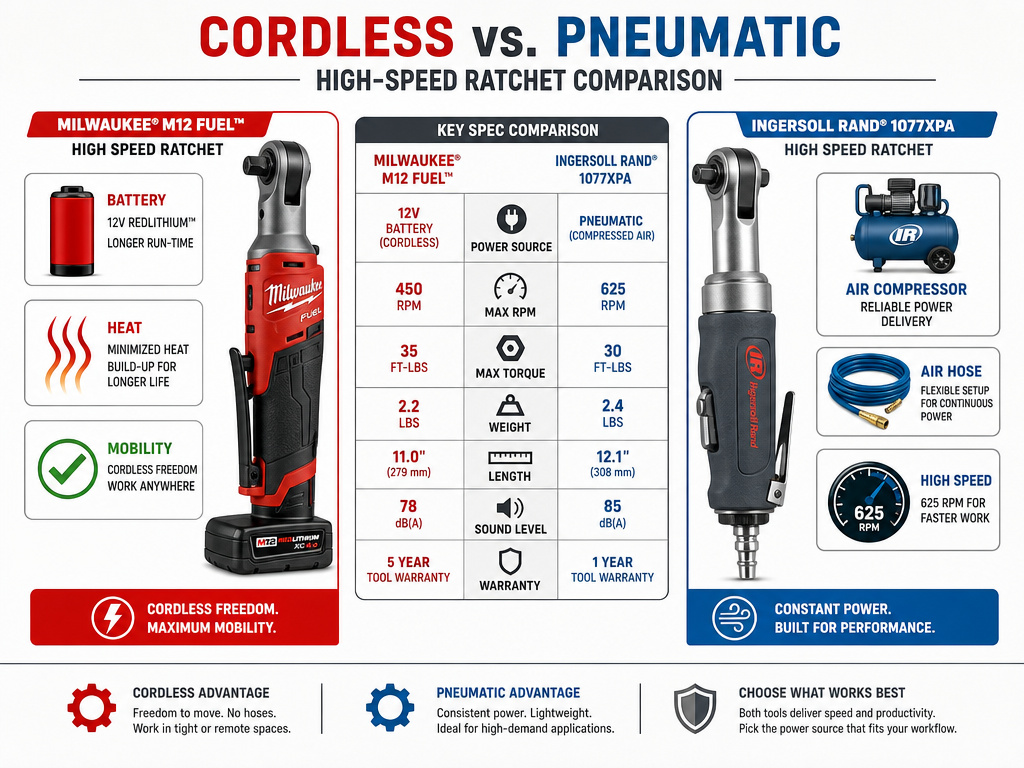
Your shop setup decides this. Both types are “high speed,” but their personalities are different.
Cordless (Electric) High Speed Ratchets, like the Milwaukee M12 FUEL, are defined by convenience. No hose. You grab it and go. The trade-off is that even brushless motors generate heat under sustained use, which can trigger thermal protection. The speed is also load-dependent; as resistance increases, RPM drops. They’re perfect for mobile mechanics, quick jobs, or shops where dragging an air hose is a hassle. Our roundup of the best cordless ratchets digs into the top contenders.
Pneumatic (Air) High Speed Ratchets, like the Ingersoll Rand 1211MAX-D4, are shop anchors. They run cooler and can sustain their rated 625 RPM free speed as long as your compressor keeps up. The Ingersoll Rand 1211MAX-D4, for example, uses a twin hammer mechanism. But they demand infrastructure: a compressor, air hoses, and regulators. General safety guidelines call for using clean, dry air at 90 psig maximum at the inlet, unless the tool specifies a higher rating. The safety manual mandates using a Safety Air Fuse and anti-whip device on the hose to prevent injury if a coupling fails.
| Factor | Cordless High Speed Ratchet | Pneumatic High Speed Ratchet |
|---|---|---|
| Power Source | Battery (e.g., M12™) | Compressed Air (90 psig max) |
| Max RPM (Example) | 450 RPM (Milwaukee) | 625 RPM (Ingersoll Rand) |
| Torque (Example) | 35 ft-lbs (Milwaukee) | 80 ft-lbs nut busting (Ingersoll Rand) |
| Infrastructure Needed | Battery & Charger | Compressor, Hose, Regulator, Filtration |
| Mobility | Excellent | Tethered to air hose |
| Maintenance | Battery care, electronics | Lubricator, water filter, hose inspection |
| Noise | Motor whine | Motor whine + exhaust hiss |
For a deeper dive on this choice, our comparison of electric ratchet vs air ratchet breaks down the long-term costs and performance.
Primary Use Cases: Where This Tool Earns Its Keep
You don’t buy a high speed ratchet for everything. You buy it for specific, repetitive tasks where its unique profile pays off.
- Automotive/Mechanical Work: This is the home ground. Think valve cover bolts, intake manifold bolts, transmission pan bolts, anywhere you have a cluster of fasteners in a confined space. You break them loose with a breaker bar or impact wrench, then use the high speed ratchet to zip them all out in a fraction of the time.
- Assembly Line/Production Work: Running down dozens of identical fasteners to a consistent snug point before final torque. The speed directly boosts productivity.
- Appliance Repair: Dishwashers, washing machines, cramped spaces with sheet metal covers held by many small bolts. The slim head is a lifesaver.
- Tight Clearance Work: Anywhere a standard impact or even a power ratchet with a bigger head can’t physically fit. The 0.75-inch head profile is the selling point.
Common mistake: Using it for the initial break-loose on a rusty or over-torqued fastener. You’ll hear the motor bog and strain. That’s the sound of you shortening the tool’s life. Use the correct air ratchet or impact technique for breaking torque, then switch to speed.
The pattern is consistent: access and repetition. If you’re doing a one-off project on an open bench, a standard drill or ratchet might suffice. If you’re facing a tight engine bay with 20 identical bolts, the high speed ratchet is your best friend.
Key Specifications to Decode Before You Buy
The spec sheet tells the real story. Here’s what to look for, with real numbers from our fact sheet.
- Drive Size: This determines your socket size. 1/4″ and 3/8″ are most common for high speed models, balancing size and capability. The Milwaukee M12 FUEL comes in both. A 1/2″ drive, like the Ingersoll Rand, is for heavier work but has a larger head.
- RPM (Revolutions Per Minute): The speed rating. 0–450 RPM (Milwaukee) or 625 RPM (Ingersoll Rand). Higher isn’t always better, control matters. A variable-speed trigger is essential.
- Maximum Torque: The twisting force limit. 35 ft-lbs for the Milwaukee. This is a critical ceiling. Exceed it regularly, and you will damage the tool.
- Head Profile/Size: Often listed as head thickness. 0.75 inches is a best-in-class claim. Measure the spaces you work in.
- Battery Platform (Cordless): This locks you into an ecosystem. The Milwaukee runs on the M12™ system. Don’t buy the tool without considering the cost and availability of batteries.
- Air Requirements (Pneumatic): Check CFM (Cubic Feet per Minute) and PSI. The Ingersoll Rand 1211MAX-D4 has a CFM High rating of 13.7 CFM and an Average CFM of 4, and requires a maximum of 90 psig at the inlet. Your compressor must meet this.
- Warranty: This signals expected durability. Milwaukee offers a five-year warranty on the tool, with exceptions as outlined in its warranty terms. Ingersoll Rand offers a one-year warranty. Read the exclusions.
Safety and Operational Limits You Can’t Ignore
These tools are safe when used within their design box. Step outside it, and the risks are physical and mechanical.
- Temperature Limits: The Milwaukee operator’s manual (USA & Canada section) specifies a recommended ambient operating temperature of 0°F to 125°F, which is equivalent to -18°C to 50°C in its French Canadian section. Storing or using it outside this range can damage the battery and electronics. It also warns not to expose a battery pack or tool to fire or temperatures above 265°F (130°C), as that may cause an explosion.
- Electrical Safety: The manual states: Hold the power tool by insulated gripping surfaces when the fastener may contact hidden wiring. General safety guidelines for air ratchets state the tool is not insulated against electric shock.
- Air Supply Safety (Pneumatic): The general safety guide is strict. Always use clean, dry air. Damaged, frayed, or deteriorated air hoses should not be used. You must turn off, bleed, and disconnect the air supply before changing accessories or performing maintenance.
- Personal Protective Equipment (PPE): Safety glasses are non-negotiable. Gloves protect your hands from sharp edges and pinching. Hearing protection is advised for prolonged use, especially with pneumatic tools.
The overarching rule is respect the tool’s purpose. It’s a precision speed instrument, not a universal brute. Learning how to use a cordless ratchet properly means understanding these boundaries.
Frequently Asked Questions
What is a high speed ratchet used for?
It’s used to quickly install or remove multiple fasteners in tight, confined spaces where speed is more valuable than extreme torque. Common applications include automotive repair (valve covers, intake manifolds), appliance repair, and any production assembly work.
Is a high speed ratchet the same as an impact wrench?
No. They are fundamentally different tools. A high speed ratchet provides continuous, smooth rotation for speed. An impact wrench delivers high, concussive torque through a hammering mechanism for breaking loose stuck fasteners. They are often used together in a workflow.
What is the most powerful high speed ratchet?
“Powerful” is ambiguous. For highest RPM, pneumatic models like the Ingersoll Rand 1211MAX-D4 at 625 RPM are common. For highest torque in a compact cordless format, models like the Milwaukee M12 FUEL deliver 35 ft-lbs max, which is low compared to impact wrench torque. Check our guide to the best electric ratchets for current top performers.
Can a high speed ratchet replace my air ratchet?
Cordless high speed ratchet can replace an air ratchet for mobility and convenience, especially for lighter to medium-duty tasks. For heavy, continuous-duty shop work where sustained speed and cooler operation are critical, a pneumatic air ratchet may still be preferred. The need for a compressor is the main trade-off.
What drive size should I get: 1/4″ or 3/8″?
For most automotive and general mechanical work, 3/8″ drive is the most versatile. It offers a robust connection and access to a vast range of socket sizes. 1/4″ drive is excellent for very small fasteners and extremely tight spaces, like electronics or small appliances. Your existing socket set likely dictates the choice.
The Bottom Line
A high speed ratchet is a specialist. It won’t be your most-used tool, but in the specific situations it’s designed for, a cluster of bolts in a deep, narrow cavity, nothing else comes close. The choice between cordless and pneumatic boils down to your shop’s heartbeat: the freedom of a battery or the relentless power of an air line.
Remember the 35 ft-lbs torque ceiling on leading cordless models. That’s the hard limit. Treat it as a speed tool, use it to run fasteners down and out after the hard work is done, and it will last for years. Pair it with an impact wrench for breaking torque, and you have a professional-grade fastener workflow. For a broad look at the top options across categories, our reviews of the best power ratchets can point you to the right model for your bench.
