
Power Tool Combo Kits Pros and Cons: How to Choose
This post contains affiliate links. As an Amazon Associate, we earn from qualifying purchases.
Choosing a power tool combo kit over buying individual tools is a cost-benefit calculation based on three things: the real quality of the “free” tool included, the battery and charger pack, and the platform you’re committing to for the next decade. The pros are upfront savings and ecosystem convenience; the cons are weaker tools, mismatched batteries, and locking into a brand that might not have the next specialty tool you need.
The 20V Max label on the box isn’t a power rating; it’s a marketing convention for a nominal 18-volt system. The DEWALT DCF845 impact driver, for example, specifies a maximum torque of 1,825 in-lbs, but that output depends entirely on the battery you pair with it, a detail many kit buyers miss. This gap between the promise on the box and the performance in your hand is where kit value is won or lost, a central point in any discussion of power tool combo kits pros and cons.
What follows is a field-level audit. We’ll decode the spec sheets, compare warranty fine print, and break down how to spot a bundle of real value versus a box of future regrets.
Key Takeaways
- The biggest hidden cost isn’t the price tag; it’s the underpowered “filler” tool you’ll use once and the weak batteries that force constant charging mid-job.
- A “20V MAX” label means an 18-volt nominal system, the 20V figure is a peak, no-load measurement.
- Kit warranties vary dramatically: a 5-year tool warranty (like Benchmark’s) is a serious commitment, while DEWALT offers a 3-year limited warranty, 1-year free service, and a 90-day money-back guarantee.
- The most important spec isn’t torque or speed; it’s the battery’s watt-hour (Wh) rating, which determines real runtime.
- Never buy a kit for a tool you wouldn’t purchase separately at full price.
The Hidden Price You Actually Pay (and the 2 Questions That Reveal It)
You see a box with a drill, an impact driver, two batteries, a charger, and a bag for less than the drill alone. It looks like stealing. That feeling is the first trap.
The real price isn’t on the sticker. It’s the future upgrade cost you’ll incur when the 1.3Ah battery drains after ten deck screws, or when the brushed motor on the “free” circular saw starts smoking on its second sheet of plywood. I learned this the hard way early on, chasing the deepest discount on a store-brand kit. The drill chuck wobbled within a year, and the tiny batteries couldn’t finish a small shelving project. I ended up replacing the whole system within eighteen months, effectively paying twice.
To spot real value, ask two questions before you touch your wallet: 1. Would I buy this specific tool model as a standalone purchase? 2. Is the battery capacity (in Ah) and charger speed matched to the work I’ll actually do?
If the answer to either is no, you’re not getting a discount. You’re prepaying for frustration.
The 20V MAX Voltage Label Means What, Exactly?
Walk any tool aisle and you’re bombarded with 20V MAX branding. It sounds more powerful than 18V, doesn’t it? Here is the explanation.
Per the official DEWALT DCK2101QQ2 sell sheet and the BLACK+DECKER manual, “20V MAX” refers to the maximum initial battery voltage measured without a load. The nominal, working voltage is 18 volts. Every major brand using this label (DEWALT, BLACK+DECKER, Benchmark) is playing the same marketing game.
Common mistake: Assuming a 20V MAX tool is more powerful than an 18V tool. They are the same nominal voltage. The true power difference comes from motor design and battery discharge capability, not the label.
This isn’t just semantics. It reframes your entire comparison of buying tools separately versus buying a kit. Don’t compare a 20V MAX kit to an 18V kit. Compare the actual motor specs (brushless vs. Brushed) and the battery’s watt-hour output.
Anatomy of a Kit: Dissecting a Real Spec Sheet
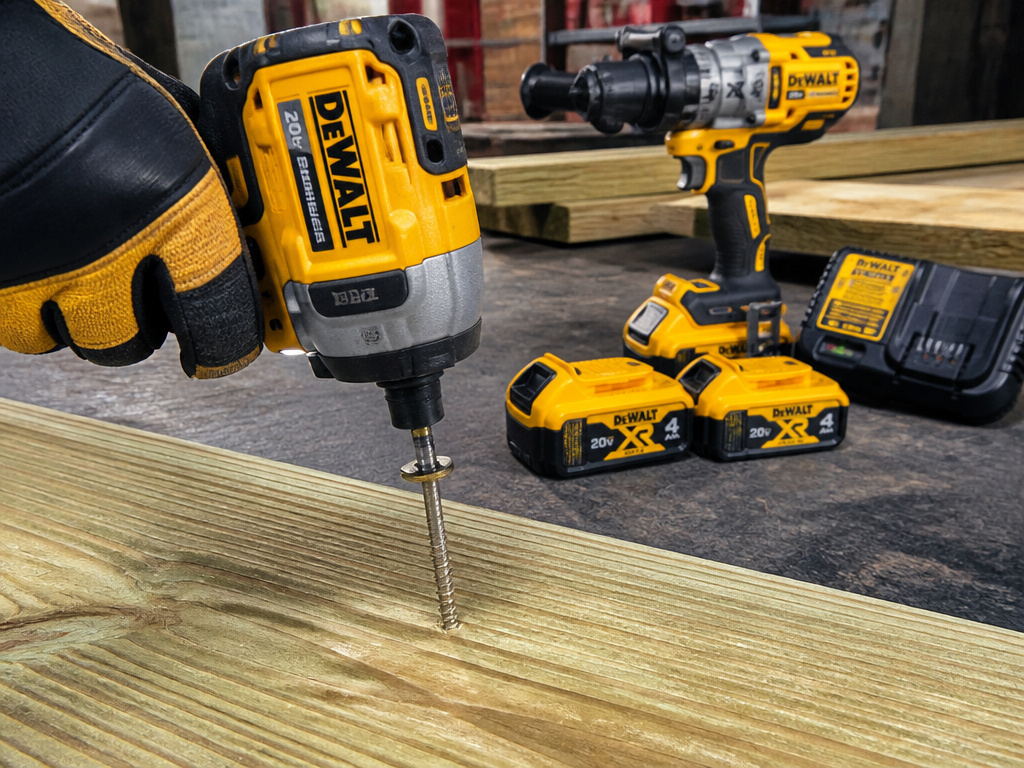
We will focus on the important numbers instead of marketing claims. Using the DEWALT DCK2101QQ2 kit as a benchmark, here’s what a robust spec sheet looks like.
The kit includes the DCD1007 hammer drill and the DCF845 impact driver. The drill’s maximum power is listed as 1,211 MWO with the included 4Ah battery, jumping to 1,530 MWO with a larger, separately sold battery, showing the tool can grow with your needs. The impact driver delivers 1,825 in-lbs of torque across three speed settings.
Here’s how these core tools stack up against common DIY tasks:
| Tool & Key Spec | Ideal For | Will Struggle With |
|---|---|---|
| DCD1007 Drill (1/2″ Chuck, 0-2,000 RPM) | Drilling holes up to 1/2″ in wood/metal, light masonry with hammer function. | Repeated, large-diameter (>1/2″) holes in steel or thick concrete. |
| DCF845 Impact (1,825 in-lb, 3-Speed) | Driving long lag bolts, deck screws, and general assembly. | Delicate trim work (use drill clutch on low setting instead). |
| 2x 4Ah Batteries (144 Wh total) | A full day of mixed drilling/driving for a DIYer. | Continuous use of a high-draw tool like a circular saw (needs larger/extra packs). |
| Standard Charger | Overnight charging, maintaining a set of batteries. | Fast turnaround on a job site (requires a fast charger, sold separately). |
This table reveals the kit’s boundaries. It’s excellent for building a deck or remodeling a room, but it’s not an industrial framing or concrete rig. Knowing the power tool combo kits pros and cons before you buy is the difference between satisfaction and a garage sale.
Battery Math: Why Amp-Hours Are a Lie (and Watt-Hours Are Truth)
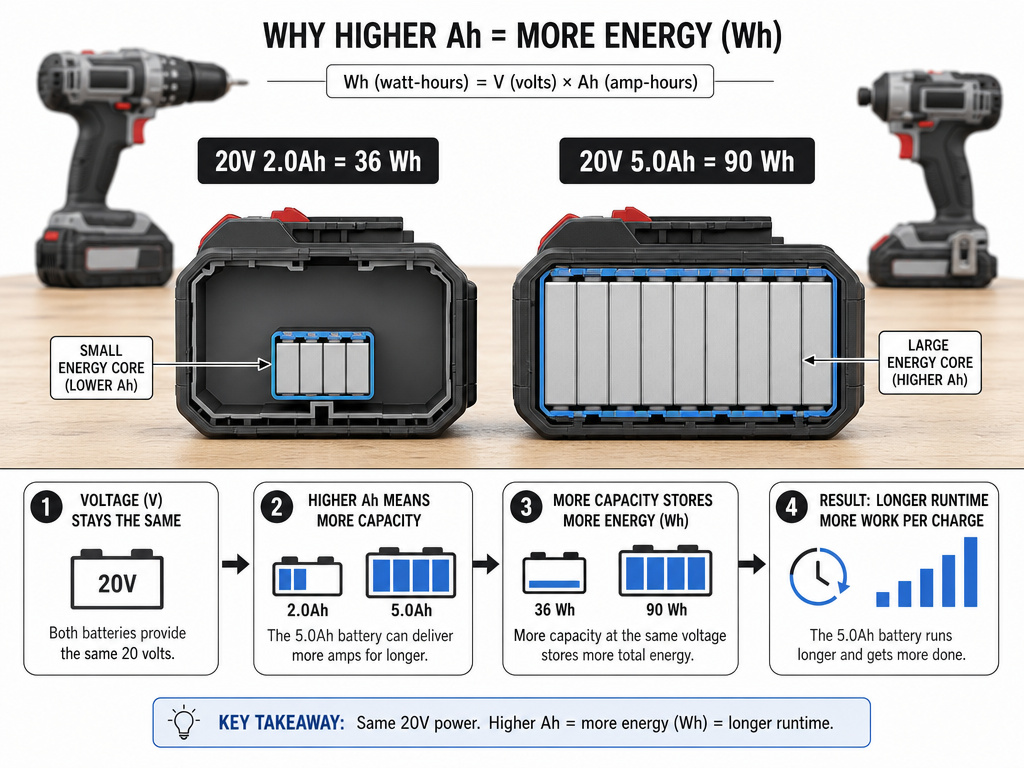
A kit says it includes “two 5.0Ah batteries!” It sounds like endless runtime. It’s not.
Amp-hours (Ah) measure capacity, but they ignore voltage. For true energy storage, you need Watt-hours (Wh): Volts × Amp-hours = Watt-hours. A 20V (18V nominal) tool with a 5.0Ah battery stores 90 Wh. That same tool with a 2.0Ah battery stores only 36 Wh, less than half the energy.
A 20V Max tool with a 5.0Ah battery delivers 90 Wh (Watt-hours), while with a 2.0Ah pack it delivers 36 Wh. The larger pack doesn’t just last longer; it can often sustain higher power output for demanding tools.
This is why a kit with two small batteries is a false economy. You’ll spend more time swapping and charging than working. When evaluating how many batteries a power tool combo kit needs, think in Watt-hours. For a weekend warrior, 70-90 Wh total (like two 4Ah packs) is a practical starting point. For heavier use, you’ll immediately be shopping for bare tools and bigger batteries.
The Brushless vs. Brushed Motor Trap (In Kits)
Brushless motors are more efficient, powerful, and durable. They’re also more expensive. In a kit, brands often use a brushless motor in the headline drill but pair it with brushed motors in less prominent tools like the circular saw or oscillating tool.
Check the tool for an “XR” (DEWALT) or similar designation. If it’s not there, it’s likely brushed. A brushed motor in a combo-kit saw isn’t a deal-breaker for occasional use, but understand the trade-off: it will wear out faster under load and drain batteries quicker. My stance has softened here. For a DIYer using a saw a few times a year, a brushed tool can be perfectly fine. But if that saw is for a moneymaking deck-building side hustle, the brushless upgrade is essential.
Warranties Are Not Equal. Read the Fine Print
A warranty is a manufacturer’s confidence quantified in time. Kit warranties are a patchwork of policies, and they reveal a lot about expected longevity.
| Brand / Kit Example | Tool Warranty | Battery Warranty | Key Additional Benefit |
|---|---|---|---|
| BENCHMARK 20V MAX Kit | 5 Years Limited | 3 Years Limited | As stated in manual. |
| DEWALT DCK2101QQ2 | 3 Years Limited | 3 Years Limited | 1 Year Free Service, 90-Day Money-Back Guarantee. |
| BLACK+DECKER Matrix | 2 Years (Home Use) | 2 Years (Home Use) | Standard limited warranty. |
The Benchmark 5-year tool warranty is an outlier and signals a focus on durability. DEWALT’s 3-year warranty is industry standard for prosumer brands, but their 90-day money-back guarantee is a unique safety net if the kit simply isn’t right for you. The 1-year free service covers wear parts, which is huge for maintaining performance.
Notice the pattern? The battery warranty is often shorter. They’re the most expensive consumable.
Safety: The Non-Negotiable Fine Print Everyone Skips
A new tool smells like possibility. The manual smells like homework. Do the homework.
The safety warnings in these manuals are not suggestions; they are documented hazard analyses. The DEWALT manual explicitly warns that dust from sanding, sawing, and grinding may contain chemicals known to cause cancer, birth defects, or other reproductive harm, like lead, crystalline silica, arsenic, and chromium.
Before you start: Always wear eye protection certified to ANSI Z87.1 (or CSA Z94.3), hearing protection for extended use, and a NIOSH/OSHA-approved dust mask. Secure your workpiece with clamps. These aren’t precautions; they are the baseline cost of admission for working with power tools.
For example, the BENCHMARK 20V MAX OSCILLATING MULTI-TOOL KIT must be connected to a 120V AC, 15A circuit. Using it on an overloaded circuit or a flimsy extension cord can damage the tool and create a fire hazard. This is the unglamorous, critical groundwork that separates a successful project from a trip to the emergency room.
How to Audit a Kit Before You Buy (A 4-Step Checklist)
You’re in the store, box in hand. Here’s your last line of defense.
- Identify Every Component. Open the box (or check the side panel). List each tool by exact model number (e.g., DCD1007, not “20V hammer drill”). Verify the list of tools in a combo kit matches the advertised list. Missing a side handle or belt hook? That’s a red flag for a returned or tampered-with kit.
- Decode the Batteries. Find the battery model (e.g., DCB2104). Note the Amp-hour (Ah) rating. Are they the compact, lightweight packs or the heavy, high-capacity ones? Match this to your work, overhead installs need light packs.
- Check the Charger. Is it a standard charger or a “fast” charger? A standard charger will take longer to charge a battery than a fast charger, which can dictate your workflow. This dictates your workflow.
- Look Up the Manuals. Use your phone. Search “[Tool Model] manual PDF.” Find the specs and safety warnings. This 5-minute investment can save you from a kit built around a discontinued or problematic tool generation.
This process turns you from a consumer into an inspector. It’s the single best way to ensure the bundle in your cart is the one you researched.
Which power tool combo kit should I buy?
Your choice depends on the jobs you do. For heavy-duty professional work, look for kits with brushless motors and higher torque ratings, like an impact driver with over 1,700 inch-pounds of torque. These handle demanding fastening tasks without strain. For general DIY, a standard drill and driver combo with 2.0Ah batteries will suffice for assembling furniture and light repairs. If you’re on a strict budget, basic brushed-motor kits exist, but be aware their components may wear faster. Always check exactly which tools and batteries are included, as package contents can change. Identify the specific tool models from their rating labels to know what you’re really getting.
Best power tool combo kit for the money
The best value kit balances capable tools with a meaningful warranty, avoiding the cheapest components that fail quickly. Look for a kit that includes at least two batteries with a total capacity of at least 4.0Ah, as a kit with 4.0Ah total will run longer than one with 2.6Ah. Consider the warranty length as a proxy for durability; a three-year limited warranty suggests more confidence than a two-year one. Some brands also offer a money-back guarantee period, which reduces your risk. The real cost is replacing a failed system, so a slightly higher initial price for tools with modern features and better battery technology often saves money in the long run.
Milwaukee vs DeWalt vs Ryobi comparison
Major brands differentiate themselves through warranty, performance specs, and battery technology. One brand offers a three-year limited warranty on tools plus one year of free service and a 90-day money-back guarantee. Another provides a two-year warranty for home use. Performance varies; for example, one brand’s impact driver delivers 1,825 inch-pounds of torque, while another’s model is rated for 1,700. Battery capacity is key: a 20V Max tool with a 5.0Ah battery delivers significantly more watt-hours than with a 2.0Ah pack. Newer battery packs using pouch cells are rated for roughly twice the charge cycles of older cylindrical cell designs, affecting long-term value.
Frequently Asked Questions
Are power tool combo kits worth the money?
They can be, but only under specific conditions. A kit is worth it if you need at least two of the included tools, the battery capacity matches your projects, and you’re confident in the brand’s broader ecosystem for expanding a combo kit later. If you’re buying it for one primary tool and tolerating the rest, you’re better off buying a bare tool and a battery separately.
What is the biggest disadvantage of a combo kit?
The most common disadvantage is being locked into a battery platform with a weak or incomplete selection of future tools. You might get a great drill/impact kit, only to find the same brand’s oscillating tool or angle grinder is underpowered or poorly reviewed. The bundle discount can become a long-term limitation.
How do I choose between a DEWALT and a Milwaukee combo kit?
Look past the color. Compare the specific tool models in each kit (e.g., DEWALT DCF845 vs. Milwaukee equivalent), the warranty terms, and, most importantly, the other tools you’ll want in the future. If you anticipate needing a wide range of specialty cordless power tools, research which brand’s ecosystem is stronger in those areas. Don’t choose based on the drill alone.
Is it better to buy a combo kit or individual tools?
For your very first cordless tools, a well-chosen combo kit is often the most cost-effective way to get a drill, impact driver, batteries, and charger. For any subsequent tools, or if you already have batteries, buying individual “bare tools” is usually cheaper and lets you choose the exact model you want.
Do all tools in a combo kit share the same battery?
Yes, that’s the primary advantage. All cordless tools in a single brand’s combo kit (e.g., all 20V MAX DEWALT tools) are designed to use the same battery packs. However, always double-check; some brands have sub-platforms or older battery types that are not cross-compatible.
Before You Go
The ultimate question isn’t “cordless or corded?” It’s “controlled growth or locked-in regret?” A combo kit is a strategic opening move, not a final solution.
Treat your first kit as the foundation of a modular system. Buy it with the intention of growing your tool collection intelligently. That means choosing a brand with a deep bench of tools you’ll actually want next, be it an orbital sander, a compact recip saw, or a job-site radio.
And remember the oldest rule in the shop: sometimes the right tool is the one plugged into the wall. For stationary bench tools like grinders, planers, or miter saws used in one place, the unwavering power of a corded power tool often beats the convenience of a battery. The best workshop is a hybrid one, built on choice, not constraint.
