
How to Expand a Power Tool Combo Kit: A Strategic Guide
This post contains affiliate links. As an Amazon Associate, we earn from qualifying purchases.
To expand a power tool combo kit, you must commit to a single battery platform and then purchase compatible “bare tools” individually. Avoid buying additional kits; instead, add specific tools you need as bare tools, invest in extra high-capacity batteries, and use sales cycles to save money. The goal is to build a custom set that fits your exact projects, not to accumulate duplicates.
That single-battery rule is the line between an organized workshop and a drawer full of incompatible chargers. The process isn’t about endless buying—it’s about strategic addition, which is the core of how to expand a power tool combo kit.
What follows: how to decode battery platform lingo, the math behind buying bare tools, the two sales windows that matter, and the full strategy for how to expand a power tool combo kit if you picked wrong.
Key Takeaways
- Your battery platform is a five-year commitment; choose based on the brand’s full tool lineup, not the drill in your starter kit.
- A “bare tool” costs 30-50% less than the same tool sold in a kit with a battery and charger.
- Never buy a second combo kit from the same brand—you’re paying for batteries you already own.
- Sell or trade tools from an old, unwanted platform online; the cash funds your new ecosystem.
- Store lithium-ion batteries at a 40-60% charge in a cool, dry place to prevent permanent damage.
The Core Mistake That Costs You Money
You bought a starter kit. It has a drill, an impact driver, maybe a circular saw, and two batteries. Your next project needs an oscillating multi-tool. So you walk into the store and see a shiny new combo kit on sale—it has the multi-tool, another drill, two more batteries, and a charger.
It’s a trap. You’re about to pay for a second charger and a third battery you don’t need, all while adding a duplicate drill to your collection. The money you “save” on the kit is erased by the redundant components. I’ve seen workshops with three identical chargers plugged into the same power strip, all for one brand. That’s wasted cash and outlet space.
The smart path is the bare tool. This is the tool alone, sold without a battery or charger. It assumes you already own the platform’s battery. For example, adding a tool like the DeWalt DCS381B oscillating multi-tool sold as a bare tool to your existing DeWalt 20V MAX system might cost $120. The comparable kit, with a battery and charger, runs $199. You just saved $79 and avoided another charger cluttering your bench.
Decoding the Battery Platform: More Than Just a Brand
Your platform isn’t just “DeWalt.” It’s “DeWalt 20V MAX.” Or “Milwaukee M18.” Or “Ryobi ONE+ 18V.” These are distinct electrical and physical systems. A Ryobi ONE+ battery will not fit a DeWalt tool, period. But confusion often happens within a brand.
Take Milwaukee. The M12 platform (12-volt) and the M18 platform (18-volt) are different. An M12 battery is smaller and fits only M12 tools. An M18 battery is larger and fits only M18 tools. They are not interchangeable. Similarly, DeWalt’s 20V MAX and 60V FLEXVOLT platforms share some compatibility, but it’s specific. You must know which system your starter kit uses.
Common mistake: Assuming all tools from a single brand share batteries. Always check the voltage designation (12V, 18V, 20V) on your existing tools and batteries before buying.
This is where the owner’s manual is your best friend. The BENCHMARK 20V MAX OSCILLATING MULTI-TOOL KIT manual explicitly lists its compatible batteries as models 5350-023 (2.5Ah), 5350-011 (4Ah), and 5350-012 (5Ah). That’s the level of specificity you need.
| Brand | Common Platform | Physical Battery Shape | Key Tool Examples |
|---|---|---|---|
| DeWalt | 20V MAX | Slide-on T-style | Drills, impact drivers, circular saws |
| Milwaukee | M18 | Slide-on flat base | High-torque impacts, reciprocating saws, lights |
| Ryobi | ONE+ 18V | Slide-on with center groove | Over 250+ tools, from lawn mowers to glue guns |
| Makita | 18V LXT | Slide-on star shape | Track saws, grinders, dust extractors |
Your expansion plan lives and dies by this chart. If your starter kit is Ryobi ONE+, every bare tool you add must be from the ONE+ 18V line. Straying outside it means starting over.
Your First Purchase: A Bare Tool or Another Kit?
Your first addition should almost always be a single bare tool that fills a immediate, project-specific gap. Needed to cut a hole in drywall? A bare tool reciprocating saw is the answer. Need to sand a deck? A random orbital sander.
To be blunt, buying another full combo kit versus buying tools individually only makes sense in two scenarios: 1. You are switching brands entirely and selling your old kit. 2. Your starter kit came with very low-capacity batteries (e.g., 1.5Ah), and you need higher-capacity ones (4.0Ah or 5.0Ah) for longer runtime. Even then, look for “battery starter packs” that include two batteries and a charger, not a whole tool kit.
I learned this the hard way early on. I had a DeWalt drill/driver kit but needed a circular saw for a fencing project. I bought another DeWalt kit that included the saw, “for the extra batteries.” Those batteries were the same small 2.0Ah ones I already had. I spent an extra $150 for a duplicate charger and batteries that provided no extra runtime. The circular saw alone, as a bare tool, would have been half the price.
The BENCHMARK manual states its 5-year tool warranty and 3-year battery warranty exclude commercial or rental use. Your home workshop is safe, but it shows warranties are tied to how you use the kit, not just what you buy.
How to Identify and Buy the Right Bare Tools
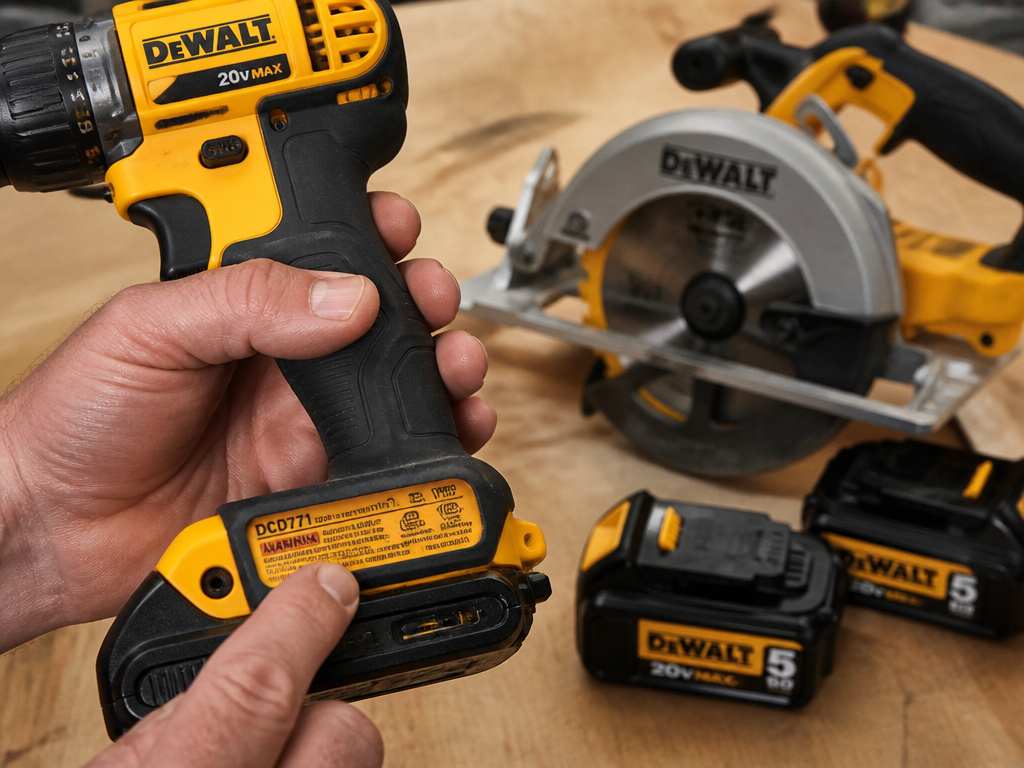
First, locate the model number on your existing tools and batteries. It’s usually near the battery port or stamped on the tool’s label. A DeWalt drill might be “DCD791.” The “DCD” prefix means “DeWalt Cordless Drill.” Search for “Dewalt DCD791 bare tool” to see if it’s sold separately. Often, the bare tool version has a “B” suffix (e.g., DCD791B).
Second, know that not every tool is available as a bare tool. Super-specialized or new tools often debut in kits only. If you can’t find a bare version, wait a few months. It usually appears.
Third, buy from authorized dealers or reputable online retailers. A bare tool should come with its own manufacturer’s warranty. The BENCHMARK warranty is 5 years for the tool, 3 for the battery—but that’s for the original kit purchase. A bare tool you add later has its own warranty timeframe.
Here’s a quick checklist before clicking “buy”:
- Confirm the voltage platform (20V MAX, M18, etc.).
- Verify the model number is the bare-tool version.
- Check that the seller is an authorized dealer for warranty purposes.
- Ensure your existing batteries have sufficient capacity (Ah) for the new tool. A cordless angle grinder needs a 5.0Ah battery, not a 2.0Ah.
Managing a Multi-Brand World: The Adapter Question
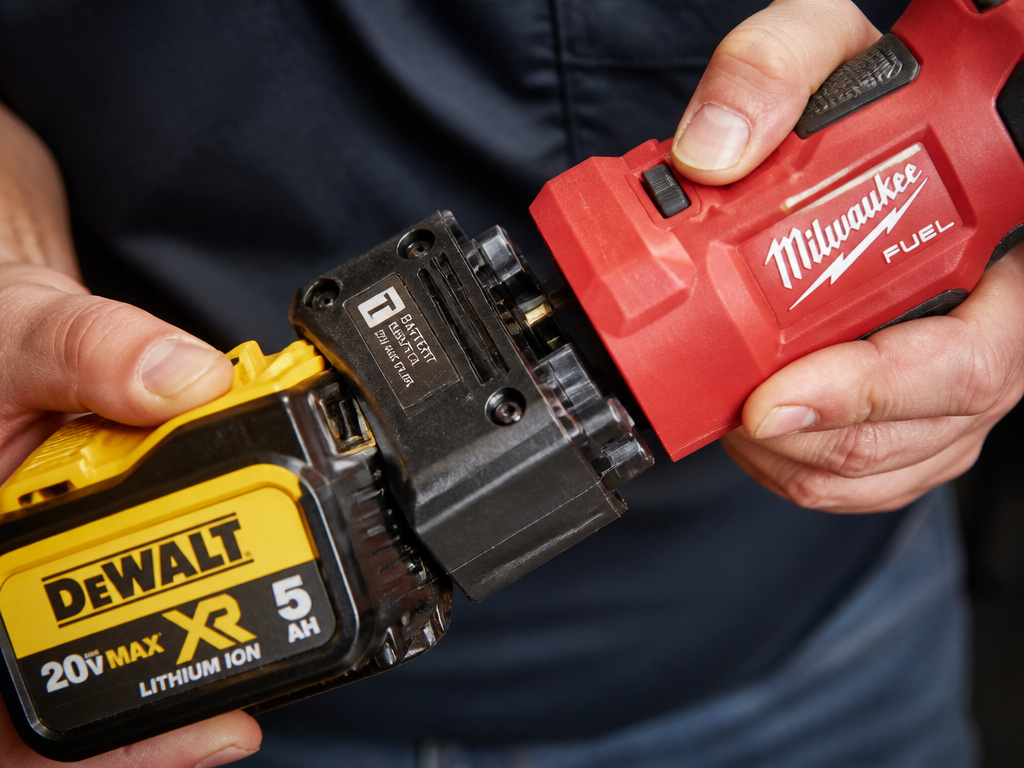
What if you have a great DeWalt drill but crave a specific Milwaukee Sawzall? Enter the battery adapter. This small plastic unit allows you to attach a DeWalt battery to a Milwaukee tool.
It sounds like a magic bullet. It’s more of a calculated risk.
| Pros of Battery Adapters | Cons of Battery Adapters |
|---|---|
| Access best-in-class tools from any brand. | Void the tool’s manufacturer warranty instantly. |
| No need to invest in a second battery ecosystem. | Can cause intermittent power delivery or tool damage. |
| Great for trying a new brand before fully committing. | Adds length and bulk, hurting tool balance. |
| Saves money compared to buying a new platform kit. | Rarely supports tool-to-battery communication (fuel gauges, overload protection). |
I keep one adapter in my shop for a single purpose: to run a Milwaukee M12 soldering iron from my more plentiful DeWalt batteries. It’s a low-draw tool where a power hiccup won’t cause damage. I would never use an adapter on a high-torque impact wrench or a circular saw. The risk of a voltage spike damaging a $200 tool isn’t worth the $30 adapter.
The STIHL KMA 120.0 R manual is unequivocal: “Operate the KombiEngine with a STIHL AP battery.” Using unauthorized batteries or attachments is “extremely dangerous” and voids the warranty. While that’s for outdoor power equipment, the principle is the same. Manufacturers design the battery and tool to communicate. An adapter breaks that link.
Planning Your Battery Fleet
Your starter kit likely came with two compact batteries (e.g., 2.0Ah). These are fine for drills and drivers. But as you add tools like a circular saw, angle grinder, or leaf blower, runtime plummets. You need a battery strategy.
Think in terms of work cycles. A 5.0Ah battery will provide longer runtime for a circular saw than a 2.0Ah battery. If you have a full day of cutting, you need either several high-capacity batteries or a fast charger to cycle them.
Where this goes sideways: Using a single small battery for a high-draw tool. The battery overheats, the tool’s power drops, and you’ll smell a faint, sweet burning plastic scent from the battery vents. That’s the sign of a stressed pack.
So, how many batteries do you need? A rule for a serious DIYer:
- 2 compact batteries (2.0-3.0Ah): For precision work, overhead driving, and lightweight tools.
- 2 high-capacity batteries (5.0-8.0Ah): For saws, grinders, outdoor equipment, and all-day projects.
- 1 fast charger: The 6A fast charger compatible with the BENCHMARK system can refill a 5.0Ah battery in about an hour versus three on a standard charger.
Also, respect battery chemistry. The STIHL manual recommends storing lithium-ion batteries at a 40-60% state of charge. Storing them fully charged or fully dead for extended periods can shorten their lifespan. My garage used to be a battery graveyard until I started following that 40-60% rule.
Timing Your Purchases: The Sale Seasons
Tool companies have sales cycles as predictable as the seasons. Buying a bare tool at full retail is for emergencies only.
The two biggest windows: 1. Black Friday through December: The year’s deepest discounts on kits and bundles. This is the best time to buy a starter kit if you’re switching platforms, or to snag a “buy a tool, get a free battery” promo. 2. Father’s Day and Memorial Day: Major holidays for home improvement stores. This is prime time for bare tool discounts and battery pack deals.
I mark these dates on my calendar. If I know I need a cordless router by summer, I wait for the Memorial Day sales. The savings can be significant. Outside these windows, prices are static. There’s no “secret month” for tool deals.
When to Cut Losses and Switch Platforms
Sometimes, you realize your starter platform was a mistake. The brand doesn’t make the specialty tool you need, or their batteries are notoriously short-lived. Switching is painful but sometimes necessary.
Here’s the exit strategy: 1. Sell your old kit complete. List the drill, impact driver, batteries, charger, and case as a single unit on Facebook Marketplace or a tool-specific forum. A used, name-brand kit in good condition can retain a portion of its retail value. 2. Use the proceeds to buy a new starter kit from your desired brand during one of the sale periods mentioned above. 3. Consider battery adapters as a temporary bridge for one or two favorite old tools, but plan to replace them.
The process of how to expand a power tool combo kit isn’t a linear path. It’s an evolution of your workshop’s needs. The goal isn’t to own every tool from one brand, but to own the right tool for every job you actually do.
Storing and Organizing Your Growing Collection
A collection of bare tools and batteries becomes a mess without a system. A toolbox won’t cut it. You need wall control.
I moved to a French cleat wall system. Each bare tool has a custom holder that snaps onto the cleats. Batteries live on a dedicated charging station shelf. This does two things: it makes every tool instantly visible and accessible, and it protects your investment. Tools rattling in a drawer get damaged. A hanging tool does not.
Also, designate a “project bag.” When you start a job, pull only the tools and batteries you need and put them in a durable tote. This keeps the rest of your shop organized and prevents you from losing a drill under a pile of 2x4s. It sounds simple. It changes everything.
How to Choose a Power Tool Brand for Your Kit
Stick with the brand you already own. Your first combo kit locked you into a battery platform, and that’s your ecosystem. Expanding outside of it means buying into a whole new set of batteries and chargers, which is the financial trap you want to avoid. The real strategy is to buy bare tools that are compatible with your existing batteries. Before you buy, check your tool’s manual for compatible battery model numbers. Manufacturers design their tools to work only with their own specific battery systems. Focus your search on adding bare tools from the same brand family to maximize the value of your initial investment.
Frequently Asked Questions
Can I use any brand’s battery in my tool with an adapter?
Technically, yes—if an adapter exists. Practically, it voids warranties and risks damaging both the tool and battery due to mismatched power management. Use adapters only for low-power, non-critical tools where you accept the risk.
What does “20V MAX” really mean if the nominal voltage is 18V?
“20V MAX” is a marketing term indicating the maximum initial voltage. The BLACK+DECKER manual states its 20V MAX drill has a nominal voltage of 18V, while the BENCHMARK manual lists the voltage as ’20 V’ without specifying nominal voltage.
Is it worth buying a combo kit for the extra batteries?
Rarely. You usually overpay for the bundled charger and get duplicate tools. It’s almost always cheaper to buy a “battery starter pack” (two batteries and a charger) and the specific bare tool you need separately. Run the math before assuming the kit is a deal.
How do I know if a bare tool will work with my older batteries?
Check the battery’s voltage (e.g., 20V) and physical shape. Any bare tool from the same brand and voltage platform that uses the same physical battery connection will work. A 20V MAX battery from 2015 will power a 20V MAX bare tool bought today. Battery capacity (Ah) only affects runtime, not compatibility.
What’s the first tool I should add to my basic drill/driver kit?
An oscillating multi-tool. Its versatility for plunge cuts, sanding, scraping, and detail work makes it the most-used tool after a drill. For a homeowner, a circular saw is a close second for larger projects.
The Bottom Line
Expanding a kit is an exercise in restraint. Fight the urge to buy another all-in-one box. Instead, study your battery platform like a mechanic studies an engine—know its specs, its limits, and its compatible parts.
Commit to buying bare. Watch for sales. Sell what you don’t need. And hang every tool you own on a wall where you can see it. That last part isn’t just about organization. It’s a daily reminder that you built this set intentionally, one smart purchase at a time.
Your final tool count doesn’t matter. The right tool for the next job does. Everything else is just inventory.
