
How Many Batteries DO You Need in a Power TOOL Combo KIT?
This post contains affiliate links. As an Amazon Associate, we earn from qualifying purchases.
Most starter power tool combo kits include two batteries. This isn’t an accident, it’s the minimum for continuous work, letting you use one while the other charges. Stepping up to three or more batteries is for professionals running several high-drain tools like saws and vacuums back-to-back.
That two-battery baseline works for drilling a deck or assembling furniture. Where people get stuck is on day two of a bigger project, when a circular saw and a drill are both needed and the single charger can’t keep up. The number you need depends less on the tool count and more on the power draw of those tools and your personal tolerance for waiting. A key question is how many batteries do you need in a power tool combo kit.
What follows: a breakdown of typical kit contents, why capacity matters more than pure count, and a simple system to make two batteries work for three or four tools without the downtime that frustrates weekend warriors.
Key Takeaways
- Two batteries are the industry standard for a reason; they enable a basic charge-use cycle for a drill and impact driver, which covers most starter projects.
- Battery capacity (Ah) dictates runtime, not the number of tools a kit can support. A 5Ah battery lasts 2.5x longer than a 2Ah battery under the same load.
- For larger projects involving saws or grinders, plan for at least three batteries or a fast charger to avoid workflow stoppages.
- Manufacturer specs on battery storage disagree; DeWALT says store fully charged, while other sources, such as some STIHL manuals, recommend 40-60% charge for longevity. Both agree: never store a battery completely dead.
- High-capacity packs (like a DeWALT DCB609) can be classified as multiple batteries for shipping when a Transport Cap is attached, a regulatory quirk that doesn’t affect your use.
How Many Batteries Come in a Kit?
Open any major retailer’s website and look at cordless combo kits. You’ll see a pattern: the vast majority include two battery packs. A BENCHMARK 20V MAX OSCILLATING MULTI-TOOL KIT lists its compatible batteries (2.5Ah, 4Ah, 5Ah) as sold separately, implying the bare-tool approach. Conversely, a BENCHMARK 12V MAX CORDLESS ROTARY TOOL KIT clearly includes one 12V, 2.5 Ah battery. For the larger, more common drill/driver/ saw combos, two is the default.
This two-battery standard isn’t arbitrary. It’s the cheapest way for manufacturers to provide a functional system. With two batteries, you can hypothetically use one tool continuously by cycling the packs, as one depletes, the other charges. In practice, charger speeds and tool power demands complicate this, but for the core tools in a starter kit (a drill and an impact driver), it’s often sufficient. When you’re looking at a combo kit vs individual purchase, those two bundled batteries often represent a significant portion of the perceived value.
Common mistake: Assuming every tool in a 5-piece kit needs its own dedicated battery. You don’t run all five simultaneously. The battery is the shared power source; the tools are just different outlets for it.
The Critical Role of Battery Capacity
The question “how many batteries?” is incomplete without asking “how big are they?”, especially when you compare a how many batteries do you need in a power tool combo kit. A battery’s capacity, measured in Amp-hours (Ah), tells you how much energy it stores. A 5Ah battery stores 2.5 times the energy of a 2Ah battery, so under the same load it will provide significantly longer runtime. This is why comparing 2Ah vs 5Ah is more important than comparing raw battery counts.
A kit with two 5Ah batteries offers more total available energy than a kit with two 2Ah batteries, even though the count is the same. This capacity directly translates to less frequent swapping and charging, which is the true bottleneck in a project. If your work involves high-drain tools like circular saws, reciprocating saws, or angle grinders, High-drain tools like circular saws can deplete a 2Ah battery very quickly., then high-capacity batteries are a necessity, not a luxury.
| Battery Capacity (Ah) | Best For | Runtime Compared to 2Ah |
|---|---|---|
| 2.0 Ah | Drills, impact drivers, lights. Lightweight and compact. | Baseline (1x) |
| 4.0 Ah | All of the above, plus occasional saw use. Good balance. | ~2x longer |
| 5.0 Ah | Sustained use of saws, grinders, vacuums. Less frequent swaps. | ~2.5x longer |
| 6.0 Ah+ | Professional, all-day use with high-drain tools. Maximum runtime. | 3x longer or more |
Manufacturers design their combo kit contents with this in mind. A starter kit aimed at a new homeowner will often pair lighter tools with compact batteries. A “pro” or “XR” level kit will bundle heavier-duty tools with higher-capacity packs. Always check the Amp-hour rating; it’s a better predictor of your experience than the voltage alone.
Why Do Most Kits Only Include Two Batteries?
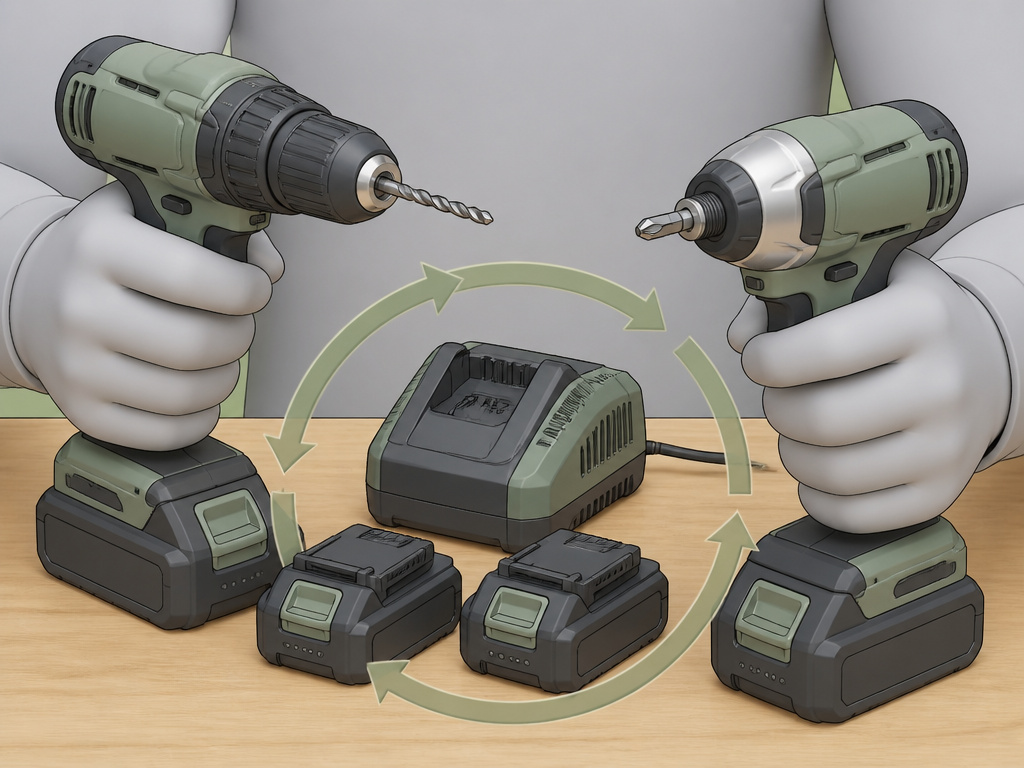
From the manufacturer’s perspective, it’s a cost and value equation. Including a third battery would significantly increase the kit’s price, potentially pushing it out of a competitive sweet spot. Two batteries demonstrates the cordless system’s benefit over a single corded tool, fulfilling the promise of portability and convenience. It’s enough to get you started and invested in their battery platform.
The real strategy becomes clear after the purchase. Once you own the charger and a couple of batteries, buying additional bare tools, sold without a battery or charger, is markedly cheaper. This is the ecosystem lock-in. Your next tool, a cordless circular saw, might cost $120 as a bare tool versus $180 in a kit with another battery you may not immediately need. This is the fundamental difference in a bare tool vs kit purchase decision.
For the user, two batteries create a simple, manageable workflow for the most common paired tools: a drill and an impact driver. You drill a pilot hole, switch tools to drive the screw, and by the time you need the drill again, the first battery might be recharged (depending on your charger). It’s a designed rhythm that works for assembly and light construction.
A kit with two batteries is a closed-loop system. It’s designed to function, not to excel under heavy demand. Adding a third battery breaks that loop and turns it into an open system capable of handling unexpected work.
Managing a 2-Battery Kit: A Practical Workflow
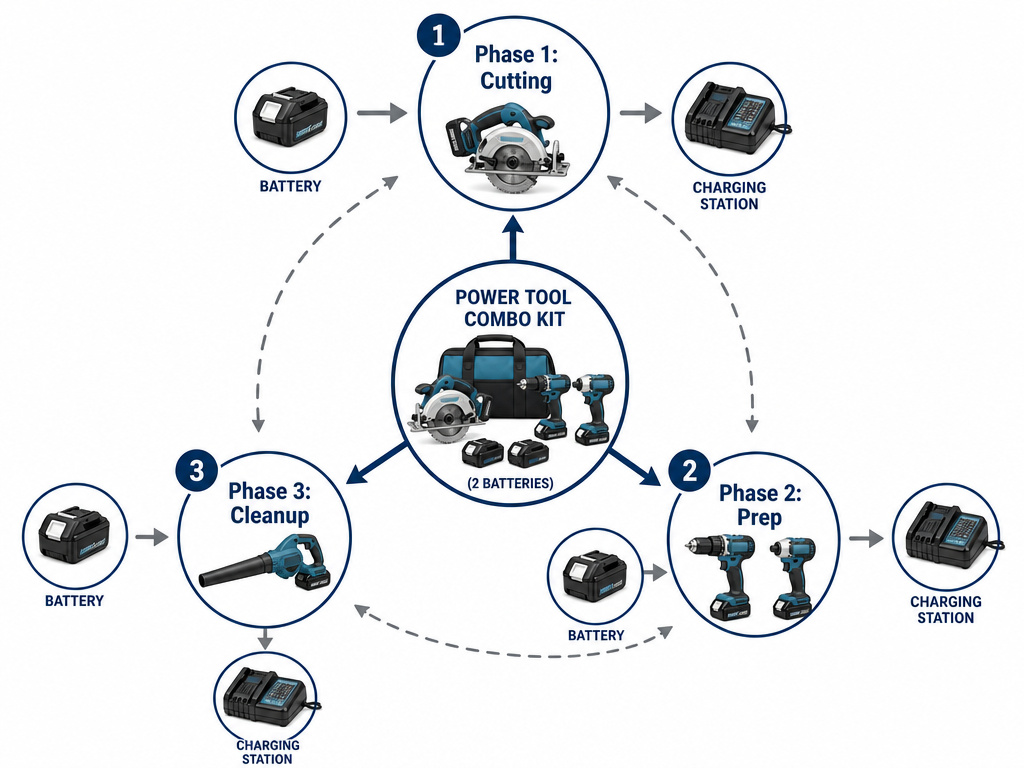
So you’ve bought a standard kit with two batteries. How do you avoid the dreaded downtime when a third tool enters the mix? It comes down to sequencing and understanding your tools’ appetites.
First, identify the power hogs. In a typical kit, the drill and impact driver are sippers compared to the circular saw or reciprocating saw. The saw is your gas guzzler. Plan your work so the high-drain tool isn’t used simultaneously with another. Cut all your lumber first with the saw, using one battery. While that battery charges, move to drilling and driving with the second battery. By the time you’re done prepping holes, the first battery is likely ready for the saw again or for cleanup with a blower or light.
Here’s a tactical table for a 4-tool, 2-battery setup:
| Work Phase | Primary Tool (Battery A) | Secondary Tool (Battery B) | Charging Status |
|---|---|---|---|
| Phase 1: Cutting | Circular Saw | (Idle) | Battery B on charger |
| Phase 2: Prep/Assembly | Drill | Impact Driver | Battery A on charger |
| Phase 3: Cleanup/Finish | Blower or Light | (Any) | Both batteries cycling |
This rhythm falls apart if you need the saw and drill at the same time, which is why for complex or time-sensitive projects, investing in a third battery is the first logical step to expand a combo kit. A third battery acts as a buffer, ensuring one is always charged and ready when a high-priority tool goes dead.
When Two Batteries Aren’t Enough
You need more than two batteries when your workflow can’t tolerate a stoppage, which is the practical answer to how many batteries do you need in a power tool combo kit. This isn’t about luxury; it’s about friction. If you find yourself watching a charger light blink more than once per hour, you need another battery.
The clearest sign is when you own multiple high-drain tools and use them in succession. Cutting rafters with a circular saw, then switching to a reciprocating saw for notches, then using an angle grinder to clean up, each of these can drain a standard battery in well under an hour. Even with a fast charger, you’ll hit a wall. Professionals and serious DIYers learn this quickly. The initial kit gets the platform started, but the first accessory purchase is often another high-capacity battery.
Another scenario is when you’re working far from an outlet. Having three or four fully charged batteries means you can work a full day without needing to plug in a charger, which is crucial for roofing, fencing, or remote jobsites. It’s about energy independence.
Consider your charger, too. Standard chargers that come in kits are often slower than rapid chargers available for purchase separately., effectively increasing the utility of your existing batteries. If buying another battery isn’t in the budget, a faster charger is a solid half-step.
Battery Care and Compatibility: Making Your Investment Last
Your batteries are the heart of the cordless system. How you treat them affects their battery lifespan and, by extension, how many you feel you need. Modern lithium-ion packs have an Electronic Protection System that guards against overloading, overheating, and deep discharge, but they’re not invincible.
One of the most confusing points is storage. Manuals don’t agree. The DeWALT manual advises storing a fully charged pack in a cool, dry place. However, common best practice from many battery experts, and spelled out in other OEM manuals, recommends a 40-60% charge for long-term health to minimize stress on the cells. The BENCHMARK manual notes a fully charged lithium-ion battery will lose about 2% of its charge per month during storage, which implies self-discharge. The DeWALT manual advises to never store a battery completely depleted. It may not recover.
Temperature is critical. The DeWALT manual specifies the optimal air temperature for charging is between 65 °F and 75 °F (18 °C and 24 °C) and warns not to charge when the pack is below +40 °F (+4.5 °C) or above +104 °F (+40 °C). A cold battery pack may charge at a slower rate than a warm battery pack.
For safety, always use the manufacturer’s charger. The DeWALT manual explicitly states: “DO NOT attempt to charge the battery pack with any chargers other than a DeWALT charger.” Their systems are designed to work together.
Where this goes sideways: Storing batteries in a non-climate-controlled garage. Summer heat and winter cold accelerate aging and can permanently reduce capacity, making you think you need more batteries when you actually need to care for the ones you have.
When it’s finally time to retire a battery, recycle it properly. The BENCHMARK manual instructs you to cover the terminals with electrical tape upon removal and to never dispose of rechargeable batteries in normal household garbage. This isn’t just about being green; it’s a fire safety issue. Damaged cells can rupture, and the electrolyte is flammable. Knowing how to store power tool batteries properly extends their useful life.
How Brushless Motors Affect Battery Life
Brushless motors are more efficient than older brushed motors. This efficiency means they draw power from the battery in a smarter way, converting more of the battery’s energy into useful work at the tool. A tool with an efficient motor will simply get more runtime from the same battery pack compared to a less efficient tool. This is a key reason why many modern kits feature brushless tools; they help you work longer on a single charge. Knowing how to store power tool batteries properly extends their useful life.
Frequently Asked Questions
Is a power tool combo kit worth it?
For most people starting out, yes. The savings on the bundled tools and batteries versus buying them individually are significant. It also ensures you’re getting into a compatible ecosystem. The value starts to diminish if the kit includes tools you’ll never use.
What is the most common tool combo kit?
The most common is a drill and impact driver combo, often with two batteries, a charger, and a bag. The next step up adds a circular saw, a reciprocating saw, and a work light. These 5-tool sets are the sweet spot for many DIYers.
Which power tool battery lasts the longest?
Runtime is determined by capacity (Ah). A 5Ah battery will last longer than a 2Ah battery under the same load. Longevity, how many charge cycles the battery withstands, is influenced by chemistry, build quality, and how well you care for it (avoiding extreme temperatures and deep discharges).
Can I use any brand’s battery on my tools?
No, with very rare exceptions. Batteries and tools are part of a proprietary voltage and communication system. A DeWALT 20V battery cannot power a Makita tool, and vice versa. Some generic or value brands may advertise cross-compatibility, but this is risky and can void warranties.
Before You Go
Be realistic. For your first foray into cordless tools, a kit with two batteries isn’t just fine, it’s the right move. You’ll learn your actual needs by using it.
The moment you find yourself stalled, waiting for a battery to charge in the middle of a cut or a drilling run, that’s your signal. Not to abandon the platform, but to grow your tool collection strategically. Buy a third, higher-capacity battery first. Then add bare tools as your projects demand. This approach spreads the cost and builds a system tailored to your actual workflow, not a marketer’s idea of what you should own.
That third battery is the difference between a hobbyist setup and a working toolkit. You can start with two. You’ll probably end up with more.
