
Nicad vs Lithium Ion Power Tool Batteries: The Bottom Line
This post contains affiliate links. As an Amazon Associate, we earn from qualifying purchases.
The choice between NiCad and lithium-ion power tool batteries hinges on three concrete differences: chemistry determines weight and toxicity, discharge rate dictates power delivery under load, and lifespan defines long-term cost. For most users today, lithium-ion is the better buy, offering lighter weight, higher energy density, and no toxic cadmium. NiCad still holds a narrow edge in extreme cold and ultra-high discharge scenarios.
That chemistry line is a public health regulation in the European Union and a weight penalty in your tool bag. The EU Batteries Directive restricts cadmium use, but sources disagree on current applicability to power tools: the Directive states the portable power tool exemption ended in 2016, while Paslode still recommends its NiCd battery for use in electric tools. This illustrates the practical debate over nicad vs lithium ion power tool batteries.
The rest of this guide walks through the specs that matter in the nicad vs lithium ion power tool batteries debate, including voltage, amp-hours, watt-hours, discharge curves, and real-world temperature limits. You’ll see where manufacturers disagree, what the data sheets actually say, and how to pick the right pack for the jobs you actually do.
Key Takeaways
- Lithium-ion packs win on energy density, a Milwaukee V28 Li-ion pack delivers more run time at 2.3 pounds than a 2.4-pound 18V NiCad pack.
- The “memory effect” debate is real. Hitachi claims 95% of NiCad batteries suffer from it; Milwaukee says professional-grade packs do not. Your charging habits decide the truth.
- NiCd batteries contain toxic cadmium, the EU restricts their sale to replacement and specific uses, mandating producer recycling for industrial packs.
- Cold tolerance splits the difference. NiCad performance declines below 20°F, while Li-ion holds most run time down to about 0°F.
- Always match the charger to the battery chemistry, using a NiCad charger on a Li-ion pack risks fire, and conditioning advice differs wildly between types.
What Is the Memory Effect and Does It Still Matter?
The term gets thrown around like a universal truth. It isn’t. The memory effect refers to a NiCad battery’s tendency to “forget” its full capacity if repeatedly only partially discharged before recharging. The battery’s voltage curve drops prematurely, cutting your run time short.
Here’s where it gets messy. Manufacturers directly contradict each other.
Where sources disagree: Hitachi Power Tools’ Kevin Fairchild states, “About 95 percent of NiCad batteries have memory effect problems.” Milwaukee Electric Tool’s John Sara counters, “There is no memory effect for professional grade power tool batteries.”
So who’s right? Both, from a certain angle. The cheap, consumer-grade NiCad packs bundled with big-box store tools are far more susceptible to lazy charging habits. The premium cells in a contractor’s Milwaukee or Metabo HPT pack are engineered to tolerate partial cycling better. But even those have limits.
The practical takeaway is behavioral. If you own NiCad tools, discharge them fully before charging whenever possible. That one habit sidesteps the entire debate. For lithium-ion, the rule flips, avoid deep discharges. Letting a Li-ion pack hit zero too often accelerates cell degradation.
The Chemistry & Weight Trade-Off You Feel in Your Hand
Open a Paslode NiCad battery Safety Data Sheet. The ingredients list is a heavy metals roster: 10-25% Nickel, 10-25% Cadmium and compounds, plus cadmium and nickel hydroxides. That’s why an 18V NiCad pack weighs about 2.4 pounds. A 24V pack jumps to 3.3 pounds.
Now pick up a modern lithium-ion pack. A Milwaukee V28 Li-ion battery, with its complex chemistry of lithium-nickel-cobalt-manganese oxides and carbon anodes, weighs 2.3 pounds yet delivers 28 volts. The energy density is simply higher. More power, less heft.
That weight difference translates directly to fatigue. Running a cordless drill overhead or a saw all day, a pound feels like five by hour three. This is the primary reason lithium-ion dominates new tool sales.
Technical Snapshot: A NiCd block battery’s capacity is rated in ampere-hours (Ah) at +20°C (+68°F) for a 5-hour discharge to 1.0V, per the IEC 60623 standard. This standardized test allows for direct comparison, but real-world tool use with high current draws rarely matches this gentle discharge curve.
The environmental issue is critical and cannot be ignored. Cadmium is toxic. Under the EU Batteries Directive (2006/66/EC), the sale of consumer Ni–Cd batteries is banned except for medical use, alarm systems, emergency lighting, and portable power tools (with the power tool exemption ending in 2016). Used industrial Ni–Cd batteries must be collected by their producers for recycling. This regulatory pressure alone is phasing out NiCad.
Cold Weather Performance: Which Battery Quits First?
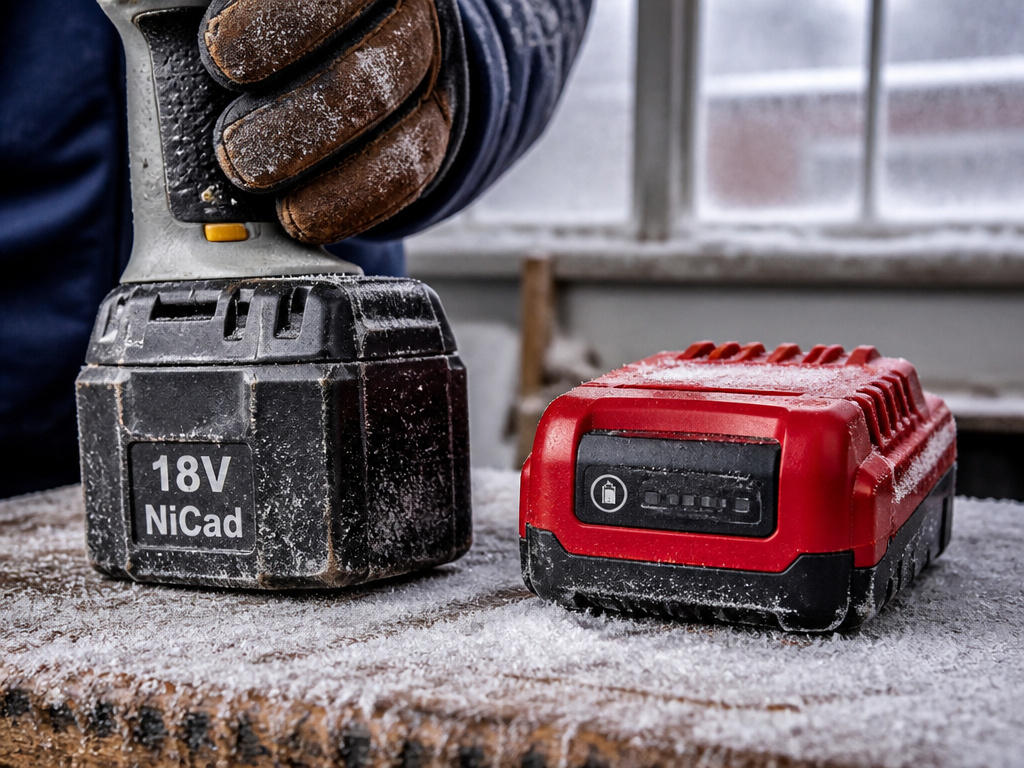
You store your tools in an unheated garage or work outdoors in winter. Temperature matters.
NiCad batteries perform well in cold temperatures, with performance decline starting below 20 degrees Fahrenheit. They’ll still work, but run time drops noticeably.
Lithium-ion batteries maintain most of their run time down to about 0 degrees Fahrenheit. Below that, both chemistries struggle, but Li-ion’s internal protection circuitry can shut the pack down entirely to prevent damage, leaving you with a suddenly dead tool.
I learned this the hard way with a cordless impact driver left in a truck bed overnight in a Michigan winter. The NiCad pack had enough juice to drive a dozen screws sluggishly. The lithium-ion pack on the same tool, from the same brand, showed full bars on the charger but delivered a weak half-turn before the tool shut off. It wasn’t dead; the board inside was saving itself.
For consistent cold-weather work, NiCad’s predictable taper beats Li-ion’s abrupt shutdown. For everything else, Li-ion’s broader operating range wins.
Decoding Power: Voltage, Amp-Hours, and the Real Metric (Watt-Hours)
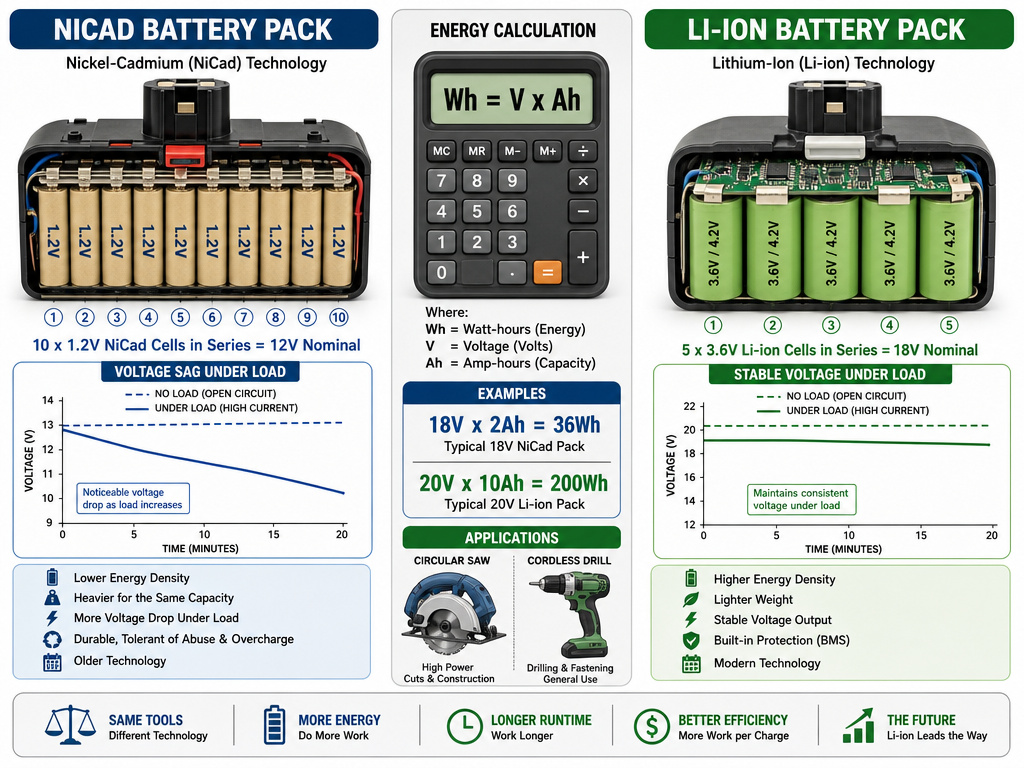
Tool marketing loves “20V MAX” labels. It’s mostly noise. A fully charged lithium-ion cell sits at about 4.2V; five cells in series give you a nominal 18V, a peak of 21V. That’s your “20V” rating. A NiCad pack’s voltage sags more under load, so an 18V NiCad and an 18V Li-ion pack will not deliver the same punch through a heavy cut.
Amp-hours (Ah) tell you capacity, but not the whole story. A battery’s amp-hour (Ah) rating indicates its capacity, but the actual current it can deliver depends on its specific discharge rate capabilities. But can it deliver 30 amps for 6 minutes? That depends on the discharge rate, where NiCd traditionally shines.
The number that actually compares energy is the watt-hour (Wh). It’s voltage multiplied by amp-hours. Check the spec sheets:
- Milwaukee M18B2 Li-ion: 18V, 2.0Ah, 36 Wh
- DeWalt 20V Max battery DCB210 has an energy rating of 200 Wh.
- Paslode NiCad: No Wh rating provided, just chemical composition.
Higher Wh means more total energy in the pack. When comparing, find the Wh rating. It’s the closest thing to a “gas tank size” number that works across voltages and chemistries.
| Battery Model | Chemistry | Voltage | Capacity (Ah) | Energy (Wh) | Best For |
|---|---|---|---|---|---|
| Milwaukee M18B5 | Li-ion | 18V | 5.0 Ah | 90 Wh | High-demand tools (saws, grinders) |
| DeWalt DCB210 | Li-ion | 20V | N/A (see Wh) | 200 Wh | Extended run time, large yard tools |
| High-surge applications, cold weather | |||||
| JCB 18LI-5 | Li-ion | 18V | 5.0 Ah | N/A. | Construction tools, fast charging |
Charging, Conditioning, and Confusing Manuals
Nothing highlights the gap between old and new tech like charging instructions. A JCB 18V lithium-ion battery manual states: “After charging for the first time, ensure the battery is completely discharged before placing on charge again. Repeat this charging and discharging cycle 4 to 5 times to ensure battery is correctly conditioned.”
This advice conflicts with the general consensus that modern lithium-ion batteries do not benefit from deep discharge cycles, which can stress them. However, JCB’s manual specifically recommends this conditioning process for their batteries. The correct practice for Li-ion is shallow cycling, topping them off whenever convenient.
For NiCad, the old rule stands: full discharge, full charge. This helps mitigate the memory effect risk, real or perceived.
Charging speed is another divide. A JCB 18LI-2 (2.0Ah) charges in 45 minutes on a fast charger. An 18LI-5 (5.0Ah) takes 75 minutes. Charging speed and heat generation depend on the specific battery and charger design.
Before you start: Never use a NiCd charger for a Li-ion battery, or vice-versa. The charging algorithms and voltage cut-offs are different. At best, it won’t charge. At worst, the Li-ion pack’s protection circuit could be damaged, leading to a thermal runaway risk.
Safety and Lifespan: What Fails and Why
All batteries fail. How they fail differs.
NiCad Failure Modes:
- Memory Effect: Reduced capacity from partial cycling.
- Internal Short: Dendrite growth over many cycles can bridge cells.
- Electrolyte Dry-out: Overheating from fast charging or high loads.
Lithium-ion Failure Modes:
- Thermal Runaway: Overcharge, short circuit, or physical damage can cause uncontrollable heating. The JCB manual warns of fire or explosion risk above 130°C.
- Protection Circuit Failure: The board managing cell balance and temperature can fail, rendering the pack dead or dangerous.
- Cell Degradation: Capacity fades with time and heat, even if unused.
Battery lifespan is dictated by charge cycles, storage temperature, and usage patterns, not a fixed number of years. The lifespan of any battery pack is dictated by charge cycles, storage temperature, and how hard you push it battery lifespan.
Proper battery storage is critical. Store NiCd partially discharged (about 40%). Store Li-ion at about 50% charge in a cool, dry place. Leaving either chemistry fully charged on the shelf for months accelerates decay.
The Direct Replacement Question: Can You Swap?
You have an old 18V NiCad drill. Can you slap a new 18V lithium-ion pack on it? Almost certainly not.
The tool’s electronics and motor are designed for the voltage curve and current delivery of its original chemistry. A NiCd tool expects voltage to sag under load. A Li-ion pack holds voltage higher, longer, which could overheat the motor.
Furthermore, the physical connection is rarely identical across generations within the same brand. Even if it fits, the charger is incompatible. You need the correct protocol for charging batteries safely.
Your real choice in the nicad vs lithium ion power tool batteries decision is between replacing the entire tool+battery+charger ecosystem or sticking with the old one until it dies. For occasional use, maintaining a NiCad system is cheaper. For daily driving, upgrading to lithium-ion is a productivity leap.
Frequently Asked Questions
Can I directly replace my NiCd battery with a lithium-ion battery?
No, not directly. Even if the physical connector fits, the tool’s internal electronics and motor are designed for the specific discharge characteristics of NiCd chemistry. Using a Li-ion pack can lead to motor damage or tool failure. You typically need to upgrade the entire tool.
What are the best batteries for power tools today?
For most users, lithium-ion batteries are the best choice. They offer the best combination of light weight, high energy density, and consistent power delivery. Brands like Milwaukee (M18/FUEL), DeWalt (20V MAX/FlexVolt), and Makita (18V LXT) lead in performance and ecosystem breadth.
Which battery is better, NiCad or lithium-ion?
Lithium-ion is better for the vast majority of power tool users. It provides more power, longer run time, and less weight. NiCad retains only niche advantages: superior performance in very high discharge-rate applications (like some high-torque tools) and slightly better tolerance for consistent use in temperatures just below freezing.
Are NiCd batteries banned?
In the European Union, the sale of consumer Ni–Cd batteries is banned with exemptions for medical devices, alarm systems, emergency lighting, and, until 2016, portable power tools. They are not banned in the United States, but their market share has dwindled due to the superiority of lithium-ion technology and cadmium’s toxicity, which complicates battery disposal.
How can I tell if my old battery is NiCd or Li-ion?
Check the label. NiCd packs often state “Ni-Cd” or “Nickel Cadmium.” Li-ion packs will say “Li-ion” or “Lithium-ion.” Physically, NiCd packs are often heavier and bulkier for their voltage. If the manual is gone, search the model number online; the Wikipedia entry on nickel-cadmium batteries can provide technical background to help identify older chemistries.
Why does my new 20V lithium-ion tool feel more powerful than my old 18V NiCad?
Two reasons. First, lithium-ion maintains a higher voltage under load, so the tool receives more consistent power. Second, the “20V MAX” rating is a peak measurement (about 21V), while the old 18V NiCad rating is nominal, its voltage drops quickly when you pull the trigger. The actual energy difference, measured in watt-hours, is also likely significantly higher in the new pack.
The Bottom Line
Here’s the blunt verdict: unless you’re running a specialty high-discharge tool in a freezer, buy lithium-ion. The weight savings alone justify the upgrade for anyone using tools for more than ten minutes at a time.
For those holding onto legacy NiCad systems, your playbook is simple. Match the charger, discharge fully before recharging, and understand that proper battery storage will extend their serviceable life. When they finally die, revive a battery services can sometimes replace the cells with high-quality modern ones, often outperforming a new OEM NiCad pack.
The technology shift is about moving from a toxic, heavy, temperamental power source to a cleaner, smarter, and more powerful one. Your tools should work for you, not the other way around. Select the battery that allows your tools to perform.
