
How Long Does a Power Tool Battery Last? Key Takeaways
This post contains affiliate links. As an Amazon Associate, we earn from qualifying purchases.
A power tool battery’s lifespan has two answers: its total service life and its runtime per charge. The total life is measured in full charge cycles, typically 500 to 1,500 for most lithium-ion packs, while the runtime per charge varies from 15 minutes to over 12 hours, depending on the tool’s power demand and the battery’s capacity (measured in watt-hours, Wh).
Those two numbers are quoted differently. Most guides treat them as one topic. They’re not.
Your runtime per charge is a moving target, affected by wood density, blade sharpness, ambient temperature, and whether you’re using a hedge trimmer or a demolition hammer. The total lifespan, however, is decided before you ever pull the trigger, by the battery’s internal chemistry, your charging habits, and how you store it between jobs.
What follows pulls the runtime specs straight from STIHL, Husqvarna, and EGO Power+ manuals, shows where the manufacturers disagree on storage, and explains why your real-world mileage will always be less than the chart says.
Key Takeaways
- A battery’s total lifespan is its number of full charge cycles; for example, STIHL’s AP System batteries with round cells are rated for up to 1,200 cycles, while their AP 500 S battery with laminate cells is rated for up to 2,400 cycles.
- Runtime per charge swings wildly by tool: a Husqvarna 542i XP chainsaw runs 50 minutes on a small battery but 12 hours on the largest pack.
- Heat is the main enemy. EGO Power+ batteries shut down at 158°F (70°C), and Bosch’s IXO specifies charging only between 41°F and 113°F (5°C–45°C).
- A sudden drop in runtime after a full charge is the clearest sign an EGO Power+ battery needs replacement. The manual says so directly.
How Long Per Charge? What the Manuals Actually Say
The charts in a manufacturer’s guide show the best-case scenario. They assume sharp blades, ideal feed pressure, and material that matches the tool’s sweet spot. In reality, a dull chain on a hardwood log can cut a STIHL MSA 120 C-BQ’s 55-minute runtime in half.
We begin with the numbers they publish. This table shows how runtime expands with battery capacity for common outdoor tools.
| Tool & Model | Battery Used | Energy (Wh) | Runtime (Up To) |
|---|---|---|---|
| STIHL MSA 120 C-BQ Chainsaw | AK 20 | 144 Wh | 40 min |
| STIHL MSA 120 C-BQ Chainsaw | AK 30 | 180 Wh | 55 min |
| STIHL HSA 26 Hedge Trimmer | AS 2 | 28 Wh | 110 min |
| STIHL HSA 100 Hedge Trimmer | AP 500 S | 337 Wh | 270 min (4.5 hrs) |
| Husqvarna 542i XP Chainsaw (Pruning) | BLi100 / Small Pack | Not Specified | 50 min |
| Husqvarna 542i XP Chainsaw (Pruning) | BLi950X / Largest Pack | Not Specified | 12 hrs |
| Husqvarna Aspire LC34-P4A Lawn Mower | P4A 18-B45 | Not Specified | 10 min |
| Husqvarna Aspire LC34-P4A Lawn Mower | P4A 18-B72 | Not Specified | 25 min |
Notice the pattern. Smaller batteries for lighter tools, the STIHL AS 2 battery is only 28 watt-hours but runs a hedge trimmer for nearly two hours. Jump to professional gear like the HSA 100 trimmer, and you need the AP 500 S pack’s 337 Wh to hit four and a half hours. Wh matters more than volts or amp-hours alone because it captures total energy storage.
Where this goes sideways: Trusting the “up to” runtime for heavy work. STIHL’s own footnotes warn these are approximate values that vary with material, cutting technique, and blade condition. A homeowner trimming soft boxwood will hit the upper limit; a landscaper tackling overgrown hawthorn will not.
The takeaway is simple. You can’t ask “how long does a power tool battery last” without naming the tool and the job. A battery is a tank of energy. A blower sips from it; a circular saw guzzles.
The Lifespan in Years: It’s About Cycles, Not Time
This is where most online advice on how long does a power tool battery last gets vague. They’ll say “three to five years” as if a calendar decides when your battery dies. It doesn’t. A battery ages through charge cycles, one full discharge and recharge, and through chemical decay that happens even when it’s sitting on a shelf.
STIHL publishes their cycle-life specs clearly. Their AP System batteries with round cells can be fully recharged up to 1,200 times. Their top-tier AP 500 S battery uses laminate cells rated for 2,400 cycles. That’s a massive difference in potential service life if you’re charging daily.
Do the math. If you run a landscaping business and drain a battery every workday, 1,200 cycles gets you roughly four and a half years of use before capacity drops off a cliff. For a weekend DIYer who charges once a month, the same battery could last decades, but it won’t, because calendar aging still occurs.
Lithium-ion cells degrade over time due to internal chemical reactions. A battery stored at full charge in a hot garage will lose capacity faster than one kept at a partial charge in a cool basement, even if it’s never used. That’s why storage practice is the second half of the lifespan equation.
The stated cycle life is a laboratory maximum. Real-world factors like heat, deep discharges, and frequent partial charges (instead of full cycles) will reduce the actual number you get. Treat 1,200 cycles as a ceiling, not a guarantee.
Charging and Storage: Where the Manuals Conflict
Heat is public enemy number one for lithium-ion batteries. It accelerates internal degradation and can trigger safety cut-offs. The EGO Power+ manual is explicit: their batteries provide optimal performance between 41°F and 104°F (5°C–40°C). If the pack exceeds 158°F (70°C) during use, it shuts down and flashes an orange indicator for ten seconds. It won’t restart until things cool to 152°F (67°C).
Charging has its own tight temperature window. The Bosch IXO manual says you can charge between 41°F and 113°F (5°C–45°C), but they recommend staying between 41°F and 95°F (5°C–35°C) for best results. STIHL flatly states their batteries require an ambient temperature above 41°F (5°C) to charge. Trying to charge a cold battery won’t work, and forcing heat into it can damage the cells.
This table lays out the conflict.
| Manufacturer / Source | Recommended Storage Charge | Notes |
|---|---|---|
| EGO Power+ (56V Battery Manual) | 30% – 50% | For storage longer than 30 days. |
| STIHL (Battery FAQ) | 40% – 60% | For long-term storage. |
Why does this matter? Storing a lithium-ion battery at 100% charge for months stresses the cathode and accelerates capacity loss. Storing it fully depleted can allow the voltage to drop so low the protection circuit permanently disables it. The sweet spot is a partial charge, but the exact percentage isn’t standardized. EGO says 30–50%, STIHL says 40–60%. For you, the rule is simple: don’t store them full, don’t store them dead. Aim for one or two lights on a four-LED indicator.
Other storage rules are universal. STIHL says store batteries separate from the tool in a secure, dry location away from direct sunlight and children. STIHL specifies a maximum storage temperature range of 14°F to 122°F (-10°C to 50°C). Most garages and sheds in temperate climates stay within that, but an uninsulated shed in Arizona or Minnesota can push past the limits.
The Real-World Killers: What Actually Shortens Battery Life
You can follow all the storage rules and still kill a battery early. Here are the three things I’ve seen wipe out packs long before their cycle count is up.
1. The Partial Charge Marathon. Some users never let their battery drop below 50%, constantly topping it up after short tasks. This isn’t a full cycle, but the constant micro-charging keeps the battery at a high state of charge, which stresses the cells. It’s better to run it down to 20-30% before a full recharge.
2. Heat Soak From the Tool. After heavy use, the tool’s motor is hot. So is the battery bay. Slapping that warm battery straight onto a charger adds thermal stress on top of electrical stress. Let it cool for 15-20 minutes first. You’ll hear a faint hum and feel warmth through the plastic casing when it’s too hot to charge.
3. Ignoring the Self-Maintenance Signals. Modern batteries aren’t passive. The EGO Power+ pack has an advanced self-maintenance function. If stored for a month, it automatically performs a self-discharge operation to a safe level, then enters sleep mode maintaining 30% charge. If you grab a battery that’s been sleeping and try to charge it immediately, the charger might flash an error. It’s not broken; it’s waking up. Give it a minute.
Common mistake: Using a battery until the tool completely dies. Most cordless tools have low-voltage cutoffs to protect the battery, but running it down to zero on every cycle puts more strain on the cells than stopping at one bar. Think of it like never letting your car’s gas tank go below a quarter full.
Signs It’s Time for a New Battery
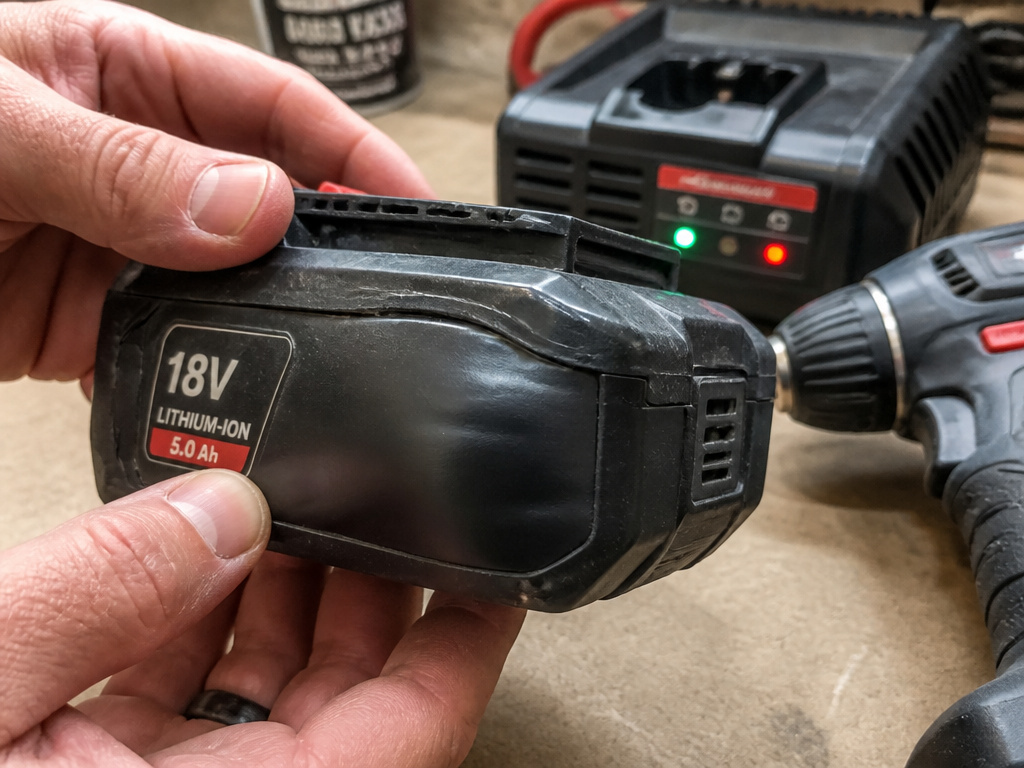
Replacement isn’t always obvious. The answer to how long does a power tool battery last isn’t a single date. A battery doesn’t just stop working one day. It fades. Here’s how to spot the decline.
- The Work Stops Mid-Job. The most telling sign is a significantly reduced run time after a full charge. The EGO Power+ manual states this clearly: it indicates the batteries are near the end of their usable life. If your string trimmer used to do the whole yard and now quits halfway, the battery is telling you it’s done.
- The Charger Lies. The LED shows “full” in 15 minutes when it used to take an hour. This often means the battery can no longer accept a full charge, its internal resistance is high, so the charger sees a “full” voltage quickly, but the capacity isn’t there.
- Swelling or Physical Damage. Any bulge in the battery case is a major red flag. It means gases are building up inside from cell decomposition. Stop using it immediately and dispose of it properly at a battery recycling center. Do not charge a swollen battery.
- It Won’t Hold a Charge Overnight. You charge it, take it off the charger, and come back the next day to find it dead. This points to a failing cell or a problem with the battery’s internal management circuitry.
When you see these signs, you have a choice: replace the pack or explore methods to revive a battery. For most modern lithium-ion packs, reconditioning is a temporary fix at best. The underlying cell chemistry has degraded.
Frequently Asked Questions
Should I leave my power tool battery plugged in all the time?
No. Modern “smart” chargers usually stop charging when full, but leaving the battery connected keeps it at 100% charge, which accelerates long-term capacity loss. It’s also a minor fire risk. Charge it, use it, and store it partially charged if you won’t use it for a while.
How long do DeWalt 20V batteries last?
DeWalt doesn’t publish cycle-life data in their public manuals, but their 20V MAX lithium-ion cells are similar to other brands. DeWalt doesn’t publish cycle-life data in their public manuals, so a specific cycle range cannot be confirmed. Runtime per charge varies by capacity (1.5Ah, 5.0Ah, etc.) and the tool’s amp draw.
What is the typical lifespan of a Ryobi 40V battery?
Like DeWalt, Ryobi doesn’t provide official cycle counts. Their 40V lithium-ion platform is designed for longer runtime in high-demand tools like mowers. Ryobi doesn’t provide official cycle counts, so a specific lifespan expectation cannot be confirmed. The lifespan of power tools in a brand’s ecosystem often depends more on the battery than the tool itself.
How to bring a dead tool battery back to life?
For a lithium-ion battery that won’t charge, sometimes a “jump-start” with a compatible charger or a specialized analyzer can wake it up if the voltage has only dropped slightly below the cutoff. Always prioritize safety and proper disposal.
The Bottom Line
A power tool battery’s life is a two-part story. Its runtime per charge is a flexible number dictated by the tool’s hunger and the battery’s watt-hour capacity, check the manual’s charts, then expect less. Its total service life is a harder limit set by charge cycles and calendar aging, with heat being the great accelerator.
The one move that gives you the most life for your money isn’t about charging. Keep batteries at a partial charge, in a cool, dry place, separate from the tool. That single habit does more to delay the inevitable fade than any charging trick.
When the fade finally wins and runtime drops by half, that’s your signal. The battery isn’t lazy; it’s retired. Trying to squeeze out a few more charges usually costs more in frustration than a new pack. Your tools work for you. Don’t spend your weekend working for a dying battery.
