
Extension Cord Gauge for Power Tools Explained
This post contains affiliate links. As an Amazon Associate, we earn from qualifying purchases.
Choose an extension cord gauge based on your tool’s amperage and the total cord length. Using a thinner 16-gauge cord for that job causes voltage drop, motor strain, and a cord that can overheat.
That heat is the warning sign most people miss until the plug feels soft. The gauge number, 16, 14, 12, 10, is an inverse scale: a lower number means a thicker copper wire inside. Thicker wire has less electrical resistance, so it can deliver more power (amperes) over a longer distance without overheating. This isn’t about convenience; it’s about preventing a substantial product hazard as defined by federal safety regulators, and a key part of this is understanding extension cord gauge for power tools explained.
What follows is the workshop translation of the official charts and standards. This guide explains how to read your tool’s amp rating, match it to a gauge and length, understand the cryptic letters on a cord’s jacket, and avoid the common mistakes that lead to melted plugs and damaged tools.
Key Takeaways
- Match the gauge to the tool’s amperage AND the total cord length, a 16-gauge cord is for light-duty tools (e.g., 1-13 Amps at 50 feet, 1-10 Amps at 100 feet).
- For a 15-amp tool like a miter saw, use a minimum 14-gauge cord at 50 feet; at 100 feet, step up to 12-gauge.
- Never use an indoor-rated cord outdoors, outdoor cords must be marked with a ‘W-A’ or ‘W’ suffix and have a jacketed construction.
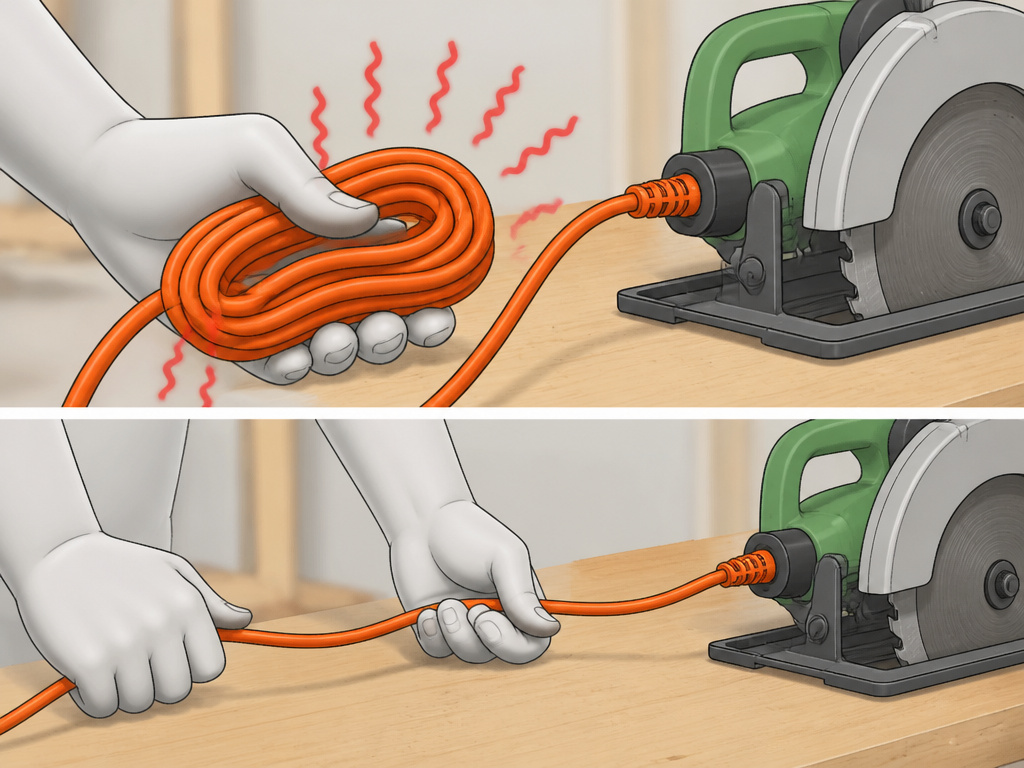
- A coiled cord is a fire hazard, heat cannot dissipate, creating a serious shock and electrical safety risk.
- According to Milwaukee Tool, grounded tools (three-prong plug) require a three-wire extension cord, and double-insulated tools can use either a two- or three-wire cord.
The Core Rule: Match Gauge to Amperage and Length
Here is a key point to understand. You don’t pick a cord based on how “heavy-duty” it looks, a key point in the extension cord gauge for power tools explained. You match two numbers: the amperage (amps) your tool draws and the total distance from the outlet.
The amperage is on the tool’s nameplate, usually near the motor. A typical corded drill might pull 4-6 amps, a circular saw 13-15 amps, and a high-demand tool like a table saw or air compressor can hit 15-20 amps. This is your starting point.
Per UL 817 standards incorporated by the CPSC, for general use, the minimum wire size is 16 AWG, or 17/18 AWG with integral overcurrent protection. However, the University of Texas EHS advises that extension cords must be a 3-wire type to be grounded. Cords with 18 AWG or larger conductors must also withstand a 30-pound pull test for strain relief.
Length is the second variable. Every foot of cord adds resistance. To compensate for voltage drop over distance, you need a thicker wire (a lower gauge number). The University of Texas EHS extension cord factsheet provides a clear, conservative chart. Here’s the practical translation for common power tool scenarios:
| Tool Example (Amperage Range) | 25 ft Cord | 50 ft Cord | 100 ft Cord |
|---|---|---|---|
| Work Light, Trimmer (1-10A) | 16 Gauge | 16 Gauge | 16 Gauge |
| Circular Saw, Mower (14-15A) | 14 Gauge | 14 Gauge | 12 Gauge | | Table Saw, Compressor (16-20A)| 12 Gauge | 12 Gauge | 10 Gauge |
At 13 amps, the wire overheats, the insulation softens, and the voltage at your tool can drop by 10% or more. The motor labors, loses power, and burns out prematurely.
Why Gauge Matters: Voltage Drop and Overheating
This is practical physics you can feel, and it’s why the extension cord gauge for power tools explained matters. When a wire is too thin for the current traveling through it, it acts like a resistor. This resistance causes two immediate problems: voltage drop and heat generation.
Voltage drop means the tool doesn’t get the 120 volts it expects. If the voltage drops significantly, the motor has to draw more amperage to produce the same power. It strains, sounds labored, and can overheat internally. You’re essentially starving your tool while cooking the cord.
The heat is tangible. After running a saw on an undersized cord, feel the cord jacket near the plug. If it’s warm, it’s working too hard. Hot is a warning. Too hot to hold comfortably is a failure in progress, unplug immediately.
For corded tools that rely on consistent wall power, this is critical. Their performance and longevity are directly tied to getting clean, full voltage.
Decoding Cord Jacket Markings
The cryptic letters on a cord jacket are a standardized code telling you the cord’s construction, insulation, and suitable environment. Understanding them is part of reading tool specs for your workspace.
The OSHA construction standard requires flexible cords to be rated for hard or extra-hard usage. You’ll see codes like SJTW, SJOOW, or STO. Here’s the breakdown:
- S: Standard flexible cord.
- J: Junior service (300-volt insulation). No ‘J’ means 600-volt insulation.
- T: Thermoplastic vinyl jacket.
- W: Rated for outdoor use (-A in the U.S., W in Canada). This is essential for any outdoor work.
- O: Oil-resistant.
- E: Thermoplastic elastomer (TPE) jacket.
For a typical workshop where a cord might see occasional oil, grease, and outdoor use, a cord rated for hard service and outdoor use (like types containing ‘W’ and ‘O’) is appropriate. It’s a junior hard-service cord, rated for 300 volts, with a thermoplastic jacket suitable for outdoor use.
Common mistake: Using an indoor cord (no ‘W’ rating) outside. They lack the thicker, sunlight and moisture-resistant jacketing required by UL 817 Section 30. The insulation degrades faster, creating a shock hazard.
Essential Safety Rules Beyond Gauge
Gauge is the first checkpoint, not the only one. Federal safety rules outline other “readily observable characteristics” that, if missing, mean a cord is unsafe.
- Grounding: This is binary. If your tool has a three-prong plug (grounded), you must use a three-wire extension cord. The grounding pin must be intact. Using a “cheater” adapter or removing the pin defeats the safety system. Double-insulated tools (marked with a square-in-a-square symbol) can use two- or three-wire cords.
- Strain Relief: The plug should be molded on or have a clamp where the cord enters. This prevents the wires from pulling loose inside. The standard requires strain relief to withstand a 30-pound pull force, and a weight must be steadily suspended for 1 minute without the cord pulling loose.
- Condition: Never repair a frayed or damaged cord with electrical tape. The CPSC extension cord business guidance is clear: tape is not a solution. Replace the cord. Inspect plugs for cracking or discoloration from heat.
- Never Daisy-Chain: Connecting multiple cords multiplies resistance and connection points for failure. If you need 150 feet, use a single cord of the correct gauge for that length and amperage. The same rule applies if using one cord for multiple tools, sum the amperages of all tools running simultaneously to find your required gauge.
A critical, often overlooked rule involves cord reels.
An extension reel can only carry its full rated current when completely extended. A cord in use while coiled on a reel traps heat, creating a serious shock and fire hazard.
That whirring shop fan on a coiled cord? It’s building a pocket of heat that can melt the jacket from the inside out. Always fully extend the cord.
Special Scenarios and Edge Cases
Workshop reality rarely fits a perfect chart. Here’s how to handle the gray areas.
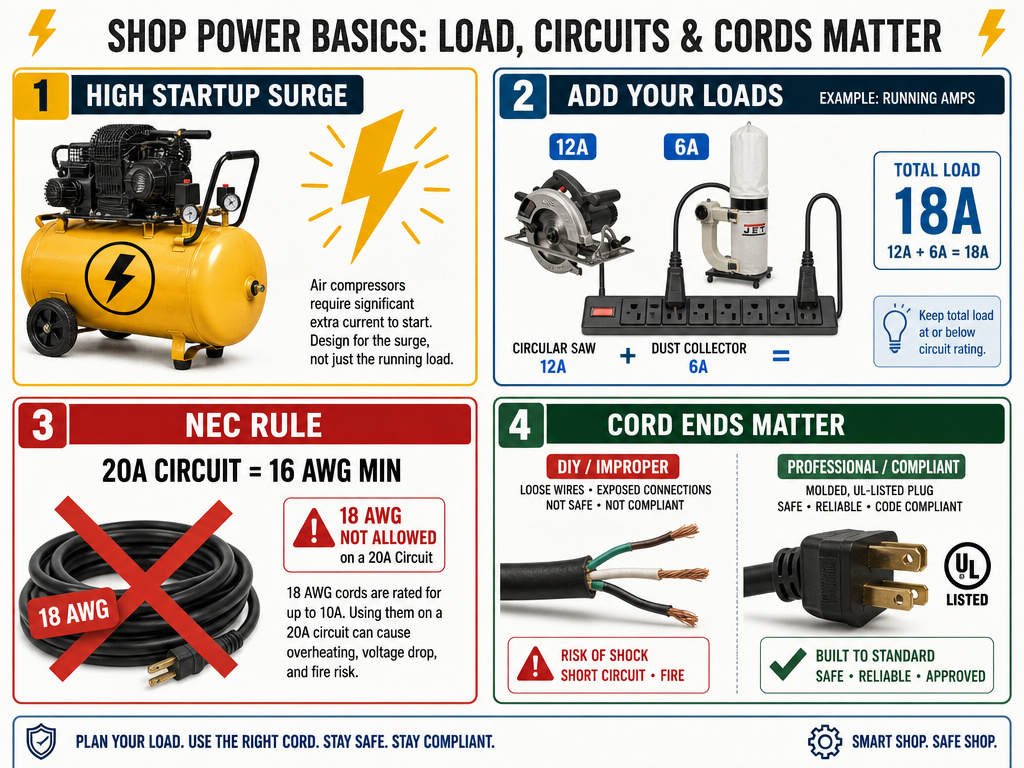
- Air Compressors: These have high startup surges (locked rotor amps). If your compressor draws 15 amps running, you need a cord rated for the higher startup load. For tools with high startup surges like air compressors, a thicker gauge cord may be necessary. For more, see our comparison on extension cord vs air hose options.
- Multiple Tools on One Circuit: You can run a drill and a work light from one outlet. But if you plan to run a saw and a dust collector from the same cord via a splitter, you must add their amperages. A 12-amp saw plus a 6-amp collector needs a cord rated for 18 amps, that’s a 12-gauge cord at 50 feet, at minimum.
- The National Electrical Code (NEC) prohibits using any extension cord in a 20-amp circuit unless it is 16 AWG or larger (so, 14, 12, or 10 AWG). An 18-gauge cord is never permitted on a 20-amp circuit, regardless of the tool’s draw.
- Making Your Own Cord: It’s possible, but you must use the correct components and know how to replace a cord properly. For most, buying a UL-listed cord is safer and more reliable.
The general reference on power cords notes that in a 20-amp circuit, the extension cord must be at least 16 AWG. This aligns with the NEC and is a good baseline rule to remember: when in doubt, thicker is safer.
Frequently Asked Questions
What happens if I use too small of an extension cord?
The cord overheats, potentially melting the insulation and creating a fire or shock risk. Your tool receives lower voltage, causing it to run poorly, overheat, and burn out its motor prematurely. You’ll also notice a significant loss of power.
Is a 12-gauge extension cord always better than a 14-gauge?
For a given length, a 12-gauge cord can safely carry more amperage than a 14-gauge cord. It’s “better” for heavier loads but is also thicker, heavier, and more expensive. It’s overkill for a lamp or phone charger. Match the gauge to the need.
Can I use an outdoor extension cord indoors?
Yes. Outdoor cords (marked with ‘W’) are built to a more durable standard and are safe for indoor use. The reverse is not true, never use an indoor cord outdoors.
How do I know if my extension cord is overloaded?
Touch the cord along its length, especially near the plug, after the tool has been running for a few minutes. Warm is a caution sign. Hot is a stop-now sign. Also, listen for a buzzing from the cord or a bogging-down sound from the tool.
Does a longer extension cord require a thicker gauge?
Yes. To deliver the same amount of power over a longer distance with acceptable voltage drop, you need a thicker wire (lower gauge number). A 100-foot cord must be a thicker gauge than a 25-foot cord for the same tool.
The Bottom Line
Don’t overthink this, but don’t guess. Grab your tool, find the amp rating on its label, and measure the distance from the outlet. Cross-reference those two numbers with a reliable chart like the one from the University of Texas EHS. If your saw is 15 amps and you need 50 feet, the answer is 14-gauge. Write it on the cord with a marker if you have to.
Invest in two or three good cords that cover your common scenarios: a short, heavy 12-gauge for the high-amp tools by your bench, and a longer, durable 14-gauge SJTW for general yard and driveway work. That covers 90% of home workshop needs.
And remember the essential rule: if a cord ever feels hot under load, it’s telling you it’s wrong. Unplug it, and step up the gauge. That simple reflex is the difference between a job done and a trip to the hardware store, or worse.
