
10 Best Dust Collection Systems in 2026
This post contains affiliate links. As an Amazon Associate, we earn from qualifying purchases.
Our best overall dust collection system is the WEN DC1300 5-Micron Dust Collector for its high airflow and dual-tool capacity. For premium stationary setups, consider the Powermatic PM1900TX TurboCone, and for health-grade fine dust filtration, the Powermatic PM2200HK Cyclone excels. Choosing the right system means matching its power and size to your specific workshop and tools. We based this guide on manufacturer specifications, expert analyses, and patterns in owner feedback to help you find a unit that fits your space and workflow.
Top 10 Dust Collection Systems in the Market
Certain content that appears on this site comes from Amazon. This content is provided "as is" and is subject to change or removal at any time.
The Best Dust Collection Systems, Reviewed
WEN DC1300 5-Micron Dust Collector
What We Like
- High 1,300 CFM airflow for effective chip collection
- Large 50-gallon bag reduces emptying frequency
- Mobile base with casters for easy shop maneuvering
- Dual inlets allow connecting two tools simultaneously
Trade-offs
- Bag design may permit more airborne dust than sealed canisters
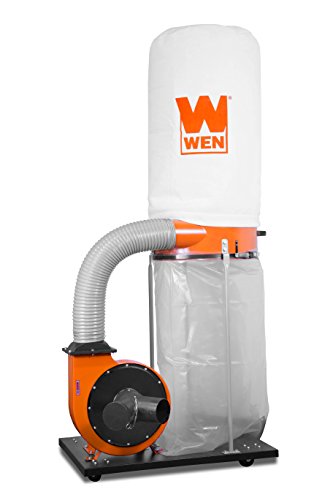
Moving 1,300 cubic feet of air per minute, the WEN DC1300 has the suction to handle the big chips from a planer or a jointer without breaking a sweat. That power, combined with its generous 50-gallon collection bag, makes it a workhorse for a busy small to mid-size shop. You can hook up two machines at once, and rolling it around on the included mobile base is a one-person job. It’s a straightforward, capable collector that gets the fundamentals right.
The trade-off for its simplicity and value is in filtration. The 5-micron bag will capture the visible sawdust, but it won’t trap the ultra-fine particles like a dedicated 1-micron HEPA system, such as the Festool CLEANTEC CT 36. For general woodworking where you’re not dealing with hazardous materials, it’s more than sufficient. If your primary need is capturing fine finishing dust at the source, you’ll want to look at a dedicated extractor instead.
Powermatic PM1900TX TurboCone Dust Collector
What We Like
- TurboCone design improves chip separation
- All-metal duct construction for rigidity
- Remote timer allows for programmed shutoff
- Steel impeller for sustained peak performance
Trade-offs
- At 268 pounds, it requires a dedicated floor space
- Large 46 x 23 inch footprint consumes significant shop area
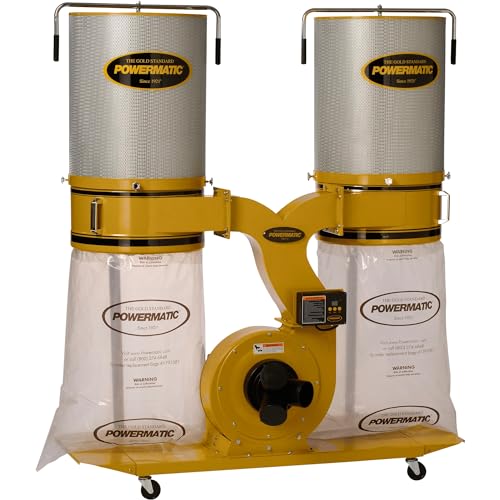
The Powermatic PM1900TX uses a TurboCone design that separates heavier chips before they reach the filter to prevent premature clogging. This feature, combined with a 3 HP motor and a 2-micron canister filter, is grouped with other models that performed well in expert round-ups. A remote-controlled digital timer can be programmed for up to 99 minutes, allowing you to run the system after finishing work.
Its all-metal duct construction and weight of 268 pounds indicate a stationary unit meant for permanent installation. Among the other products listed, its dimensions and weight are more comparable to stationary cyclone collectors like the Jet JCDC-2 than to portable dust extractors like Festool’s model. Multiple 4-inch dust ports allow several hoses to be attached at once for connecting to different tools.
Product photos
Jet JCDC-2 Cyclone Dust Collector

What We Like
- Two-stage cyclone preserves CFM for the motor
- Manual filter cleaning system for quick maintenance
- Remote with timer for automatic shutoff
- Swivel casters and quick-release drum levers
Trade-offs
- Requires 230-volt single-phase power hookup
- Weighs 235 pounds despite its compact footprint
- Lacks the larger dust capacity of 50+ gallon units
Its two-stage cyclone provides more working CFM than comparable single-stage units, which helps keep the air moving in a mid-size shop. The pleated filter captures particles down to 1 micron, a level of fine dust control that matters for sanding operations. A 30-gallon drum on independent casters holds heavy debris and can be rolled to a convenient spot for emptying.
This cyclone delivers far finer filtration and better motor efficiency than a simpler bag collector like the WEN DC1300, but you give up some overall collection capacity. The trade-off for that performance is a substantial 235-pound weight and a requirement for 230-volt power, so it’s a permanent shop fixture, not a portable job-site unit. For a dedicated workshop where fine dust control is a priority over massive chip volume, it hits a compelling sweet spot.
Powermatic PM2200HK Cyclone Dust Collector
What We Like
- High 1,543 CFM airflow handles multiple tools
- One-handed drum release simplifies bag changes
- Vacuum gauge provides real-time system feedback
Trade-offs
- Requires a dedicated 230V single-phase electrical circuit
- Fixed filter size lacks the compact footprint of a shop vac
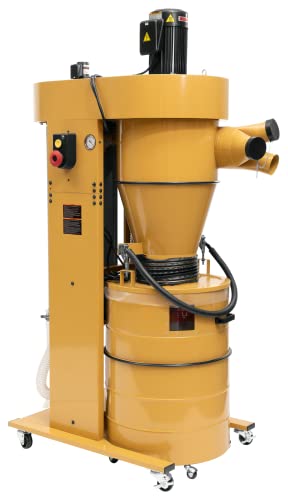
A HEPA filter that captures 99.97% of particles as small as 0.3 micron provides serious health protection for any shop. This filtration level, combined with a 3 HP motor moving 1,543 cubic feet of air per minute, suits woodworkers running large tools like cabinet saws and planers for hours. The integrated vacuum lines in the drum and multiple hose port options show it’s designed for a permanent, high-volume installation.
This unit’s substantial physical and electrical requirements are the main consideration. You need the floor space for its 85.2-inch height and the wiring for its 230V motor. For a large, dedicated shop where air quality is non-negotiable, research notes it performed well among cyclones. For a smaller space or where mobility is key, a compact extractor like Festool’s is a more practical choice, though it can’t match this cyclone’s air volume.
Product photos
Festool CLEANTEC CT 36 Dust Extractor
What We Like
- Five suction levels for different tasks.
- T-LOC system for convenient Systainer stacking.
- HEPA filtration for fine dust capture.
Trade-offs
- At 39.3 lb, it's a heavy unit for a shop vac.
- Smaller capacity than dedicated cyclone collectors.
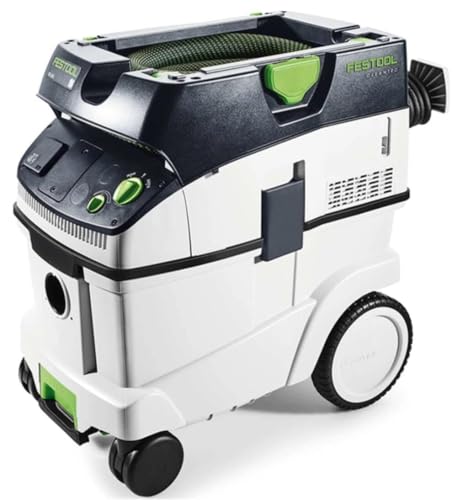
This Festool extractor suits a woodworker who values a clean, connected workflow, moving between sanders, routers, and saws without breaking stride. The five suction levels and HEPA filter let you dial in the right power for the job while capturing the finest particles, which is crucial for health and a spotless shop.
You trade the high-volume capacity of a large cyclone for intelligent portability. Festool’s model weighs 39.3 pounds, making it far more mobile than a 268-pound Powermatic PM1900TX cyclone collector. Its design prioritizes clean air and tool integration over bulk material handling from large stationary machinery.
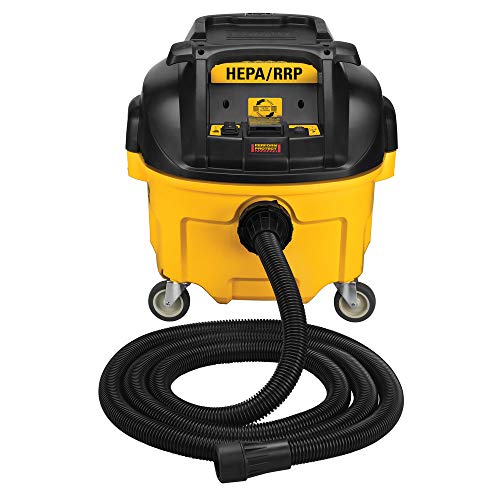
DeWalt DWV010 HEPA Dust Extractor
What We Like
- Automatic filter cleaning for continuous operation
- Power Tool Actuation controls vacuum with tool
- Heavy-duty wheels and casters for jobsite mobility
- HEPA certification for lead-safe renovations (with specified filter)
Trade-offs
- 8-gallon capacity requires frequent emptying on large projects
- 150 CFM is modest for large stationary tools
- 1.25-inch hose diameter limits chip capture from big planers
Automatic filter cleaning pulses every 30 seconds, allowing continuous operation with tools like sanders without stopping to maintain suction. Power Tool Actuation controls the vacuum with a connected tool, and heavy-duty wheels with casters provide jobsite durability. The 15-foot anti-static hose with a universal swivel connector offers secure, flexible reach for cleanup around a work area.
Its 150 CFM airflow and 1.25-inch hose diameter are suited for extractor tasks like sanding and sawing. For managing higher chip volumes from larger stationary tools, other listed systems like the WEN DC1300 or Powermatic PM1900TX have specifications for greater CFM and larger collection capacities. The DeWalt’s design meets EPA RRP rules for lead with specific HEPA filters, focusing on fine dust containment during renovation work.
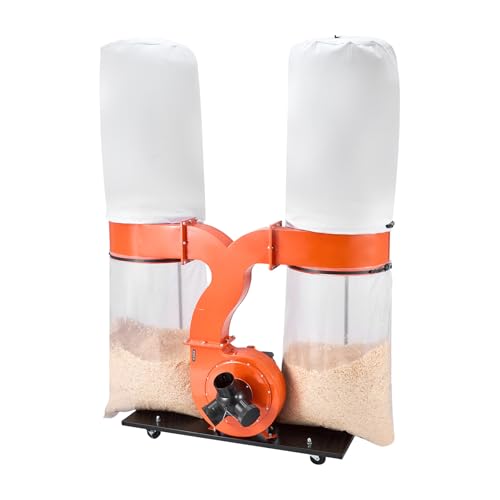
VEVOR 1550 CFM Vortex Dust Collector
What We Like
- Massive combined dust storage capacity
- Powerful 3.0HP overload-resistant motor
- Quick-clip bag system for fast disposal
Trade-offs
- Requires a dedicated 220V circuit
- Large footprint at nearly 79 inches tall
- Operation noise up to 90 decibels
A 1550 CFM airflow moves a serious volume of air, providing strong suction for rapid dust removal. That raw power is built for a busy workshop running multiple machines or a single large planer, efficiently pulling chips and fine dust from the source. The dual-bag system provides enormous storage, with two 42-gallon filter bags and two 35-gallon collection bags, letting you work for extended sessions without constant stops to empty the bin. This is the unit you get when moving the maximum amount of debris quickly is your primary goal.
That capability comes with significant physical requirements. You need the floor space for its substantial footprint and must have a 220V outlet available, which rules out many garage shops. While the 2.5-micron filtration is effective, it’s not the finest in the guide; the Powermatic PM2200HK, for instance, captures particles down to 1 micron. For general shop cleanup with immense air volume, the VEVOR is a workhorse, but it trades ultimate filtration finesse and plug-and-play convenience for pure suction force.
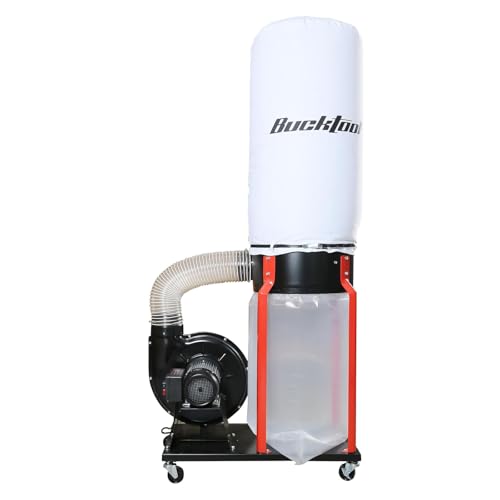
BUCKTOOL 1-1/2 HP Dust Collector
What We Like
- Internal dust baffle improves collection efficiency
- Mobile base for flexible workshop positioning
- Dual 4-inch ports for connecting two machines
- Direct 6-inch inlet boosts airflow significantly
Trade-offs
- Tall 82.7-inch height requires ample ceiling clearance
- 5-micron filtration is less fine than 1- or 2-micron systems
Its 1-1/2 HP motor delivers up to 1100 CFM, providing strong suction for woodworking machines like table saws and planers. An internal dust baffle helps direct heavier particles into the lower bag first, which can reduce filter clogging and extend the bag’s service life. The mobile base allows the collector to be positioned near different tools, helping to improve suction by reducing long hose runs in a garage or small workshop.
The trade-off is in filtration fineness. Its 5-micron filter catches a lot, but it won’t match the air-scrubbing capability of a 1- or 2-micron system like the Powermatic PM1900TX for ultra-fine sanding dust. You get capable chip collection and basic fine dust control in a single, movable package. For a small to mid-sized shop prioritizing raw chip collection over clinical air filtration, this collector delivers core performance where it counts.
Product photos
Jet DC-1100VX Vortex Cone Dust Collector

What We Like
- Vortex cone improves chip separation.
- 2-micron filter for superior air quality.
- Permanently-lubricated motor for continuous duty.
- Quick-connect bags for easy emptying.
Trade-offs
- At 79 inches tall, it requires significant vertical clearance.
Superior shop air quality comes from its 2-micron canister filter, which captures fine dust that escapes many bag filters. Jet’s Vortex Cone technology improves chip separation and collector bag packing efficiency, according to the product description. This single-stage design offers an economical and quiet operation for a workshop setting.
Its single-stage operation is an economical design, but it does not separate the motor from the debris stream like a dedicated cyclone system. The unit is a stationary shop collector with four casters for mobility, not a compact, portable jobsite extractor. You are buying a dedicated system for a permanent workshop setup with industrial controls designed for years of trouble-free use.
Product photos
SHOPMAX 20-Gallon Dust Collector

What We Like
- Powerful 677 CFM suction for its class
- Convenient 20-gallon onboard dust storage
- Includes five hose adapters for versatile connections
- Easy to move with integrated wheels and handle
Trade-offs
- 677 CFM is lower than stationary cyclone units
- Smaller capacity means more frequent emptying
At 55 pounds with two wheels and an onboard handle, the SHOPMAX 20-Gallon Dust Collector is designed for easy transport around a workshop. Its 677 CFM maximum airflow provides suction capable of serving a single woodworking machine, and the five included hose adapters connect to a range of tools directly. This setup suits a woodworker needing to move collection capacity to different tools rather than maintaining a fixed central system.
This unit’s mobility comes with trade-offs in pure power and capacity. Its 20-gallon bin will fill up faster than a stationary unit like the 50-gallon WEN DC1300, and its airflow can’t match the suction of a dedicated 3HP cyclone. For a one-man shop where space is shared and tools are rearranged often, however, the SHOPMAX delivers capable cleanup without becoming a permanent fixture.
Product photos
How We Evaluated Dust Collection Systems
This guide is based on an analysis of manufacturer specifications, technical documentation, and expert reviews to understand key performance metrics. It focuses on criteria important for shop use: airflow (CFM) for chip removal, filtration level for air quality, physical footprint for shop fit, and features like mobility or tool-activation that affect daily convenience. While this approach identifies capable systems, it does not provide the long-term durability insights that come from years of actual use in a specific workshop.
What To Look For In Dust Collection Systems
Selecting a system is about balancing suction power, filtration quality, and physical practicality for your space. Your primary machines, shop size, and health priorities dictate the right choice.
Key criteria are airflow (CFM) for chip removal, filtration fineness for air quality, physical size for your shop, and features like mobility or automatic start that match your workflow.
Airflow and Suction Power
Airflow, measured in Cubic Feet Per Minute (CFM), determines a system’s ability to capture debris at the tool. A unit with 1,300 CFM or more can effectively service a primary machine like a table saw or planer, while systems around 150 CFM are suited for portable extractors connected to sanders.
For central systems, look for a motor horsepower rating that supports the CFM you need. Motors with lower horsepower are common for budget shop collectors, while premium units with higher horsepower drive the greatest CFM. Remember, long duct runs and small hose diameters will reduce effective suction at the tool.
Filtration and Dust Separation
Filtration is critical for capturing the fine, breathable dust that poses health risks. Look for the filter’s micron rating; a 5-micron bag catches chips but allows fine dust through, while a 2-micron canister or a certified HEPA filter is necessary for hazardous fine dust. Systems with a cyclone or vortex cone design provide two-stage separation, dropping most chips into a drum before air reaches the filter.
This preserves filter life and maintains suction. For the cleanest air, prioritize systems that combine high CFM with fine filtration, as seen in our guide to top-performing cyclone dust collectors.
Physical Practicality
A system’s footprint, power requirements, and capacity must fit your shop’s reality. Measure your available floor and ceiling space, as some collectors are very tall. Check your electrical panel; many high-CFM systems require a dedicated 230-volt circuit, while portable units use a standard household outlet. Dust capacity, from small extractor bins to large collection bags, determines how often you empty it. Mobile bases are essential for flexible single-car garage setups, while stationary collectors suit dedicated shops. Planning your dust collection setup involves considering these physical constraints from the start.
- Check your shop’s ceiling height before ordering a tall unit.
- Verify you have the correct voltage outlet available.
- Consider how often you’ll want to stop and empty the collection bag or drum.
The best system is the most powerful one that physically and electrically fits your shop while meeting your filtration needs.
Dust Collection Systems Compared
The following table compares key specifications across all ten systems to highlight their differences in power, filtration, and size at a glance.
| Product | Motor Power | Airflow (CFM) | Filter Finesse |
|---|---|---|---|
| WEN DC1300 5-Micron Dust Collector | 14-amp | 1,300 CFM | 5-micron |
| Powermatic PM1900TX TurboCone Dust Collector | 3 HP, 230V 1Ph | N/A | 2-micron canister |
| Jet JCDC-2 Cyclone Dust Collector | 2 HP, 230V 1Ph | N/A | 2-micron |
| Powermatic PM2200HK Cyclone Dust Collector | 3 HP | 1,543 CFM | 1-micron HEPA |
| Festool CLEANTEC CT 36 Dust Extractor | N/A | N/A | HEPA |
| DeWalt DWV010 HEPA Dust Extractor | 15-amp | 150 CFM | HEPA |
| VEVOR 1550 CFM Vortex Dust Collector | 3.0HP induction | 1550 CFM | 2.5 micron |
| BUCKTOOL 1-1/2 HP Dust Collector | 1-1/2 HP | 1100 CFM | 98% at 5 microns |
| Jet DC-1100VX Vortex Cone Dust Collector | 1-1/2 HP | N/A | 2-micron canister filter |
| SHOPMAX 20-Gallon Dust Collector | 6.3 amp | 677 CFM | N/A |
Frequently Asked Questions
What is the best dust collection system?
The “best” system depends entirely on your shop. For most woodworkers needing high-volume chip collection from multiple tools, a unit like the WEN DC1300 with high CFM and dual inlets is an excellent starting point. Those in a permanent shop prioritizing health may need a cyclone with HEPA filtration.
What’s the difference between a dust collector and a dust extractor?
A dust collector is typically a larger, stationary system designed for high-volume chip and dust removal from big machinery like table saws and planers. A dust extractor is a more mobile, often HEPA-filtered vacuum designed for connected tool use, like sanding or cutting, and excels at capturing fine dust.
Which dust extractor is better, Bosch or Festool?
We focus on systems within our research scope. For automatic, HEPA-filtered extraction that starts with your tool, the Festool CLEANTEC CT 36 in our lineup is a strong option for mobile workshop users, especially those invested in a compatible tool ecosystem.
What should I look for in a system for a small shop?
For limited space, prioritize compact footprints and mobility. Look for units with integrated wheels, a smaller vertical profile, and sufficient CFM for your primary tool. The SHOPMAX 20-Gallon unit is a good example of a portable workshop solution, and our resource on dust collection for small shops offers further guidance.
Do I need a cyclone separator?
A cyclone or two-stage separator greatly improves system efficiency by separating heavy chips before air hits the filter, maintaining suction and reducing filter maintenance. It’s highly recommended for any serious shop, and you can learn more about the types of dust collectors to understand the benefits.
The Bottom Line
The WEN DC1300 5-Micron Dust Collector is our best overall pick for woodworkers needing powerful, high-airflow chip collection from multiple stationary tools in a garage or dedicated shop. If your budget is tighter, the BUCKTOOL 1-1/2 HP Dust Collector offers solid value, while those requiring certified HEPA filtration for fine dust should look to the Powermatic PM2200HK Cyclone.
Ultimately, choosing a dust collection system is about honest assessment: match the unit’s CFM, physical size, and electrical needs to your shop’s reality, and never compromise on filtration for the fine dust you can’t see.
