
Single Stage vs Two Stage Dust Collector: How to Choose
This post contains affiliate links. As an Amazon Associate, we earn from qualifying purchases.
A single-stage dust collector pulls all debris through its impeller and into a filter, offering higher CFM and a lower upfront cost. A two-stage dust collector uses a cyclone or separator to remove bulk chips before the air reaches the impeller and filter, providing superior fine dust capture, longer filter life, and sustained suction, but at a higher price and with more floor space required. For most hobbyists with a mobile, single-tool setup, a single-stage unit is a sensible start. If you run a planer or sander for hours, have a ducted system, or your shop shares air with living space, a two-stage cyclone is the long-term investment.
The separator is the part that changes everything in the single stage vs two stage dust collector debate. It’s a simple mechanical difference with complex consequences for your wallet, your cleanup time, and the air you breathe.
What follows is a breakdown of the measured performance trade-offs in the single stage vs two stage dust collector choice, the real-world costs hidden in filter replacements, and a clear framework for matching the machine to your actual shop habits. By the end, you’ll know whether to roll a portable unit from tool to tool or plan for a permanent cyclone installation.
Key Takeaways
- The single-stage JET DC-1100VX moves 505 CFM at 3.7 in. W.c., while the comparable Oneida two-stage cyclone moves 475 CFM at 5.4 in. W.c., the cyclone’s resistance costs some airflow but delivers higher static pressure and 99.5% fine dust capture.
- A two-stage system’s filter only sees fine dust, extending its life dramatically; using a dust separator with a single-stage collector gets you 90% of this benefit for a fraction of the cost.
- For shops attached to a house or with heavy planer/sander use, a two-stage cyclone is essential for air quality; for weekend projects with a table saw and router, a mobile single-stage unit is often perfectly adequate.
- Ignore peak CFM ratings measured with no filter or ducting; real-world airflow at the tool is often 40 to 60 percent lower than the advertised number.
- Many 2- and 3-horsepower cyclones require a 240-volt dedicated circuit, a significant installation factor often overlooked in initial planning.
The Core Mechanical Difference: One Part Changes Everything
The separator is the key component. A two-stage dust collector has one; a single-stage does not. This major feature is the defining mechanical element that redirects the entire workflow of chips and dust.
In a single-stage machine, everything you suck up, the half-inch planer curl, the knot, the stray screw, travels the same path. Air and debris enter the inlet, pass directly through the spinning impeller blades, and are blown into a collection bag. The filter, whether a bag or a canister, sits right in this stream. It catches everything, from bulky chips down to the finest powder, all at once.
A two-stage dust collector adds a cyclone or baffled separator ahead of the impeller and filter. This stage uses centrifugal force to spin heavier particles out of the airstream and into a collection drum. Only the remaining fine dust, suspended in the air, continues on to the impeller and the final filter.
This separation changes three things fundamentally: what hits your impeller, what loads your filter, and what you breathe. The impeller is protected from impact damage, the filter isn’t buried under chips, and the fine dust that escapes capture is a fraction of what a single-stage unit would recirculate.
The Measured Trade-Off: CFM vs. Static Pressure
You can’t just look at a horsepower rating. The real performance story is told by two numbers: CFM (cubic feet per minute), which is the volume of air moved, and static pressure (in inches of water column), which is the system’s ability to overcome resistance in ducts and hoses.
Independent testing of two 1.5 HP models, a JET DC-1100VX canister (single-stage) and an Oneida two-stage cyclone, lays out the trade-off with hard numbers.
| Model (1.5 HP) | Measured CFM | Static Pressure | Fine Dust Capture |
|---|---|---|---|
| JET DC-1100VX (Single-Stage) | 505 cfm | 3.7 in. W.c. | 98.2% |
| Oneida Two-Stage Cyclone | 475 cfm | 5.4 in. W.c. | 99.5% |
The single-stage unit moves more air (505 CFM vs. 475 CFM) because it has no separator adding resistance. The two-stage unit has higher static pressure (5.4 in. W.c. Vs. 3.7 in. W.c.) because the cyclone itself creates that resistance. What you get for that trade is a jump in fine dust capture from 98.2% to 99.5%, and a filter that stays clean.
Where this goes sideways: Comparing published “peak” CFM ratings. A Shop Fox W1687 might claim 1,280 CFM, and a WEN DC1300 1,300 CFM, but these are typically measured with no filter or ducting attached. Real-world airflow at the tool, through a hose and a loaded filter, is often 40 to 60 percent lower. The measured CFM figures in the table above are far more useful for planning.
This is a core principle when you compare a single stage vs two stage dust collector: a two-stage cyclone often needs a stronger motor to deliver the same effective airflow at the tool as a single-stage unit, it’s working against its own separator. It’s a core principle of any two-stage system, like a single stage vs two stage air compressor, as well: added stages manage pressure and efficiency, not just raw output.
Filter Life, Health, and the Hidden Long-Term Cost
The dust that damages your lungs is the fraction roughly 10 microns and smaller, especially particles under 2.5 microns. These stay airborne for hours and pass straight through cheap filter bags.
This is where the separator pays its rent. In a two-stage system, the filter only ever sees this fine fraction. In a single-stage unit, the filter is packed with chips and coarse dust, which clogs the filter and reduces airflow. A clogged filter severely reduces airflow.
| Scenario | Filter Loading | Typical Maintenance Interval | Fine Dust Recirculation |
|---|---|---|---|
| Single-Stage (30-micron bag) | Chips + All Dust | Requires frequent cleaning | High |
| Single-Stage (1-micron canister) | Chips + All Dust | Requires less frequent cleaning than a bag filter | Moderate |
| Two-Stage Cyclone (1-micron filter) | Fine Dust Only | Requires infrequent cleaning | Very Low |
Adding a separator to a single-stage collector reduces filter loading by 90%. That’s the single most cost-effective upgrade you can make, turning a $300 collector into a system that behaves like a $1,500 one. It’s the difference between shaking out a filter during every coffee break and forgetting about it for a month.
For the cleanest air, you need good filtration. The Clearvue CV1800 is rated for 0.5-micron particles, while many budget units ship with 30-micron bags or 5-micron filters. If you’re looking at complete dust collector systems, like the best dust collector systems, the filtration rating is the first spec to check after CFM.
Single-Stage: When the Simpler, Cheaper Machine Wins
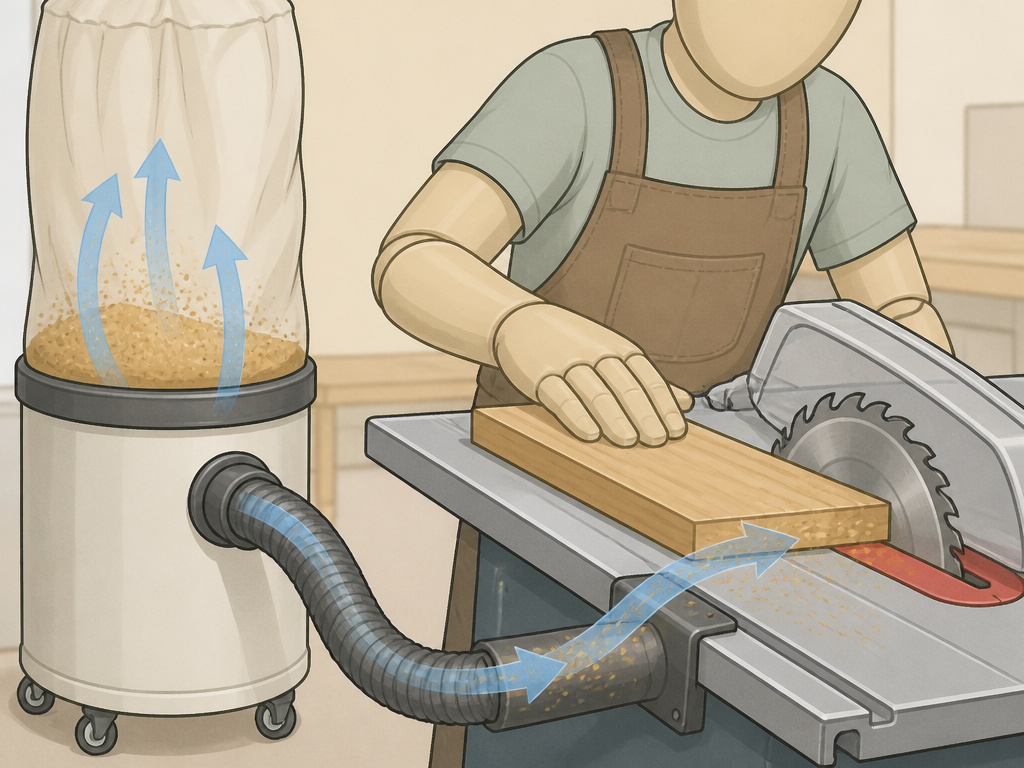
A single-stage dust collector is a reasonable choice. Full stop. It’s not a “lesser” tool; it’s the right tool for a specific set of conditions.
Think about a typical 1 to 1.5 horsepower unit on casters. It fits in a 2′ x 3′ corner, you roll it to your table saw with a short 4-inch hose, you make your cuts, and you empty the bag. The workflow is simple, the footprint is small, and the upfront cost is low. For a garage shop used on weekends, or for someone who mostly works with a table saw, bandsaw, and router table, this is often all you need.
The financial logic is clear: you get the most CFM per dollar. A unit like the Shop Fox W1687 delivers serious airflow for the price. The trade is that you commit to more frequent filter maintenance and accept that more fine dust will escape. If you only run the shop for a few hours a week on small projects, that’s a perfectly rational trade to make.
Common mistake: Using a single-stage collector for drywall sanding without a bag. The ultra-fine gypsum powder coats the impeller and motor, acting as an abrasive that can kill the unit. Always use a filter bag for fine dust.
This mobile, one-tool-at-a-time approach is the polar opposite of installing a central system, which is at the heart of the dust collector vs shop vac debate; it’s about matching the machine’s mobility to your shop’s layout.
Two-Stage Cyclone: The Upgrade Justified by Volume and Time
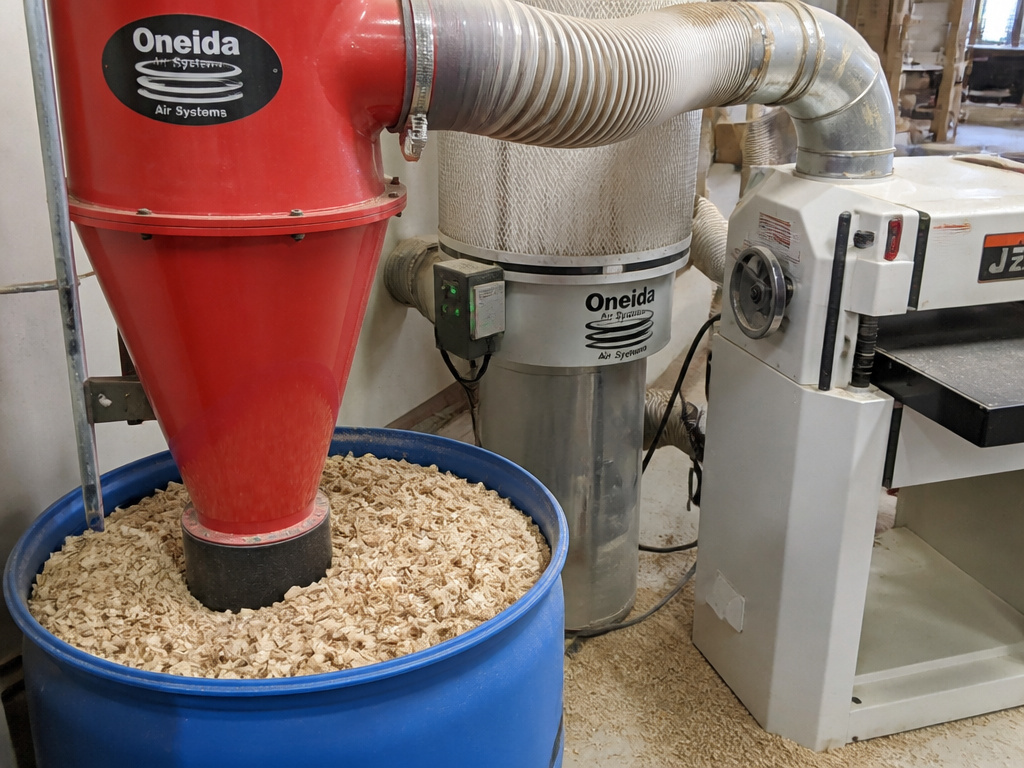
A two-stage cyclone dust collector stops being an option and starts being a necessity when your shop habits hit certain thresholds. The decision isn’t about square footage; it’s about tool usage and air quality requirements.
You should seriously consider a two-stage system if:
- You run a thickness planer or drum sander regularly.
- You work in sessions longer than 2-3 hours at a stretch.
- Your shop is in a basement or garage attached to your house.
- You have a ducted system serving three or more stationary tools.
- You notice suction dropping noticeably halfway through a job with your current single-stage unit.
The cyclone pays for itself in filter life and consistent performance. The separator protects the impeller from damage, allowing for more efficient blade designs. It also means most of your waste ends up in a easy-to-empty 55-gallon drum, not a fiddly bag. For a dedicated space, a wall-mount dust collector, like the best wall mount dust collectors, or a full cyclone is the professional approach.
Worth knowing before you start: Many 2- and 3-horsepower cyclones require a 240-volt dedicated circuit. That’s an additional installation cost and a potential deal-breaker if your panel is full. Always check the electrical requirements before falling in love with a model’s specs.
This category involves heavy-duty tools and permanent installations, similar to the power considerations when choosing among two-stage air compressors, like the best 2 stage air compressors. The investment is significant, but the payback in productivity and shop environment is real.
The Hybrid Path: Adding a Separator to Your Single-Stage Collector
You don’t have to replace your entire machine to get two-stage benefits. Adding a cyclone or baffle separator ahead of your single-stage collector’s inlet is the most cost-effective performance upgrade in dust collection.
A separator like a Dust Deputy or a DIY Thien baffle sits between your tool hose and the collector inlet. It spins out the chips and bulk dust into a trash can or drum. Only the fine dust makes it to your collector’s impeller and filter. This simple add-on can reduce filter loading by 90%, maintain strong suction throughout a work session, and extend filter life by months or years.
It’s the perfect middle path. You keep your affordable, mobile single-stage unit but gain the core advantage of a two-stage system: a clean filter. For a small shop looking for a two-stage dust collector on a budget, this is often the smartest financial and practical move. It’s also a great way to test if your workflow truly needs a full cyclone before spending thousands.
The catch? It adds resistance, which will cost you some CFM. You’re making the same CFM-for-filter-life trade-off as a built-in two-stage system, just with a modular setup.
Decision Framework: Which Collector Fits Your Shop?
Stop looking at horsepower. Start asking these questions about your actual work. Your answers will point you to the right type of machine.
1. What’s your heaviest-use tool?
- Table saw, bandsaw, router table: A mobile single-stage is fine.
- Thickness planer, drum sander, jointer: Plan for a two-stage cyclone.
2. What’s your typical session length?
- Under 2 hours, intermittent use: Single-stage.
- Over 3 hours, continuous use: Two-stage.
3. Where is your shop located?
- Detached garage, shed: Single-stage is acceptable.
- Basement, garage attached to house: Two-stage is strongly recommended.
4. What’s your system setup?
- Mobile, one tool at a time: Single-stage.
- Ducted system with multiple drops: Two-stage.
5. What’s your budget & upgrade path?
- Tight budget, want to start now: Single-stage unit + plan to add a separator later.
- Ready to invest in a long-term solution: Two-stage cyclone.
If you answered mostly with the first options, a machine like the WEN DC1300 or a JET canister model will serve you well. If you leaned toward the second options, start researching two-stage dust collectors for a small shop or full cyclones from Oneida or Clearvue. For specialized applications like handling saturated media, you’d look into best wet dust collectors.
How do you protect the impeller from damage?
In a single-stage collector, all debris passes directly through the impeller. This means chips, knots, and even stray hardware can strike the fan blades, potentially causing damage, imbalance, and noise over time. A two-stage system adds a separator, usually a cyclone, before the fan. This separator uses centrifugal force to throw the bulk of the heavy chips and debris into a collection drum before the air reaches the impeller. By removing these larger particles, the separator protects the impeller, allowing for more efficient fan designs and significantly extending its operational life and balance.
How does ductwork design affect performance?
Published CFM numbers are often measured with no ducting or filter, so real-world airflow at your tool is typically much lower. Every foot of duct, every elbow, and every reducer adds resistance, which reduces the effective suction. Clogs most often happen at elbows or reducers, especially when moving long planer shavings. A well-designed system uses the shortest, straightest possible runs with smooth, large-diameter ducts to minimize this loss. Adding a separator, like a cyclone, also introduces a small amount of resistance, which can further reduce airflow unless compensated for with a more powerful motor.
What horsepower do I need for my shop?
For a small hobby shop where you move a collector from tool to tool with a short hose, a 1 to 1.5 horsepower single-stage unit is a common and reasonable starting point. This suits one-tool-at-a-time use on equipment like a table saw or router table. If you run chip-producing tools like a thickness planer regularly, or have a permanent ducted system serving three or more stationary tools, a two-stage cyclone is recommended. These systems often require a stronger motor, typically 1.5 to 3 horsepower, to overcome the added resistance of the cyclone and ductwork and maintain good airflow.
Frequently Asked Questions
Can I convert my single-stage dust collector into a two-stage system?
Yes. Adding a cyclone or baffle separator ahead of the collector’s inlet is a common and effective upgrade. It gives you the primary benefit of a two-stage system, keeping chips out of the filter, for a fraction of the cost of a new machine. You will lose some CFM due to the added resistance.
Is a two-stage dust collector worth it for a hobbyist?
It depends on your tools and session length. If you only use a table saw for an hour on weekends, a single-stage is sufficient. If you regularly run a planer or sander for long sessions, or if your shop shares air with your home, a two-stage cyclone is a worthwhile investment for your health and the machine’s performance.
What CFM do I actually need?
Ignore peak ratings. Look for measured CFM with a filter attached. Sources disagree on the recommended minimum CFM; one source suggests at least 600 CFM for a starter dust collector, while others cite much higher peak ratings for specific models. The best approach is to calculate the needs of your largest-dust-producing tool and account for significant duct losses, as real-world airflow can be 40 to 60 percent lower than published ratings.
What’s the difference between a “vortex cone” and a true cyclone?
Vortex cone is a molded plastic insert inside some single-stage collectors meant to create a spinning air pattern. It’s a minor improvement. A true cyclone is a large, standalone conical vessel designed for maximum centrifugal separation. The cone is a feature; the cyclone is the machine’s core component. Don’t confuse them.
The Bottom Line
The single-stage vs. Two-stage choice is about matching a machine’s design to your shop’s reality.
For most people starting out, the right move is a 1.5 HP single-stage unit on casters. Use it, learn its limits, and the first time you have to stop mid-project to clean a clogged filter, buy a separator add-on. That hybrid system will handle 90% of home shop needs for years.
Commit to a full two-stage cyclone only when your work justifies it: when you’re running ducting, feeding a hungry planer for hours, or when the air in your shop needs to be as clean as the air in your house. That’s not a beginner’s purchase; it’s a craftsman’s investment.
Either way, prioritize filtration over raw horsepower. A 1-micron filter on a modest collector does more for your lungs than a 5-micron bag on a monster. Your future self will thank you for that one decision.
