
9 Best Sanders For Deck in 2026
This post contains affiliate links. As an Amazon Associate, we earn from qualifying purchases.
We chose the Bosch GET75-6N Electric Orbital Sander as the best overall deck sander for its balance of power, control, and excellent dust management, a crucial factor for outdoor work. For refinishing expansive surfaces, the Onfloor 16 Inch Wood Floor Sander excels, while the Makita 9903 Belt Sander is ideal for aggressive material removal.
Sanding a deck is demanding, and the wrong tool can make a long job frustrating and ineffective. You need a sander that matches your deck’s size, your material removal goals, and your tolerance for dust and cord management. We researched specifications, manufacturer data, professional round-ups, and patterns in owner feedback to select these nine picks. This guide will help you find the right sander for your specific deck project.
Top 9 Sanders For Deck in the Market
Certain content that appears on this site comes from Amazon. This content is provided "as is" and is subject to change or removal at any time.
The Best Sanders For Deck, Reviewed
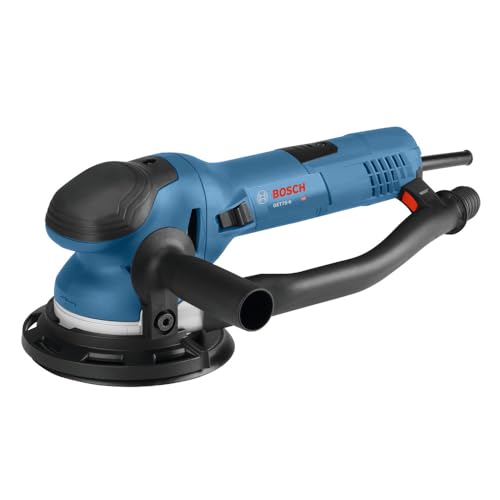
Bosch GET75-6N Electric Orbital Sander
What We Like
- Variable 7.5 amp motor for power and control
- Multi-hole pad accepts wide variety of 6-inch discs
- Includes two vacuum hose adapters for dust management
Trade-offs
- Dust collection requires a separate shop vacuum purchase
A powerful 7.5-amp motor and a turbo mode that triples stock removal provide aggressive sanding for large surfaces, while its standard random orbit setting handles finishing work. This dual-mode operation means it can manage both rapid material removal and final smoothing without needing two separate tools. That flexibility suits extended projects like refinishing wood floors or furniture where both stages are required.
Its corded design and 5.7-pound weight mean managing a power cord and some arm fatigue during all-day use. The passive dust collection system also requires connecting a separate shop vacuum, adding another hose to the setup. For detailed seam work, a specialized tool like the Teakdecking Systems Seam Sander Kit would be more appropriate, positioning this Bosch as a primary sander for larger areas.
Onfloor 16 Inch Wood Floor Sander

What We Like
- Integrated 1 HP vacuum for dust control
- 16-inch width sands large surfaces quickly
- Quick-change tooling simplifies maintenance
- Pivoting heads for even results on uneven decks
Trade-offs
- 16-inch cube dimensions require significant storage space
- The large, integrated design lacks portability for small decks
A 16-inch sanding width is the key detail here, letting you resurface a vast deck area in far fewer passes than a standard orbital sander. The integrated 1 HP vacuum and forgiving pivot heads mean you can focus on the finish, not the dust cloud or minor floor inconsistencies. This machine is built for the single purpose of efficiently renewing large, flat wooden surfaces. It is a logical choice for anyone facing a major deck restoration project where time and a clean worksite are priorities.
You trade portability and versatility for that immense coverage. At 16 inches in every dimension, this is a workshop-grade tool you roll to the job, not a sander you carry in one hand like the Makita 9903. Its design is specialized for broad, open floors. For sanding between deck boards or working on a small landing, a more compact, maneuverable tool would be far more practical, but for the sheer scale of a large deck, this Onfloor’s design is purpose-built.
Makita 9903 Belt Sander

What We Like
- Powerful 8.8 AMP motor
- Variable speed control dial
- Auto-tracking belt system
- Flush sanding design
Trade-offs
- At 9.5 lb, it's heavier than many orbital sanders
- Weighs 9.5 pounds
An 8.8 AMP motor provides the power for demanding material removal, while a variable speed dial adjusts the belt from 690 to 1,440 feet per minute for different stages of work. This auto-tracking belt system maintains alignment without manual adjustment, letting users concentrate on their technique. Its innovative design allows sanding flush to a wall with both the nose and side of the tool.
That power and capability come with trade-offs. Weighing 9.5 pounds, it demands more arm strength over long sessions compared to a lighter orbital sander like the DEWALT 20V MAX XR. Operation is also corded, which limits mobility on large projects. The front grip is designed for comfortable handling during use.
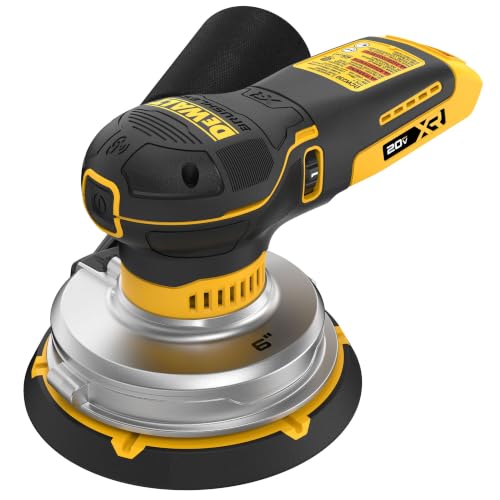
DEWALT 20V MAX XR Cordless Orbital Sander
What We Like
- Lowest vibration versus leading competitors.
- Integrated wireless vacuum control button.
- Five-speed dial for finish and material removal.
Trade-offs
- Tool-only listing; requires separate 20V MAX XR battery and charger.
- Dust extractor and Tool Connect chip are sold separately.
Cordless operation allows movement across a deck or workspace without an extension cord. The listing mentions up to 41 minutes of runtime and the capacity to sand up to 200 square feet under ideal conditions, which could cover a significant section of a project on a single charge. This mobility is paired with a design that claims the lowest vibration versus leading competitors, a feature intended to reduce user fatigue during long sanding sessions.
The trade-off is that you’re buying into a system. The tool itself doesn’t include a battery, and to use the clever wireless vacuum start feature, you’ll need a compatible DEWALT dust extractor. For a dedicated, high-power corded option that plugs right in, the Bosch GET75-6N with its larger 7.5-amp motor is the more straightforward route. But if you’re already invested in the 20V MAX platform or prioritize a clean, uncluttered workspace, this sander integrates smoothly.
Product photos
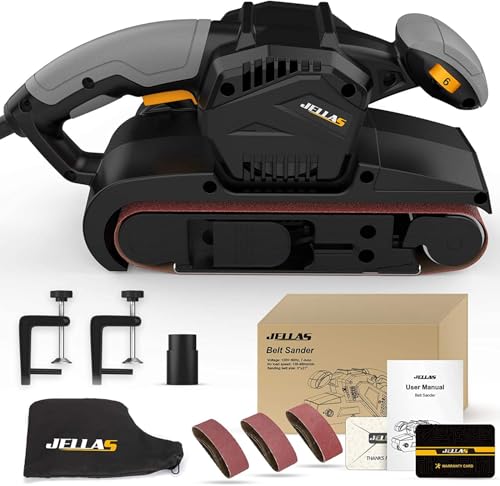
Jellas 7Amp Handheld Belt Sander
What We Like
- Includes metal clamps for bench sander conversion
- Comes with ten sanding belts in five grits
- Variable speed dial with six settings
- Lock-on button for continuous operation
Trade-offs
- Requires a table for bench sander mode, adding setup time
- At 13.4 inches long, it's less compact for tight deck corners
The inclusion of two metal C-clamps is what sets this sander apart for deck work. You can secure it to a workbench, turning it into a stationary tool for sanding railings, balusters, or trim pieces with both hands free. That 7-amp motor has the grunt to handle aggressive stock removal on pressure-treated planks, while the variable speed control lets you dial it back for a finer finish. This dual-purpose design is a smart fit for the DIYer who needs to tackle both large deck surfaces and detailed component refinishing without investing in two separate machines.
The trade-off for this versatility is bulk. It’s longer and heavier than a purpose-built handheld like the Makita 9903, so maneuvering it overhead on a vertical surface or in a confined seam will be more tiring over a full day. For the primary task of sanding vast, open deck flooring, a larger drum sander like the Onfloor 16 Inch would be far more efficient. But if your project involves a mix of flat deck boards and intricate rail work, this Jellas model effectively gives you two tools in one shop footprint.
Product photos
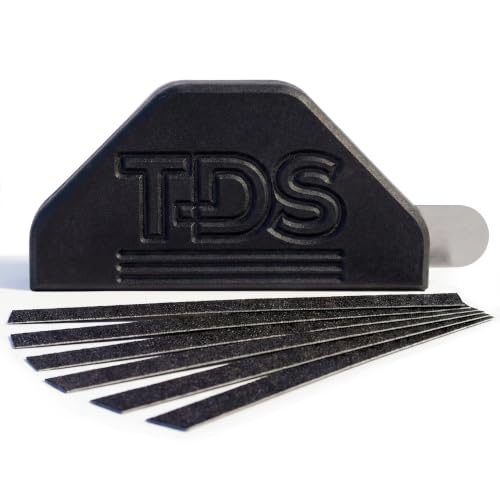
Teakdecking Systems Seam Sander Kit
What We Like
- Adjustable depth for seams from 3/16" to 7/8"
- Corrosion-proof stainless steel construction
- Ergonomic grip for all-day use
- Complete kit with six replaceable sanding strips
Trade-offs
- Specialized design is only for seam sidewall sanding
- Depth range may not suit seams wider than 7/8"
An adjustable depth range from 3/16″ to 7/8″ means you can dial in the exact profile needed to clean out old caulk from deck seams without damaging the surrounding wood. This tool is built for the specific, finicky job of preparing seam sidewalls on teak or wooden decks, where precision is everything. Its stainless steel build and contoured handle are designed for the long, repetitive work of a full deck refit, aiming to eliminate hand fatigue and deliver a perfectly clean bonding surface for new caulk.
Designed for a single critical task, this manual sander focuses entirely on preparing deck seam side walls. It reportedly outpaces manual scraping methods by 70% on teak and composite projects, but its purpose is not for sanding large, flat surfaces. The tool exists to solve one problem exceptionally well, leaving broad surface work to more conventional sanders.
Product photos
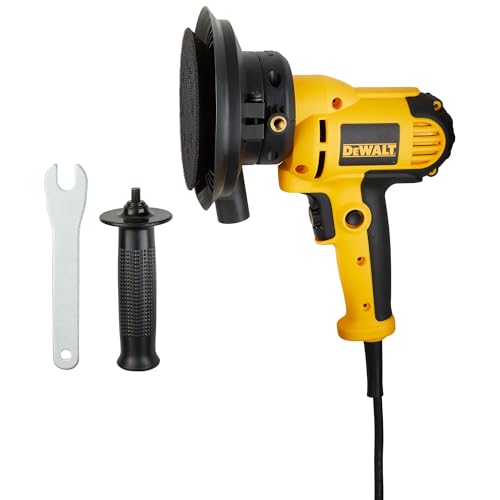
DEWALT DWE6401DS Rotary Sander
What We Like
- Variable speed trigger for material control
- Mid-handle design reduces user fatigue
- Accepts common 5-inch sanding discs
- Adjustable dust shroud improves workspace
Trade-offs
- Rotary action may leave swirls on softwood without care
- Requires a separate vacuum for optimal dust control
The 0 to 3,700 orbits-per-minute variable speed trigger gives you precise control to tackle everything from aggressive paint stripping to final smoothing without switching tools. Combined with the adjustable dust shroud, this sander is built for the user who values a clean, controlled workspace. The mid-handle design and soft grip make it comfortable for long sessions, letting you focus on the deck, not your aching arms.
A 5-inch rotary sander uses a single-motion pattern, which requires a steady hand to avoid swirl marks on softer woods. Its compact size, at 9.9 inches long and 4.8 pounds, makes it easy to maneuver in confined spaces. The adjustable dust shroud connects to a vacuum, helping to keep the work area clean.
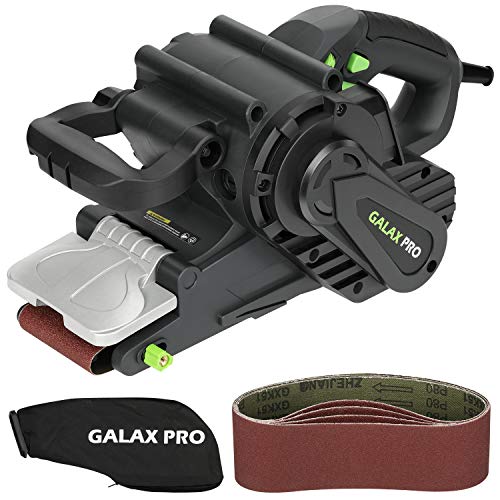
GALAX PRO 8A Belt Sander
What We Like
- Powerful 8A motor for aggressive stock removal
- Six variable speeds for material control
- Auto-tracking belt system minimizes adjustments
- Lock-on button enables continuous operation
Trade-offs
- Corded design limits range of movement
- Only includes coarse P80 grit belts
An 8-ampere motor provides high power for stock removal on large areas like floor boards and decking. Six variable speed settings deliver belt speeds up to 6 meters per second, with a dial for matching speed to different workpieces. The package includes five P80 grit belts and a dust bag, allowing work to begin immediately.
The trade-off is that it’s a dedicated workhorse, not a detail tool. You’ll need to follow up with a finer-grit orbital sander for a smooth finish. Compared to a more versatile cordless option, this sander is firmly anchored by its cord, which is a minor hassle for the unlimited runtime on a big project. Its heft and power demand respect. This isn’t a sander you use with one hand while on a ladder.
Product photos
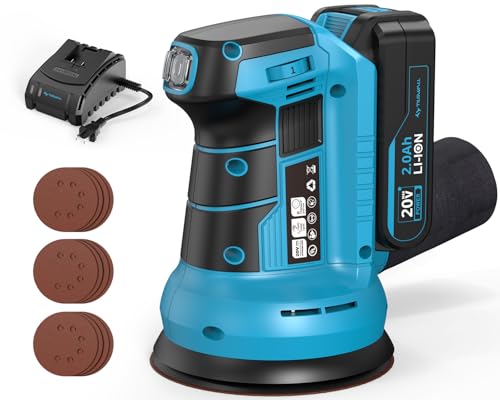
Tilswall 20V Cordless Orbital Sander Kit
What We Like
- Kit includes battery, charger, and sanding discs
- Low-vibration, ergonomic grip for comfort
- Variable speed for different sanding tasks
Trade-offs
- 5-inch pad is smaller than some dedicated deck sanders
- Random orbit action is slower than a belt sander for heavy stock removal
This cordless orbital sander arrives as a complete kit with a battery, charger, and sanding discs, so you can start a project without needing to purchase any other components. Its variable speed adjusts between 7,000 and 11,000 orbits per minute, which allows for control over the work pace from quick material removal to smooth finishing. The included 5-inch sanding pad provides wider coverage than smaller sanders, helping to reduce visible sanding marks on surfaces.
The 5-inch random orbit design is a dual-action sander intended for tasks like woodworking and furniture refinishing. For sanding very large, flat surfaces like an entire deck, a machine designed for that scale, such as the Onfloor 16 Inch Wood Floor Sander, would cover area faster. Unlike the tool-only DEWALT 20V MAX XR cordless orbital sander, the Tilswall kit includes a battery and charger in the box.
Product photos
How We Evaluated Sanders For Deck
Our selection process started with manufacturer specs for power, pad size, speed, and dust collection. These details help predict a tool’s capability on a deck. We then looked at professional guides to see how contractors prioritize features like motor amperage and integrated vacuum systems for outdoor work. Finally, we analyzed verified owner feedback, focusing on durability on large projects, ease of use on uneven boards, and real-world dust management effectiveness, which impacts workspace cleanliness and project time.
Our key evaluation criteria centered on material removal rate, control and finish quality, dust management, and ergonomics for extended use. The rate of stock removal, determined by motor power and sander type (belt vs. Orbital), dictates how quickly you can strip old finish or level boards.
Control is vital to avoid gouging softwood decking and to achieve a uniform surface ready for stain or sealant. Effective dust management, whether through integrated vacuums or adapter ports, is non-negotiable for health and keeping your work area clear. Since a deck is a large, open space, we also considered the tool’s weight, grip design, and corded versus cordless operation for user fatigue over several hours of work.
This evaluation is based on product specifications and aggregated information. The goal is to provide a reliable shortlist to help you confidently compare the leading best sanders for decks based on your specific project needs.
What To Look For In Sanders For Deck
Choosing the right sander transforms a daunting deck refinishing project into a manageable, even satisfying, task. The ideal tool efficiently removes old material, provides a consistent finish, and keeps the work area clean.
The key is matching the sander’s power and action to your deck’s condition. For heavy removal, use a belt sander; for final smoothing, an orbital sander; and for large decks, consider a wide-floor model. Always prioritize dust control.
Power & Action Type
The sander’s motor power, measured in amps for corded models, directly influences how quickly it can strip layers of old stain or level uneven boards. More powerful motors, like the 8.8 AMP unit in the Makita 9903, handle aggressive work faster. The sander’s action type is equally important: belt sanders offer the fastest material removal but require more skill to avoid gouging, making them a top choice for heavy-duty deck sanding.
Orbital and random orbital sanders are far more user-friendly, providing a swirl-free finish ideal for final smoothing, which is why they are often the core of any deck sanding project.
Surface Compatibility & Control
Your deck’s size, wood type, and condition dictate the best tool for the job. A wide, flat-deck sander like the Onfloor model covers large areas rapidly but is impractical for small decks or detailed railings. For intricate areas like corners, seams between boards, or railings, you need a compact sander or a specialized tool like the Teakdecking Systems Seam Sander.
Control features are critical; variable speed dials, like those on the DEWALT cordless sander, allow you to match the sanding pace to the task, from fast stripping to slow, careful finishing. This adaptability is a hallmark of the best deck sanders.
Dust Management & Setup
Outdoor sanding creates a massive amount of fine dust that coats everything and poses a health risk. A sander with effective dust collection is essential. Systems range from simple ports that connect to a shop vacuum (like the Bosch model) to fully integrated vacuums (like the Onfloor).
Consider your setup: if you have a shop vacuum, a port may suffice; if not, a model with built-in collection saves an extra equipment purchase. For cordless convenience in open spaces, a model like the Tilswall kit offers a complete, ready-to-run solution without hunting for an outlet.
- Check if the sander includes vacuum hose adapters or requires a separate purchase.
- Verify the dust port matches your shop vacuum’s hose diameter.
- For cordless models, confirm the kit includes a battery and charger, or factor that into your cost.
- Consider the sander’s weight and grip if you’ll be using it for hours at a time.
Always start with a coarser grit to remove old material and finish with progressively finer grits for a stain-ready surface.
Sanders For Deck Compared
To help you compare these top choices at a glance, the table below outlines their key specifications, power sources, and primary strengths.
| Product | Motor Power | Sanding Type | Sanding Size |
|---|---|---|---|
| Bosch GET75-6N Electric Orbital Sander | 7.5 Amp | Orbital | 6 Inch Disc |
| Onfloor 16 Inch Wood Floor Sander | 1.5 HP sander | Planetary | 16 inches |
| Makita 9903 Belt Sander | 8.8 AMP | Belt | 3" x 21" |
| DEWALT 20V MAX XR Cordless Orbital Sander | 20V MAX XR | Orbital | 6 inches |
| Jellas 7Amp Handheld Belt Sander | 7 Amp | Belt | 3 x 21 inch |
| Teakdecking Systems Seam Sander Kit | N/A | Strip | 6 strips |
| DEWALT DWE6401DS Rotary Sander | 6 amp | Rotary | 5-inch |
| GALAX PRO 8A Belt Sander | 8 amperes | Belt | 76 x 533 mm |
| Tilswall 20V Cordless Orbital Sander Kit | 20V | Orbital | 5 inches |
Frequently Asked Questions
What is the best sander to use on a deck?
For most deck owners, a variable-speed random orbital sander like our best overall Bosch GET75-6N offers the best balance. It provides sufficient power for material removal, delivers a smooth finish without swirl marks, and connects to a vacuum for crucial dust control. For very large decks or aggressive stripping of thick old finish, a belt sander or a dedicated floor sander becomes more efficient.
Do floor sanders work on decks?
Yes, large drum or orbital floor sanders designed for interior wood floors can be highly effective on expansive, flat deck surfaces. Our “Best For Large Decks” pick, the Onfloor 16 Inch model, is essentially a floor sander adapted for outdoor use. These tools remove material incredibly quickly but are bulky, require significant storage space, and are not suitable for decks with many railings, steps, or tight corners.
What is the quickest way to sand a deck?
The fastest method combines a powerful belt sander for the main field of deck boards to rapidly strip old finish, followed by a random orbital sander for final smoothing and edges. Using a coarse grit sandpaper (like 40-60 grit) on the belt sander maximizes removal rate. Always sand along the length of the boards, not across them, to follow the wood grain and avoid creating cross-grain scratches that require extra sanding to remove.
What is the best way to sand old paint off a deck?
Removing old, peeling paint requires a sander with aggressive stock removal capability. A high-amperage belt sander, such as the GALAX PRO 8A or Makita 9903, is typically the most effective tool for this job. Start with a very coarse grit belt (like 40 grit) to grind down the paint layers, being careful not to gouge the underlying wood. You may need to follow up with medium and fine grits on an orbital sander to smooth the bare wood for a new finish.
What grit sandpaper should I start with on a deck?
Begin with a coarse grit between 40 and 60 to effectively remove old stain, paint, or weathered wood. For heavily coated or rough surfaces, start at the lower end (40 grit). For softer woods or decks in better condition, you can start at 60 or 80 grit to be less aggressive. Always progress through a sequence to finer grits, such as 80 or 100, then 120, to eliminate scratches and create a smooth surface for your new finish, following standard sandpaper grit for wood practices.
The Bottom Line
The Bosch GET75-6N Electric Orbital Sander is our top recommendation for deck owners seeking a versatile, powerful, and dust-conscious tool that excels at both material removal and final finish work. It’s particularly well-suited for those who already own a shop vacuum and want professional-grade results.
If you’re refinishing a very large, open deck, prioritize the Onfloor 16 Inch Wood Floor Sander for its speed and integrated dust collection. For budget-conscious DIYers tackling a major restoration, the GALAX PRO 8A Belt Sander offers serious power for aggressive work. Ultimately, the most important factor is matching the sander’s power and design to the scale of your project and your specific deck’s condition to make the job efficient and the results lasting.
