
10 Best Chop Saw Blades in 2026
This post contains affiliate links. As an Amazon Associate, we earn from qualifying purchases.
For heavy-duty metal cutting, the DEWALT DW8001 Chop Saw Blade is our best overall pick for its aggressive, durable performance. For clean, burr-free cuts in mild steel, choose the Evolution Power Tools 14BLADEST, and for bulk value, the Benchmark Abrasives 10-pack is a solid choice.
The wrong blade can ruin a cut, waste material, or even damage your saw. You need a blade that matches your metal type, saw specifications, and desired finish.
Top 10 Chop Saw Blades in the Market
Certain content that appears on this site comes from Amazon. This content is provided "as is" and is subject to change or removal at any time.
The Best Chop Saw Blades, Reviewed
DEWALT DW8001 Chop Saw Blade

What We Like
- High-performance aluminum oxide grain for long life
- Proprietary material mix ensures durable wheels
- High grain concentration for aggressive cutting action
- Smoother running from concentrated grain design
Trade-offs
- Abrasive wheel design wears down faster than carbide blades
- Produces more dust and sparks than cold-cutting blades
This 14-inch metal cut-off wheel uses a high-performance aluminum oxide grain, which means it cuts aggressively and is built for long life. Its high grain concentration contributes to a smoother running wheel and that fast cutting action. For someone who needs to slice through metal stock like angle iron or rebar, this blade offers a straightforward, reliable choice.
As an abrasive wheel, the DW8001 will wear down with use, unlike a carbide-tipped blade such as the Evolution 14BLADEST which is designed for cutting mild steel with no heat. You are choosing raw cutting speed over the extended life of a different blade technology. For heavy, repetitive metal cutting where wheel replacement is expected, the blade’s proprietary material mix is formulated for durable, long life.
Product photos
Evolution Power Tools 14BLADEST Carbide-Tipped Blade
What We Like
- Cuts mild steel with no heat, burrs, or sparks
- Thin kerf design for accurate, clean cuts
- Hardened steel body minimizes vibration
Trade-offs
- Only for mild steel, not hardened or high-carbon
- Requires a compatible 14-inch chop saw
- Specific 1600 RPM maximum limits tool compatibility
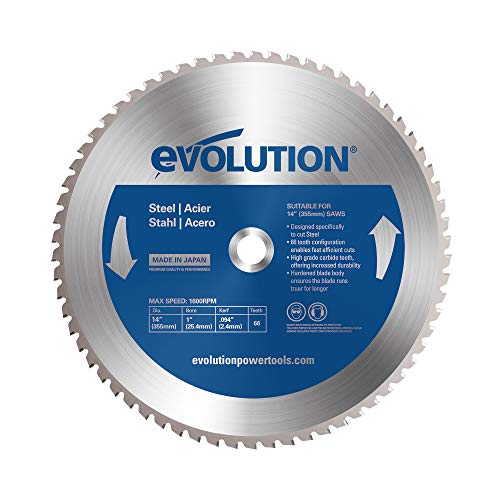
Evolution’s 14-inch blade is designed exclusively for cutting mild steel, which means it should not be used on galvanized or hardened steel. Its carbide-tipped teeth and cold-cutting action produce virtually no sparks, and the cut material can be handled moments later. The 66-tooth design and thin kerf contribute to accurate cuts with minimal burrs.
The blade’s material limitation is its defining characteristic, as it is not suitable for stainless steel, aluminum, or high-carbon steel. Evolution offers a separate range of blades for those materials. For consistent work on mild steel, the hardened steel body and premium carbide teeth are engineered for durability and a clean finish.
DEWALT DW8023 Abrasive Cutting Wheel
What We Like
- Aluminum oxide grain for long cutting life
- High grain concentration for aggressive cutting
- Thick fiberglass sheets withstand extreme applications
- Engineered to hold up at high chop saw speeds
Trade-offs
- Abrasive wheel wears down, unlike carbide or diamond blades
- 1/8-inch kerf wastes more material than thinner blades
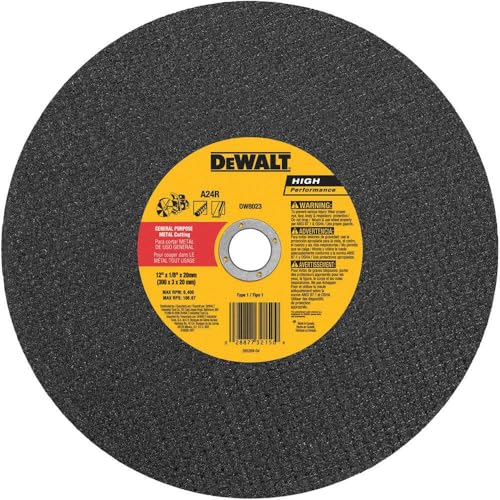
This 12-inch wheel uses a high concentration of aluminum oxide grain, which means it chews through metal quickly and lasts longer between changes. The two full sheets of thicker fiberglass are the key to its durability, letting it handle the high RPMs and heavy pressure of a chop saw without coming apart. It’s a straightforward, heavy-duty abrasive blade for the metalworker who needs reliable, fast cut-offs on angle iron, rebar, or pipe and doesn’t want to baby their tool.
The DEWALT DW8023 is a 12-inch abrasive cutting wheel designed for metal. Its construction includes two full sheets of thicker fiberglass, which helps it withstand extreme applications and high speeds. The wheel uses a high concentration of aluminum oxide grain, a combination that provides an aggressive cutting action and contributes to a long service life.
Benchmark Abrasives Aluminum Oxide Chop Saw Blade
What We Like
- Premium aluminum oxide material for clean, precise cuts
- Industrial-grade performance for demanding environments
- Compatible with most major 14-inch chop saw brands
- 10-pack offers extended supply for frequent users
Trade-offs
- 14-inch diameter limits use to compatible saws only
- Abrasive blade wears down, unlike carbide or diamond alternatives
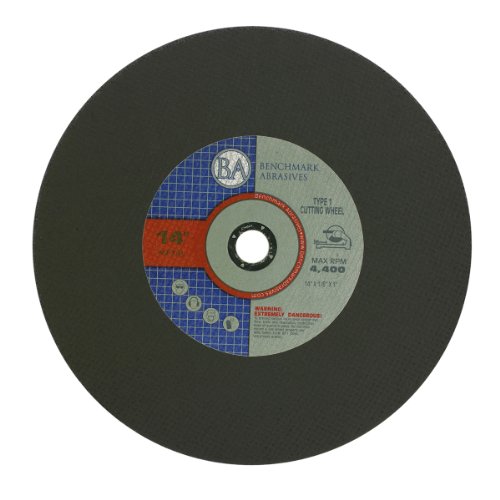
A 10-pack of 14-inch aluminum oxide cut-off wheels makes this a practical choice for anyone who goes through blades regularly. The industrial-grade construction and compatibility with Dewalt, Milwaukee, Makita, and virtually every other major brand mean you can stock up once and keep multiple saws running. It’s built for the shop that needs to cut through ferrous metals, iron, steel, and light gauge materials day in and day out, offering a reliable supply of blades that meet professional standards.
The blade’s abrasive aluminum oxide composition means it gradually wears down with each use, so it’s a consumable item designed for replacement. For extensive or heavy-duty cutting, the pack of ten provides volume and value. This contrasts with the extended single-blade lifespan of a carbide-tipped option like the Evolution Power Tools 14BLADEST, which is described as generating no heat or sparks.
Product photos
Makita A-90532 Dry Ferrous Metal Cutting Blade

What We Like
- 60 teeth for a smooth cut in metal.
- Designed specifically for dry cutting ferrous metals.
- 12-inch diameter suits many common chop saws.
Trade-offs
- At 3.0 pounds, it is heavier than many abrasive wheels.
- Blade is limited to ferrous metals like steel.
- Requires a saw with a 1-inch arbor hole.
Its 60-tooth design is built for slicing through steel and other ferrous metals with a cleaner, more finished edge than a rough abrasive wheel provides. The blade is designated for dry cutting. This makes it a solid choice for fabrication shops or serious DIYers building with angle iron or tubing where minimizing burr and heat distortion is a priority.
The trade-off is in its heft and specialization. At three pounds, it demands a sturdy, well-balanced chop saw to run smoothly, unlike the lighter one-pound Evolution 14BLADEST blade. For a shop that cuts a variety of metals, a carbide-tipped blade offers more versatility, but for dedicated steel cutting where finish matters, this Makita delivers a specific advantage.
Mercer Abrasives 603010 Chop Saw Blade

What We Like
- Reinforced arbor hole for durability
- 10-pack offers good supply for frequent use
- Center-reinforced wheel construction
Trade-offs
- Limited to cutting ferrous metals only
- 12-inch diameter fits fewer saws than 14-inch options
The Mercer 603010’s 7/64-inch thickness is its defining feature. It’s a smart choice for anyone doing a lot of repetitive cuts on steel stock or angle iron, where speed and material economy add up. The ten-pack means you can swap in a fresh wheel without a trip to the store, keeping the project moving.
This is a general-purpose wheel with a maximum speed rating of 5,100 RPM for use on a chop saw. It is reinforced at the center and arbor for structural integrity during operation. According to the specifications, it is designed for cutting ferrous metals.
Product photos
Benchmark Abrasives 6-Inch Cut Off Wheels

What We Like
- Thin-profile design minimizes material waste.
- High 11,000 RPM rating enables fast cutting.
- Aluminum oxide grain delivers consistent, sharp cuts.
- Broad compatibility with major tool brands.
Trade-offs
- The 6-inch diameter limits cut depth on thick stock.
- Abrasive wheel wears down faster than carbide blades.
These 6-inch cut-off wheels have a 0.045-inch thin kerf, which means they remove very little material for clean, accurate cuts on metal sheets, pipes, and tubing. Their aluminum oxide abrasive construction is designed for consistent, burr-free results on materials like steel and aluminum. With a rating up to 11,000 RPM, they are built for high-speed, smooth cutting in applications from general fabrication to shipbuilding, fitting any tool with a standard 7/8-inch arbor.
As an abrasive wheel, its material is designed to be worn away during the cutting process. This is a standard characteristic of Type 1 cut-off wheels, which are manufactured as consumables for cutting and grinding tasks. The 25-count pack provides multiple wheels for extended use across various projects.
Product photos
IVY Classic Swift Cut Metal Cut-Off Blade
What We Like
- Double-reinforced with fiberglass mesh for durability.
- Metal-reinforced arbor provides extra strength.
- Designed for cutting steel, angle iron, and sheet metal.
- Aluminum-oxide grain facilitates faster cutting.
Trade-offs
- Cannot be used on high-speed saws, restricting compatible tools.
- Type 1 blade design is for cut-off work only, not grinding or notching.
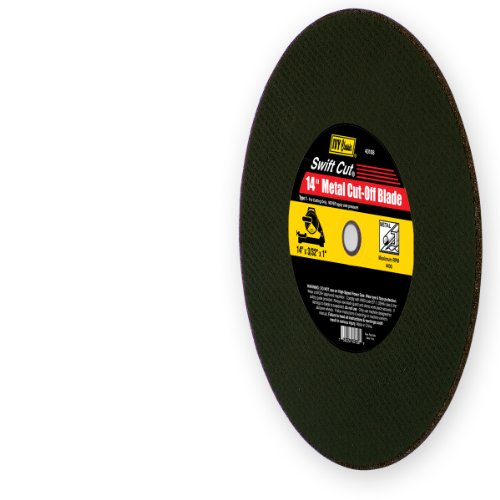
Designed to cut steel, angle iron, and sheet metal, this 14-inch blade uses a resin-bonded aluminum-oxide grain for faster cutting on ferrous metals. Its double reinforcement with fiberglass mesh adds durability and safety, while the arbor is reinforced with metal for extra strength. This is a Type 1 cut-off blade, so it is for straightforward cutting only on a chop saw running at or under its 4,400 RPM maximum.
The blade has a slim 3/32-inch width, which is suitable for clean cuts in metal. It is an abrasive disc, so it will wear down with use, unlike a carbide-tipped blade such as the Evolution 14BLADEST which is designed for different cutting characteristics. This makes it a specialized consumable for cutting ferrous metals, not for use on high-speed saws.
TWIN-TOWN Cermet Metal Cutting Saw Blade

What We Like
- Cermet tips for cool cutting and long life
- Laser-cut stabilizer vents reduce vibration and warp
- Electrophoretic coating fights rust and corrosion
- Designed for low-RPM metal cut-off saws
Trade-offs
- 12-inch size limits cut depth versus 14-inch blades
- Requires a low-RPM metal saw, not a standard wood chop saw
Cermet tooth tips, a ceramic and metal composite, are designed for a cool cut and long blade lifetime. This makes the TWIN-TOWN blade suited for shops frequently cutting mild steel profiles like pipe, angle iron, and tube, where reducing heat can matter. Laser-cut stabilizer vents aim to dampen vibration and reduce warp, while an electrophoretic coating fights rust, supporting durability in metalworking conditions.
A specialized 12-inch blade rated for 2000 RPM, this product requires a low-RPM metal cut-off saw with a 1-inch arbor, not a standard woodworking chop saw. Its diameter provides a specific cutting capacity compared to other blades in its category. It fits a user whose priority is the cermet cutting action for mild steel over a larger blade’s potential cut depth.
Product photos
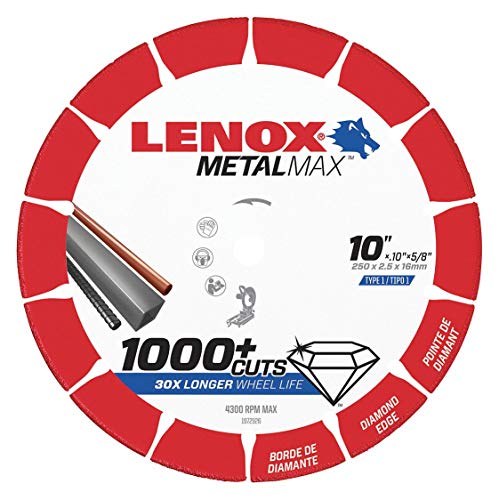
Lenox Tools METALMAX Diamond Cut-Off Wheel
What We Like
- Solid steel body reduces breakage risk for safety
- Maintains original diameter for control and reach
- Delivers 1,000+ cuts per wheel in carbon steel
- Produces less dust than bonded abrasive wheels
Trade-offs
- 10-inch diameter offers less reach than common 14-inch blades
- Diamond edge is specialized for metal, not a general-purpose blade
Delivering 1,000 or more cuts in carbon steel before a wheel change means high-volume shops can power through stacks of tube or bar stock with far fewer interruptions. The Lenox Tools METALMAX wheel uses advanced diamond technology bonded to a solid steel body, so it doesn’t wear down like a conventional abrasive wheel. This maintains the original wheel diameter throughout its life, which keeps your cut line consistent and eliminates the need to adjust your grip for a shrinking disc.
Designed as a specialized 10-inch consumable cut-off wheel, this is not a toothed saw blade. Its diameter provides slightly less cutting capacity than common 14-inch options like the Evolution 14BLADEST. For relentless metal cutting, the core trade-off is the 30X longer life compared to thin bonded abrasive wheels.
How We Evaluated Chop Saw Blades
We based our evaluation on manufacturer specifications, documented expert round-ups, and patterns in owner feedback. The most important criteria were the blade’s cutting material (abrasive, carbide, or diamond), its compatibility with your saw’s diameter, arbor, and maximum RPM, and its kerf width for material efficiency. We also considered durability and the type of finish produced, whether a fast, aggressive cut or a clean, cold one. Since this is a research-led evaluation, we cannot verify real-world blade life or performance claims beyond what the data and feedback patterns indicate.
What To Look For In Chop Saw Blades
Selecting the right blade requires matching its design to your specific metal and saw. A blade built for mild steel will fail on hardened stock, and a high-speed blade can be dangerous on a low-RPM saw.
Key criteria are blade material (abrasive for speed, carbide for clean cuts), saw compatibility (diameter, arbor size, RPM), and kerf width (thinner saves material, thicker may be more durable).
Blade Material & Application
The blade’s composition dictates what it can cut and the finish it leaves. Abrasive wheels, like the DEWALT DW8001, use aluminum oxide grains for fast, aggressive cuts in a variety of metals but wear down and produce sparks. Carbide-tipped blades, such as the Evolution Power Tools 14BLADEST, are designed for clean, cold cuts in specific materials like mild steel with minimal burrs.
Diamond-edge wheels offer extreme longevity for high-volume carbon steel cutting but are a specialized, premium choice. Always verify the blade is rated for your specific metal type, whether ferrous, non-ferrous, or hardened steel.
Saw Compatibility
A blade must physically and operationally match your chop saw. The most critical specs are the blade diameter (common sizes are 12-inch and 14-inch), the arbor hole size (often 1 inch), and the maximum RPM rating of the blade versus your saw’s speed. Using a blade rated for a lower RPM than your saw produces is a serious safety hazard.
Furthermore, some blades, like the TWIN-TOWN Cermet blade, are engineered specifically for low-RPM metal cut-off saws and will not perform correctly on a standard high-speed wood chop saw. Our guide to the best chop saws can help if you’re selecting a new tool.
Kerf & Cutting Performance
Kerf is the width of material removed by the blade. A thin kerf, like that on the Evolution blade, wastes less material and can provide more accurate cuts, which is crucial for precision fabrication. A thicker kerf, common on abrasive wheels, may be more durable for extreme applications but consumes more stock.
Understanding thin kerf vs full kerf blades helps you balance cut quality with material cost and blade life. The number of teeth or grain concentration also affects finish; a higher tooth count or denser grain generally provides a smoother cut but may cut slower than an aggressive, low-tooth or coarse-grain design.
- Check your saw’s manual for the correct blade diameter and arbor size.
- Match the blade’s maximum RPM rating to your saw’s no-load speed.
- Confirm the blade material is suitable for the metals you cut most often.
- Consider a blade’s kerf width if you are cutting expensive stock or need precision.
- Inspect blades for damage and know when to replace a blade for safety and performance.
The safest rule: never exceed the blade’s maximum RPM rating, and always use a blade designed for your specific saw and material.
Chop Saw Blades Compared
The table below provides a quick comparison of key specifications to help you narrow your choice.
| Product | Diameter | Arbor Size | Material / Tooth Type |
|---|---|---|---|
| DEWALT DW8001 Chop Saw Blade | 14 inches | N/A | Aluminum oxide |
| Evolution Power Tools 14BLADEST Carbide-Tipped Blade | 14 inches | 1 inch | Carbide-tipped |
| DEWALT DW8023 Abrasive Cutting Wheel | 12 inches | 20mm | Aluminum oxide |
| Benchmark Abrasives Aluminum Oxide Chop Saw Blade | 14 inches | 1/8" x 1" | Aluminum oxide |
| Makita A-90532 Dry Ferrous Metal Cutting Blade | 12 inches | 1 inch | Ferrous metal |
| Mercer Abrasives 603010 Chop Saw Blade | 12 inches | 1 inch | N/A |
| Benchmark Abrasives 6-Inch Cut Off Wheels | 6 inches | 7/8 inches | Aluminum oxide |
| IVY Classic Swift Cut Metal Cut-Off Blade | 14 inches | 1 inch | Resin-bonded aluminum oxide |
| TWIN-TOWN Cermet Metal Cutting Saw Blade | 12 inches | 1 inch | Cermet |
| Lenox Tools METALMAX Diamond Cut-Off Wheel | 10-Inch | 5/8-Inch | Diamond Edge |
Frequently Asked Questions
What is the best chop saw blade?
The best blade depends on your primary task. For overall heavy-duty metal cutting where speed and durability are key, the abrasive DEWALT DW8001 is an excellent choice. For shops needing clean, cold cuts in mild steel without secondary finishing, the carbide-tipped Evolution Power Tools blade is best.
Who makes the best quality saw blades?
Several manufacturers are renowned for quality in different niches. DEWALT and Makita produce highly regarded abrasive and carbide blades known for durability and performance in professional settings. For specialized clean-cutting applications, brands like Evolution Power Tools and TWIN-TOWN offer innovative designs.
What is the difference between a chop saw blade and a miter saw blade?
Chop saw blades are primarily designed for cutting metal, using abrasive materials, carbide tips, or diamond edges to handle tough stock. Miter saw blades are typically for woodworking, with many fine teeth for smooth crosscuts in lumber and trim. Using a wood blade on metal is dangerous and will ruin the blade.
What are the best blades for cutting metal?
The best blades for cutting metal are defined by the metal type and desired finish. For general ferrous metals, abrasive wheels like the DEWALT DW8023 offer fast cutting. For clean cuts in mild steel, a carbide-tipped blade is superior. For maximum life in carbon steel, a diamond-edge wheel like the Lenox Tools METALMAX is a top performer.
Can I use a chop saw blade on a miter saw?
No, you should not use a metal-cutting chop saw blade on a standard wood miter saw. The saw’s motor, speed, and safety guards are not designed for the sparks, torque, or debris generated by cutting metal. Always use blades for miter saws that are specifically rated for woodworking on that tool.
The Bottom Line
For professional metalworkers and serious DIYers who need a fast, durable blade for heavy cutting across various metals, the DEWALT DW8001 abrasive blade is the best overall choice. If your budget is tight, the IVY Classic Swift Cut offers reliable performance for standard cut-off tasks. Shops focused exclusively on clean, burr-free mild steel cuts should opt for the Evolution Power Tools carbide-tipped blade. Ultimately, the single most important factor is ensuring the blade’s material, diameter, arbor size, and maximum RPM are fully compatible with your specific chop saw and the metal you intend to cut.
