
Hammer Drill vs Impact Driver: Which Should You Buy?
This post contains affiliate links. As an Amazon Associate, we earn from qualifying purchases.
A hammer drill is for drilling holes into hard materials like concrete and brick using a forward-pounding action, while an impact driver is for driving screws and fasteners into wood and metal using high-torque rotational impacts. For most DIYers starting a tool collection, an impact driver is the more versatile first purchase, but you need a hammer drill for any masonry work.
That’s the straightforward split. The confusion starts when you look at a tool like the DeWalt DCH273B hammer drill, it spins and pounds, and an impact driver also makes a loud banging noise. Understanding the hammer drill vs impact driver distinction is key. They feel similar in the hand, but they solve completely different problems.
What follows is a breakdown of the physics inside each tool, the projects each one owns, and the mistakes that happen when you mix them up. By the end, you’ll know exactly which one to reach for in the hammer drill vs impact driver debate, or if you need both.
Key Takeaways
- Hammer drills deliver axial (forward) impacts for breaking masonry; a model like the DeWalt DCH273B hits with 2.1 Joules of energy at up to 4,600 blows per minute.
- Impact drivers deliver rotational (twisting) impacts for torque; they can generate over 1,200 ft-lbs to sink large screws without stripping the head.
- You cannot drill into concrete with an impact driver. It provides zero forward pounding force, so the bit will just spin and overheat.
- Impact drivers require hex-shank bits; hammer drills use a standard 3-jaw chuck that accepts round or hex shanks.
- For a first tool, an impact driver covers more common tasks, but buy a hammer drill the day you need to mount anything to brick or concrete.
The Core Difference in One Sentence
A hammer drill pounds forward to break material; an impact driver hammers rotationally to spin fasteners.
The key functional difference is the direction of the impact force. A hammer drill creates a longitudinal impact along the axis of the bit, a straight-line pounding. An impact driver creates a rotational impact, delivering bursts of torque in the same direction the chuck spins.
That axial versus rotational distinction dictates every single thing these tools can and cannot do. It’s not about power. It’s about the type of force.
Think of a hammer drill like a miniature jackhammer. Its internal mechanism, whether a gear-driven cam or a pneumatic piston, shoves the bit forward thousands of times a minute while it spins. This “chipping and drilling” action is what crumbles concrete and brick. The Bosch DIY guide notes this percussion mechanism is coarser and delivers a stroke-like smash.
An impact driver works like a wrench you hit with a hammer. Inside, a heavy-duty spring compresses and releases with every half-turn, delivering a sudden rotational jerk. This multiplies torque dramatically, allowing it to drive a long lag bolt where a standard drill would stall. The energy goes into turning the fastener, not into the material in front of it.
Breaking Down the Hammer Drill
A hammer drill solves one problem: making holes in hard, brittle materials. Its entire design is a compromise to achieve that forward-pounding action.
The specs tell the story. Look at the DeWalt DCH273B. It delivers 2.1 Joules of impact energy and has a no-load speed of 0 – 1,100 RPM with a blow rate of 0 – 4,600 blows per minute (BPM). That Joules figure is the punch behind each hit. For hammer drill performance, Bosch DIY suggests checking whether the manufacturer follows EPTA Procedure 05. For context, Bosch states that 0.6 Joules can penetrate concrete but isn’t enough for chiseling or larger holes. The DCH273B’s 2.1 Joules is squarely in the “drill a ½-inch anchor hole” range.
The mechanism is louder and vibrates more than a standard drill. You feel it in your hands and arms, a constant, gritty rattle. That’s the sound of the internal hammering mechanism at work. It’s why these tools often have vibration-dampening handles.
When does a hammer drill become a rotary hammer? This is where one source, Bosch DIY, adds a clarifying layer most others skip. They distinguish between an “impact drill” (a lighter, mechanically-driven hammer drill) and a “rotary hammer” (a heavier, pneumatic hammer drill). Bosch DIY distinguishes between an ‘impact drill’ (a lighter, mechanically-driven hammer drill) and a ‘rotary hammer’ (a heavier, pneumatic hammer drill), while other sources generally use ‘hammer drill’ as the overarching term for tools with axial percussive action. A true rotary hammer is a bulkier, more powerful tool for core drilling or demolition. For our purposes, if it has a hammer icon on the dial, it’s a hammer drill.
| Aspect | Specification / Detail | Why It Matters |
|---|---|---|
| Primary Action | Axial (forward) impact + rotation | Creates a chipping force to break masonry. |
| Key Spec (Energy) | Impact Energy (Joules) e.g., 2.1 J | Determines the size of hole and hardness of material it can tackle. |
| Key Spec (Rate) | Blows per Minute (BPM) e.g., 0-4,600 | Higher BPM can mean faster drilling in some materials. |
| Typical Chuck | 3-Jaw Keyless Chuck | Accepts standard round-shank drill bits and masonry bits. |
| Best For | Drilling into concrete, brick, stone, block. | Installing anchors, running conduit through walls, mounting to masonry. |
You use a hammer drill by setting it to hammer mode (the little hammer icon), inserting a carbide-tipped masonry bit, and applying steady, moderate pressure. Let the tool do the pounding. Forcing it only wears you and the bit out faster.
Common mistake: Using a standard drill/driver with a masonry bit for anchor holes. The drill lacks the pounding action, so you lean on it hard. The motor overheats, the bit dulls instantly, and the hole is ragged and undersized. A proper hammer drill gets it done in seconds with light pressure.
Understanding the Impact Driver
If the hammer drill is a specialist, the impact driver is the brute-force specialist for fasteners. Its job is to deliver insane amounts of rotational torque to drive or remove screws, bolts, and nuts.
The magic is in the rotational impact. A standard drill relies on continuous torque from the motor. When resistance gets too high, the motor stalls or the clutch slips. An impact driver’s mechanism, a spring-loaded hammer and anvil, delivers rapid rotational blows. Each impact delivers a huge spike of torque, far exceeding what a standard drill can produce continuously. Sources note DeWalt impact drivers can range from 70 to 1,200 ft-lbs of torque.
This does two things. First, it drives long screws into dense wood without a pilot hole. Second, it drastically reduces kickback and wrist fatigue. The reaction force from the impacts is mostly absorbed inside the tool. You can drive hundreds of deck screws without feeling like you’ve been in a fight.
Physically, impact drivers are more compact and use a quick-release hex collet. This only accepts bits with a ¼-inch hexagonal shank. No adapters, no chuck key. Its compact size allows it to reach into tight spaces where a full-size drill cannot.
I’ve seen more than one DIYer strip the threads on a soft aluminum part by over-torquing with an impact driver. The tool is so powerful that on small screws or delicate materials, it’s overkill. That’s its main limitation: a lack of finesse.
| Aspect | Specification / Detail | Why It Matters |
|---|---|---|
| Primary Action | Rotational (twisting) impact | Generates extremely high torque to overcome fastener resistance. |
| Key Spec | Torque (ft-lbs or in-lbs) e.g., 1,200 ft-lbs | Determines the size of fastener it can drive or loosen. |
| Typical Chuck | ¼” Hex Quick-Release Collet | Only works with hex-shank bits; allows for one-handed bit changes. |
| Best For | Driving long screws, lag bolts, deck screws; assembling frames, building decks. | Any high-volume or high-resistance fastening task in wood or metal. |
You can use an impact driver to drill holes in wood or metal if you buy hex-shank drill bits or a hex-to-chuck adapter. It won’t be as smooth or precise as a drill, but for a quick hole, it works. The drilling with an impact driver has a specific set of trade-offs.
Side-by-Side: Direct Comparison
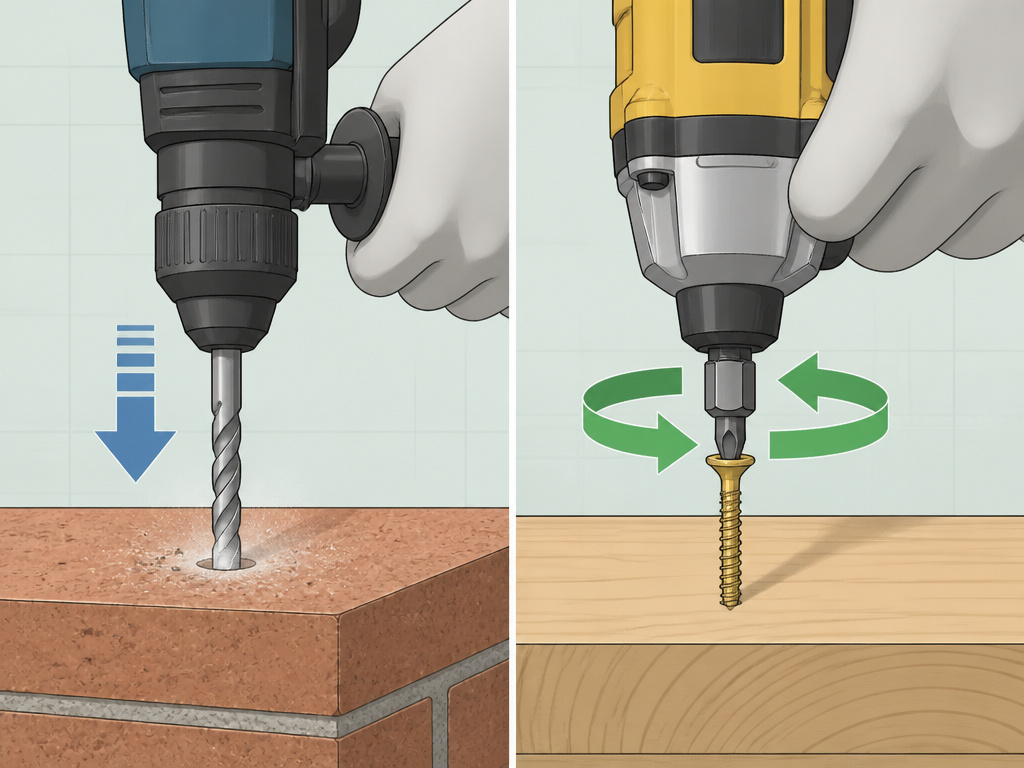
When you line them up, the differences in purpose and design become undeniable. This isn’t about which is better in the hammer drill vs impact driver comparison. It’s about which is right for the job in front of you.
| Feature | Hammer Drill | Impact Driver |
|---|---|---|
| Impact Direction | Axial (Forward). Pounds the bit into the material. | Rotational (Twisting). Hammers to spin the fastener. |
| Primary Use | Drilling into masonry: concrete, brick, stone. | Driving fasteners: screws, lag bolts, nuts. |
| Chuck Type | 3-Jaw Chuck. Accepts round and hex shanks. | ¼” Hex Collet. Only accepts hex-shank bits. |
| Can it drill wood/metal? | Yes, in drill-only mode. It’s a competent standard drill. | Limited. Requires hex-shank bits; less control than a drill. |
| Can it drive screws? | Yes, in drill/drive mode (with clutch). Slow and clumsy for big jobs. | Excellent. This is its primary and best function. |
| Torque Output | Moderate (for driving). Higher torque numbers are for drilling force. | Very High. Specifically for overcoming fastener resistance. |
| User Feel | Vibrates forward/back. Loud, rattling sound. | Vibrates rotationally. Loud, distinct “rat-a-tat-tat” sound. |
| Size & Weight | Generally larger and heavier due to hammer mechanism. | More compact and shorter, better for tight spaces. |
The hammer drill vs regular drill comparison is also useful if you’re trying to understand where a basic drill fits into all this. A standard drill is your generalist for precise drilling and light-to-medium screw driving.
When NOT to Use Each Tool

Getting this wrong costs you time, money, and results. Here are the hard stops.
Never use an impact driver for:
- Drilling into concrete, brick, or cinder block. It provides zero axial impact. You’ll burn out the motor and ruin the masonry bit long before you make a meaningful hole.
- Precise, small screw driving. The raw power will instantly strip the head of a #6 cabinet screw or drive it straight through drywall. Use a drill with a clutch.
- Operations requiring a delicate touch. The sudden impacts can crack brittle materials or mar finished surfaces.
Never use a hammer drill for:
- High-volume screw driving. It’s slow, heavy, and the forward vibration is exhausting over dozens of screws. You also risk damaging the hammer mechanism if used extensively in non-hammer mode.
- Driving screws into metal or near edges. The pounding action can distort thin metal or crack material near a hole edge.
- Any task where a standard drill would suffice. You’re carrying extra weight and complexity for no benefit, wearing out a more expensive tool.
Where this goes sideways: Using a hammer drill (in hammer mode) to drive a screw. The pounding action will absolutely destroy the screw head and likely damage the driver bit in under ten seconds. The mechanism is fighting the task.
The impact driver vs impact wrench distinction is another common point of confusion, impact wrenches are for heavy-duty bolting, like lug nuts.
Which Tool Should You Buy First?
This is the question you probably came here to answer. To be honest.
For many DIYers and homeowners, an impact driver is the more useful first cordless tool. Why? Most early projects involve assembly and construction: building a shelf, assembling furniture, putting up a fence, building a deck. These are fastener-heavy tasks where the impact driver shines. It makes hard work easy and saves your wrist. A standard drill can drill holes, but an impact driver solves the harder problem of driving screws efficiently.
You will eventually need a hammer drill. When you decide to mount a TV on a brick wall, install a mailbox post, or run a cable through a concrete foundation, you will absolutely need one. For those one-off projects, a mid-range corded hammer drill is a smart, affordable purchase. It sits on your shelf until you need it.
If your projects regularly involve masonry, or you’re building out a tool collection for a renovation, then buying a cordless hammer drill makes sense. In fact, a popular option for many is a combo kit. These bundles pair a hammer drill/driver and an impact driver. Our guide on the best impact drill combos breaks down the top choices.
Project Guide: Choosing the Right Tool
Now we’ll apply this information. Here’s how to decide on your next Saturday project.
Task: Build a wooden deck.
- Drilling pilot holes for lag bolts: Use a hammer drill in drill-only mode, or a standard drill.
- Driving the 4-inch lag bolts: Use the impact driver. This is its ideal use case.
- Drilling into the concrete footing for post anchors: Use the hammer drill in hammer mode with a masonry bit.
- Driving deck screws: Use the impact driver for speed and to avoid fatigue.
Task: Install floating shelves on a drywall and stud wall.
- Drilling pilot holes into the wood shelf brackets: Use a standard drill or hammer drill in drill mode.
- Driving screws into the drywall/studs: Use a standard drill with a clutch to avoid over-driving. An impact driver is too powerful here and will rip through the drywall.
Task: Mount a house number on a brick wall.
- Drilling holes into the brick for plastic anchors: Use a hammer drill in hammer mode with a masonry bit.
- Driving the screws into the anchors: Use a standard drill with a clutch on a low setting. An impact driver could crack the anchor or the brick.
For deep dives on specific models, check our reviews of the best hammer drills and best impact drivers.
Frequently Asked Questions
Can you use an impact driver to drill into concrete?
No. An impact driver cannot drill into concrete, brick, or any masonry. It delivers rotational impacts only, which provide torque for driving screws. Drilling masonry requires forward-pounding (axial) impacts to break the material, which only a hammer drill or rotary hammer provides. Trying this will destroy your bit and potentially your tool.
Can a hammer drill be used as a regular drill?
Yes. Every hammer drill has a “drill-only” mode (usually indicated by a drill bit icon). In this setting, the hammering mechanism is disengaged, and it functions exactly like a standard cordless drill/driver. You can use it for drilling wood/metal and driving screws with its adjustable clutch. It’s often heavier than a dedicated drill, but it works.
Is a hammer drill better than an impact driver?
This is like asking if a saw is better than a hammer. One is not universally “better.” A hammer drill is better for drilling into concrete. An impact driver is better for driving large screws. For a first tool, many find the impact driver more versatile for common tasks, but you will need a hammer drill for masonry work. The real answer is often to own both.
What’s the difference between a hammer drill and a rotary hammer?
This is an advanced distinction. As Bosch DIY clarifies, what most DIYers call a “hammer drill” is technically an “impact drill”, a lighter tool with a mechanical hammering action. A true “rotary hammer” is larger, uses a pneumatic hammer mechanism, and is for heavier demolition, core drilling, and chiseling. For drilling anchor holes, a standard hammer drill is fine. For breaking up a concrete slab, you need a rotary hammer. Our article on the hammer drill vs rotary hammer explains this in detail.
Do I need special bits for each tool?
Yes. Impact drivers require ¼-inch hex-shank bits. These are widely available for screwdriving and, less commonly, for drilling. Hammer drills use a standard 3-jaw chuck that can accept either round-shank bits (most common for drilling) or hex-shank bits. Always use carbide-tipped masonry bits in a hammer drill when working with concrete or brick.
The Bottom Line
The reality is this. You can’t substitute one of these tools for the other. The difference between impact driver and drill is fundamental, not incremental.
Start with an impact driver if your world is mostly wood and metal. Its ability to drive screws will change how you approach projects. Buy a hammer drill the first time you need to put a hole in concrete or brick, renting one is a fine option for a single job.
If you’re building a tool set from scratch, skip the internal debate and get a quality drill and impact driver combo kit. It’s an effective way to have the right tool for the majority of drilling and driving tasks a home will ever throw at you. That’s how you build capability without clutter.
