
Can You Use an Impact Driver to Drill Holes?
This post contains affiliate links. As an Amazon Associate, we earn from qualifying purchases.
Can you use an impact driver to drill holes? The short answer is that some manufacturers say yes while others say no, but you shouldn’t make a habit of it. The long answer is that the manufacturers who build them can’t agree.
An impact driver delivers short, rotational hammering blows to break loose stuck fasteners or drive long screws. That same hammering action can chew through wood and soft metal if you use a 1/4″ hex shank drill bit. It’s a brute-force method that lacks the smooth, controlled rotation of a drill.
The manuals tell a conflicting story. Ryobi and SKIL don’t list drilling as an intended use. A generic Home Depot safety sheet flatly states “the impact driver is not designed to be used as a drill.” But Kreg’s manual says its tool “is designed for drilling holes” right before warning you not to use it as a drill in the next section, highlighting the disagreement even within a single manual. Milwaukee publishes specific drilling capacities for one of its models. The answer is a complex patchwork of corporate liability, engineering capability, and the real-world fact that a tool in your hand will get used for more than its manual says.
What follows is a breakdown of the specs, the direct warnings, and the one procedure that minimizes risk if you decide to proceed. You’ll also get the mechanical reason why a hole saw or a large auger bit is a guaranteed failure in an impact driver, and when renting the right tool is the only smart move.
Key Takeaways
- You can drill holes with an impact driver using 1/4″ hex shank bits, but manufacturer manuals are split on whether you should.
- Use only impact-rated drill bits; standard twist bits will snap within seconds under the hammering action.
- The hammering mechanism creates a rougher, less precise hole and generates significantly more noise, so hearing protection is essential.
- For holes larger than the specific capacities listed by a manufacturer (e.g., Milwaukee’s 1″ hole saw limit) or in masonry/tile, use a drill or hammer drill; the impact driver’s design may not handle the lateral stress.
- Pre-drill pilot holes in hard wood when screw-driving; the SKIL manual explicitly advises this to avoid cracking the workpiece.
What the Manuals Actually Say (And Where They Disagree)
The most honest answer to the can you use an impact driver to drill holes question comes from the people who built the tool. So I pulled the operator manuals for four major brands. The consensus you expect isn’t there.
“This Impact Driver tool is designed for drilling holes or driving screws with the appropriate bit and batteries.” – Kreg 20V Ionic Drive™ Owner’s Manual. Two pages later, the same manual states: “The impact driver is not designed to be used as a drill.”
That’s not a typo. It’s a contradiction printed in the same document, which tells you everything about the legal and practical tightrope these companies walk. They know you might try it, so they begrudgingly acknowledge the capability while warning against making it a standard practice.
Other brands are less ambiguous. The Ryobi One+ 18V manual lists applications like “Driving long deck screws” and “Driving Tapcon® screws.” Drilling is absent. SKIL’s manual follows the same pattern. The generic warning sheet from Home Depot states: “The impact driver is not designed to be used as a drill.”
Then there’s Milwaukee. The manual for the 2403-20 model lists a “drilling mode” and provides specific drilling capacities: 1/2″ Steel Flat Bit, 1-1/8″ Auger Bit, 1″ Hole Saw. That’s a manufacturer admitting you can drill and publishing the limits.
The table below shows the split.
| Brand & Model | Stated Design Purpose | Published Drilling Capacity? |
|---|---|---|
| Ryobi One+ 18V | Driving fasteners only. | No. |
| SKIL 20V Hex | Driving fasteners only. | No. |
| Kreg 20V Ionic | “Drilling holes or driving screws” & “not designed to be used as a drill.” | No specific sizes. |
| Milwaukee 2403-20 | Includes a drilling mode. | Yes: 1/2″ steel, 1-1/8″ auger, 1″ hole saw. |
This disagreement on can you use an impact driver to drill holes is your first clue. If the engineers and lawyers can’t settle it, your results will be unpredictable. The capability exists, but the endorsement does not.
The Mechanical Reason Drilling Is a Compromise
An impact driver works by delivering rotational impacts, thousands of short, sharp hammer blows to the anvil each minute. For example, the Ryobi One+ 18V model delivers 3,200 IPM (Impacts Per Minute). This is fantastic for breaking friction and driving a screw without straining your wrist.
For drilling, this is a problem. A drill provides constant, smooth rotation. A sharp bit shears material cleanly. An impact driver’s hammering action pulverizes material. In wood, you get a torn, splintered exit hole. In metal, you risk work-hardening the surface and snapping the bit. The vibration also makes precise starting and steering nearly impossible.
The internal mechanism explains why there are practical size limits, which some manufacturers specify. The force is concentrated on a small 1/4″ hex shank. A large-diameter bit, like a hole saw or a 1-inch auger, creates enormous sideways force. That force doesn’t just push down; it tries to bend the shank in the collet. The hammering action amplifies this stress. The shank can snap, or more commonly, the bit’s hex end can become rounded and spin uselessly in the chuck.
That’s why Milwaukee’s listed capacity for its 2403-20 tops out at a 1″ hole saw. It’s not a recommendation; it’s the calculated mechanical limit before things break. For many impact drivers, the practical limit may be lower than the maximum capacities published by some manufacturers.
The Step-by-Step Safety Drill (If You Proceed)
Be realistic. Sometimes the drill’s battery is dead, or you just need one hole in a stud. If you’re going to use your impact driver to drill, this sequence minimizes the damage, to your workpiece, your bit, and your ears.
- Select the correct bit. This step is mandatory. You must use an impact-rated drill bit with a 1/4″ hex shank. These are constructed from tougher steel and have a thicker shank to withstand the impacts. A standard twist drill bit will snap.
- Mark your hole precisely. Use a center punch for metal or an awl for wood. The impact driver’s tendency to “walk” means you need a solid starting dimple.
- Start at a low speed. Squeeze the trigger gently to begin rotation before the hammering impacts engage. Most impact drivers have a variable-speed trigger; use it. The Milwaukee manual advises to “always start drilling at low speed and with the bit tip in contact with the workpiece.”
- Apply firm, straight pressure. Let the tool do the work. Do not force it or lean into it at an angle. Angled pressure is the fastest way to snap a bit.
- Clear chips frequently. For deep holes, pull the bit out every 1/2 inch to clear debris. Impact drivers are poor at ejecting chips, which leads to overheating and binding.
- Listen and feel. If the sound changes to a high-pitched shriek or the tool starts vibrating violently, stop immediately. The bit is dull, bound up, or about to break.
Where this goes sideways: Using a standard drill bit adapter (a 1/4″ hex holder that accepts round-shank bits). This adapter is the weak link in the system. The hammering forces are concentrated on its internal jaws, which often fail and send the bit spinning uncontrollably. It’s a hazard.
The process is straightforward but physically taxing. Your hands and wrists absorb all the vibration that a drill’s clutch and gearing would normally manage. After a few holes, you’ll understand why it’s not the intended use.
When You Absolutely Should Not Use an Impact Driver to Drill
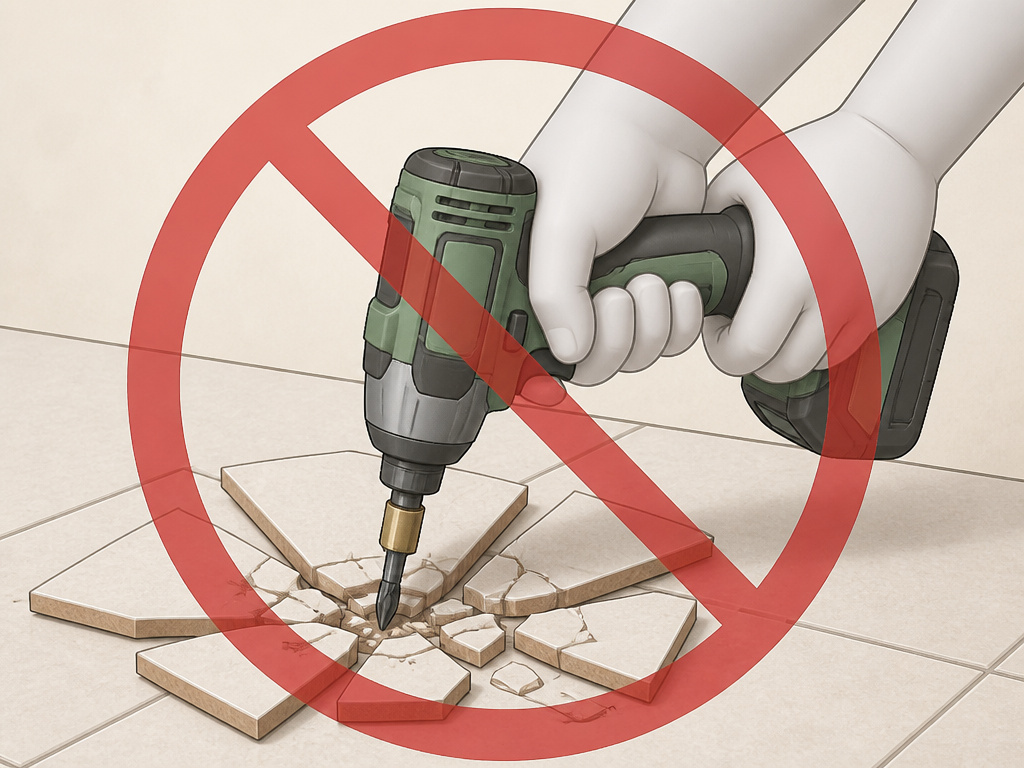
Some materials and scenarios turn a workaround into a destructive, dangerous mistake. Here’s the short list of hard stops.
- Masonry, Tile, or Glass. The hammering action will shatter brittle materials. You need a hammer drill’s percussive forward blows, not an impact driver’s rotational ones. For concrete, you need the right tool for tough materials.
- Large-Diameter Holes (>1/2″). As covered, the lateral stress on the shank is too great. Use a drill or a hole saw arbor designed for constant torque.
- Precision or Clean-Finish Work. If the hole needs to be perfectly round, sized for a dowel, or on finished furniture, use a drill. The impact driver will tear the grain or wallow out the hole.
- Extended Drilling Sessions. The internal mechanism of an impact driver is built for short, high-torque bursts. Prolonged drilling generates excessive heat in the motor and hammer assembly, shortening the tool’s life.
- When Working Near Hidden Wiring. Every manual has this warning for a reason. Manuals from Kreg, Ryobi, SKIL, and Milwaukee advise to “hold the power tool by insulated gripping surfaces” if the fastener (or bit) might contact hidden wiring. Drilling blindly into a wall is riskier than driving a screw.
The noise alone is a significant deterrent. An impact driver is significantly louder than a drill when the impacts are cycling. The Milwaukee manual explicitly says to “wear ear protectors when impact drilling.” Ignoring that for a two-hour deck project is a straight path to hearing damage.
Impact Driver vs. Drill: The Tool You Actually Need
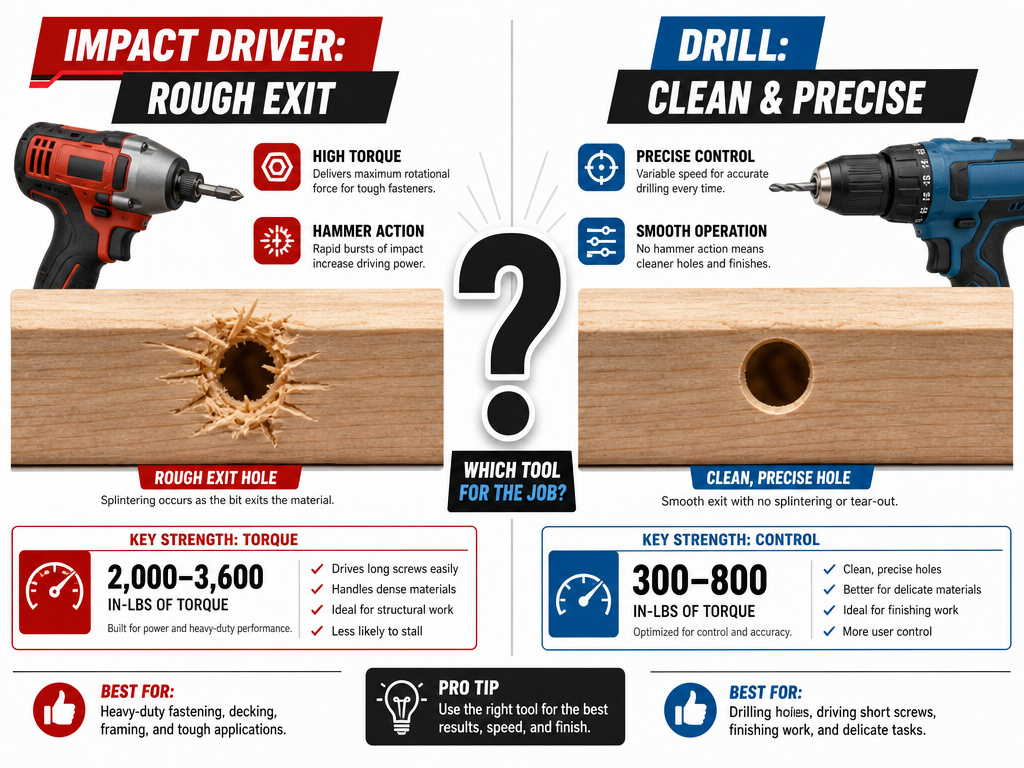
This is a practical matter of matching the tool’s inherent strengths to the job. Think of it as a short, specific comparison.
| Task | Impact Driver Wins | Drill/Driver Wins |
|---|---|---|
| Driving long lag bolts | Effortlessly. High torque (e.g., the Ryobi One+ 18V model provides 1,500 in.lbs). | Struggles, strains the clutch motor. |
| Driving dozens of deck screws | Faster, less user fatigue. | Slower, more wrist strain. |
| Drilling a clean 3/8″ hole in wood | Possible, but rough exit. | Clean, precise hole. |
| Drilling into metal | Slow, risks bit breakage. | Smooth, controlled speed. |
| Drilling a 1″ hole with a hole saw | Not recommended; high failure risk. | The correct tool for the job. |
| Installing a cabinet hinge | Too much power, lacks precision clutch. | Perfect. Set clutch to avoid stripping screws. |
For the DIYer, a drill/driver, or better yet, a combo kit with both tools, covers 95% of tasks. The impact driver excels at its niche: high-torque fastening. The drill excels at controlled drilling and precise fastening. Using an impact driver to drill is like using a sledgehammer to tap in a finishing nail. It might work, but it’s the wrong tool.
Essential Gear and Safety Protocol
If you’ve weighed the risks and are moving forward, your success hinges on using the right accessories and following the safety rules printed in the manuals. This isn’t optional.
Must-Have Accessories:
- Impact-Rated Drill Bits: Look for bits explicitly labeled for impact driver use. Brands like Bosch, DeWalt, and Milwaukee make them. These are the best impact bits for the job because they’re forged to handle the shock.
- ANSI Z87.1 Safety Glasses: The Ryobi manual mandates eye protection “with side shields marked to comply with ANSI Z87.1.” Drilling creates flying chips; impacting creates shrapnel if a bit fails.
- Hearing Protection: Simple earplugs or muffs. Manuals from Milwaukee, Kreg (which references the ANSI S12.6 standard), and Ryobi are clear: extended operation requires hearing protection.
- Dust Mask: For any dusty operation, the Ryobi manual advises a face or dust mask. Drilling drywall or MDF creates fine, irritating dust.
Safety Protocol (Compiled from Manuals):
- Inspect the bit before each use. Look for cracks or a worn hex end.
- Secure your workpiece. A slipping piece of wood or metal can grab the bit and spin violently.
- Keep a firm grip on insulated surfaces. This is repeated in the Ryobi, SKIL, and Milwaukee manuals specifically for situations where contact with hidden wiring is possible.
- Do not over-tighten. The SKIL manual warns: “Do not over-tighten, as the force of the impact driver can break the fastener.” This applies double to drilling, forcing a bound bit will break it.
- Let the tool cool. If the housing becomes hot to the touch, stop and let the tool cool.
Following these steps won’t make drilling with an impact driver as good as using a drill. It just makes it less bad. The right technique always matters more than raw power.
Renting a proper tool (hammer drill) as a cost-effective alternative
If you’re facing a project that involves drilling into masonry or need to make a lot of clean, precise holes in tough material, the most straightforward solution is to rent the right tool. While some impact drivers can drill small holes in wood or metal, they are not designed for masonry and lack the hammering action of a dedicated hammer drill. Renting a hammer drill for a day is often more cost-effective than buying a tool you’ll rarely use, and it guarantees you have the correct power and action for the job. This avoids the strain and potential damage you risk by forcing an impact driver to perform a task it wasn’t built for.
Frequently Asked Questions
Can impact drivers be used to drill holes?
Yes, physically they can, using a 1/4″ hex shank drill bit. However, most manufacturer manuals do not list drilling as an intended use and some explicitly advise against it. The results will be rougher, louder, and harder to control than with a drill.
Can I turn my impact driver into a drill?
No, you cannot change its fundamental hammering action. You can only use drill bits that fit its 1/4″ hex chuck. It will never operate with the smooth, constant rotation of a drill. For precision work, the difference from a drill is too great to overcome.
What drill bits can I use in an impact driver?
Only impact-rated drill bits with a 1/4″ hex shank. Standard round-shank twist bits are not constructed to withstand the impacts and will break. You must use bits specifically designed for the hammering action.
When not to use an impact driver for drilling?
Do not use it for drilling masonry, tile, glass, or any brittle material. Avoid drilling holes larger than 1/2″ in diameter. Do not use it for precision holes where a clean finish is required. Do not use it with standard drill bit adapters.
Is it bad for the impact driver to drill with it?
Extended drilling sessions generate more heat and wear on the hammer mechanism and motor than the high-torque, short-burst driving it’s designed for. Occasional, careful use for small holes is unlikely to cause immediate failure, but it accelerates wear compared to using it as intended.
Before You Go
Here’s the shop-floor truth. You can drill a hole with an impact driver in a pinch. I’ve done it to mount a bracket when my drill was across the shop. The hole was ugly, the bit was hot, and my ears rang. It worked, but I wasn’t proud of it.
The manuals are conflicted because reality is conflicged. The tool possesses the capability, but endorsing it opens manufacturers to liability when bits break or work is ruined. Your takeaway shouldn’t be a simple yes or no. It should be a conditional: yes, if you use impact-rated bits, follow the safety steps, and accept a subpar result. No, if you need a clean, precise, or large hole.
For your next project, grab the right tool. If you don’t own a drill, that’s what you should buy first, not a set of impact driver bits to force a square peg into a round hole. An impact driver is a brilliant specialist. Let it be one.
