
10 Best Dust Extractors For Woodworking in 2026
This post contains affiliate links. As an Amazon Associate, we earn from qualifying purchases.
Our top choice for a woodworking dust extractor is the Festool CLEANTEC CT 26 EI HEPA Dust Extractor for its powerful, adjustable suction and best-in-class HEPA filtration. We also highlight top picks for budget shop collectors, space-saving wall-mount units, and OSHA-compliant portables. Managing fine dust is a critical health and safety task in any shop, not just a cleaning chore. This guide is based on research into specifications, manufacturer data, expert round-ups, and patterns in owner feedback to help you choose the right system for your workspace.
Top 10 Dust Extractors for Woodworking in the Market
Certain content that appears on this site comes from Amazon. This content is provided "as is" and is subject to change or removal at any time.
The Best Dust Extractors for Woodworking, Reviewed
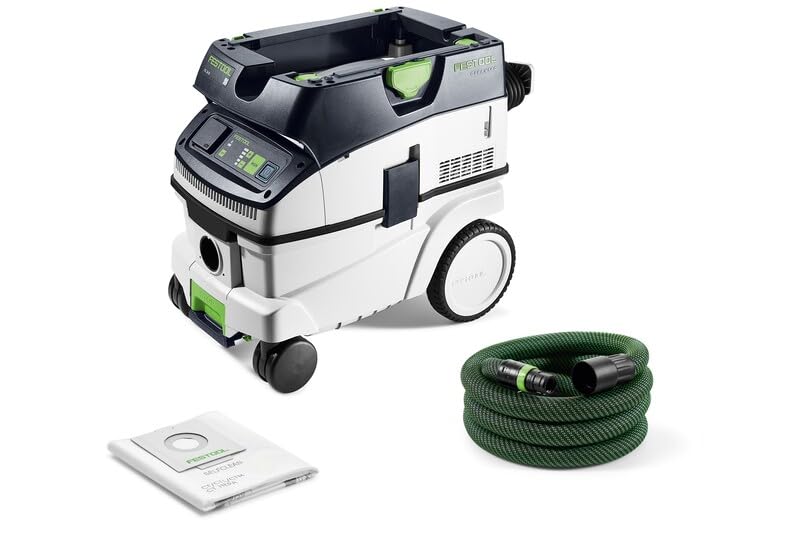
Festool CLEANTEC CT 26 EI HEPA Dust Extractor
What We Like
- Five levels of adjustable suction power
- Automatic start with corded tools and Bluetooth
- Convenient T-LOC Systainer attachment
- HEPA filtration for fine dust
Trade-offs
- At 37.9 lb, it's heavier than the Festool CT Midi I
- Premium system requires compatible Festool accessories
Automatic tool-triggered operation starts your corded tool and the extractor together, so you can focus on sanding or routing without fumbling for a switch. This Festool is built for the woodworker who prioritizes a clean, healthy shop above all else. Its HEPA filtration is designed to capture fine dust from sanding, and the five adjustable suction levels let you dial in the right pull for different tools. According to one experienced owner, spending on what they considered the best dust collection for lung protection was a priority they never regretted.
You are buying into a premium, wall-powered ecosystem. The integrated Bluetooth allows the extractor to start automatically with compatible battery packs, adding cordless flexibility. Its weight of 37.9 pounds gives it a solid, stationary feel compared to a lighter unit like the 20-pound DEWALT FLEXVOLT. It’s a substantial investment, but the research includes an owner’s perspective that spending money for the best dust collection was a worthwhile priority.
WEN DC3474 Woodworking Dust Collector

What We Like
- Mobile base with swivel casters for easy repositioning
- Optional wall-mount design saves floor space
- Includes a 15-gallon collection bag for frequent emptying
- Onboard carrying handle aids in transport
Trade-offs
- 600 CFM is adequate for single tools, not whole-shop ducting
- 15-gallon bag fills quickly during heavy milling sessions
A 600 CFM airflow and a 4-inch port make this collector a solid match for connecting directly to a single stationary tool like a table saw or planer. The included mobile base lets you wheel it around a small shop, and the option to mount it on the wall is a clever space-saver. For the woodworker taking their first step beyond a shop vacuum, this unit delivers the core function of a dust collector without a complex setup, you just hook it up and get to work.
The trade-off is capacity. That 15-gallon bag is practical for keeping the unit’s footprint manageable, but you’ll be unzipping it more often than you would with a 50-gallon system. It’s a dedicated shop unit, not a portable extractor you’d carry to a jobsite like a Festool. When your needs grow to multiple machines running simultaneously, you’ll be looking at more powerful systems, but for straightforward, one-at-a-time tool collection, the WEN DC3474 covers the fundamentals effectively.
POWERTEC DC5371 Wall Mount Dust Collector

What We Like
- Compact, wall-mount design saves floor space
- 1-micron bag contains fine dust effectively
- Vortex base design improves dust removal efficiency
- Dual-voltage motor offers installation flexibility
Trade-offs
- 560 CFM is lower than some dedicated floor units
- Requires regular port cleaning to prevent clogging
A 560 CFM airflow from a wall-mounted unit is a smart solution for a small pro or hobby shop where every square foot counts. The dual-voltage 1 HP motor gives you wiring options, and the 1-micron bag does a solid job of trapping the fine particles you don’t want in the air. This collector fits a workshop that needs dedicated dust collection for a specific stationary machine, without committing a rolling floor unit to the task.
Mounting this dust collector on a wall frees up floor space in a small shop, but its fixed location requires regular maintenance to sustain its 560 CFM airflow. The unit’s 4-inch inlet has a protective grate that can accumulate debris, so the manufacturer advises removing the hose periodically to check for clogs and prevent efficiency losses. This design makes it a dedicated station for dust collection rather than a portable tool.
Festool CT Midi I HEPA Dust Extractor

What We Like
- Bluetooth starts vac from battery packs
- Touch operation for intuitive control
- Smooth hose for high suction power
- Internal hose holder for clean transport
Trade-offs
- 3.9-gallon capacity needs frequent emptying
- At 130 CFM, less suction than larger collectors
The Festool CT Midi I HEPA Dust Extractor includes Bluetooth technology, which allows it to start automatically when used with Bluetooth battery packs or a remote control. Its 130 CFM suction and 24.9-pound weight make it a mobile option for dust extraction. According to expert round-ups, users who prioritize lung protection and dust collection have chosen Festool products for this purpose.
The 3.9-gallon container capacity means it holds less debris than larger stationary collectors. It is a mobile dust extractor with a smooth suction hose designed for high suction power and an internal hose holder for transport. Research mentions that Festool sanders and vacs are considered to have the best dust collection but are also very expensive.
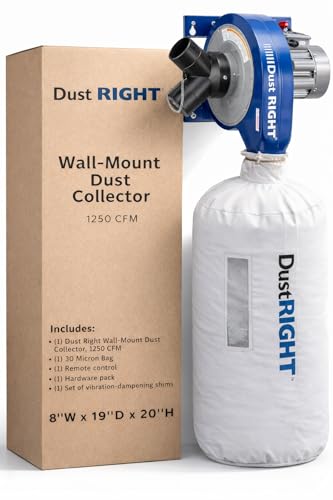
Rockler Dust Right Wall Mount Dust Collector
What We Like
- High 1250 CFM airflow supports multiple tools
- Space-saving vertical wall-mount design
- Remote control for convenient shop-wide operation
- Upgradeable to 1-micron filtration system
Trade-offs
- 30-micron bag is coarse for fine dust capture
- Clear bag window is for monitoring, not a sealed filter
With 1250 CFM of airflow, this wall-mount collector provides the suction to support multiple tools at once from a single unit. Its vertical, space-saving design mounts directly to a wall, keeping floor space clear in a busy woodworking shop. The included remote control allows operation from anywhere in the shop, eliminating the need to walk back to the unit to start or stop it.
Consider the filtration. The included 30-micron bag catches chips and coarse dust, but it lets the fine stuff float right back into your air. You’ll want that 1-micron canister upgrade for sanding. Compared to the compact POWERTEC DC5371, which comes with a 1-micron bag, the Rockler unit offers more airflow but starts with a less refined filter. It’s built for moving a lot of air first, with fine filtering as an optional second step.
DEWALT FLEXVOLT 60V Dust Extractor

What We Like
- OSHA Table 1 compliant for up to 5-inch tools
- Automatic filter cleaning with dual filters
- Wireless tool control with included remote
- Compact and T-Stak compatible for stacking
Trade-offs
- 125 CFM is lower than stationary collectors
- Smaller capacity than dedicated shop collectors
The 125 CFM airflow is the key spec here. Paired with the right shroud, it meets OSHA Table 1 standards for tuckpointing and surfacing. That makes it a serious choice for contractors who need certified compliance on a jobsite, not just a clean shop. Its 20-pound weight and compact footprint mean you can actually carry it up a ladder or stack it with other T-Stak gear. The wireless remote and automatic filter cleaning are practical touches for keeping your focus on the cut, not the vacuum.
This extractor trades raw suction power for portability and compliance. You won’t move the volume of chips a shop collector like the WEN DC1300 can, but you can move the entire unit with one hand. It’s a purpose-built portable. For a pro needing a HEPA vac that ticks the regulatory boxes without being a burden, the DeWalt is a logical fit. If your work never leaves the garage, a dedicated wall-mount unit will offer more capacity for the space.
Product photos
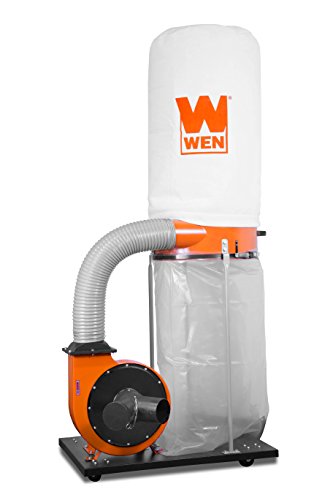
WEN DC1300 Woodworking Dust Collector
What We Like
- High 1300 CFM airflow captures chips effectively
- Dual 4-inch inlets allow two-tool hookup
- Massive 50-gallon bag reduces emptying frequency
- Mobile base makes repositioning in a shop easy
Trade-offs
- 5-micron filtration misses fine dust for some tools
- Requires significant floor space for the unit and bag
With an airflow up to 1,300 cubic feet per minute, the WEN DC1300 can manage the substantial dust and chips from larger stationary tools. Its dual 4-inch inlets allow two tools to be connected simultaneously, a practical feature for a small shop with multiple stationary machines. The vertical collection bag holds up to 50 gallons, enabling extended work sessions between emptying.
The trade-off for that large capacity is a footprint that commands floor space, a consideration if your shop is tight. While the mobile base helps you wheel it between tools, this isn’t a portable extractor you’d tuck under a benchtop. For a compact, wall-mounted solution that saves floor space, the POWERTEC DC5371 offers a different approach, though with less overall air volume and bag capacity.
Product photos
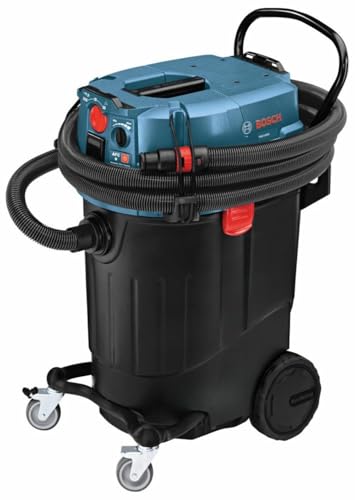
Bosch VAC140AH Dust Extractor
What We Like
- Auto-clean function runs every 15 seconds
- HEPA filter captures 99.97% of fine dust
- Power-tool-activated switching for convenience
- OSHA silica dust compliance system included
Trade-offs
- 38-pound weight is substantial for a portable unit
- Requires compatible tools for automatic activation
The automatic filter cleaning every 15 seconds is the core of this extractor. That feature means you can run a sander or saw for an extended session without constantly stopping to check suction or clean the filter manually. It serves users who need consistent, high-efficiency dust capture from tools like sanders and saws, and who value a system designed to meet strict jobsite health standards. The 14-gallon capacity and 97-inch water lift provide solid mid-range performance for a shop vacuum, handling dry debris effectively.
This extractor moves 150 cubic feet of air per minute, which provides strong suction for connected power tools. It cannot move the volume needed for a large planer or jointer from across the room like a dedicated unit such as the WEN DC1300. That makes it a superb companion for tool-specific hookups and mid-sized cleanup jobs, not a central shop collector. For someone moving between job sites or using several tools in sequence, the auto-clean and tool-activation features justify its place as a premium portable.
Product photos
BUCKTOOL Wall Mount Dust Collector
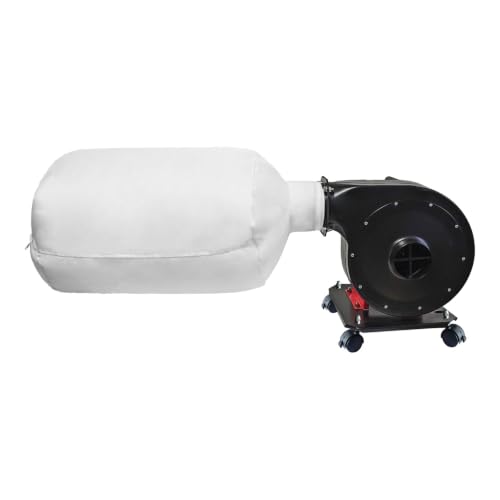
What We Like
- TEFC motor is quiet and built for frequent use
- Dual-mount design offers permanent or portable setup
- Captures fine dust down to 2 microns
- Locking casters provide stability during operation
Trade-offs
- Airflow is less than half of some wall-mount competitors
- Filtration is not as fine as other 1-micron bag systems
The 660 CFM airflow from its 1.2 HP motor provides solid suction for a shop managing daily sawdust. Where this collector truly stands out is its dual-mount flexibility. You can bolt it to the wall to save floor space, or use the locking casters to roll it between machines. That makes it a versatile fit for a mid-sized workshop where your layout or tool lineup might change. The sealed TEFC motor is built for the long haul, and the 2-micron bag helps keep fine particles from circulating.
The trade-off for this flexibility is in pure suction power and filtration finesse. It moves less air than a large, single-stage unit like the WEN DC1300, so it’s better suited for single-tool hookups than complex ducting. The 2-micron bag is effective, but if your primary concern is capturing the very finest dust for health reasons, a model like the POWERTEC DC5371 with its 1-micron bags is worth a look. This Bucktool is about giving you options without demanding a permanent shop footprint.
Product photos
Rikon 60-101 Wall Mount Collector
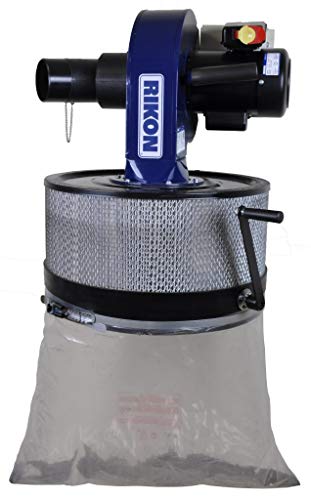
What We Like
- 1-micron pleated canister filter for fine dust
- Wall mount design saves floor space
- Dual voltage 1 HP motor for flexibility
Trade-offs
- No mobile base, permanently fixed to wall
- No integrated collection bag or drum included
The 1-micron pleated canister filter is the standout feature here, meaning it captures the fine, hazardous dust particles that other collectors let back into your shop air. That filtration level, combined with a wall-mount design that gets the unit off your precious floor space, makes this collector a solid fit for a small to medium-sized shop where air quality is a priority.
Mounting this unit on the wall saves floor space, but it cannot be moved once installed. You can’t wheel it over to a different corner of the garage. For a stationary setup, that’s fine, but it locks you into a specific workflow. Compared to a mobile unit like the Festool CT Midi I HEPA, which is designed for portability, the Rikon is a set-it-and-forget-it solution. Its lightweight construction, hinted at by the unspecified weight, might also mean less vibration damping than a heavier, floor-standing model.
Product photos
How We Evaluated Dust Extractors for Woodworking
This guide examines manufacturer specifications and expert reviews to outline core performance metrics and features. It focuses on three key criteria. First is filtration level, which is critical for capturing harmful fine dust. Second is airflow capacity (CFM), which determines how effectively a collector can service tools. Third is the physical design, affecting how a unit integrates into a shop’s workflow and space constraints. As a research-based overview, it relies on documented product information and reported user experiences.
What To Look For In Dust Extractors for Woodworking
Choosing the right system involves balancing filtration, power, and practicality for your specific shop setup. Understanding the differences between a dedicated dust extractor and a standard shop vac is a key first step in our shop vac vs dust extractor comparison.
Look for HEPA-level filtration for fine dust, sufficient CFM for your tools, and a design, portable, wall-mount, or large-capacity, that fits your shop’s workflow and space.
Filtration Level
The most important factor is how fine a dust particle the system can capture. For lung health, you need filtration that traps particles under 10 microns. A true HEPA filter, which captures 99.97% of particles at 0.3 microns, is the gold standard for sanding and milling operations. Some stationary collectors use 1-micron pleated canister filters or bags, which offer excellent fine-dust control, while others may use 5-micron or even 30-micron bags primarily designed for larger chips.
Airflow Capacity (CFM)
Measured in cubic feet per minute, CFM indicates the collector’s ability to move air and capture debris. A minimum of 400 CFM is often cited to keep dust suspended in ductwork over short runs. Higher CFM ratings, like 1250 or 1300 CFM, support multiple tools or high-volume machines like planers. Lower CFM units, around 130 CFM, are adequate for single-tool extraction like a sander but won’t support a whole-shop ducted system. For a deeper look at high-capacity systems, explore our guide to the best dust collection systems.
Design & Integration
Consider how the collector will live in your shop. Portable extractors offer mobility for job sites or moving between tools, while wall-mount designs save precious floor space in small workshops. Capacity matters too; a 50-gallon bag reduces emptying frequency for high-volume work, whereas a 3.9-gallon bin is more manageable for frequent moves. Features like automatic start, Bluetooth control, and tool-activated switching add significant convenience for daily use.
- Check the inlet size matches your tool ports, as common sizes include two and a half inches, four inches, and six inches.
- Ensure the unit has adequate mobility features like casters and a manageable weight if you plan to move it.
- Verify the power requirements match your shop’s electrical setup.
- Look for onboard storage for hoses and accessories to keep your shop organized.
- Consider the noise level if your shop is in a shared living space.
For health, prioritize filtration first, then match the CFM and form factor to your most common tasks and shop layout.
Dust Extractors for Woodworking Compared
The comparison table below summarizes the key specifications and features of our top picks to help you see the differences at a glance.
| Product | Airflow (CFM) | Filtration | Mounting/Mobility |
|---|---|---|---|
| Festool CLEANTEC CT 26 EI HEPA Dust Extractor | N/A | HEPA | Mobile |
| WEN DC3474 Woodworking Dust Collector | 600 CFM | 5-micron | Mobile |
| POWERTEC DC5371 Wall Mount Dust Collector | 560 CFM | 1 micron | Wall mount |
| Festool CT Midi I HEPA Dust Extractor | 130 CFM | HEPA | Mobile |
| Rockler Dust Right Wall Mount Dust Collector | 1250 CFM | 30 micron | Wall mount |
| DEWALT FLEXVOLT 60V Dust Extractor | 125 CFM | HEPA | Mobile |
| WEN DC1300 Woodworking Dust Collector | 1300 CFM | 5-Micron | Mobile |
| Bosch VAC140AH Dust Extractor | 150 CFM | HEPA | Mobile |
| BUCKTOOL Wall Mount Dust Collector | 660 CFM | 2-micron | Wall-mount or portable |
| Rikon 60-101 Wall Mount Collector | 800 or 1 100 CFM | 1 micron | Wall mounted |
Frequently Asked Questions
What is the best dust extractor for woodworking?
A leading option among the models reviewed is the Festool CLEANTEC CT 26 EI HEPA Dust Extractor. It combines adjustable suction power with automatic tool start, a large capacity, and true HEPA filtration, offering a comprehensive health-focused solution for serious woodworkers.
What is the best dust extraction system for woodworking?
For a permanent shop system, a high-CFM dust collector like the WEN DC1300 or Rockler Dust Right Wall Mount unit is best for multiple stationary tools. For fine dust control at a fixed station, a wall-mount collector with 1-micron filtration, like the Rikon 60-101, is an excellent choice. Our article on dust collectors covers these stationary systems in detail.
What is the best vacuum dust extractor for woodworking?
The best vacuum-style extractors are portable, HEPA-filtered units like the Festool CT Midi I or DEWALT FLEXVOLT 60V Dust Extractor. They are designed for direct tool hookup, automatic operation, and fine dust capture, making them ideal for sanding, routing, and job site work where mobility and compliance are key.
What is the best dust collection system for a small woodshop?
For a small shop with limited floor space, a wall-mount dust collector is ideal. The POWERTEC DC5371 offers great value and efficient 1-micron filtration in a compact footprint. The BUCKTOOL model adds versatility with a dual-mount design that can be either wall-mounted or set on a mobile base.
What’s the difference between a dust extractor and a shop vac?
A dust extractor is engineered specifically for fine particulate with sealed systems and HEPA filters to protect your lungs, while a shop vac is a general-purpose cleaner for larger debris and liquids.
The Bottom Line
The Festool CLEANTEC CT 26 EI HEPA Dust Extractor is our best overall pick for the woodworker ready to invest in top-tier, health-conscious dust control for a dedicated shop. If your budget is tighter, start with the capable WEN DC3474, and if floor space is your primary constraint, look to the efficient POWERTEC DC5371 wall-mount unit.
Ultimately, the most important factor is the filtration level. Prioritizing a system that captures the fine dust you can’t see will make the biggest difference for your shop’s air quality and your long-term health. For specific advice on outfitting a dedicated workspace, our resource on wood shop dust extractors offers further guidance.
