
10 Best Dust Collectors in 2026
This post contains affiliate links. As an Amazon Associate, we earn from qualifying purchases.
Our best overall dust collector is the Jet Cyclone Dust Collector JCDC-2 for its effective paddle-cleaned filter and programmable remote. The Powermatic PM2200HK earns the best high-performance HEPA award, and the Rockler Dust Right is the top space-saving wall-mount pick. Choosing the right unit means balancing suction power, filtration fineness, and your shop’s physical and electrical space. We researched specifications, expert analysis, and owner feedback to create this list of ten models that suit different shop sizes, budgets, and health priorities.
Top 10 Dust Collectors in the Market
Certain content that appears on this site comes from Amazon. This content is provided "as is" and is subject to change or removal at any time.
The Best Dust Collectors, Reviewed
Jet Cyclone Dust Collector JCDC-2

What We Like
- Manual paddle system quickly cleans the pleated filter
- Remote includes programmable timer for automatic shutoff
- Drum rolls away independently on casters
Trade-offs
- At 235 lb, moving requires a solid floor and space
- 50.7-inch width demands a significant shop footprint
- Single-phase 230V power limits installation flexibility
Its two-stage cyclone design separates heavy debris before air reaches the filter, so the pleated material stays cleaner and maintains strong suction longer. The filter captures particles down to 1 micron, which returns exceptionally clean air to your shop. This 2 HP, 230V unit is built for serious woodworking volume, handling both chips and fine dust with a 30-gallon collection drum.
The trade-off is its substantial presence. You need the floor space for its 50-inch width and a dedicated 230-volt outlet. Compared to a compact wall-mount like the Rockler Dust Right, this is a central shop anchor. For a pro shop or a dedicated hobbyist, that’s a fair exchange for the performance. If your ceiling height is limited or you need three-phase power, the JET Vortex Cone model offers a different form factor to consider.
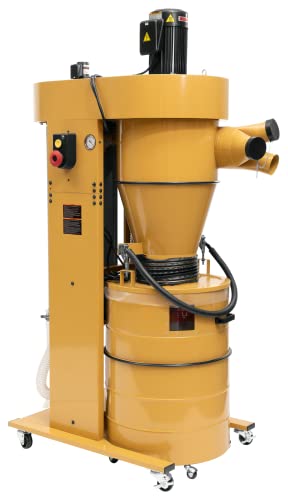
Powermatic Cyclone Dust Collector PM2200HK
What We Like
- Auto-cleaning HEPA filter maintains performance
- High 1,543 CFM airflow for powerful suction
- One-handed drum release simplifies bag changes
- Vacuum gauge provides clear system feedback
Trade-offs
- Large footprint at 85.2 inches tall
- Weighs 370 lbs, requiring permanent placement
- Needs dedicated 230-volt single-phase power
Moving 1,543 CFM through a true HEPA filter makes this collector a serious solution for shops where air quality is non-negotiable. Its auto-cleaning filter technology provides 99.97% efficiency at 0.3 microns without constant manual cleaning. This is ideal for a busy professional or dedicated hobbyist during long sanding or milling sessions, as it prioritizes capturing the finest dust.
This collector requires a dedicated, sizable floor space and a 230-volt outlet, with a footprint over four and a half feet long and a weight of 370 pounds. Its three-horsepower motor moves 1,543 cubic feet of air per minute, delivering the strong suction needed for large shop tools. For a more compact cyclone from the same brand, the Powermatic TurboCone also has a 3 HP motor but fits in a much smaller cabinet. Its filter captures particles down to 2 microns rather than the HEPA standard.
Product photos
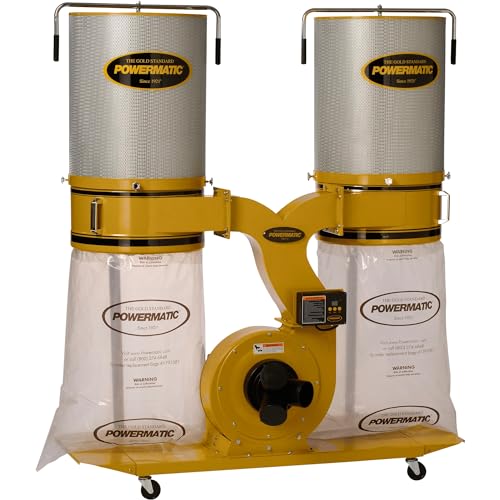
Powermatic TurboCone Dust Collector PM1900TX-CK1
What We Like
- Remote-controlled timer for automated shut-off
- TurboCone design improves chip separation
- All-metal duct construction for rigid airflow
- Multiple 4-inch ports for simultaneous connections
Trade-offs
- Weighs 268 pounds, requiring a permanent shop location
- Needs a dedicated 230V single-phase electrical circuit
The programmable remote control is the standout feature here, letting you set the collector to run for up to 99 minutes and then shut off from across the shop. This is a major convenience for multi-tasking or when you’re finishing a cut and walking away. Combined with a 3 HP motor and the TurboCone’s efficiency at separating chips before they hit the filter, this unit is built for sustained performance in a busy workshop. It’s a premium choice for the woodworker who values automation and wants to manage dust collection without constantly returning to the machine.
With a weight of 268 pounds, this collector requires a permanent shop location rather than being moved around. Its 2-micron canister filter provides strong performance for typical workshop dust, though expert round-ups place it among other well-performing cyclones rather than singling it out. For the finest hazardous powders, a model like the Powermatic PM2200HK with its 1-micron HEPA filter would be a more suitable choice.
Product photos
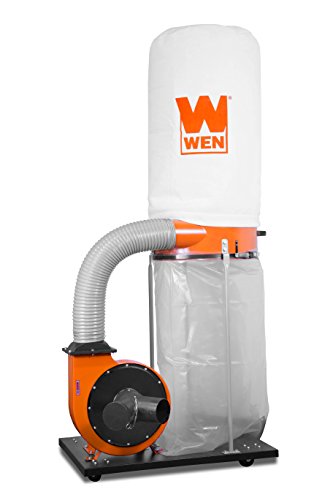
WEN DC1300 Dust Collector
What We Like
- High 1,300 CFM airflow for strong suction
- Dual 4-inch inlets for connecting two tools
- Large 50-gallon dust collection bag
- Mobile base provides easy shop movement
Trade-offs
- 5-micron filtration is coarser than many cyclones
- Relies on a bag filter instead of a canister
With an airflow rating of up to 1,300 CFM, the WEN DC1300 moves a substantial volume of air, which is the core requirement for effective dust collection. Its dual 4-inch inlets allow connections for two tools simultaneously. A mobile base with four swivel casters is included, making it easy to reposition the unit around a workshop.
Filtration is specified at 5 microns, which captures visible dust but is less fine than the 1 or 2-micron filters on units like the Powermatic PM2200HK or Jet JCDC-2. The 50-gallon collection bag provides high capacity compared to compact wall-mount models. This places it between smaller, lower-capacity collectors and larger systems with finer filtration.
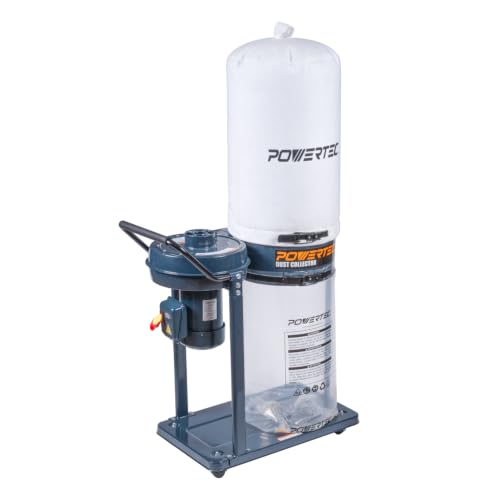
POWERTEC DC1081 Dust Collector
What We Like
- Includes mobile base with casters
- Quick-release bag clamps for easy emptying
- Single-phase motor works on 120V household current
Trade-offs
- Bag filtration lacks fine canister filter performance
- 1-micron bag filtration (not a canister or HEPA type)
Weighing 55 pounds and equipped with a mobile base on casters, this 1 HP collector can be rolled to different machines. Its 800 CFM air suction capacity is designed to keep a workshop free from woodchips and sawdust from woodworking machines. The motor runs on 120V or 240V, so it can plug into a standard outlet for a stationary setup or a centralized collection point.
Filtration uses a standard 1-micron bag, which is different from the 2-micron canister filter on the Jet DC-1200VX-CK3 or the 1-micron HEPA filter on the Powermatic PM2200HK. The unit’s function is to eliminate harmful dust particles and create a clean workspace environment. Its versatility allows it to be moved to a required point or connected to a centralized dust collection destination.
Product photos
Rockler Dust Right Wall Mount Dust Collector
What We Like
- Wall-mount design saves critical floor space
- 650 CFM can support multiple tools at once
- Clear bag with zipper simplifies cleanup
- Upgradeable to a 1-micron canister filter
Trade-offs
- 30-micron stock bag is coarse for fine dust
- Lacks a built-in mobile base for repositioning
- Requires wall space and secure mounting
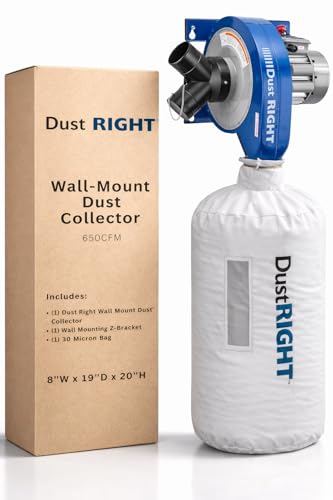
Mounting on the wall saves critical floor space, a key advantage for cramped workshops. Its 650 CFM suction supports multiple tools at once, according to the product description. The included 30-micron bag has a clear window and a bottom zipper, which simplifies checking the fill level and cleanup.
Filtration starts at 30 microns with the included bag, so finer dust particles can pass through. The design is upgradeable to a 1-micron canister for finer filtering. For a unit with a 1-micron bag included and higher 800 CFM airflow, the POWERTEC DC1081 is an alternative that requires floor space.
VEVOR Wall Mount Dust Collector

What We Like
- Strong 560 CFM suction for a 1 HP unit
- Large 21-gallon collection bag reduces emptying frequency
- Bottom zipper on bag allows for quick, tool-free cleanup
- Wall-mount design saves valuable floor space
Trade-offs
- 2.5-micron filtration allows finer dust than some cyclones
- Fixed bag system lacks the fine dust separation of a cyclone
A 560 CFM airflow from its 1 HP motor provides stable, powerful suction, which handles both coarse sawdust and fine sanding dust for a single machine connection. The 21-gallon non-woven collection bag accommodates larger amounts of debris, reducing cleaning breaks during medium and small woodworking projects. Its wall-mount design and 24-pound weight allow it to be installed off the floor, saving space in a workshop.
Filtration captures particles down to 2.5 microns, lowering airborne dust for enhanced workshop air quality, though some finer particles may remain. The motor operates at up to 90dB, which reduces noise during long sessions compared to some louder units. A convenient bottom zipper on the bag allows for quick debris removal without needing to detach it or use extra tools.
Product photos
BUCKTOOL 1-1/2 HP Dust Collector
What We Like
- High 1100 CFM airflow for multiple tools
- Internal dust baffle extends filter life
- Flexible dual 4-inch or single 6-inch port setup
- Mobile base for easy repositioning
Trade-offs
- 5-micron filtration is coarser than some 1-micron models
- Tall 82.7-inch height may not fit low-ceiling shops
- Single-stage design lacks cyclone pre-separation
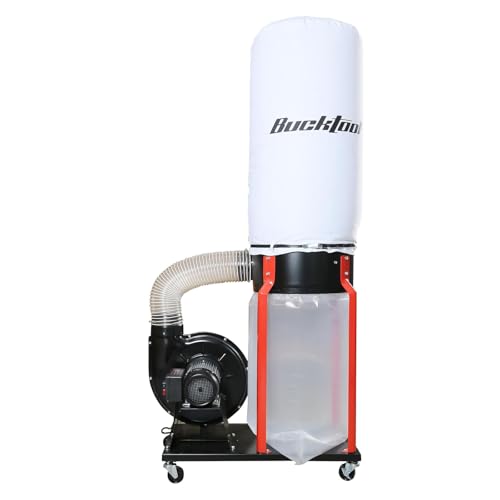
The BUCKTOOL dust collector delivers up to 1100 CFM, a flow rate that can serve multiple machines like table saws and planers according to its description. An internal dust baffle is designed to direct heavier particles into the collection bag first, which aims to reduce filter clogging and maintain airflow. This combination of high airflow and the baffle design suits shops where the unit might be moved on its mobile base to different stationary tools.
Its filter is rated at 98% efficiency for 5-micron particles, which helps capture fine dust from operations like sanding. Other products on the list, such as the Powermatic PM2200HK, are listed with a 1-micron HEPA filter. For general woodworking where chip removal is the priority, the BUCKTOOL provides its stated filtration level.
Product photos
Jet Vortex Cone Dust Collector DC-1200VX-CK3

What We Like
- Vortex Cone improves chip separation
- High 1200 CFM air velocity
- Permanently-lubricated continuous-duty motor
- Quick-connect collection bags
Trade-offs
- Requires a 3-phase electrical connection
- Single-stage design offers less fine dust separation than a cyclone
With an airflow of 1200 CFM, this dust collector is designed for high air velocity, which helps capture debris quickly from tools. Its vortex cone improves chip separation and bag packing efficiency, aiming to prevent premature filter clogging for sustained performance. The permanently-lubricated, totally-enclosed, fan-cooled motor is rated for continuous duty, intended for extended operation periods.
This is a single-stage design, which is noted for economical and quiet operation at 70-80 db, but finer dust goes directly into the collection system. The unit includes swivel casters for maneuverability and total portability. Compared to other cyclone-style collectors in the list, it uses a different separation method and operates on a 230/460V 3-phase electrical supply.
Product photos
VEVOR Vortex Cone Dust Collector
What We Like
- Large 42-gallon bag minimizes emptying frequency
- Strong 1100 CFM airflow for efficient debris collection
- 2.5-micron filtration reduces fine airborne dust
- Clip-style bag design allows for quick maintenance
Trade-offs
- At 75.6 inches tall, it requires significant vertical clearance
- 2.5-micron filter is less fine than 1-micron HEPA units
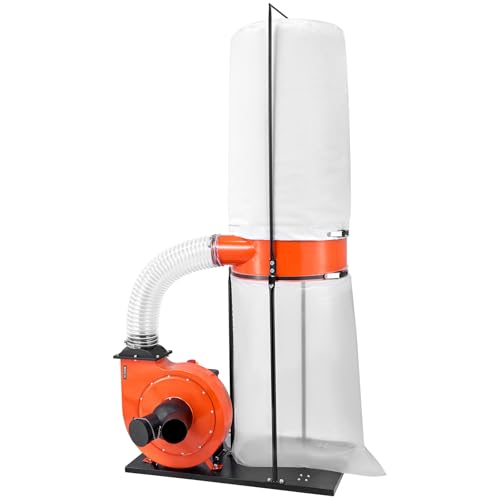
With a 42-gallon collection bag, this dust collector lets you run extended sanding or milling sessions without constant interruptions to empty it. That high capacity pairs with 1100 CFM of suction, which efficiently clears dust from the workspace. The 2.5-micron filtration traps fine particles, and the clip-on bag design makes cleanup straightforward.
The trade-off is in filtration fineness and footprint. While it captures plenty, its 2.5-micron filter isn’t as tight as the 1-micron HEPA standard found on units like the Powermatic PM2200HK, so it may not be the best choice for those with severe allergies. Its height is also considerable. For a shop with lower ceilings or a need for medical-grade air cleaning, a different cyclone might be wiser. But for general woodworking where bag capacity is the primary bottleneck, this collector’s large-volume design solves a real problem.
Product photos
How We Evaluated Dust Collectors
Our selection is based on a review of manufacturer specifications, expert round-ups from woodworking publications, and patterns in owner feedback. We prioritized three key criteria: airflow measured in CFM for effective chip removal, and filter rating in microns for capturing fine, breathable dust. We also considered physical design factors like footprint and mobility, which determine if a unit fits a real workshop. This research-led approach identifies reliable performers, but it cannot replicate the long-term durability testing of years of daily use in a specific shop environment.
What To Look For In Dust Collectors
The right dust collector protects your health and keeps your shop clean. You must match its capabilities to your machines, your space, and the type of dust you create.
Key factors are airflow (CFM), which dictates suction power; filtration fineness (microns), which controls breathable dust; and physical design, including footprint and power requirements, which determine if it fits your shop.
Airflow and Power
Airflow, measured in cubic feet per minute (CFM), is the engine of a dust collection system. Higher CFM, like the 1,543 from the Powermatic PM2200HK, provides the suction needed to pull chips through longer duct runs or from multiple machines. Motor horsepower relates to this, but the impeller design and ducting are equally critical for real-world performance.
A unit with strong CFM but poor filtration simply puts fine dust back into the air, so these specs must be balanced. For a deeper dive into central systems, our dust collector reviews cover this in detail.
Filtration and Dust Separation
Filtration fineness, stated in microns, is a health imperative. A 5-micron bag catches chips but misses fine sanding dust, while a 1-micron canister or true HEPA filter (like on the Powermatic PM2200HK) captures the particles that pose the greatest respiratory risk. Many cyclone dust collectors use a two-stage design where a vortex separates heavier chips before air reaches the fine filter, dramatically extending filter life and maintaining suction. Understanding the difference between single-stage and two-stage dust collectors is crucial for long-term performance and maintenance.
Shop Fit and Practical Design
A dust collector must physically fit your space. Consider the footprint, height, and weight, some units like the Jet JCDC-2 weigh over 200 pounds and need a permanent location. Mobility via a built-in base is key for single-stage units moved between tools. Electrical requirements are a major constraint; many high-performance models need a dedicated 230-volt circuit, while 120-volt units offer more installation flexibility. For space-challenged workshops, dust collectors for small shops like wall-mount models become essential.
- Check the unit’s height against your ceiling clearance.
- Verify your shop’s electrical capacity matches the collector’s voltage and amperage needs. Plan for duct runs or hose lengths, and consider adding blast gates for a multi-tool system.
- Account for bag or drum capacity to gauge how often you’ll need to empty it.
The best collector is the most powerful one with the finest filtration that you can actually fit and power in your shop.
Dust Collectors Compared
The following table compares the key specifications and features of all ten dust collectors to help you see the differences at a glance.
| Product | Motor Power | Airflow (CFM) | Filtration |
|---|---|---|---|
| Jet Cyclone Dust Collector JCDC-2 | 2 HP | N/A | 2-Micron Filter |
| Powermatic Cyclone Dust Collector PM2200HK | 3 HP | 1,543 CFM | 1-Micron HEPA Filter |
| Powermatic TurboCone Dust Collector PM1900TX-CK1 | 3 HP | N/A | 2-Micron Canister Filter |
| WEN DC1300 Dust Collector | 14-amp | 1,300 CFM | 5-Micron |
| POWERTEC DC1081 Dust Collector | 1 HP | 800 CFM | 1 micron bag |
| Rockler Dust Right Wall Mount Dust Collector | N/A | 650 CFM | 30 micron |
| VEVOR Wall Mount Dust Collector | 1 HP | 560 CFM | 2.5 micron bag |
| BUCKTOOL 1-1/2 HP Dust Collector | 1-1/2 HP | 1100 CFM | 98% at 5 microns |
| Jet Vortex Cone Dust Collector DC-1200VX-CK3 | 2 HP | 1200 CFM | 2-micron canister |
| VEVOR Vortex Cone Dust Collector | 1.5 HP | 1100 CFM | 2.5 micron |
Frequently Asked Questions
What is the most powerful dust collector available?
The most powerful dust collectors for home and professional shops typically feature motors with three to five horsepower, require 230-volt power, and can move a high volume of air. These units are designed for central ducted systems serving multiple machines simultaneously, but their large size and electrical requirements make them unsuitable for many home garages.
What is the best dust collector for home use?
The best dust collector for a home workshop balances sufficient power with practical size and standard 120-volt power. Look for a portable single-stage unit with a mobile base, like our Best Portable Workshop pick, or a space-saving wall-mount model. For many home workshops, a key upgrade is adding a dust separator to improve the performance of a budget-friendly unit.
Which is the best dust collector?
The “best” dust collector depends entirely on your shop’s needs. For a central shop with 230V power, a cyclone with fine filtration like our Best Overall Jet model is excellent. For maximum fine-dust control, a HEPA unit like the Powermatic PM2200HK is best. For small shops, a wall-mount or portable 120V collector is the most practical solution. Our guide breaks down the best options for each specific scenario among the top wood dust collectors.
Are dust collectors worth the money?
Yes, a proper dust collector is a critical investment for long-term health and shop cleanliness. It captures the fine, inhalable dust that a shop vacuum cannot handle effectively. While the upfront cost is significant, it protects your lungs, keeps your workspace cleaner, and can improve the performance and lifespan of your tools. Understanding the dust collector vs shop vac distinction highlights why a dedicated system is necessary for serious woodworking.
What is better, a dust collector or an air filter?
They serve different, complementary roles. A dust collector captures dust at the source, preventing it from entering the shop air. An air filter cleans dust that has already escaped into the atmosphere. For true health protection, you need a collector with fine filtration first; an air filter is a secondary system for catching any remaining airborne particles.
The Bottom Line
For the serious woodworker with a central shop and 230V power, the Jet Cyclone Dust Collector JCDC-2 is our best overall pick, offering an excellent balance of powerful suction, fine filtration, and convenient filter cleaning. If budget or space is the primary constraint, look directly to our Best Budget Wall-Mount or Best Portable Workshop picks by name.
No single feature matters more than matching the collector’s filtration fineness to the dust you create; protecting your health from invisible particles is the non-negotiable starting point for any purchase.
