
10 Best Dust Extractors For Wood Shop in 2026
This post contains affiliate links. As an Amazon Associate, we earn from qualifying purchases.
The Festool CLEANTEC CT 36 EI AC HEPA Dust Extractor is the best overall dust extractor for a wood shop because of its automatic filter cleaning and tool-activated operation. For high-volume chip collection, the Best High-Capacity Cyclone award goes to the VEVOR 1100 CFM Vortex Cone, while the Fein Turbo II excels in quiet operation. Each of these addresses a distinct shop need, from compliance to compact spaces.
Managing wood dust is a critical health and safety task. The right system captures harmful fine particles and keeps your workspace clean, but needs vary widely between a one-person cabinet shop and a garage hobbyist.
Our recommendations are based on manufacturer specifications, expert round-up reviews, and patterns in user feedback. We focused on criteria that matter most for effective and practical shop dust control.
Top 10 Dust Extractors For Wood Shop in the Market
Certain content that appears on this site comes from Amazon. This content is provided "as is" and is subject to change or removal at any time.
The Best Dust Extractors For Wood Shop, Reviewed
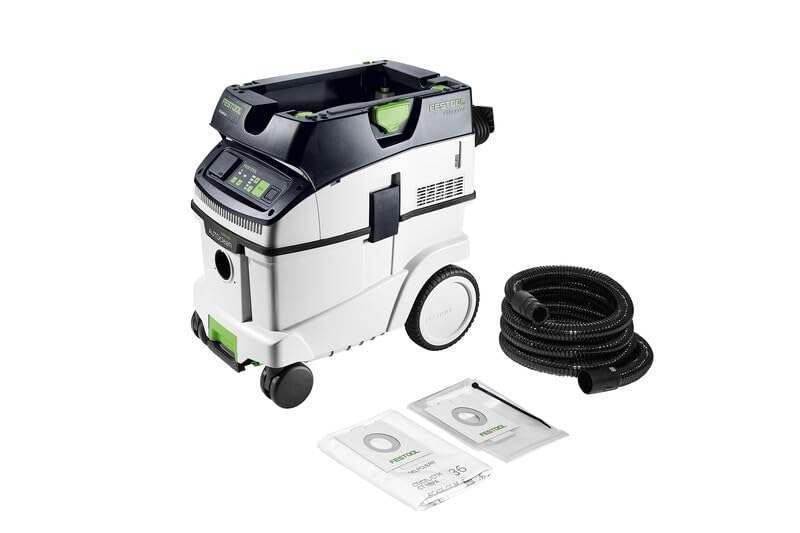
Festool CLEANTEC CT 36 EI AC HEPA Dust Extractor
What We Like
- App-controlled automatic filter cleaning for sustained power.
- Automatic start for both corded and Bluetooth power tools.
- Intuitive touch controls for easy operation.
Trade-offs
- At 34 pounds, it's heavier than many portable shop vacuums.
- Smaller capacity than stationary dust collectors like the JET DC-1100VX-CK.
The integrated Autoclean system is the decisive feature, using app-set intervals to maintain suction power automatically during heavy, dusty work. This makes it a premium choice for woodworkers who demand consistent performance from sanders and saws without stopping to clean the filter. The automatic electrical outlet and Bluetooth tool start add a layer of workshop convenience that truly streamlines the workflow.
You trade raw collection capacity for this smart, self-maintaining portability. It’s a powerful extractor, not a high-volume collector, so for managing a large cabinet saw or planer, a dedicated unit like the VEVOR 1100 CFM is better suited. But for connected tool use and fine dust control, the Festool’s automation is in a class of its own, justifying its place at the bench of a serious craftsman.
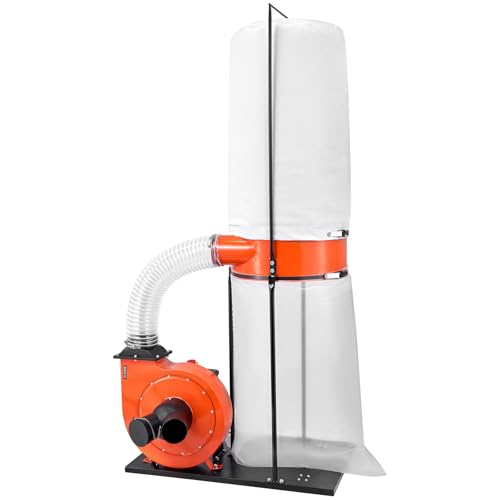
VEVOR 1100 CFM Vortex Cone Dust Collector
What We Like
- High 1100 CFM airflow for fast debris clearing
- Large 42-gallon bag minimizes emptying frequency
- 2.5-micron filtration improves air quality
- Clip-style bag access simplifies maintenance
Trade-offs
- Large footprint at 75.6 inches tall
- Heavy 68.1 lb weight limits portability
The VEVOR dust collector’s 1100 CFM suction provides intense airflow power, which quickly pulls in coarse sawdust and fine debris for efficient workshop dust clearing. Its 1.5HP induction motor delivers steady suction power for continuous woodworking operations, and the 42-gallon collection bag captures more dust to minimize downtime during small to medium jobs. This system is built for woodworking tasks where strong, stable suction and a large collection capacity are the primary needs.
The trade-off is its substantial size and industrial noise level, which demands dedicated floor space and hearing protection. It’s a stationary workhorse, not a portable vac. Compared to a compact extractor like the Fein Turbo II, which is built for clean-up and tool-triggered use, the VEVOR is for central collection. You’re choosing raw collection capacity over flexibility and quiet operation.
Product photos
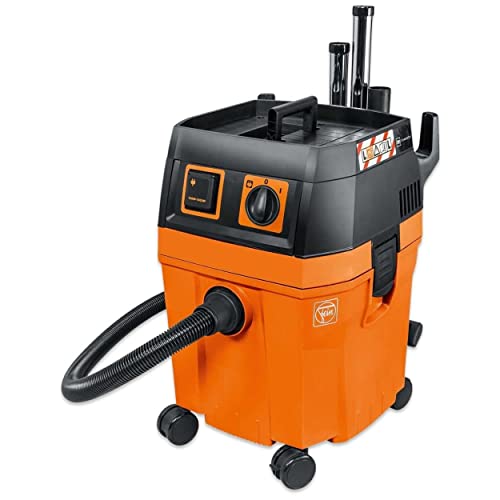
Fein Turbo II HEPA Wet/Dry Dust Extractor
What We Like
- Exceptionally quiet 66 dB(A) operation.
- Integrated autostart outlet for tool activation.
- Full anti-static system for safety with fine dust.
- Long cord and hose for extended workspace coverage.
Trade-offs
- 8.5-gallon capacity is smaller than many stationary dust collectors.
- 151 CFM is lower than dedicated high-volume collectors like the VEVOR.
The Fein Turbo II operates at 66 dB(A), a low noise level for a wet/dry extractor, which facilitates use in noise-sensitive environments like attached garages. It provides 151 CFM airflow and 98 PSI static water lift for the removal of dust, debris, and liquids. An integrated anti-static system is designed to prevent electrostatic buildup during operation.
With an 8.5-gallon capacity, the unit is more compact and lighter at 25.0 pounds than many larger dust collectors. It has a 19-foot power cord and a 13-foot hose for an extended operating range in a workspace. The autostart outlet synchronizes the vacuum with connected power tools to activate automatically.
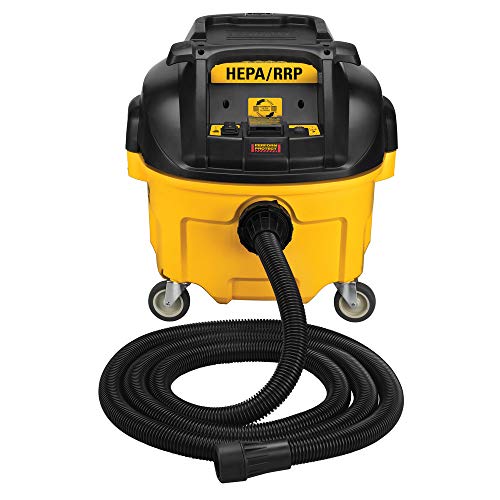
DEWALT DWV010 HEPA Dust Extractor
What We Like
- Automatic filter cleaning for continuous operation
- Power Tool Actuation for linked on/off control
- Heavy-duty wheels and casters for jobsite mobility
- Universal swivel hose connector for secure fit
Trade-offs
- 8-gallon capacity requires frequent emptying on large jobs
- HEPA compliance requires a specific, separate filter purchase
An automatic filter clean that pulses every 30 seconds allows continuous operation with a planer or sander, eliminating pauses to clean the filter. This 8-gallon DeWalt extractor’s 15-amp motor delivers 150 CFM of airflow. Its Power Tool Actuation feature controls the vacuum’s on/off operations automatically with a connected tool. Heavy-duty wheels and casters provide jobsite durability, and a universal hose connector with swivel capability offers a secure fit.
This extractor is designed for a specific scale of work. It’s a shop vac-style unit, not a full dust collector. The 8-gallon bin will fill up fast if you’re milling a stack of lumber, and its 150 CFM can’t service a machine like a cabinet saw or a large drum sander. For that level of work, you’d be looking at a dedicated dust collection system. For connecting to a miter saw, router table, or handheld sander, however, it delivers a crucial set-it-and-forget-it feature that makes practical sense for many workshops.
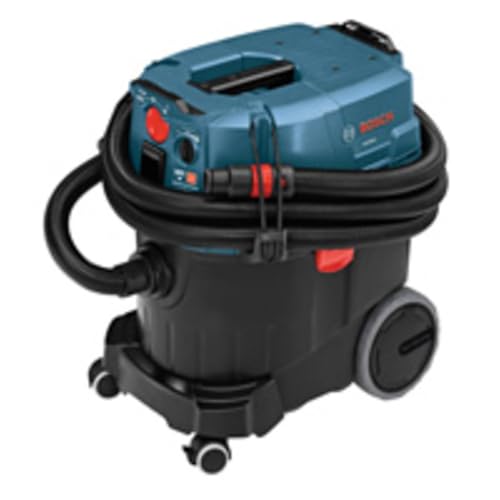
Bosch VAC090AH Dust Extractor
What We Like
- Automatic filter cleaning maintains suction
- HEPA filter aids OSHA silica compliance
- Power-tool-activated start and stop
- Adjustable suction force for the application
Trade-offs
- 9-gallon capacity is smaller than stationary collectors
- 150 CFM is less than vortex-style dust collectors
For shops needing documented dust control, the Bosch VAC090AH is built to help meet OSHA silica standards. Its HEPA filter captures 99.97% of particles at 0.3 microns, and an automatic cleaning cycle runs every 15 seconds to help maintain suction during long tasks. This design suits concrete grinding or cutting silica-heavy materials where consistent filtration is required. Power-tool activation and adjustable suction let it integrate directly into a workflow where you switch frequently between a grinder and other tools.
You trade raw collection volume for this focused compliance and convenience. Its 150 CFM and 9-gallon capacity are ample for connected tool use, but they’re a fraction of what a large vortex collector like the VEVOR offers for whole-shop air cleaning. This Bosch lives at the workbench, not as a central system. For a professional woodworker needing to check the silica compliance box on specific tasks, it’s a purpose-built solution. For someone just looking to manage general sawdust from a table saw or planer, a simpler, higher-volume system might be more practical.
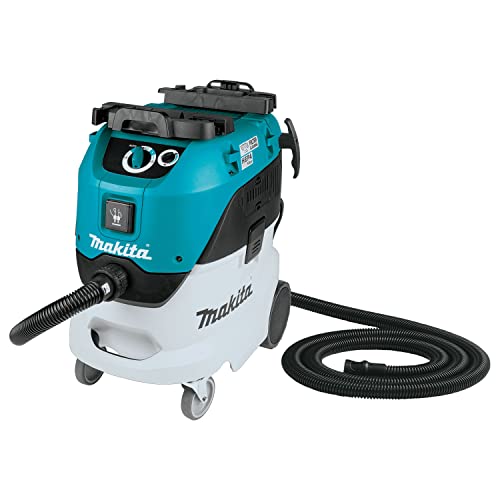
Makita VC4210L HEPA Dust Extractor
What We Like
- Automatic filter cleaning extends component life.
- HEPA filter captures fine, hazardous dust effectively.
- Tool-activated outlet provides convenient, debris-clearing operation.
- Two-stage filtration pre-filters bulk dust for efficiency.
Trade-offs
- Its 31.5-inch length requires significant floor space.
- Lacks the high-volume CFM of dedicated dust collectors.
An automatic filter cleaning system paired with true HEPA filtration makes this extractor a serious choice for anyone concerned with air quality. The 148 CFM and 92-inch water lift provide strong suction for shop vacuum tasks, while the two-stage system ensures the HEPA filter isn’t clogged by larger debris. This design is built for the woodworker who generates a mix of fine sanding dust and larger chips but needs to reliably capture the harmful particulates.
Mobility is the main consideration, as this model weighs over 35 pounds and is nearly 32 inches long. It’s less mobile than compact shop vacs, making it more of a shop-floor anchor than a quick carry. For capturing dust at a single machine or during detail work, it’s excellent. For managing the output of a large planer or a full dust collection system, you would need a unit with higher airflow capacity.
JET DC-1100VX-CK Vortex Dust Collector

What We Like
- 2-micron canister filter for superior air quality
- Vortex Cone improves chip separation and bag packing
- Sustained filter performance resists premature clogging
- Industrial controls designed for years of trouble-free use
Trade-offs
- At 79 inches tall, requires significant vertical clearance
High-efficiency filtration is the key feature, thanks to a 2-micron canister filter that traps fine dust other single-stage collectors often recirculate. This makes it a standout for woodworkers who prioritize a cleaner breathing environment. The Vortex Cone design helps keep the filter from clogging too quickly, which maintains strong suction as the bag fills. It’s a serious machine for a small to mid-sized shop where you need to move it between tools but don’t want to compromise on dust control.
With its 2-micron canister filter, this dust collector prioritizes clean air in the shop by trapping very fine particles. The single-stage design contributes to economical and quiet operation, making it suitable for continuous use without being overly loud. Its four casters provide total portability, so you can easily move it between tools in a compact workspace.
Product photos
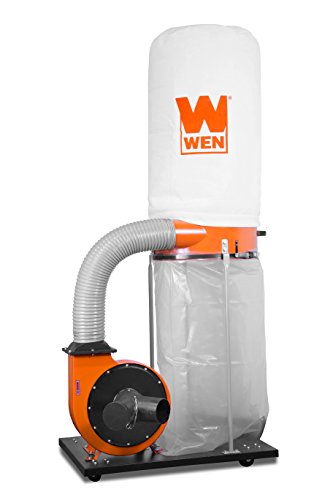
WEN DC1300 Woodworking Dust Collector
What We Like
- High 1,300 CFM airflow for efficient chip collection.
- Dual 4-inch inlets allow connecting two tools.
- Large 50-gallon bag reduces emptying frequency.
- Included mobile base provides easy shop movement.
Trade-offs
- Collection bag filters to 5 microns only.
- Requires significant floor space.
A stated ability to circulate up to 1,300 cubic feet of air per minute provides substantial airflow for managing debris from larger machines. Dual 4-inch air inlets allow two tools to be attached at once, supporting a basic central collection setup. The included mobile base with four swivel casters makes the unit easy to reposition around a workshop.
The trade-off for that raw air power is in filtration. The 5-micron collection bag will catch the visible sawdust but lets the finest, most harmful particles pass through, so you’ll want to use it in a well-ventilated space or consider an aftermarket upgrade. Compared to a compact, sealed HEPA unit like the Fein Turbo II, the WEN is about bulk chip removal, not creating a clean-breathing environment. It’s built for moving volume, not capturing the very fine finish-sanding dust.
Product photos
POWERTEC DC5371 Wall Mount Dust Collector

What We Like
- Compact wall-mount design saves floor space.
- 560 CFM airflow handles small shop tools well.
- 1-micron bag with window and zipper for clean disposal.
- Vortex base design claims 10% improved dust removal efficiency.
Trade-offs
- The 4-inch inlet grate requires regular cleaning to prevent clogging.
- 560 CFM is lower than large, freestanding collectors like the VEVOR 1100 CFM.
A 560 CFM dust collector mounted directly to your wall is the ultimate space-saver for a cramped workshop. The POWERTEC DC5371 delivers solid suction for a single machine at a time, making it a perfect fit for the small pro or serious hobbyist who needs to keep their floor clear for projects. Its 1-micron bag traps fine dust effectively, and the dual-voltage motor offers wiring flexibility. This unit is all about getting respectable dust collection without sacrificing a single square foot of precious shop real estate.
Its compact footprint comes with a system that requires a bit more maintenance. The built-in grate over the 4-inch inlet is a smart guard for the impeller, but sawdust loves to collect there. You’ll need to pull the hose off now and then to clear it out, or you’ll choke the airflow. For a dedicated, high-volume setup like a planer or drum sander, you’d want the raw power of a larger dust collector. But for keeping a bandsaw or joiner clean, this wall-mounted workhorse gets the job done.
Product photos
Festool CT MIDI I HEPA Dust Extractor

What We Like
- Bluetooth enables automatic, remote start
- Touch operation for intuitive control
- Sys-dock for instant sustainer connection
- Internal hose holder for clean transport
Trade-offs
- 3.9-gallon capacity requires frequent emptying in heavy sessions
- At 130 CFM, suction is modest for large stationary tools
The Festool CT MIDI I HEPA Dust Extractor uses integrated Bluetooth technology to start automatically with compatible battery packs or a remote control. This allows operation from a distance, which can reduce trips back to the machine. Its touch operation and Sys-dock with T-Loc for connecting sustainers are features aimed at user control and accessory organization. The unit provides 130 CFM of suction power and has a 3.9-gallon container capacity.
You trade sheer power for this smart convenience. While the suction is strong for its class, it’s not in the same league as a large collector like the VEVOR 1100 CFM unit for a table saw or planer. The bin will fill up faster than models with 8-gallon or larger capacities, so it’s better suited to intermittent use rather than all-day milling. For a compact, intelligent extractor to pair with a few primary tools, the Festool’s design is hard to beat, but you’ll want a secondary system for bulk waste.
Product photos
How We Evaluated Dust Extractors
This evaluation is based on manufacturer-published specifications, documented expert testing from woodworking publications, and consistent patterns in owner feedback.
We prioritized filtration level, measured in microns, as the primary health safeguard. Airflow in cubic feet per minute (CFM) determined a unit’s ability to keep up with different tools, while features like automatic start and filter cleaning impacted daily usability. Physical size and capacity were weighed against typical shop constraints. For a broader look at different models, our dedicated dust extractor reviews detail these trade-offs.
A research-based approach cannot replicate years of shop durability, so we noted where materials or design choices might affect long-term reliability. Our goal is to help you match a system’s proven capabilities to your specific tools and space.
What To Look For In Dust Extractors
Choosing a dust extractor means balancing the need to capture hazardous fine dust with the practical realities of your shop’s size and tool lineup. The right system protects your lungs and keeps your workspace manageable.
Key criteria are filtration level (HEPA or micron rating), airflow (CFM) to match your tools, and physical size versus capacity. Features like automatic start and filter cleaning add daily convenience but come at a higher cost.
Filtration Level
The most critical factor is how small a particle the system can capture. HEPA filters are the gold standard, trapping at least 99.97% of particles as small as 0.3 microns. This is essential for complying with OSHA silica dust regulations and protecting lung health. Many standard shop vacuums and budget dust collectors filter only to 5 microns or larger, allowing the most harmful fine dust to pass back into the air. For a deep dive on maintaining air quality, explore our guide on air filtration systems.
Canister filters, like on the JET model, often provide superior filtration and easier cleaning than traditional bags. A two-stage system, where a cyclone or separator removes bulk debris first, helps maintain filter efficiency and suction over longer periods.
Airflow (CFM) and Suction
Airflow, measured in cubic feet per minute (CFM), determines how effectively the extractor captures dust at the source. Higher CFM is necessary for stationary tools like planers and table saws that produce large volumes of chips. For sanders and handheld tools, lower CFM from a portable extractor is often sufficient.
Sustained airflow is just as important as peak numbers. Systems with automatic filter cleaning, like the Festool and DEWALT, maintain suction as fine dust accumulates. Remember that long hose runs, small tool ports, and clogged filters will all reduce effective CFM. Understanding the key differences between a shop vac and a dust extractor clarifies why dedicated extractors often provide more consistent performance for fine dust.
Size, Capacity, and Setup
Consider your shop’s footprint. Large cyclone collectors like the VEVOR need significant floor and vertical space, while wall-mounted units like the POWERTEC save floor area. Capacity, from 4 to 50 gallons, dictates how often you must empty the collection bag or drum, a frequent task with smaller portable units.
Setup involves more than plugging it in. Check that the hose diameter matches your tool ports; adapters are often needed. An automatic start outlet, where the extractor turns on with the tool, is a major convenience. For a streamlined dust collection setup, ensure your connections are secure and airtight.
.### Practical Checks
- Match the inlet size (commonly 2.5″ or 4″) to your tool’s dust ports.
- Ensure the unit’s electrical requirements (120V vs. 220V) are compatible with your shop.
- Verify mobility features like wheels or a handle if you plan to move it between tools.
- Look for onboard storage for hoses and accessories to reduce clutter.
- Consider noise levels if your shop is in a shared living space.
A good rule of thumb: prioritize HEPA-level filtration for any sanding work, and choose CFM based on your largest chip-producing tool.
Dust Extractors For Wood Shop Compared
The comparison table below details key specifications to help you weigh these factors side-by-side.
| Product | Suction Power (CFM) | Capacity (Gallons) | Weight (Pounds) |
|---|---|---|---|
| Festool CLEANTEC CT 36 EI AC HEPA Dust Extractor | Five adjustable levels | N/A | 34.0 |
| VEVOR 1100 CFM Vortex Cone Dust Collector | 1100 CFM | 42-gallon filter bag | 68.1 |
| Fein Turbo II HEPA Wet/Dry Dust Extractor | 151 CFM | 8.5-gallon | 25.0 |
| DEWALT DWV010 HEPA Dust Extractor | 150 CFM | 8-Gallon | 22.0 |
| Bosch VAC090AH Dust Extractor | 150 CFM | 9 gallons | 28.0 |
| Makita VC4210L HEPA Dust Extractor | 148 CFM | 11-gallon | 35.3 |
| JET DC-1100VX-CK Vortex Dust Collector | N/A | N/A | N/A |
| WEN DC1300 Woodworking Dust Collector | 1,300 CFM | 50-gallon | N/A |
| POWERTEC DC5371 Wall Mount Dust Collector | 560 CFM | N/A | 35.5 |
| Festool CT MIDI I HEPA Dust Extractor | 130 CFM | 3.9 gallon | 24.9 |
Frequently Asked Questions
What is the best dust collection system for a woodworking shop?
The best system depends on your shop size and tools. For a large shop with multiple stationary tools, a high-CFM cyclone collector like the VEVOR or a central dust collection system is most effective. For smaller shops or those focused on sanding, a HEPA-rated portable extractor like the Festool CT 36 provides excellent protection with greater flexibility.
What is the best dust extractor for woodworking?
Our best overall pick is the Festool CT 36 EI AC HEPA Dust Extractor. It combines automatic filter cleaning, tool-activated operation, and true HEPA filtration, making it a versatile and low-maintenance choice for serious woodworkers using a variety of tools, especially sanders.
What is the best vacuum dust extractor for woodworking?
The term “vacuum dust extractor” typically refers to portable, canister-style units. The Makita VC4210L is a strong choice here, offering two-stage filtration and automatic filter cleaning in a shop-vacuum form factor. It’s effective for mixed debris and connects easily to handheld power tools.
What is the best workshop dust extractor for a small shop?
For limited space, consider the wall-mounted POWERTEC DC5371 or a compact model like the Festool CT MIDI I. These units save floor space while providing adequate airflow for one tool at a time. Our resource on dust collectors for small shops explores more space-saving options.
Do I need a dust separator with my shop vac?
Adding a dust separator, like a cyclone unit, is highly recommended. It captures bulk chips and dust before they reach your shop vac’s filter, dramatically extending filter life and maintaining suction. It’s a cost-effective upgrade for any shop vac used for woodworking.
The Bottom Line
For most wood shops needing a balance of power, protection, and convenience, the Festool CLEANTEC CT 36 EI AC HEPA Dust Extractor is the best overall choice. Its automatic filter cleaning and tool-triggered operation make for an effective workflow, especially for sanding and sawing.
Budget-conscious shoppers should look at the WEN DC1300 for high-volume chip collection, while those in noise-sensitive environments will appreciate the Fein Turbo II. For shops requiring documented compliance with silica dust regulations, the Bosch VAC090AH is specifically designed for that task.
Ultimately, the single most important factor is filtration. Ensuring your system captures fine dust below 5 microns is a non-negotiable investment in your long-term health, making HEPA-level filtration the foundation of any responsible shop setup.
