
10 Best Spindle Sanders in 2026
This post contains affiliate links. As an Amazon Associate, we earn from qualifying purchases.
For a durable, versatile tool that excels at sanding curves and edges, the Rikon Power Tools 50-300 Oscillating Spindle Sander is our best overall pick. The Triton TSPSP650 is the best portable option, and the WEN 6524 offers the best combo value. Each of these ten models solves a different sanding challenge.
Spindle sanders are essential for cleaning up curved cuts from a bandsaw or jigsaw, but choosing the wrong one can mean poor finish quality or a tool that doesn’t fit your shop. The right balance of power, table size, and included spindle diameters makes all the difference.
This guide is based on a review of product specifications, manufacturer documentation, expert round-ups, and patterns in owner feedback. We focus on the features that matter most for efficient, clean curve sanding.
Top 10 Spindle Sanders in the Market
Certain content that appears on this site comes from Amazon. This content is provided "as is" and is subject to change or removal at any time.
The Best Spindle Sanders, Reviewed
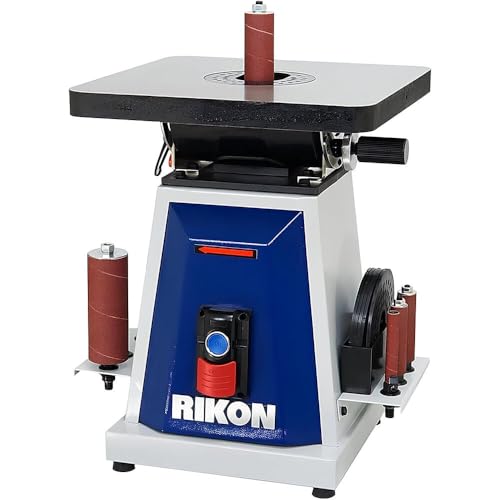
Rikon Power Tools 50-300 Oscillating Spindle Sander
What We Like
- All-steel and cast iron construction for long-term durability
- Five spindle sizes handle a wide variety of curve work
- Oscillating action provides efficient, clean sanding
- Ample, tilting table offers solid workpiece support
Trade-offs
- Lacks the variable speed found on some modern sanders.
- Weighs 76 pounds for limited portability
A half-horsepower motor and all-steel construction give the Rikon 50-300 a substantial feel for a stationary benchtop tool. Its five included spindles, from half an inch to two inches in diameter, handle a variety of curved edges. The abrasive sleeves oscillate nearly an inch while spinning, a motion designed for efficient sanding.
That durability comes with a real trade-off in portability and space. At 80 pounds with a 23.5-inch long footprint, this is a bench-hogging unit, not something you’ll tuck away on a shelf. For anyone with a cramped garage shop, the sheer mass and size are significant considerations. If your projects demand a dedicated, heavy-duty sander for curves, the Rikon 50-300 is a standout choice. For those needing more flexibility or who work with straight edges, a machine like the WEN 6524 that combines a spindle with a belt sander might be a more versatile, space-efficient solution.
Triton TSPSP650 Portable Oscillating Spindle Sander

What We Like
- Dual-action rotating and oscillating spindle for burn-free sanding
- Tool-free quick-change system for sanding sleeves
- Includes bench-mounting set for stationary use
- Variable speed motor for different materials
Trade-offs
- 650W motor, less power than some benchtop units
- Includes only four specific drum diameters
Weighing just under five pounds, the Triton TSPSP650 is a tool you can easily carry from the truck bed to the job site. That portability, combined with its included bench-mounting hardware, gives you the flexibility to tackle edge sanding on a cabinet door in the shop or finish a sink cutout on location. The variable-speed 650-watt motor and four included drum sizes handle a good range of curves and contours, making it a logical choice for woodworkers and installers who need precision sanding away from a permanent workstation.
You are trading pure stability for that portability. A dedicated benchtop unit like the Rikon 50-300 offers a much larger, heavier base for taming vibration during all-day production runs. The Triton excels as a secondary sander for its intended mobile role, but for a primary workshop machine meant for high-volume shaping, you’ll want a heavier, more stationary foundation.
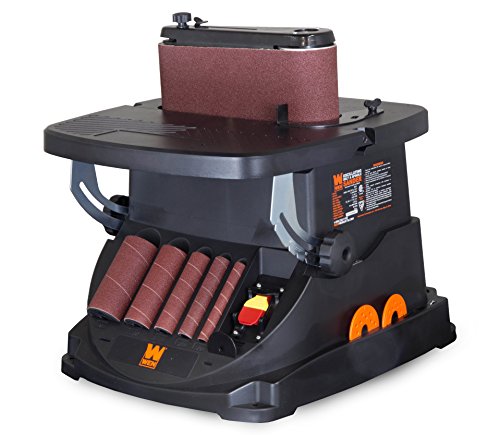
WEN 6524 Oscillating Belt and Spindle Sander
What We Like
- Includes both belt and five spindle sizes
- Onboard storage for all accessories
- Beveling work table and multiple throat plates
Trade-offs
- At 27 pounds, it's a dedicated benchtop tool
- Single belt size limits flat sanding versatility
Getting both a 4 x 24-inch belt sander and five different spindle drums in one package is a serious space and budget saver for a home workshop. This WEN model is built for the woodworker who needs to sand curves, inside cutouts, and occasional flat edges but doesn’t have the room or need for two separate machines. The thoughtful onboard storage means all the drums and throat plates have a dedicated spot, so you’re not digging through a drawer mid-project. That 3.5-amp motor provides enough power for most hobbyist tasks, oscillating the spindle to prevent burning your workpiece.
This 27-pound benchtop sander combines a 4 x 24 inch belt and five spindle drum sizes, creating a versatile, space-saving station for detailed shaping and edge work. The included beveling table and onboard storage for all accessories keep the workspace organized. According to a reviewer who compared it to a more expensive model, the WEN’s spindle locking knob is an improvement, as it did not jam during their use unlike the one on the Ridgid version.
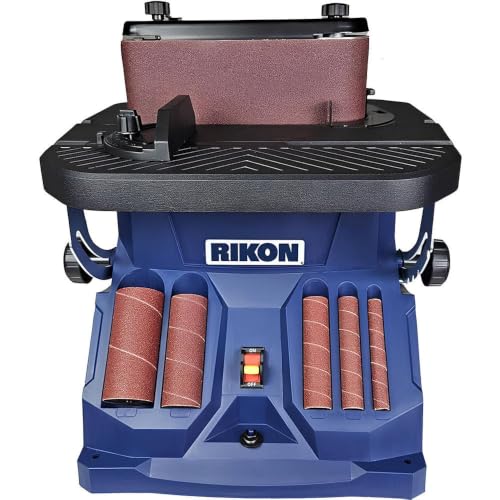
RIKON Power Tools 50-310 Spindle Sander
What We Like
- Tilting table handles common bevels up to 45 degrees
- Integrated storage for sanding sleeves and spindles
- Includes a dedicated dust collection port
Trade-offs
- Its 21-inch length demands considerable bench space
- No variable speed control listed in specifications
This sander is built for the woodworker who needs stability for sizable projects, pairing that real estate with a tilting table for beveled edges and a dust port to manage the inevitable mess. It’s a solid, single-purpose machine for a workshop where space isn’t the primary constraint.
You trade some portability and motor power for that expansive table. Compared to the compact Triton TSPSP650, this is a dedicated bench anchor. The fixed-speed 1/2 HP motor is sufficient for finish sanding but might feel underpowered if you frequently shape thick, hardwoods. For smoothing curves on big furniture pieces, however, the Rikon’s table size is a legitimate advantage that simplifies the work.
Product photos
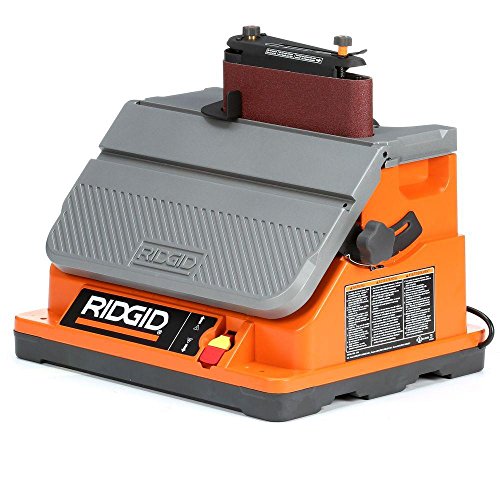
Ridgid EB4424 Oscillating Edge Belt Sander
What We Like
- Tool-free conversion between belt and spindle
- Oscillating and rotary motion for burn-free finishes
- Ball bearing construction for durability
- On-board storage for sanding sleeves and belts
Trade-offs
- A direct competitor, the WEN 6524, has a more compact 16.5-inch width
Tool-free conversion from belt to spindle is the standout feature here, letting you switch sanding modes in under a minute without hunting for a wrench. This makes the Ridgid EB4424 a serious time-saver for a workshop that handles mixed projects, from shaping edges to smoothing inside curves. Its oscillating action prevents burning and clogging, which owners appreciate for finishing work. The ball bearing construction and onboard storage point to a tool built for regular use, suiting the woodworker who values a ready-to-go, dual-purpose machine.
This sander combines edge belt and spindle sanding in one tool, so you can switch tasks without needing separate machines. Its overall footprint measures 23 inches long by 19 inches wide, requiring a dedicated spot on a workbench. While not as compact as the 16.5-inch wide WEN 6524, the design includes on-board accessory storage to keep sanding sleeves and belts within reach.
Triton TSPS450 Oscillating Spindle Sander

What We Like
- Cast iron table for superior stability
- On-board storage for all accessories
- Includes six matching sleeves and drums
- Combines rotating and oscillating action
Trade-offs
- Requires 18.5 inches of bench depth.
- Weighs more than portable spindle sanders.
Its 3.5-amp motor delivers power for shaping tasks, while the cast iron top adds mass to reduce vibration during operation. This stable platform is ideal for sanding contours, arcs, and curves, as noted in the product description. The included set of six sanding sleeves with matching drums and table inserts handles a range from 1/2 to 3 inches for common projects.
You pay for that stability with a substantial footprint. The Triton TSPS450 is a bench anchor, not a tool you’ll tuck away after each use. For a shop with limited space, a more compact model like the WEN AT6535 might be a better fit. But if you have the real estate and your work demands finesse, the cast iron top is a foundational feature that directly translates to cleaner, more controlled sanding.
JET JOSS-S Oscillating Spindle Sander

What We Like
- Massive tilting table with 90° quick index
- Ten included spindle sizes from 1/4" to 4"
- 1-1/2" oscillation reduces heat and wear
- Sealed oil-bath gear mechanism for durability
Trade-offs
- Weighs 216 lbs, requiring a permanent shop footprint
- Cabinet design is not portable or benchtop-friendly
- No variable speed motor (fixed 1720 RPM)
A 1 HP motor and a 1-1/2″ oscillation stroke give this sander the guts to handle prolonged, aggressive material removal without bogging down. That power, combined with the generous 24.5″ square table, makes it a shop anchor built for serious production work. It’s the right choice for a professional woodworker who needs a sander that can keep pace with all-day use on complex curved workpieces, from furniture parts to instrument bodies. The included set of ten spindles means you’re ready for almost any interior curve right out of the crate.
The trade-off for that industrial capability is sheer mass and size. At 216 pounds, this is a stationary cabinet tool, not something you’ll move around. It demands dedicated floor space. For a shop focused on large projects, that’s a worthy investment. If your work requires more flexibility, a benchtop model like the Rikon 50-300 offers a capable but far more compact footprint at 80 pounds, though with a smaller table and less powerful motor.
Product photos
Woodskil Variable Speed Oscillating Spindle Sander

What We Like
- Variable speed for precise control on delicate or large work
- Includes six sanding sleeves for a wide range of tasks
- Effective dust collection port for a cleaner shop
- Compact 26-pound design is easy to move and store
Trade-offs
- Motor power is less than some 1HP industrial-grade units
A 2/3HP 4A motor provides extra power for heavy-duty sanding on hardwood and large projects. Variable speed control from 1000 to 1800 RPM allows for precise finishes on delicate curves or larger surfaces. The included set of six sanding sleeves fits jobs from fine detail work to larger areas, and a dust port connection minimizes sawdust for a cleaner workspace.
Its 26-pound design offers portability and easy storage in small workshops without sacrificing stability. While not an anchor for production like heavier units, the variable speed range is a step above fixed-speed sanders for material versatility. An efficient dust collection system improves safety compared to many competitors with less effective setups.
Product photos
WEN AT6535 Oscillating Spindle Sander
What We Like
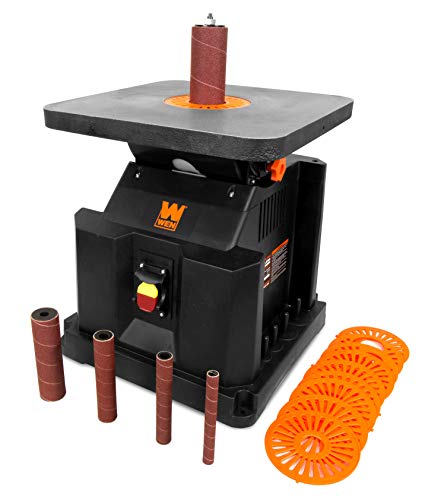
- Extra-large tilting table for big workpieces
- Onboard storage for all sleeves and accessories
- Oscillating spindle reduces sanding marks
- Comes with five spindle sizes for versatility
Trade-offs
- 33.2 lb weight demands a sturdy benchtop
- Single-speed motor lacks variable control
A 14-1/2 inch square table that tilts up to 45 degrees provides a large, stable surface for sanding angled workpieces. This is paired with five included spindle sizes, from 1/2 inch to 2 inches, for working on contours from tight inside curves to longer edges. Onboard storage keeps all the sanding sleeves and accessories organized.
The tool’s 33.2-pound weight makes it a stable, stationary fixture for a workbench. Its 2000 RPM motor operates at a fixed speed and oscillates the spindle 58 times per minute with a 5/8-inch stroke. According to one reviewer who also owns a Ridgid model, the overall fit and finish ranks among the better tools in the WEN brand.
Product photos
HORCSXR Oscillating Spindle and Belt Sander

What We Like
- Dual-mode design for both flat and contoured sanding.
- Comprehensive set of five spindle sleeves for various curves.
- Dust collection port for cleaner workshop operation.
Trade-offs
- At 42.6 pounds, it's a substantial benchtop commitment.
Combining a spindle sander and a belt sander, the HORCSXR consolidates two essential workshop tools into a single machine with a 16-inch footprint. This dual-function design handles inside curves and arcs with the oscillating spindle, while the belt section flattens edges and broad surfaces. It includes five spindle sleeves in different diameters and a table that tilts to 45 degrees, making it a space-efficient choice for mixed wood projects like furniture and crafts.
Versatility comes with certain trade-offs in dedicated performance. The spindle reaches 2000 RPM, while a model like the larger Rikon 50-300 is built for more constant professional use. For a DIY workshop where space is limited, this 42.6-pound unit combines two sanding modes. It requires a sturdy bench to support its weight and a shop vacuum connected to its dust port for effective collection.
Product photos
How We Evaluated Spindle Sanders
Our evaluation focused on research, not physical testing. We examined detailed specifications from manufacturers, studied professional and independent expert round-ups, and analyzed common themes in owner feedback to understand real-world performance and durability, as detailed in our oscillating spindle sander reviews.
Key criteria included construction quality for vibration-free operation, the range of included spindle sizes for different curve radii, and table features like size, tilt, and stability. We also prioritized effective dust collection ports and, where available, variable speed control for handling different materials.
A research-led approach has limits; it cannot measure subtle differences in vibration or the exact feel of operation. However, it reliably identifies the core strengths and trade-offs of each machine, from a compact benchtop unit to a professional floor model sander.
What To Look For In Spindle Sanders
Choosing a spindle sander means matching its capabilities to your most common projects. Consider your bench space, the scale of your workpieces, and whether you need the added versatility of a belt sander function.
Prioritize a sturdy, tilting table for workpiece control and a good range of spindle diameters for different curve sizes. An oscillating action is essential for a clean finish, and effective dust collection keeps your shop cleaner.
Construction and Power
Heavier cast iron or all-steel construction minimizes vibration, leading to more precise sanding and a smoother finish. Motor power, measured in watts or horsepower, determines how aggressively you can remove material without bogging down. A benchtop unit for hobbyist use may have ample power, while a professional shop model will feature a stronger motor for continuous, heavy-duty work.
Table and Spindle Features
The work table is your control center. A larger surface supports bigger panels, while a tilting table (often up to 45 degrees) is crucial for beveling edges. The spindle should be positioned to give you ample room to maneuver the workpiece. Look for a variety of spindle diameters; having a size close to the curve you’re sanding prevents flat spots and yields a truer contour. Learning proper spindle sander techniques maximizes the utility of these features.
Oscillation and Versatility
The oscillating (up-and-down) motion of the spindle is what defines these tools. It prevents grooves, reduces heat buildup to avoid burning the wood, and extends the life of the sanding sleeves. Some models offer dual functionality as a belt and spindle sander, which is excellent for shops needing to handle both contour and straight-edge sanding in one footprint.
- Check for tool-free spindle changes to speed up workflow.
- Ensure onboard storage keeps sleeves and accessories organized.
- Verify the dust port size matches your shop vacuum hose.
- Consider if you need variable speed for delicate or dense materials.
For general woodworking, a sander with at least five spindle sizes and a solid, tilting table will handle the vast majority of curved sanding tasks.
Spindle Sanders Compared
The table below compares key specifications across all ten picks to help you see the differences at a glance.
| Product | Motor Power | Oscillation Rate | Included Spindle Sizes |
|---|---|---|---|
| Rikon Power Tools 50-300 Oscillating Spindle Sander | N/A | 29 times/min | N/A |
| Triton TSPSP650 Portable Oscillating Spindle Sander | 650W | 50-90 opm | 1/2", 3/4", 1 1/32", 1 1/2" |
| WEN 6524 Oscillating Belt and Spindle Sander | 3.5-amp | 58 times per minute | Five (1/2" to 2") |
| RIKON Power Tools 50-310 Spindle Sander | 1/2 HP | N/A | N/A |
| Ridgid EB4424 Oscillating Edge Belt Sander | N/A | N/A | N/A |
| Triton TSPS450 Oscillating Spindle Sander | 3.5A (450W) | 58 OPM | 6 (1/2 – 3 inches) |
| JET JOSS-S Oscillating Spindle Sander | 1 HP | 1-1/2" action | 1/4", 3/8", 1/2", 5/8", 3/4", 1", 1-1/2", 2", 3", 4" |
| Woodskil Variable Speed Oscillating Spindle Sander | 2/3HP 4A | N/A | 6 (1/2" to 3") |
| WEN AT6535 Oscillating Spindle Sander | 3.5-Amp | 58 times per minute | 1/2", 3/4", 1", 1-1/2", 2" |
| HORCSXR Oscillating Spindle and Belt Sander | 500W | 58 OPM | 1/2, 3/4, 1, 1-1/2, and 2-inch |
Frequently Asked Questions
What is the best spindle sander?
The best overall spindle sander for most woodworkers is the Rikon Power Tools 50-300. Its all-steel and cast iron build provides lasting durability, the oscillating action ensures a clean finish, and its five spindle sizes handle a wide variety of curve work efficiently.
Which brand of sander is considered the best?
No single brand is best for every need. Rikon and Triton are highly regarded for their solid benchtop oscillating spindle sanders, while JET is a top choice for heavy-duty professional models. WEN and Ridgid offer excellent value in combination belt and spindle sanders.
Are Festool sanders worth the money?
Festool sanders are premium tools known for exceptional dust collection, smooth operation, and a system-based approach. For high-volume professional work where efficiency and finish are paramount, they can be worth the investment. For most hobbyists, a quality benchtop model from our list will be more than sufficient.
What is the best drum sander according to reviews?
A drum sander is a different tool used for thicknessing and smoothing large, flat boards. Our research into top drum sander models is covered in a separate guide, as the applications and considerations are distinct from those of a contour-focused spindle sander.
What’s the difference between a spindle sander and a detail sander?
A spindle sander is a stationary tool for sanding consistent curves and inside cutouts using interchangeable cylindrical sleeves. A detail sander is a handheld, often cordless tool with small, pointed pads for getting into tight corners, refinishing, and light sanding on flat or irregular surfaces.
The Bottom Line
For a reliable, do-it-all machine that will last for years, the Rikon Power Tools 50-300 Oscillating Spindle Sander is the best overall choice. Its heavy construction dampens vibration, and the five included spindles make it ready for a wide range of projects right out of the box.
If your budget is tight or you need to handle both curves and edges, the WEN 6524 combo sander delivers remarkable value. For contractors or woodworkers who move their tools, the Triton TSPSP650 provides excellent portable performance with a bench-mount option.
Ultimately, the most important factor is matching the sander’s size and features to your shop space and the scale of your work. A solid, stable table and a good selection of spindles will serve you well on countless projects, making clean-up after cutting curves a quick and satisfying task.
