
Can You Prune Trees With a Reciprocating Saw? Step-by-Step
This post contains affiliate links. As an Amazon Associate, we earn from qualifying purchases.
*Yes, you can prune trees with a reciprocating saw. It’s a fast, powerful tool for cutting branches, but it has strict limits: you need a specific pruning blade with about 5 Teeth Per Inch (TPI), and you should stick to branches within your saw’s rated capacity, as manufacturers’ recommendations vary.* Going larger risks damaging the saw, the tree, or yourself. The real trick isn’t the saw, it’s matching the blade to the wood and using a three-cut technique to prevent bark tearing.
The can you prune trees with a reciprocating saw question often hinges on that diameter limit, which is the part most online guides gloss over. Manufacturers don’t agree on a single number. Your Ryobi P2503 is rated for 3-inch limbs. A Sun Joe 24V model says 4.5 inches is fine. Push past those specs and you risk overloading the motor, causing excessive wear or damage to the saw.
What follows is the grounded version of the can you prune trees with a reciprocating saw debate: the blade specs that actually work, the safety rules straight from the manuals everyone skips, and the pruning technique that keeps your trees healthy. By the end, you’ll know exactly when to grab the reciprocating saw and when to walk back to the shed for something else.
Key Takeaways
- You must use a pruning blade, look for one with around 5 Teeth Per Inch (TPI) and large gullets to clear wet wood and sap.
- Respect the manufacturer’s diameter limit: the Ryobi P2503 is for 3-inch branches, while the Sun Joe 24V-HCS-CT is recommended for up to 4.5 inches. However, other sources, like the Bayview Informer, suggest a reciprocating saw is best for branches only up to 1-2 inches in diameter.
- Never cut from a ladder with a reciprocating saw. The Ryobi manual states this is “extremely dangerous” and a job for professionals.
- Make a three-part pruning cut (undercut, top cut, final cut) to avoid tearing the bark and harming the tree, a technique specified in Husqvarna’s guides.
- Clean sap off your blade immediately after use; letting it harden turns your blade into a sticky, ineffective paperweight.
The Right Blade for the Job: Pruning Blade Specs
Forget the general-purpose blade that came with your saw. Using it on a live branch is a shortcut to a jammed, gummed-up mess. A pruning blade is a different animal.
Pruning blades have around 5 Teeth Per Inch (TPI). The teeth are fleam ground, meaning they cut in both directions, and are designed with large gullets that efficiently remove the cutting waste and avoid blade clogging. The size of a pruning blade should be between 9 and 12 inches. Most blades will be made from high carbon steel.
That blockquote from the Bayview Informer nails the specs. The 5 TPI is the key. Fewer, larger teeth act like chisels, aggressively ripping through fibrous green wood. The large gullets, the spaces between the teeth, are critical. They give sap and sawdust somewhere to go. A standard wood blade with 10 TPI will pack solid with gunk in seconds, overheat, and stop cutting.
The 9-to-12-inch length isn’t for bragging rights. It gives you reach for cuts deep in a canopy where a shorter blade would bottom out in the guard. Brands like Diablo and Ezarc make dedicated pruning blades that fit this profile. For most jobs, a dedicated pruning blade that matches the recommended specs is a good choice. They’re consistently sharp and shed sap better than the no-name versions.
Where this goes sideways: Using a “demolition” or “bi-metal” blade meant for nail-embedded wood. Those teeth are too fine, they clog instantly with sap, and the blade will overheat and lose its temper, becoming permanently dull, after just a few cuts.
You can dive deeper into the different types of reciprocating saw blades to see how a pruning blade compares to metal-cutting or demolition options. For cutting clean wood without nails, you’ll want the right reciprocating saw blades for wood.
How Big of a Branch Can You Actually Cut?
Here’s where the clean theory of pruning meets the messy reality of wood grain and motor specs. Manufacturers give you a number, but they don’t all agree.
| Saw Model | Recommended Max Diameter | Source & Notes |
|---|---|---|
| Ryobi P2503 | 3 inches | Operator manual states “designed for trimming small branches and limbs up to 3 inches in diameter.” |
| Sun Joe 24V-HCS-CT | 4.5 inches | Manual lists a “recommended” cut of 4.5 inches, with an absolute max of 5.5 inches depending on wood type. |
| General Guidance (Bayview Informer) | 1-2 inches | Anecdotal advice suggests a recip saw is preferred for branches up to 2 inches; for anything larger, “I would be reaching for a chainsaw.” |
The Ryobi’s 3-inch limit is conservative. The Sun Joe’s 4.5-inch recommendation is more optimistic. The practical truth sits between them, heavily influenced by wood type. A dry, dead 4-inch oak branch is a brutal test. A green 4-inch pine branch might cut smoothly.
The stroke length and no-load speed matter too. The Ryobi P2503 has a 20 mm (.78 in.) stroke and runs at 0-2,600 strokes per minute. That’s decent for its class. But physics wins: a longer blade stroke and higher power output, like you’d find on a full-size corded Sawzall, will handle larger diameters more easily. That’s why searching for the best reciprocating saw for trees often leads to more powerful, professional-grade models.
Common mistake: Assuming “it cuts through it” means “it’s designed for it.” You can force a recip saw through a 6-inch limb. The motor will scream, the battery will drain in minutes, and you risk overheating the tool’s internals. The cut will also be slow and ragged. That’s your sign to use a different tool.
Reciprocating Saw vs. The Alternatives: Chainsaw, Hand Saw, Pole Saw
A reciprocating saw isn’t always the right answer. It sits in a specific niche. Knowing when to use it, and when to pick something else, saves time and frustration.
- Vs. A Chainsaw: For anything over about 4 inches in diameter, or for cutting more than a few branches, a chainsaw is the faster, more efficient tool. A recip saw excels at precision pruning and cutting in tight spaces where a chainsaw bar won’t fit. It’s also safer for overhead work if you keep both feet on the ground.
- Vs. A Hand Pruning Saw: A hand saw is silent, needs no power, and gives you exquisite control for delicate cuts. It’s perfect for one or two small branches. The recip saw wins on speed and reducing fatigue when you have a dozen or more cuts to make.
- Vs. A Pole Saw: If the branch is out of reach, that’s the pole saw’s job. A recip saw is for what you can reach while standing firmly on the earth.
The choice often comes down to project scale. Cleaning up a storm-downed limb with dozens of 2-inch branches? The recip saw is your hero. Removing a single 6-inch low-hanging limb? That’s a chainsaw or a sharp hand saw. For specialized tasks like cutting tree roots, a recip saw with a long, aggressive blade can be ideal.
Step-by-Step: How to Make the Pruning Cut
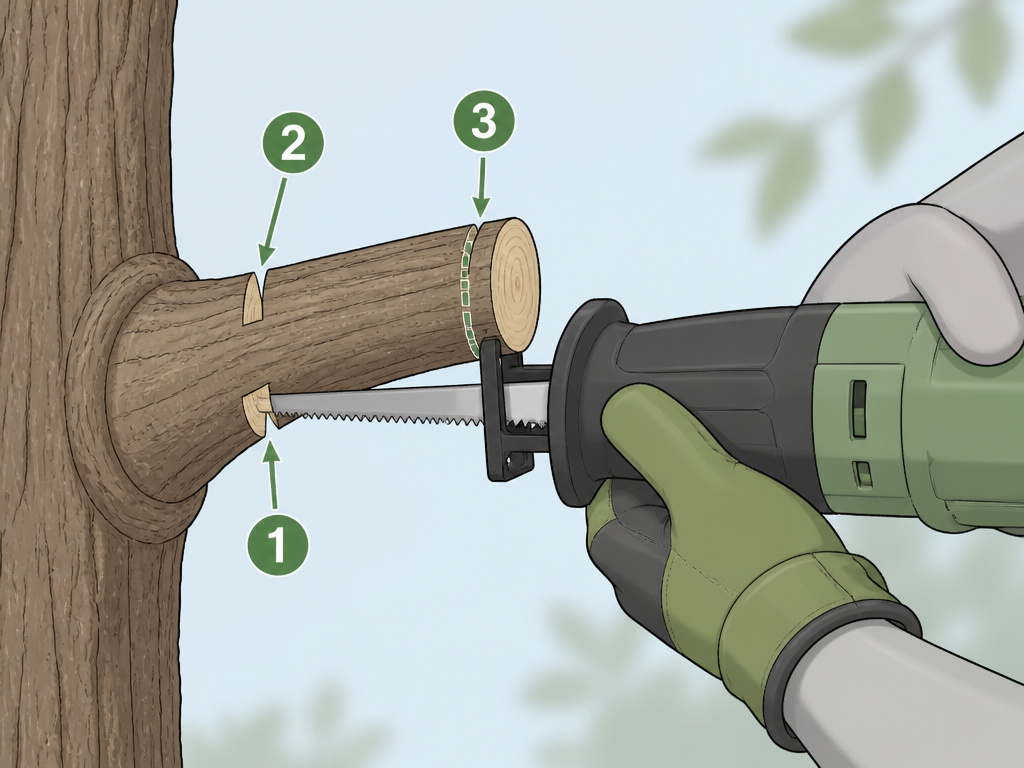
Cutting a branch off isn’t just about making it fall. It’s about making a cut the tree can heal from. Hack it off flush with the trunk and you invite disease.
The professional method, outlined in sources like the Husqvarna manual, involves three cuts to prevent the bark from tearing down the tree.
- The Undercut (Notch). A short distance out from the trunk, cut upwards through the bottom third of the branch. This creates a hinge and prevents the falling branch from stripping bark off the trunk.
- The Top Cut (Relief). Move a short distance further out along the branch from your undercut. Cut downwards until the branch breaks free at the hinge. The branch will fall cleanly.
- The Final Cut (Pruning). Now, address the stub you left. Find the branch collar, the swollen, wrinkled area where the branch meets the trunk. Your final cut should be just outside this collar, angling slightly away from the trunk. Do NOT cut into the collar. Husqvarna warns that cutting through this swelling “will slow down healing and increase the risk of fungal attack!”
Let the saw do the work. The Ryobi manual is clear: “Do not force. Use only enough pressure to keep the saw cutting.” If you’re leaning your body weight into it, the blade is dull, the wood is too hard, or the branch is too big.
Critical Safety Rules You Can’t Ignore
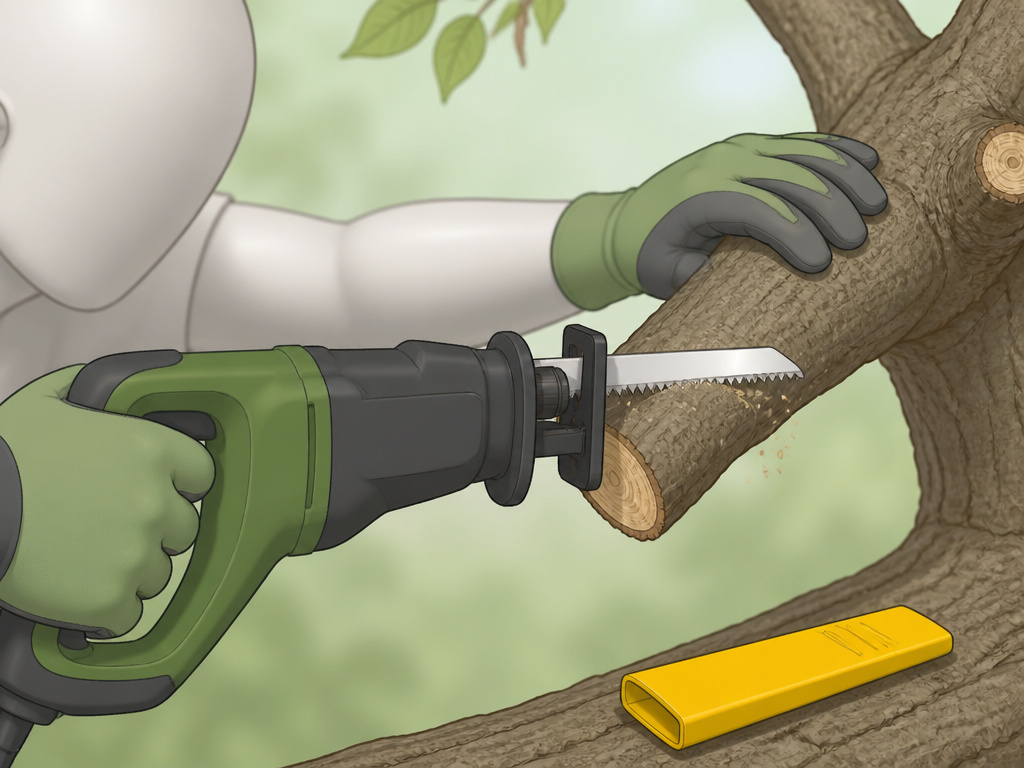
This isn’t scare talk. These are the essential rules taken directly from the operator manuals.
- No Ladders. The Ryobi P2503 manual states it plainly: “Do not cut from a ladder. This is extremely dangerous. Leave this operation for professionals.” A reciprocating saw kicks and jerks; a ladder is unstable. If you can’t reach it from the ground, use a pole saw or hire a pro.
- Grip the Insulated Handles. “Hold the saw by insulated gripping surfaces only, because the blade may contact hidden wiring.” You never know if a previous owner ran a cable through a tree.
- Use the Blade Cover. “When transporting or storing the saw, always fit the blade cover.” A bare blade is a leg-gashing accident waiting to happen.
- Secure Your Work. If the branch can wiggle, it will. That turns a clean cut into a violent shaking match. Hold small branches with your free hand (easier with a one-handed saw). For bigger ones, use a rope or strap to stabilize them.
- Power Down for Service. “When clearing jammed material or servicing the saw, make sure the power switch is off and the battery pack is removed.” This should be obvious, but rushing leads to mistakes.
These are just the pruning-specific highlights. For a full rundown, review our guide on using a reciprocating saw safely.
After the Cut: Cleaning and Maintenance
You’ve made your cuts. If you just toss the saw back in the toolbox, you’re making a mistake. Green wood, especially pine and fir, pumps out sap that will glue your blade to the holder and attract grit.
The fix is simple but immediate. As soon as you’re done:
- Remove the blade.
- Wipe it down with a rag to remove sap and debris. This dissolves the sap.
- Give the blade clamp area on the saw a quick wipe too, removing any sawdust and sap residue.
- Let the blade dry before storing it.
A blade caked in hardened sap is useless. The teeth can’t bite, and the added friction will overheat on the next use. Keeping your reciprocating saw blades for trees clean is what makes a $10 blade last for dozens of jobs instead of just one.
What do users say about pruning with a reciprocating saw?
When considering can you prune trees with a reciprocating saw, user reports confirm that it is a fast tool for smaller pruning jobs. For branches under two inches in diameter, a cut can take 10 seconds or less. User reports confirm it is a fast tool for smaller pruning jobs. A larger battery can provide hours of runtime for extended pruning sessions. However, the consensus from practical experience is clear: for anything over a couple of inches, many users will opt for a chainsaw instead. The reciprocating saw is best kept for the smaller, more manageable branches where its speed and maneuverability shine.
Frequently Asked Questions
What is the best tool for pruning a tree?
There is no single “best” tool, it’s a toolkit. For most homeowners, a combination covers 95% of jobs: a hand pruner for stems under 3/4″, loppers for branches up to 1.5″, a sharp hand pruning saw for branches 1.5″ to 4″, and a reciprocating saw with a pruning blade for multiple branches in the 2″-4″ range or for cutting in tight spaces. For larger limbs or high branches, a pole saw or chainsaw is necessary.
Can I use a Sawzall to cut tree branches?
Yes, a Sawzall (which is just Milwaukee’s brand name for a reciprocating saw) is excellent for cutting tree branches, provided you use the correct pruning blade. The same rules apply: match the blade to the job, respect the branch diameter limits, and follow proper pruning technique.
What should you not do with a reciprocating saw?
Do not use it on a ladder. Do not force it through material thicker than it’s designed for. Do not use the wrong blade type (like a metal-cutting blade on wood). Do not operate it without eye protection and gloves. Do not cut into the ground where hidden rocks can shatter the blade. And never, ever remove the blade cover during transport.
Is a cordless reciprocating saw good for pruning?
Yes, a cordless model is often ideal for pruning. It offers complete freedom of movement without managing an extension cord. Modern 18V or 20V MAX brushless models have plenty of power for pruning tasks. As noted in the research, a 5Ah battery “will last for hours of use” for intermittent pruning work. Just ensure you have a charged battery before you start.
The Bottom Line
A reciprocating saw is a fantastic pruning tool within its lane. That lane is defined by a 5 TPI blade and a branch diameter under your saw’s rated capacity, treat 4 inches as a practical, real-world max for most cordless models.
The one rule that overrides all others: if you can’t make the cut with your feet firmly on the ground, the reciprocating saw is the wrong tool. That’s not a limitation; it’s the safety protocol that keeps you out of the emergency room. For everything else, clearing storm damage, thinning overcrowded shrubs, removing old garden stakes, it’s a powerhouse that turns hours of hand-sawing into a few minutes of efficient work.
Your first step is to get the right blades for landscaping or pruning. Everything else, the clean cuts, the healthy trees, the undamaged saw, follows from that.
