
10 Best Saws To Cut Pvc Pipe in 2026
This post contains affiliate links. As an Amazon Associate, we earn from qualifying purchases.
For clean, square cuts on standard PVC pipe, the Z-saw Pipe Saw 240 is the best overall, thanks to its specially ground teeth and replaceable blade system. The compact RYOBI ONE+ HP Cordless Cut-Off Tool wins for tight spaces, while the VEVOR Portable Band Saw excels at handling large-diameter pipe.
Each addresses a different need. Cutting PVC poorly can leave rough burrs that complicate solvent-weld joints, or the wrong tool can make a simple job frustrating. You need the right balance of clean-cutting action, capacity, and convenience for your specific task.
We built this guide by researching product specifications, manufacturer data, expert round-ups, and patterns in owner feedback across ten top-rated saws, from manual to cordless.
Top 10 Saws To Cut PVC Pipe in the Market
Certain content that appears on this site comes from Amazon. This content is provided "as is" and is subject to change or removal at any time.
The Best Saws To Cut PVC Pipe, Reviewed
Z-saw Pipe Saw 240 PVC Hand Saw

What We Like
- Specially ground teeth cut PVC squarely with minimal burrs
- Five included replacement blades provide long-term value
- Replaceable blade system is economical over time
- Compact 14.8-inch length is handy for utility work
Trade-offs
- Pure manual tool requires more effort than a power cutter
- Maximum 100mm pipe capacity excludes larger-diameter work
Its specially ground teeth are made for cutting PVC pipe squarely with fewer burrs, so you can finish a job without spending extra time cleaning up ragged edges. This Z-saw handles pipe up to about 100mm in diameter, which covers common sizes for many plumbing tasks. As a brand from Japan’s hardware heartland, Z-saw includes five replacement blades and a manual, turning it into a long-term kit ready for many projects.
The trade-off is all in your arm. This is a manual saw, so cutting a stack of pipe will be a workout compared to grabbing a cordless cut-off tool like the RYOBI. It also has a defined limit, that 100mm capacity. For general-purpose cutting in wood or plasterboard, it’s perfectly capable, but its thin, fine-toothed blade is optimized for plastic, not for aggressive ripping. You’re buying precision and cleanliness over raw speed and power.
Product photos
RYOBI ONE+ HP Cordless Cut-Off Tool

What We Like
- Ultra-compact 8.5-inch length for tight spaces
- Dual LED lights illuminate the work area
- Adjustable guard and depth guide for precision
- Electric brake for rapid wheel stop
Trade-offs
- Tool only: requires a separate RYOBI ONE+ battery
- Maximum cutting depth of 0.62 inches limits thicker materials
- No included blades in the tool-only configuration
At only 8.5 inches long, this cordless cut-off tool is designed for superior one-handed control and easy access to tight spaces. Its brushless motor delivers up to 19,500 RPM for cuts through materials like metal, plastic, tile, and PVC pipe. The tool operates with all RYOBI ONE+ 18V batteries, which are sold separately.
Cutting depth is adjustable up to 0.62 inches for precise multi-material applications. The tool includes an adjustable guard for safety and an electric brake that stops the wheel rapidly. Since it’s sold without a battery, its value depends on existing ownership of the RYOBI ONE+ 18V system.
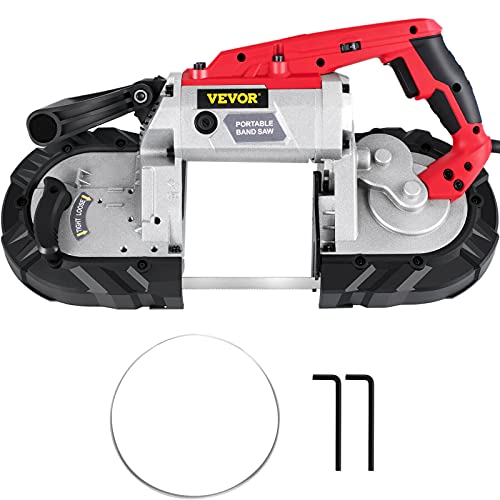
VEVOR Portable Corded Band Saw
What We Like
- 5-inch round stock capacity for large pipes
- Powerful 10-amp motor for tough materials
- Variable speed for controlled cutting
- Tool-free blade change system
Trade-offs
- At 15.8 lb, it is heavy for prolonged overhead use
- Corded design limits mobility on a jobsite
With a 5-inch capacity for round stock, this saw handles thicker materials than many handheld alternatives. Its 10-amp motor is designed for jobsite applications, providing controlled power for demanding cuts. The variable speed adjusts from 137.8 to 472.4 feet per minute, allowing users to match the pace for different materials. This combination makes it a candidate for plumbers and contractors working with large-diameter pipe or solid stock that would challenge smaller tools.
The trade-off for that capacity is heft and a cord. At 15.8 pounds, it demands respect and a firm grip, making it less suited for quick, one-handed cuts in tight spaces. For a big, stationary piece of pipe, it’s excellent, but for a crawl space full of smaller lines, you’ll feel the weight. Compared to a compact tool like the RYOBI ONE+ HP Cut-Off Tool, this VEVOR is a dedicated workhorse for large-scale tasks, not a nimble trimmer. It’s a shop or truck-based solution, not something you’d casually grab from a tool belt.
Product photos
GreatNeck True Close Quarter Hacksaw

What We Like
- Compact 12.5-inch length for tight spaces
- Adjustable brace fits any hacksaw blade
- Ergonomic grip with thumb rest for control
- Corrosion-resistant steel construction
Trade-offs
- Manual cutting requires more effort than power tools
The GreatNeck hacksaw is 12.5 inches long, a size that fits easily into a tool pouch for jobs inside a cabinet or behind an appliance. Its adjustable blade brace accepts any standard hacksaw blade, allowing you to switch to a finer tooth for plastic or a coarser one for wood. Crafted from carbon steel and chrome vanadium steel, the frame resists corrosion from moisture in plumbing or outdoor environments.
As a manual saw, cutting requires more user effort than a powered tool like the RYOBI ONE+ HP Cut-Off Tool. The ergonomic grip includes a thumb rest designed to optimize stroke pressure and comfort during use. For making a single cut in a confined space, this compact, adjustable design fulfills its purpose.
Product photos
HAUTMEC Adjustable Angle PVC Pipe Saw

What We Like
- 11-position angle adjustment for tight spaces
- 1mm thick steel blade resists flex on thick pipe
- Compact 11-inch design fits standard tool bags
- Induction-hardened teeth for clean, fast cuts
Trade-offs
- 10 TPI blade is slower on large-diameter pipe than a coarse-tooth saw
- 11-inch blade limits stroke length on wide cuts compared to longer saws
The 11-position adjustable angle handle is the defining feature here, letting you lock the blade at almost any angle to navigate tight wall cavities, under-sink areas, and narrow trenches where a fixed saw cannot operate. Its 1mm thick, high-carbon steel blade reduces flex to help maintain straight cuts in thick-walled plastic pipe. The 10 TPI double-ground teeth are designed to deliver smooth cuts with clean edges and minimal chipping in materials like PVC and acrylic.
Its flexibility comes at the cost of cutting speed on larger jobs. Designed for control and clean edges, that fine 10-tooth blade is not meant for rapidly cutting large-diameter pipe. This makes it a specialist for confined spaces. If you often work kneeling in a crawl space or overhead in a cabinet, the adjustable head will save you more frustration than the few extra seconds per cut will cost.
Product photos
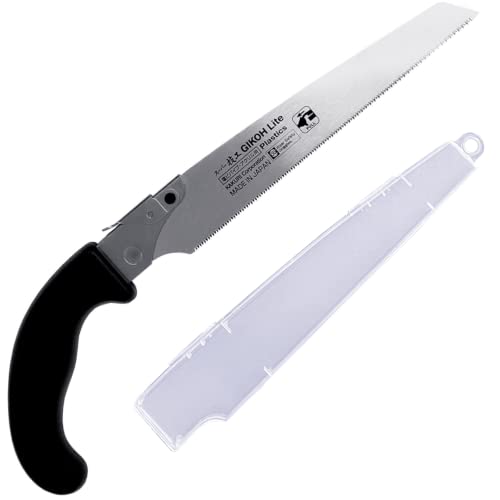
KAKURI PVC Pipe Saw
What We Like
- Tool-free blade interchange for quick swaps.
- Special fine-tooth blade minimizes burrs on plastic.
- Very lightweight and compact for tight spaces.
- Scabbard holds three spare blades with the saw.
Trade-offs
- 8.2-inch blade limits stroke length on larger pipes.
- Requires purchasing specific KAKURI replacement blades.
A tool-free, one-touch blade change system lets you swap in a fresh edge without a screwdriver. The blade is made from Japanese impulse-hardened high-carbon steel with a special fine-tooth geometry for cutting PVC and acrylics, which is intended to reduce burrs and cracks on the cut surface. At 5.9 ounces, the saw is light enough for extended handheld use.
Its compact, lightweight design uses an 8.2-inch blade, resulting in a shorter cutting stroke than longer models like the HAUTMEC Adjustable Angle PVC Pipe Saw. The quick-change system is brilliant, but it also locks you into KAKURI’s proprietary blades. A standard saw might suffice for a homeowner tackling a one-time project. For a pro who values speed and a clean finish on plastic, this system justifies its premium positioning.
Product photos
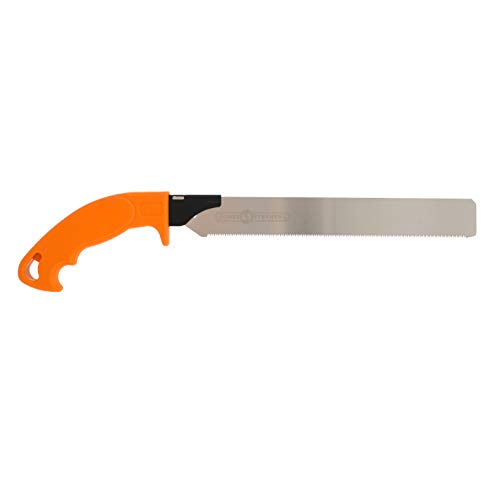
Jones Stephens E-Z Stroke Pipe Saw
What We Like
- Pull-stroke design for fast, accurate cuts
- Flexible blade allows flush cutting
- Tri-edge teeth cut soft materials cleanly
- Quick and simple blade replacement system
Trade-offs
- 8-inch blade limits depth on larger pipe
- Manual pull-stroke requires more effort than powered options like the RYOBI cut-off tool
The blade cuts on the pull stroke, which provides a controlled and accurate cutting action for materials like PVC and ABS. A flexible blade allows for flush cutting without marring an adjacent surface. Its tri-edge ground teeth, with 17 teeth per inch, are designed to cut through material like a knife.
As a dedicated hand tool, its cutting speed differs from powered alternatives like the corded VEVOR band saw or cordless RYOBI cut-off tool. The blade design prioritizes accurate cutting action over the speed of a power tool. Replacement blades are available and can be fitted to the orange handle quickly and simply.
Product photos
Hanpex High-Tension Hacksaw

What We Like
- Adjustable tension knob for blade rigidity.
- Non-slip handle reduces fatigue during use.
- Bi-metal blade cuts PVC, metal, and wood.
- Steel-reinforced core increases cutting speed.
Trade-offs
- 16.7-inch frame length requires more swing space.
- 4-inch maximum depth limits very large pipe.
- General-purpose blade is not PVC-specific.
A high-tension frame and a rigid 12-inch bi-metal blade make this hacksaw excel at producing straight, controlled cuts in PVC pipe. The adjustable knob lets you crank the blade tight, which minimizes chatter and binding in plastic. At just 0.7 pounds, it’s a nimble tool for plumbers or DIYers who need one saw that can also handle incidental cuts in copper, rebar, or wood without a blade change.
Its 16.7-inch length provides a stable, full-sized frame, which delivers more controlled strokes on tough materials like iron pipe or rebar. That same length requires a wider cutting arc, making it less nimble than more compact saws like the Z-saw Pipe Saw 240 in tight spots. The included 24 TPI bi-metal blade is contractor-grade for cutting metal and plastic, offering versatility across materials listed from wood to stainless steel.
Product photos
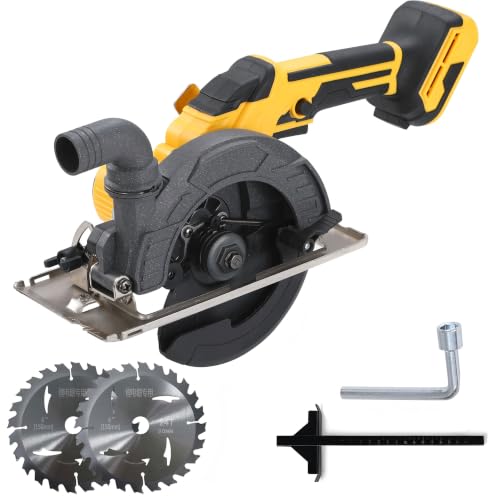
Bigheimer Brushless Circular Saw
What We Like
- Brushless motor for efficient, spark-free operation
- 45° bevel adjustment for angled cuts
- Double safety switch prevents accidental starts
Trade-offs
- Tool only: requires a compatible DEWALT 20V battery
- Maximum cut depth under 2 inches limits larger pipe
A 45-degree bevel adjustment turns this compact saw into a precise mitering tool for PVC, letting you tackle complex joints and fittings without needing a separate miter box. Its brushless motor spins a 6-inch blade at 6900 RPM, which slices cleanly through plastic pipe and leaves a smooth edge ready for solvent welding. For the DIYer or pro who frequently needs to cut pipe at precise angles for projects like furniture or irrigation systems, this saw delivers that capability in a cordless, handheld format.
This tool depends on the DEWALT battery ecosystem. That makes it a savvy buy if you already own those batteries, but requires an extra purchase if you don’t. While it handles PVC with ease, its cut depth is just shy of two inches, so it won’t slice through the very largest pipes. For quick, straight cuts on smaller pipe, a dedicated hand saw like the HAUTMEC Adjustable Angle PVC Pipe Saw is simpler. For repeated, accurate bevel work, this Bigheimer brings power tool speed to the task.
Hanpex Heavy Duty Adjustable Pipe Saw
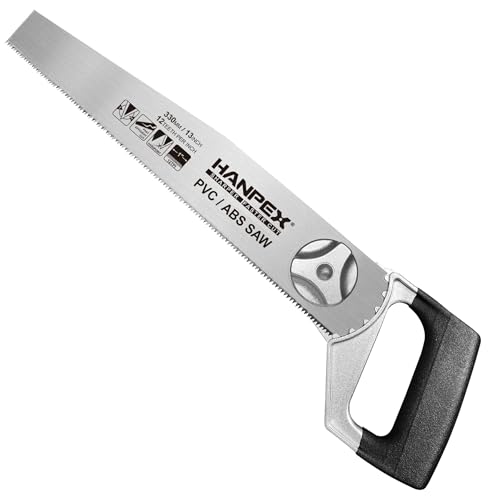
What We Like
- Adjustable angle for tight-space cuts
- Lightweight and compact at 0.7 lb
- Cuts multiple materials including PVC and wood
- Heavy-duty construction resists bending
Trade-offs
- Longer 17-inch frame limits access in very confined spaces
- Manual operation requires more effort than powered alternatives
The 13-inch blade and adjustable head let you tackle PVC in cramped spots where a standard saw just won’t fit. That’s the core of its multi-purpose claim. It’s a logical choice for a plumber or a DIYer who needs one manual saw for a mix of materials like pipe, drywall, and light wood trimming. You get a tool built for awkward angles without sacrificing a full-length cut.
Its 17-inch overall frame can’t match the extreme compactness of a dedicated close-quarter saw like the GreatNeck True Close Quarter Hacksaw. This tool is also strictly manual, so for high-volume PVC cutting, a cordless tool like the RYOBI Cut-Off Tool will save time and effort. The Hanpex sits squarely in the middle as a versatile, grab-and-go manual saw for mixed projects, not a specialist or a speed demon.
Product photos
How We Evaluated Saws To Cut PVC Pipe
Our research focused on specs from manufacturers and distributors, along with common pain points highlighted in professional forums. We prioritized three core criteria: cutting quality (to minimize burrs for proper fitting), capacity and ergonomics (to match your typical pipe size and work space), and value (including blade longevity and overall cost of ownership).
A tool that excels at one may compromise elsewhere, so we looked for clear strengths for specific user scenarios, like the Jones Stephens E-Z Stroke for its fast pull-stroke action. This is a research-led evaluation, so we cannot provide hands-on feedback on long-term durability or personal ease of use.
What To Look For In Saws To Cut PVC Pipe
Choosing the right saw for PVC depends on balancing cut quality, the pipe size you work with most, and your preferred work style. Power saws offer speed, while manual options often deliver cleaner cuts and more precise control in confined areas.
Focus on clean-cutting teeth to prevent burrs, match the saw’s capacity to your pipe diameters, and consider ergonomics for your typical workspace, tight spots favor compact, lightweight tools.
Cut Quality
For solvent-weld joints, a clean, square cut with minimal burrs is critical. Specialized PVC saws often feature fine teeth with little to no set (sideways offset), which slices through plastic cleanly rather than tearing it. A general-purpose wood or metal blade can work, but may leave a rough edge that requires deburring, as noted in user feedback on standard cutters struggling with larger pipe. Selecting the right blades for cutting PVC is key.
Capacity & Ergonomics
Match the saw’s stated maximum cutting depth or pipe capacity to your common projects. A compact saw like the GreatNeck True Close Quarter Hacksaw is superb for under-sink work but limiting for 4-inch main lines, where a band saw like the VEVOR is needed. Overall length and weight determine maneuverability; a 17-inch frame needs swing space, while an 11-inch adjustable saw fits in a tool bag. Power options like the Bigheimer brushless circular saw add the convenience of cordless operation but require a compatible battery platform.
Value & Application
For occasional DIY, a manual saw with a durable, replaceable blade offers lasting value, like the Z-saw with its five included spares. For pros or repetitive tasks, a cordless tool’s speed may justify its higher initial cost. Always consider the total system: a “tool-only” option like the RYOBI needs a battery, and the KAKURI requires specific replacement blades.
Good technique is as important as a sharp blade.
- Mark your cut line completely around the pipe for a square edge.
- Use a vise or pipe stand to secure the pipe and prevent binding.
- For manual saws, let the tool do the work, excessive force can cause the blade to wander or the pipe to crack.
- Always deburr the inside and outside of the cut with a utility knife or deburring tool, even with a clean-cutting saw.
Saws To Cut PVC Pipe Compared
The following table lets you quickly compare key specs and features across all ten of our top picks.
| Product | Blade Length | Power / Action | Weight |
|---|---|---|---|
| Z-saw Pipe Saw 240 PVC Hand Saw | 225mm | Manual | N/A |
| RYOBI ONE+ HP Cordless Cut-Off Tool | 3-inch wheel | Cordless, 19,500 RPM | N/A |
| VEVOR Portable Corded Band Saw | Bi-metal | Corded, 1100W | 15.8 Pounds |
| GreatNeck True Close Quarter Hacksaw | Adjustable | Manual | N/A |
| HAUTMEC Adjustable Angle PVC Pipe Saw | 11 inches | Manual | 0.6 pounds |
| KAKURI PVC Pipe Saw | 8-1/4 inches | Manual | 0.4 Pounds |
| Jones Stephens E-Z Stroke Pipe Saw | 8 inches | Pull-stroke action | 0.2 pounds |
| Hanpex High-Tension Hacksaw | 24 TPI bi-metal | Manual | 0.7 pounds |
| Bigheimer Brushless Circular Saw | 6 inch | Cordless, 6900 RPM | N/A |
| Hanpex Heavy Duty Adjustable Pipe Saw | 13 inches | Manual | 0.7 pounds |
Frequently Asked Questions
What is the best saw for cutting PVC pipe?
The best tool depends on your needs. For consistently clean, burr-free manual cuts on standard pipe up to 4 inches, the Z-saw Pipe Saw 240 is an excellent choice. For large-diameter work, a portable band saw like the VEVOR is more suitable. Our guide explains the strengths of each type of saw for different PVC cutting scenarios, from power options for speed to specialized hand tools for precision.
What is the best tool for cutting PVC pipes?
Beyond traditional saws, dedicated PVC tubing cutters (ratcheting style) are popular for smaller diameters because they produce a very clean, square cut with a rolling blade. For larger pipe or when you need a saw, specialized options like the HAUTMEC Adjustable Angle PVC Pipe Saw are designed for the task. Understanding the core principles of cutting plastic can help you choose between a saw, a cutter, or another tool.
What is the easiest way to cut PVC pipe?
For DIYers, a sharp, fine-tooth hand saw like the Z-saw, used with the pipe secured in a vise or miter box, is straightforward and yields good results. For speed and less effort, a power tool like a cordless cut-off tool or a reciprocating saw with a fine-tooth blade is easier. Always prioritize safety and a secure workpiece, regardless of the tool.
Can I use a regular saw to cut PVC pipe?
Yes, a standard hacksaw or handsaw can cut PVC, but it may not be optimal. General-purpose blades are often coarser and can leave more pronounced burrs, requiring extra finishing work. They also tend to dull faster on abrasive PVC. For best results, use a blade designed for plastics or metal, as these are harder and cut cleaner.
How do I make bevel cuts on PVC pipe?
For beveled ends, you need a saw that can cut at an angle. Some circular saws, like the Bigheimer, have a bevel adjustment, but their cut depth is limited. For hand tools, you can carefully guide a saw like the HAUTMEC at your desired angle, or use a miter box to guide the cut. A comparison of reciprocating saws and jigsaws highlights which power tools offer more controlled angle cutting.
The Bottom Line
For plumbers and dedicated DIYers who prioritize a clean, ready-to-glue cut on standard PVC, the Z-saw Pipe Saw 240 is the best overall manual saw, with its specialized teeth and excellent blade value. If you’re on a budget and need a versatile manual tool, consider the Hanpex High-Tension Hacksaw; if you face large-diameter pipe, the VEVOR band saw is your solution. Ultimately, the most important factor is matching the tool’s cutting action and capacity to the specific demands of your PVC project, ensuring a fit that won’t leak.
