
Why Is My Nail Gun Double Firing? Key Takeaways and Fixes
This post contains affiliate links. As an Amazon Associate, we earn from qualifying purchases.
Your nail gun is double firing because the tool recoils after the first shot and re-contacts the work surface while the trigger is still held down. This is most common with “bump” or “contact” trigger modes. The fix is to switch to sequential trigger mode, adjust your technique to pull the tool away with the recoil, or check for low air pressure and worn internal parts.
That “re-contact” is the mechanical heart of the problem. It’s not a random glitch; it’s a predictable failure of the tool’s firing sequence, and it happens faster than you can react. The Consumer Product Safety Commission (CPSC) found a second unintended firing can happen faster than the user is able to react and release the trigger. A user might ask, “Why is my nail gun double firing?”
What follows is a field guide to the seven reasons your gun is doubling up, pulled straight from OSHA publications, manufacturer recalls, and service manuals, which will help you answer why is my nail gun double firing. We’ll walk through a diagnostic flowchart, name the specific parts that fail, and tell you when to put the tool down and call for service.
Key Takeaways
- The trigger mode is the single biggest factor. Switch from bump/contact to sequential mode to eliminate recoil-based double fires.
- Low air pressure (below 70 PSI for many framing nailers) is a stealth culprit, the tool lacks the power to fully cycle, causing a partial reset and a second fire.
- A worn or dirty O-ring in the trigger valve is the most common internal mechanical failure; replacement is a 10-minute fix if you have the kit.
- DeWALT’s manual states ‘NEVER carry tool with finger on trigger,’ while OSHA notes construction workers often do it for balance. Safety guidance from the Texas Department of Insurance encourages workers to keep their fingers off the trigger when holding or carrying a nail gun.
- If your gun is a recalled RIDGID model (R09894 or R09895 within specific serial ranges), stop using it immediately and contact the manufacturer for a free repair, the safety system can fail.
Trigger Type/Mode: The Most Common Culprit
This is where most double fire mysteries, including the why is my nail gun double firing question, begin and end. Your nail gun has two brains: one for precision, one for speed. Picking the wrong one for the job guarantees trouble.
A double fire occurs when a second nail unintentionally fires because the nailer re-contacted the work piece after recoil. It can also occur if the safety contact slips while the user is positioning the nail gun.. OSHA
The DeWALT manual puts it in blunter terms: if the tool bounces after driving a fastener and you let it re-contact the work surface with the trigger still pulled, you get an unwanted second nail. That’s the “bump” or “contact” trip mode in action. It’s designed for rapid-fire nailing on long, flat runs, but it turns your tool’s own recoil into a liability.
Sequential Trip is the safer choice for most work. It requires a strict order: press the safety tip, then pull the trigger, then release both. The gun cannot fire again until you lift the tip and repeat the sequence. It eliminates the recoil problem by design. The Texas Department of Insurance notes studies suggest nail gun injury risk is twice as high when using contact triggers versus sequential triggers.
When to use Bump/Contact Mode: Only when you’re nailing off sheathing or decking in wide-open spaces, and you have a firm, two-handed grip ready to control the kick. For everything else, framing, finishing, toenailing, working in a tight corner, flip the switch to sequential.
User Technique: You’re Fighting the Recoil
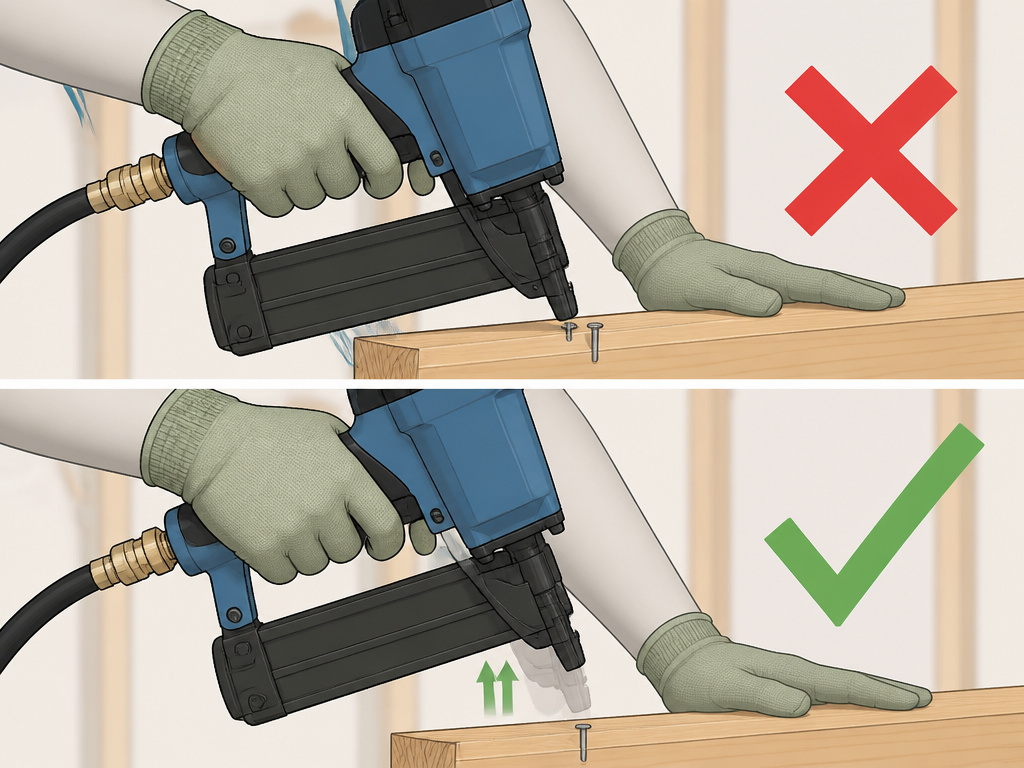
The tool is only half the equation. Your hands control the bounce. New workers, as OSHA points out, are especially prone to this: they push hard on the tool to compensate for recoil, which only forces the contact tip back onto the workpiece faster.
The correct motion is a controlled pull-away. As the nail drives and the gun kicks back, let your arms absorb the motion and lift the nose clear. Don’t fight it back down. The Husky manual explicitly advises “taking the nailer away from the workpiece using recoil” to avoid double fire.
Here’s the technique breakdown:
- Stance: Feet shoulder-width apart, knees slightly bent. Don’t overreach.
- Grip: One hand on the trigger, one hand firmly around the magazine or barrel to guide.
- Contact: Place the nose flush on the workpiece. No angled shots unless you’re prepared for a deflection.
- Fire and Release: Squeeze the trigger smoothly. The instant you feel the kick, relax your forward pressure and let the tool come back toward you an inch or two.
- Reset: For sequential mode, release the trigger completely before placing the tool for the next nail.
Common mistake: Pinning the gun to the wood with your body weight after firing. That overpowers the recoil spring and smashes the contact tip back down, triggering the second shot.
Air Pressure and Compressor Issues
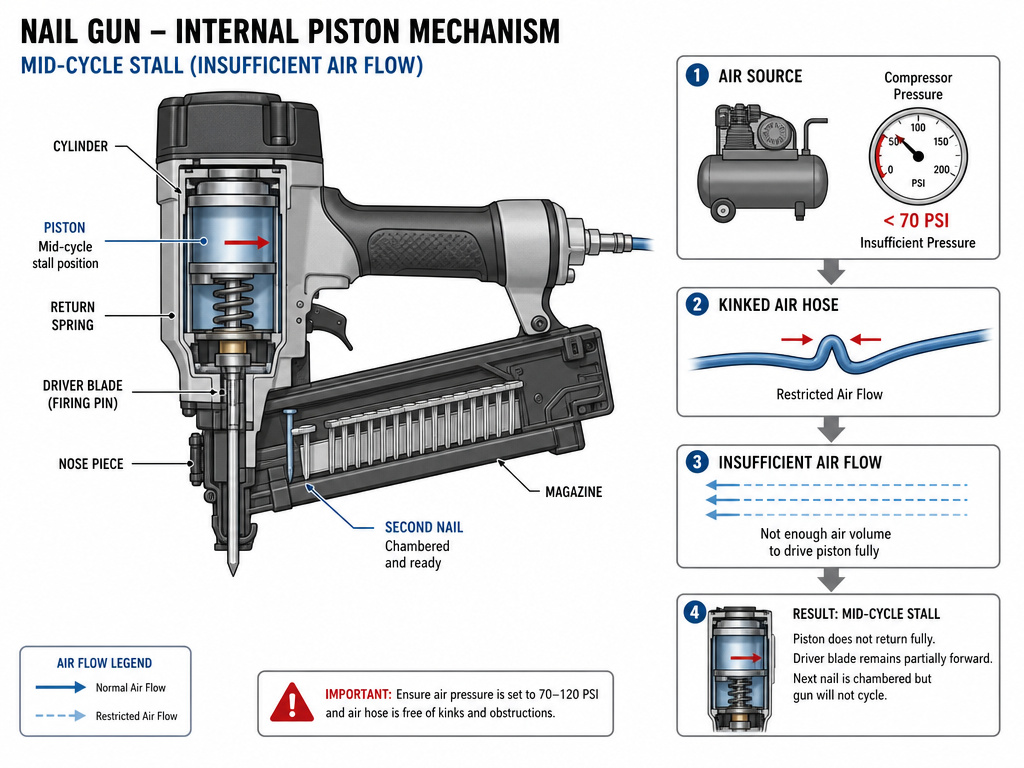
Your nail gun is an air-powered piston. If it doesn’t get enough air, the piston doesn’t complete its full cycle. It can stall partway, reset, and then fire again as pressure equalizes.
Refer to your manual for the correct operating pressure. An inconsistent air supply can contribute to erratic tool behavior.
| Symptom | Likely PSI Problem | Fix |
|---|---|---|
| Double fire with weak-sounding first shot | Pressure too low (<70 PSI) | Increase regulator setting on compressor. Check for leaks. |
| Double fire with loud report, nail barely sunk | Pressure too high (>110 PSI) | Reduce pressure. Excessive force amplifies recoil. |
| Inconsistent firing, occasional doubles | Compressor can’t keep up (tank too small) | Use a larger compressor (15+ gallon for framing). |
Check your entire air system: Use a hose rated for at least 150 psi, as the Husky manual specifies. A kinked or undersized hose acts like a straw, starving the tool. Listen for leaks at the couplers.
Worn or Faulty Internal Parts (O-Rings, Trigger Valves)
When technique, trigger mode, and air pressure are ruled out, the problem moves inside the tool. A common internal failure is a worn or dried-out O-ring in the trigger valve assembly. This tiny seal controls the air pathway that initiates the firing cycle. When it’s cracked, it leaks air internally, causing the valve to actuate erratically, sometimes twice.
The second candidate is a worn trigger valve itself. Over thousands of cycles, the metal parts can wear or get gummed up with dirt and old oil, preventing a clean, single actuation.
How to diagnose:
- Disconnect the air hose.
- Work the trigger and contact tip. They should move smoothly, with distinct clicks or stops. Any grit, stickiness, or sloppy feel indicates grime or wear.
- Listen for a faint hiss of escaping air when you pull the trigger (with the hose connected). That’s a telltale sign of a leaking O-ring.
Where this goes sideways: Trying to clean internal parts with generic lubricants. Use pneumatic tool oil only. Aerosol lubricants or WD-40 can degrade O-rings and leave sticky residues that attract more dirt.
Replacing a worn O-ring is a common repair if you have a rebuild kit specific to your nail gun model.
Using Incorrect Nails
It seems trivial, but the wrong nail can mimic a mechanical fault. If the nail is too long, too thick, or the wrong angle (21-degree vs. 30-degree), it can bind in the magazine or at the driver blade. This creates resistance. The piston drives the first nail, meets that resistance, and the sudden stop can cause a pressure rebound that cycles the tool for a second shot as it tries to complete the action.
Check three specs on your nail strip:
- Length: Is it within your nailer’s range (e.g., 2″ to 3-1/2″)?
- Angle: Does it match your gun (21-degree clipped-head, 30-degree, 34-degree)?
- Collation: Is it plastic strip, paper tape, or wire weld? Your gun is designed for one type.
A jam is often the next step after a double fire caused by wrong nails. If you hear a strange crunching sound or the second fire is accompanied by a misfeed, stop and check your nails first. For more on this, see our guide on why a nail gun is not feeding nails.
The 4-Step Diagnostic Flowchart
Stop guessing. Follow this path.
- Check the trigger mode. Is it on “bump” or “contact”? Switch to “sequential.” Does the double fire stop? If yes, problem solved. Use sequential mode.
- Check air pressure. Attach a gauge at the tool coupler. Is it between 70-110 PSI? If below 70, increase it. If above 110, decrease it. Retest.
- Check your technique. Are you pulling the tool away with the recoil, or mashing it back down? Practice the pull-away motion on scrap wood.
- Check for internal wear. With air disconnected, does the trigger feel gritty? With air connected, do you hear leaks? If yes, you likely need an O-ring or trigger valve rebuild.
If you’ve reached step 4, you’re looking at a repair. The question is: DIY or professional?
When to Call a Pro (And When Not To)
Some fixes are bench-work. Others are bench press, you need the right tools and a service manual.
DIY these fixes:
- Cleaning the exterior trigger mechanism. Disconnect air, remove any obvious dirt or sawdust with a brush and air nozzle.
- Replacing a worn O-ring with a rebuild kit. If the kit has clear instructions and you’re comfortable with basic disassembly, this is a 10-20 minute job.
- Adjusting depth of drive. The external dial is user-serviceable.
Call a professional (or consider tool replacement) for:
- A cracked or worn trigger valve housing. This requires precise parts and pressure testing.
- Any issue on a recalled tool. The July 2025 RIDGID recall (models R09894, R09895) is for a faulty dual-action engagement system. Stop using it and contact RIDGID for a free repair. Do not open it.
- If the tool is leaking air from the main body or cylinder. This indicates major seal failure, often requiring a full rebuild.
- When the cost of repair is high relative to a new tool. For a budget nailer, it may not be worth it.
Specific Brand Troubleshooting: DeWALT & RIDGID
Sometimes the answer is in the model number.
DeWALT (e.g., DWFP12233): This model has a selectable trigger. A common user error is accidentally bumping the selector switch from sequential to contact mode mid-job. Check that switch first. The manual also warns that in contact mode, the tool will fire if the safety tip is bumped while the trigger is depressed, so keep that finger off the trigger until you’re ready to nail.
RIDGID (Recalled Models R09894, R09895): This isn’t a wear issue; it’s a defect. The CPSC recall states the dual-action system can fire a nail with a trigger pull alone, bypassing the safety tip. If you have one of these 18-volt brushless nailers within the specified serial number ranges, stop using it immediately. This isn’t a fix you can make at the bench; it requires a software update from the manufacturer.
For other brands, the principles are the same. The manual is your first resource. A common issue across many brands is a failing O-ring, which is a universal repair.
Is Bostitch a common brand for double firing?
While the fact sheet does not mention Bostitch by name, the issue of double firing is a known risk with contact trigger nailers as identified by safety organizations. The core problem is not unique to a single brand but to a specific trigger design. If your nail gun uses a “bump” or “contact” trigger mode, it is susceptible to unintentional double firing from recoil. The safety recall for another major brand’s framing nailers, due to a malfunction that allowed firing by trigger alone, highlights that such mechanical failures can happen. Always check your tool’s manual for warnings about double fire in contact mode and verify its safety systems are functioning.
Can my air compressor cause double firing?
The fact sheet does not directly link compressor capacity to double firing. The primary causes are mechanical and user-related, like tool recoil re-contacting the surface. However, your air supply setup is critical for safe overall operation. Use an air hose rated to withstand significantly more pressure than your compressor’s maximum output. In cold conditions, some manuals advise a specific procedure to warm the tool, which involves temporarily reducing air pressure, removing nails, and cycling the gun. An inconsistent or excessive air supply could contribute to erratic tool behavior, so ensuring a clean, regulated supply is a foundational step in troubleshooting any pneumatic nail gun issue.
Two nails at once versus a rapid double-tap
These are two distinct problems. A true “double fire” is not two nails discharging simultaneously. It is a second, unintended nail that fires faster than you can react because the nail gun recoils and its safety tip accidentally re-contacts the work surface while the trigger is still depressed. This is a hallmark risk of contact trigger tools. If you are seeing two nails physically side-by-side, that is likely a jam or a magazine issue causing two nails to be improperly loaded into the driving channel. The rapid double-tap is the safety hazard described by OSHA and manuals; it’s the tool firing, bouncing, and firing again in one trigger pull.
Frequently Asked Questions
What’s the difference between a double fire and a rapid double-tap?
Double fire is one trigger pull resulting in two nails, usually due to recoil. A rapid double-tap is two deliberate, quick trigger pulls. The sound is different, a double fire has an almost instantaneous “bang-bang,” while a double-tap has a slight, rhythmic “bang… bang.”
Can a sequential trigger nail gun double fire?
It’s extremely rare. A sequential trigger requires a full reset (lift the tip, release the trigger) between shots, which physically prevents the recoil-recontact sequence. If a sequential gun is doubling, it points to a severe internal mechanical fault, like a broken trigger sear or valve.
What PSI should my nail gun be set to?
Refer to your manual. Refer to your manual for the correct operating pressure. Always test on scrap material first. A setting too high can cause overdrive and excessive recoil; too low leads to underwrive and potential double cycling.
Why does my nail gun double fire only in cold weather?
Cold thickens oil and contracts metal parts. The Husky manual has a specific procedure: bring the tool into a warm area, reduce air pressure to 40 PSI, remove nails, connect the hose, and blank-fire it several times to warm the moving parts. Trying to use a cold, gummed-up nailer will cause sluggish cycling and doubles.
The Bottom Line
A double-firing nail gun isn’t just annoying; it’s dangerous. It wastes nails, damages work, and most importantly, it’s a proven injury risk. The path to fixing it is almost always logical: start with the trigger mode, then your air supply, then your technique. Internal failures like O-rings are common but manageable.
If you take away one thing, let it be this: switch to sequential trigger mode. The Texas Department of Insurance data is clear, the safety gain is massive, and Recent research indicates that sequential nail guns account for less than a 1% decrease in productivity. That’s a trade-off that doesn’t just make sense. It makes the difference between a job done and a trip to the emergency room. For related issues like a gun that’s not firing at all or not sinking nails properly, the diagnostic approach is the same: start simple, work inward.
