
10 Best Sanders For Automotive Body Work in 2026
This post contains affiliate links. As an Amazon Associate, we earn from qualifying purchases.
For automotive body work, the Astro Pneumatic Tool 3008 Sander is our best overall choice for its gear-driven power and dual-action pad that leaves a swirl-free finish. For large surfaces, the Ingersoll Rand 328B excels, while the Rupes Skorpio III is ideal for precision finishing.
Choosing the right sander depends on your primary task, whether that’s aggressive material removal, flawless final prep, or working in tight spaces. This guide is based on product specifications and manufacturer data to help you identify the best sander for your specific body work needs.
Top 10 Sanders For Automotive Body Work in the Market
Certain content that appears on this site comes from Amazon. This content is provided "as is" and is subject to change or removal at any time.
The Best Sanders For Automotive Body Work, Reviewed
Astro Pneumatic Tool 3008 Sander

What We Like
- Gear driven design for heavy material removal
- Dual action pad leaves a swirl-free finish
- Balanced ball bearing construction reduces vibration
Trade-offs
- At 4.8 lb, it's the heaviest sander in the guide
- Substantial size limits maneuverability in tight spaces
An 8-inch gear-driven pad delivers the smooth strength needed to level body filler on large panels without leaving swirl marks. That combination of aggressive cutting and a clean finish makes it a foundational tool for serious bodywork. Its balanced ball bearing construction means you can run it for hours on a fender without the fatigue that comes from a chattering tool. This is the sander you reach for when you need to turn a warzone of old paint and filler into a flat, ready-to-prime surface.
This gear-driven sander is built for heavy material removal on large, flat surfaces, prioritizing power over portability. At 4.8 pounds, it is heavier than many other orbital sanders, such as the 1.8-pound AIRCAT 6700, so it is less suited for detailed work. The tool’s primary strength is its capacity for bulk work, which requires a stable, powerful tool.
Product photos
Ingersoll Rand 328B Dual-Action Orbital Sander

What We Like
- Large 8-inch pad for efficient surface clearing
- Ergonomic grip and low-vibration design for comfort
- Durable, balanced ball-bearing construction
- Variable speed and dual-action for swirl-free control
Trade-offs
- Requires a capable air compressor, not included
An 8-inch sanding pad is the key feature here, covering significantly more area with each pass than a typical 5 or 6-inch model. That makes the Ingersoll Rand 328B a serious time-saver for clearing flat panels, stripping old paint, or preparing large hoods and doors. Its dual-action motion and variable speed dial provide the control needed to avoid cutting through thin auto body metal. The low-vibration design also helps you work for longer stretches without as much fatigue. This is a tool built for broad, open work where efficiency trumps maneuverability.
Featuring an 8-inch pad, the Ingersoll Rand 328B sander is built for material removal on flat surfaces. Its dimensions make it a substantial tool, so it’s designed for clearing large panels rather than detailed work. The 2.5-pound weight and balanced construction help minimize fatigue during extended use on suitable projects, and its pneumatic design provides continuous power for automotive, metal, or woodworking tasks.
Rupes Skorpio III Orbital Sander

What We Like
- Lightweight 1.8 lb ergonomic design for effortless handling
- 6mm orbit balances control with efficient material removal
- Engineered motor maintains torque with inconsistent airflow
- Extremely smooth and quiet operation reduces fatigue
Trade-offs
- Requires a dedicated air compressor and hose setup
- 6mm orbit is less aggressive for heavy stock removal than 8-inch models
- Pneumatic-only operation lacks cordless convenience
A 6mm dual-action orbit provides the perfect balance for automotive finishing work, giving you enough bite to level body filler without the aggressive swirl pattern of a larger orbit. That small, controlled motion, combined with a lightweight 1.8-pound body, makes the Skorpio III feel like an extension of your hand for precision work on contours and final clear coat sanding. Its engineered motor is built to deliver consistent torque even if your shop air pressure dips, which means you get the same predictable cut from start to finish on a panel.
The trade-off for that precision is raw speed on large, flat surfaces. For block-sanding entire quarter panels, an 8-inch sander like the Astro Pneumatic 3008 will cover more ground faster. This Rupes tool is purpose-built for the critical stages where control is paramount. It bridges the gap between initial shaping and final polishing, excelling at the meticulous work that defines a show-quality finish.
3M Non-Vacuum Random Orbital Sander
What We Like
- Precision balanced motor for smooth operation.
- Ergonomic, low-profile design optimizes comfort.
- Aluminum body and composite cover for durability.
- Includes 3M Stikit disc pad for easy attachment.
Trade-offs
- Non-vacuum design generates airborne dust.
- For industrial use only, not for consumers.
- At 9.6 inches long, it's less compact than some palm sanders.
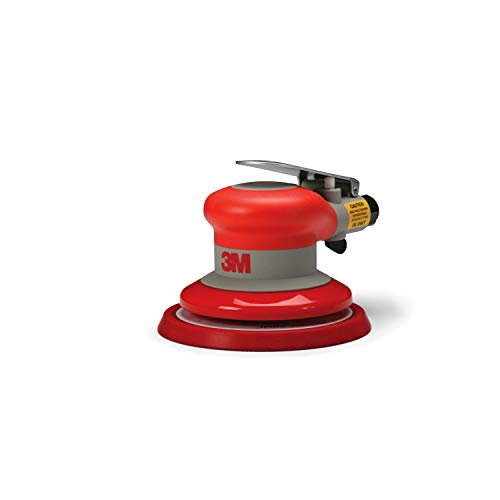
This pneumatic sander has a 3/16-inch orbit and a precision-balanced motor for smooth operation, which offers greater control and comfort. Its compact, low-profile design and aluminum body are built for durability in industrial use. The tool includes a 3M Stikit disc pad for easy attachment of adhesive-backed sanding discs.
As a non-vacuum model, it does not have integrated dust extraction. The product’s Amazon category lists it under automotive body repair tools. It is designated for industrial and occupational use only, not for consumer sale.
Product photos
Ingersoll Rand 300G Random Orbital Sander

What We Like
- Low-vibration design and contoured grip enhance control.
- 360° swivel vacuum adapter for dust extraction.
- Durable construction withstands drops and harsh chemicals.
Trade-offs
- Requires a separate, capable air compressor to operate.
- 6-inch pad is smaller than 8-inch models for broader work.
At just 2.6 pounds total, the Ingersoll Rand 300G is a tool you can wield overhead or on vertical panels all day without your arms giving out. That featherweight design, combined with its low-vibration build and contoured grip, makes it the clear choice for anyone tackling large, intricate body panels where fatigue is the enemy of a smooth finish. Its 6-inch pad and 3/16-inch orbit are perfectly suited for the fine sanding and feather edging required in automotive prep work.
Weighing just 1.9 pounds, the Ingersoll Rand 300G is easy to maneuver for extended sessions without causing fatigue. This pneumatic sander requires an air compressor, which limits its portability compared to cordless models. Its 6-inch pad and 3/16-inch orbit are designed for fine finishing tasks like feather edging and light sanding on wood or metal.
TCP Global Heavy Duty Dual-Action Air Sander
What We Like
- Lightweight design reduces user fatigue
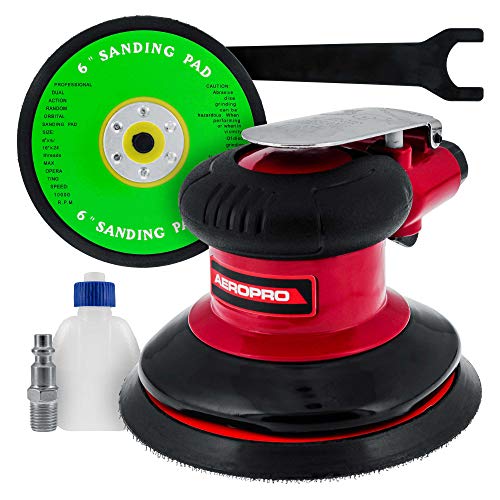
- Includes both PSA and hook & loop backing pads
- Thumb-controlled lever for speed adjustment
- Heavy-duty ball bearing construction for vibration
Trade-offs
- Suggested 2 HP compressor needed for full operation
- Free speed is 10,000 RPM
At just under two pounds, this sander is light enough to use all day without wearing out your arm, a critical factor for smoothing large panels. The inclusion of both PSA and hook & loop backing pads right out of the box means you can start working with whichever sanding discs you have on hand. It’s a straightforward, well-balanced tool built with heat-treated steel for the long haul, making it a pragmatic foundation for any shop tackling metal, wood, or fiberglass prep.
Compared to a dedicated workhorse like the Ingersoll Rand 328B, the TCP Global sander operates at a lower free speed, which can mean a bit more time on extensive sanding jobs. You’re getting a capable, versatile sander that covers the fundamentals well, sacrificing some outright cutting speed for a lower cost of entry.
Product photos
AIRCAT 6700 Non-Vac Orbital Palm Sander
What We Like
- Advanced silencing tech for 75 dBA operation.
- Ergonomic grip with smooth throttle lever.
- Double-sealed motor for dust protection.
- Compact, low-profile palm-sized design.
Trade-offs
- Non-vacuum design creates more airborne dust.
- Palm-sized body may fatigue on large panels.
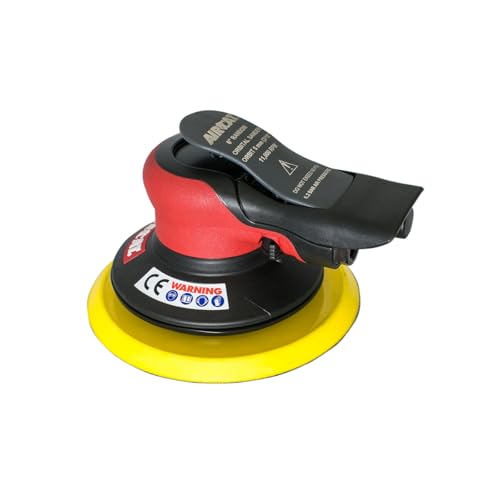
At 75 dBA, this sander’s quiet operation stands out in a shop, making hearing protection less of a constant requirement. Its advanced silencing technology and patented muffler provide reduced noise levels for a pneumatic tool. The ergonomic grip and smooth throttle lever contribute to comfortable handheld operation during professional auto body work or industrial finishing. Weighing 1.8 pounds with a low-profile design, it fits easily in one hand for work on contoured surfaces.
Engineered as a durable surface polishing tool, it is intended for finishing rather than aggressive material removal. The 3/16-inch orbital stroke is a common size for final sanding steps. Its non-vacuum design and compact form factor differentiate it from bulkier tools in the category, such as the 4.8-pound Astro Pneumatic 3008.
Chicago Pneumatic CP870 Air Random Sander
What We Like
- Dual-action operation for versatile surface work
- Safety lever and lock-off throttle prevent accidental starts
- Insulated composite grip reduces user fatigue
- Aluminum construction promises extended service life
Trade-offs
- At 4.2 lb, it's heavier than most 6-inch palm sanders.
- Lacks a vacuum port for integrated dust collection.
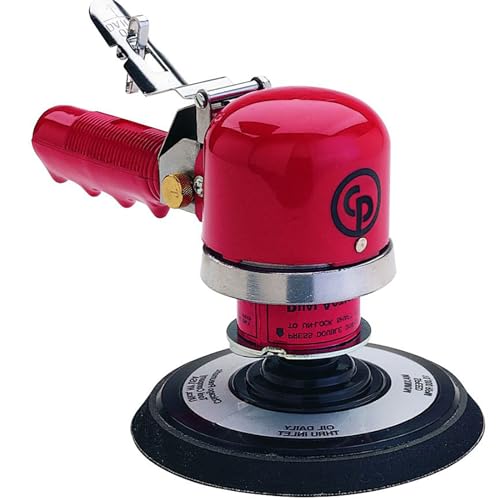
Dual-action rotary or random orbital operation defines the Chicago Pneumatic CP870, providing versatility for surface work across different applications. Its 10,000 RPM free speed supports productive sanding, and the tool’s 4.2-pound weight combined with an insulated composite over-sleeve grip aims to reduce fatigue during extended use. A safety lever with a lock-off throttle helps prevent accidental startups, which improves operating confidence in active shop environments.
That 4.2-pound weight is heavier than some other 6-inch air sanders, such as the 2.6-pound Ingersoll Rand 300G, which may demand more arm strength during overhead work. The tool is a non-vacuum model, so it does not have a built-in dust extraction hookup. Its aluminum construction and dual-action operation are general specifications for versatile and dependable service in tasks like body shop blending and pre-paint preparation.
ZFE Mini Random Orbital Air Sander
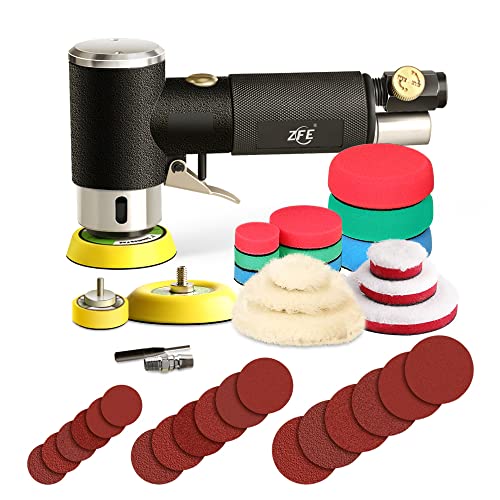
What We Like
- Extremely light at just 2.3 pounds
- Three interchangeable backing plate sizes
- Complete kit with pads and papers
- Low vibration for detailed control
Trade-offs
- Maximum 3-inch orbit limits large panel work
- Requires a capable air compressor to run
- Smaller pad sizes consume supplies faster
A 15000 RPM motor packed into a 2.3-pound body makes this sander feel like an extension of your hand, not a chore to hold overhead. That featherweight design, combined with its trio of small backing plates, is why it shines for automotive detail work. You can maneuver it into door jambs, around mirror mounts, and over complex curves where a full-size sander simply won’t fit. The included assortment of pads and papers gets you started immediately on spot repairs, rust removal, or final smoothing before paint. This is a specialist, not a generalist.
With a maximum pad size of 3 inches, this sander is smaller than models like the 8-inch Astro Pneumatic 3008. Its compact form is intended for focus areas rather than large, flat panels. The tool is suggested for tasks like removing solder joints, deburring woodwork, and mold manufacturing where its size is applicable.
Product photos
TOOLPEAK 5-inch Random Orbital Air Sander

What We Like
- Powerful 10,000 RPM motor for rapid material removal.
- Lightweight, ergonomic palm grip reduces user fatigue.
- Low 8 CFM air consumption suits many compressors.
- Standard 5-inch hook-and-loop pad uses common sandpaper.
Trade-offs
- Smaller 5-inch pad area reduces sanding coverage speed.
- Limited to air power, requiring a capable compressor.
A 10,000 RPM motor in a 2.2-pound body makes this sander a quick and surprisingly nimble option for detail work and smaller panels. The low 8 CFM air consumption allows it to run on most air compressors without overtaxing them. An ergonomic palm-grip design with vibration dampening also reduces user fatigue during long sanding tasks.
The trade-off is in scale. That compact 5-inch pad simply covers less ground than the 6-inch or 8-inch models in the guide, like the Ingersoll Rand 300G, so flattening a large hood or quarter panel will take more time. For extensive projects, the smaller work area becomes a real limitation. But for spot repairs, feathering edges, and final sanding, its lightweight power hits a sweet spot.
Product photos
How We Evaluated Sanders For Automotive Body Work
Our evaluation focused on manufacturer specifications, expert round-up recommendations, and consistent feedback from professionals who use these tools daily. We prioritized criteria that directly impact the quality and efficiency of body work: pad size and orbit for material removal, weight and ergonomics for operator comfort, and air requirements for compatibility with common shop compressors. This research-based approach identifies tools suited for specific tasks, but it cannot replicate the feel of a sander in your hand over a long work session.
What To Look For In Sanders For Automotive Body Work
Selecting the right sander means matching its capabilities to the specific demands of automotive repair, from aggressive leveling to delicate final sanding. Understanding the core differences in tools will help you build a versatile kit or choose a single, effective workhorse.
Look for a sander whose pad size, orbit, and power match your most common task. Consider weight for fatigue, and ensure your air compressor can supply the required CFM for pneumatic models.
Pad Size & Orbit
Pad diameter determines how much surface area you cover with each pass. An 8-inch pad, like on the Ingersoll Rand 328B, clears large panels quickly but is less nimble in tight spots. A 5-inch or 6-inch pad offers more control for detail work.
The orbit, measured in millimeters, indicates how far the pad travels in its circular pattern. A larger orbit, such as 8mm or 10mm, removes material more aggressively, while a smaller 3mm or 6mm orbit, like on the Rupes Skorpio III, provides a finer, more controlled finish ideal for paint prep.
Weight & Ergonomics
A sander’s weight and grip design directly affect control and fatigue. Heavy-duty models like the Astro Pneumatic 3008 (4.8 lb) offer power for flattening panels but can be tiring for overhead work. For extended finish sanding, lighter tools under 2.5 pounds, such as the Rupes Skorpio III or the ZFE Mini Sander, are easier to maneuver. Features like a contoured grip, a smooth throttle lever, and effective vibration dampening are critical for professional use, as noted in feedback on the 3M and Ingersoll Rand 300G models.
Air Requirements & Power Source
Most professional-grade automotive sanders are pneumatic, requiring a capable air compressor. Key specifications are CFM (cubic feet per minute) consumption and operating PSI. A sander needing 8 CFM is suitable for many smaller shop compressors, while tools requiring fifteen or more CFM demand a larger system. Electric or cordless DA sanders exist but are less common in pro body shops. They trade the need for an air compressor for sanding for corded or battery-powered convenience, which can be a consideration for shops without sufficient air supply.
.### Practical Checks Before You Buy
- Verify your compressor’s CFM output meets or exceeds the sander’s requirement.
- Check the backing plate system (PSA or hook-and-loop) for compatibility with your preferred sandpaper.
- Consider if you need a vacuum port for integrated dust collection or can manage the mess from a non-vacuum model.
- Assess the sander’s balance in your hand, if possible, as a top-heavy tool increases fatigue.
- Ensure replacement parts like pads and seals are readily available for the model you choose.
A sander that feels right for the job will save you time and produce better results.
Sanders For Automotive Body Work Compared
The table below compares key specifications across all ten models to help you see the differences at a glance.
| Product | Pad Size | Weight | Power Source |
|---|---|---|---|
| Astro Pneumatic Tool 3008 Sander | 8 inches | 4.8 Pounds | Gear driven |
| Ingersoll Rand 328B Dual-Action Orbital Sander | 8 inches | 2.5 pounds | Pneumatic |
| Rupes Skorpio III Orbital Sander | N/A | 1.8 Pounds | Pneumatic |
| 3M Non-Vacuum Random Orbital Sander | 5 in | 2.2 Pounds | Pneumatic |
| Ingersoll Rand 300G Random Orbital Sander | 6 inches | 2.6 pounds | Pneumatic |
| TCP Global Heavy Duty Dual-Action Air Sander | 6" | 1.9 pounds | Pneumatic |
| AIRCAT 6700 Non-Vac Orbital Palm Sander | N/A | 1.8 Pounds | Pneumatic |
| Chicago Pneumatic CP870 Air Random Sander | 6-inch | 4.2 pounds | Pneumatic |
| ZFE Mini Random Orbital Air Sander | 1, 2, 3 inch | 2.3 pounds | Pneumatic |
| TOOLPEAK 5-inch Random Orbital Air Sander | 5 inches | 2.2 Pounds | Pneumatic |
Frequently Asked Questions
What is the best type of sander for auto body work?
For most auto body tasks, a dual-action (DA) random orbital sander is the best type. It combines a spinning and orbiting motion to remove material efficiently without leaving the circular swirl marks common with a simple disc sander. Our guide covers several top sanders for auto body work, from heavy-duty gear-driven models for leveling to lightweight tools for finish sanding.
What is the best sanding machine for car body?
The “best” machine depends on the specific job. For flattening large panels and aggressive material removal, a powerful sander with a large pad, like the Ingersoll Rand 328B, is ideal. For final paint preparation and working on complex curves, a precision-focused tool like the Rupes Skorpio III delivers a superior finish. Our best overall, the Astro Pneumatic 3008, strikes a balance for technicians needing one versatile, heavy-duty sander.
What is the best brand of sandpaper for auto body work?
While our guide focuses on sanders, the sandpaper brand is equally important. Look for reputable brands known for consistent grit and durable backing materials specifically formulated for automotive paints, primers, and fillers. Using the correct abrasive sequence (starting coarse and moving progressively finer) is crucial for a smooth, defect-free surface ready for painting.
Can you use an orbital sander for an auto body?
Yes, an orbital sander is a fundamental tool for auto body work. It’s essential for tasks like smoothing body filler, feathering edges, and preparing surfaces for primer and paint. The key is selecting the right orbital sander, typically a dual-action random orbital model. You need the appropriate pad size and power for your specific application, whether it’s car bodywork sanders for large panels or detail work.
Do I need a special air compressor for a bodywork sander?
Most professional pneumatic sanders require a compressor that can deliver sufficient CFM (cubic feet per minute) at the tool’s operating pressure. A small, portable compressor often cannot keep up, causing the sander to stall. Always check the sander’s air consumption specs and ensure your compressor’s output meets that demand for continuous operation, which is why matching your air compressors to your tools is a critical step.
The Bottom Line
For a single, heavy-duty sander that efficiently tackles large panel work and leaves a finish ready for primer, the Astro Pneumatic Tool 3008 Sander is our best overall choice. If your budget is tight, the TOOLPEAK model offers capable performance, while those focused exclusively on flawless final sanding should look to the award-winning Rupes Skorpio III for precision finishing. Ultimately, the most important factor is matching the sander’s power, pad size, and weight to the specific automotive repair tasks you perform most often.
