
Single Stage vs Two Stage Air Compressor: Key Differences
This post contains affiliate links. As an Amazon Associate, we earn from qualifying purchases.
Choosing between a single-stage and two-stage air compressor isn’t about picking the “better” technology. It’s about matching a machine’s thermodynamic design to your actual air demand. A single-stage compressor, like the Kaishan KRSP, compresses air in one pass to pressures around 100–135 PSI, and Kaishan states it is best suited for applications with run hours fewer than 2,000 hours per year. A two-stage compressor, like the Kaishan KRSP2, compresses air twice with cooling in between, reaching 150–175+ PSI and delivering 15–20% more air flow (CFM) at the same horsepower. Kaishan states such compressors are ideal for high run hours, base-load industrial scale operations, and facilities operating two or more shifts.
The efficiency gain comes from physics, not marketing. Compressing air heats it up, and hot air resists further compression. A two-stage design uses an intercooler to shed that heat between compressions, so the second stage works on denser, cooler air. That simple mechanical step changes the entire cost equation for a shop running multiple shifts, which is the core difference in a single stage vs two stage air compressor.
What follows is a breakdown of the specs that matter, pressure, CFM, duty cycle, and efficiency, plus the real-world tool demands that should push your decision in the single stage vs two stage air compressor question one way or the other. We’ll also clear up the rampant confusion about duty cycles and show you how to spot the difference just by looking at the pump.
Key Takeaways
- Match your highest continuous PSI need: If your tools require a consistent 120 PSI or more, Aivyter states a two-stage compressor is the proper mechanical choice to avoid thermal strain. However, CAPS Australia notes benefits are not noticeable in installations below 90kW running one shift.
- CFM at pressure is your buying spec: A two-stage unit like the FS Curtis NX185 delivers 191 more CFM @ 125 PSI than a comparable single-stage model, meaning it can run more tools or recover faster.
- Duty cycle is a hard limit, not a suggestion: Sources disagree on the duty cycle for reciprocating compressors: Stellar Industries states 50%, while Aivyter notes a limit of roughly 80%. Only industrial two-stage rotary screw models are built for 100% continuous run time.
- Efficiency savings have a minimum threshold: According to CAPS Australia, compressing air in two stages provides an energy saving of 10 to 12 per cent, but these savings aren’t noticeable in installations below 90kW running one shift.
- Total cost is dominated by electricity: Aivyter states that over a 10-year horizon, electrical utility consumption drives approximately 75–80% of total lifecycle expenditures, making a more efficient two-stage model a smarter investment for high-use scenarios.
How a Two-Stage Compressor Works (The Thermodynamic Edge)
Forget cylinders for a second. The core advantage is thermal management. When you compress air, its temperature spikes, Aivyter reports that the thermal profile for a single-stage compressor shows high discharge temperatures (>350°F / 176°C). That hot, low-density air is harder to compress further, wasting energy and cooking internal components.
A two-stage compressor breaks the job in two. The first stage compresses air to an intermediate pressure; Aivyter notes a typical range of 80 to 100 PSI. That air then travels through an intercooler, a network of fins or tubes that cools it down. This cooling condenses out moisture and, crucially, increases the air’s density.
The intercooler is the heart of the efficiency gain. By cooling the air between stages, the compressor works on a denser charge. The second stage then raises this pre-compressed, cool air to the final pressure (e.g., 175 PSI) using significantly less energy than a single-stage machine would need for the same jump from atmospheric pressure.
This process, detailed in guides like the Air Compressor Insider explanation, is why two-stage compressors have a 10–15% lower specific power consumption above 90 PSI. The motor simply does less work. You’ll notice this in two ways: your tools maintain pressure better under load, and your energy meter spins slower over a month of heavy use.
Pressure and CFM: The Performance Specs That Actually Matter
Most discussions start with PSI, but that’s only half the story. You need to know both the maximum pressure a compressor can hold and how much air it can deliver at the pressure your tools need.
Typical Pressure Ranges
Sources agree on the bands, though specific max numbers vary. This isn’t deception; it’s the difference between a maximum burst pressure and a safe, continuous operating threshold.
| Compressor Type | Reported Maximum Pressure Range | Key Source & Note |
|---|---|---|
| Single-Stage | 100–115 PSIG (Kaishan) to 120–135 PSI (Pye-Barker, Quincy, Aivyter) | Best for pressures at or below this range for continuous duty. |
| Two-Stage | 175 PSI (Hankemotor, Quincy) to 200+ PSI (Pye-Barker) | 150–175+ PSI is the standard operational threshold (Aivyter). |
The CFM Advantage
Pressure is potential; CFM (cubic feet per minute) is delivery. This is where the two-stage design shines. By splitting the compression, it generates more air flow per horsepower.
A concrete example from FS-Compression: a 250 HP single-stage compressor delivers 1,026 CFM at 125 PSI. A two-stage FS Curtis NX185 at the same 250 HP delivers 1,217 CFM at 125 PSI. That’s a 191 CFM increase.
Where this goes sideways: Buying a compressor based only on tank size. A large tank with a weak pump just takes longer to fill and will still drain quickly running a sander. The pump’s CFM output at your required PSI is the only number that predicts whether your tool will stall.
For a home shop, a two-stage rotary screw compressor will recover faster between uses due to its higher CFM output per horsepower. In an auto shop, this can mean running tools like a die grinder and an impact wrench closer to simultaneously without waiting on the pump.
Duty Cycle and Durability: The Run-Time Reality Check
This is the most confused spec in guides about air compressor types. Duty cycle is the percentage of time a compressor can run within a 10-minute period without overheating. It’s a hard thermal limit.
The Conflicting Claims
You’ll see sources that directly contradict each other, and it’s critical to present both sides:
- Claim A (Pye-Barker): “The duty cycle of almost all two-stage air compressors is 100%.”
- Claim B (Stellar Industries & Aivyter): Reciprocating (piston) compressors are air-cooled and cannot run continuously. Stellar states a 50% duty cycle for their two-stage hydraulic units, and Aivyter notes an 80% limit for piston two-stage models.
Who’s right? Both, but for different compressor categories. The 100% claim applies almost exclusively to industrial two-stage rotary screw compressors, which use advanced oil-injection cooling. The 50-80% claims are for the two-stage reciprocating (piston) compressors common in auto shops and larger workshops.
| Compressor Type | Typical Duty Cycle | Mechanical Reason |
|---|---|---|
| Single-Stage Reciprocating | Sources vary | Air-cooled; requires cool-down time to prevent overheating. Stellar Industries states a 50% duty cycle for reciprocating compressors. |
| Two-Stage Reciprocating | 50% (Stellar Industries) to ~80% (Aivyter) | Intercooler helps, but piston/cylinder heat buildup remains a limit. |
| Two-Stage Rotary Screw | 100% | Oil-injection cooling between stages manages heat for continuous run. |
The takeaway is simple. When you compare a single stage vs two stage air compressor, if you need a compressor to run non-stop for hours, like in a manufacturing line, you must choose a two-stage rotary screw model. For intermittent, heavy-duty use, a two-stage piston unit is fine, but you must respect its duty cycle and let it cool.
The Visual Identification Guide
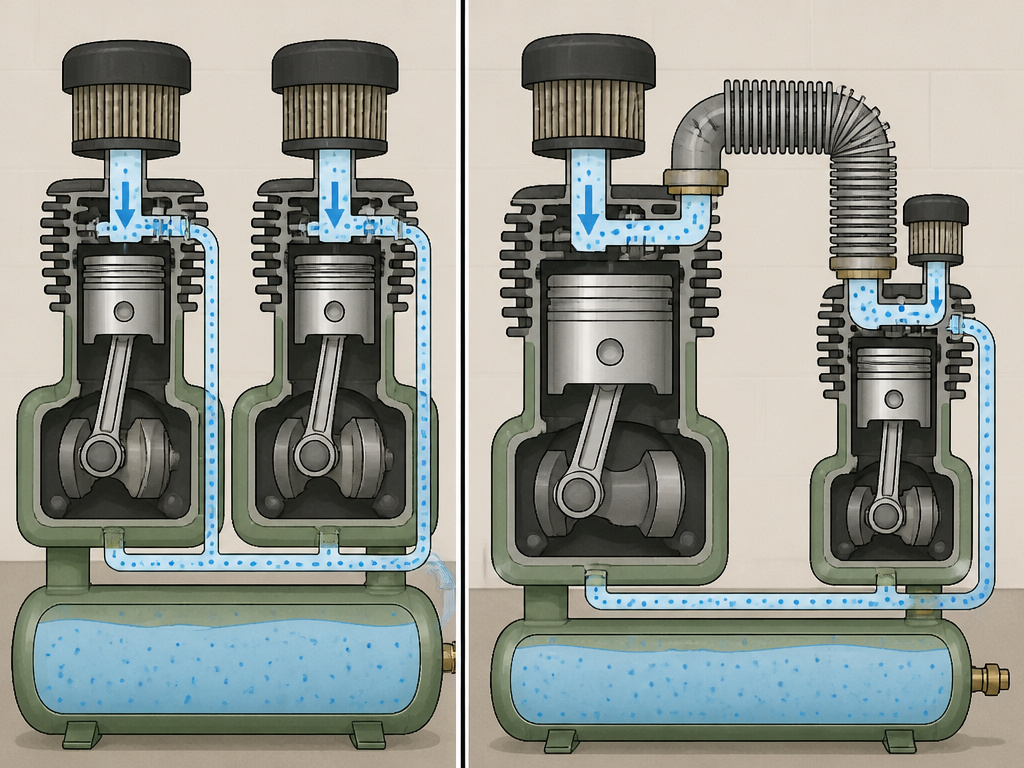
You can often tell the type just by looking at the pump. This cuts through the marketing speak on the nameplate.
For Reciprocating (Piston) Compressors:
- Single-Stage: All cylinders are the same size. Each cylinder will have its own intake filter or be fed from a common manifold, and they all discharge air directly into the tank.
- Two-Stage: Cylinders are different sizes. You’ll see one larger-diameter cylinder (low-pressure stage) and one smaller-diameter cylinder (high-pressure stage). A thick, finned cooling tube (the intercooler) will connect the two.
For Rotary Screw Compressors:
Visual identification is harder, as both stages are housed in a single “airend.” You must rely on the model name and spec sheet. Look for terms like “two-stage,” “KRSP2” (Kaishan), or “NX” series (FS Curtis).
Easy to miss: The number of cylinders does NOT equal the number of stages. A three-cylinder “V-twin” pump where all pistons are the same size is still a single-stage machine. The stages are defined by the compression path, not the piston count.
Single-Stage vs. Two-Stage: The Decision Matrix
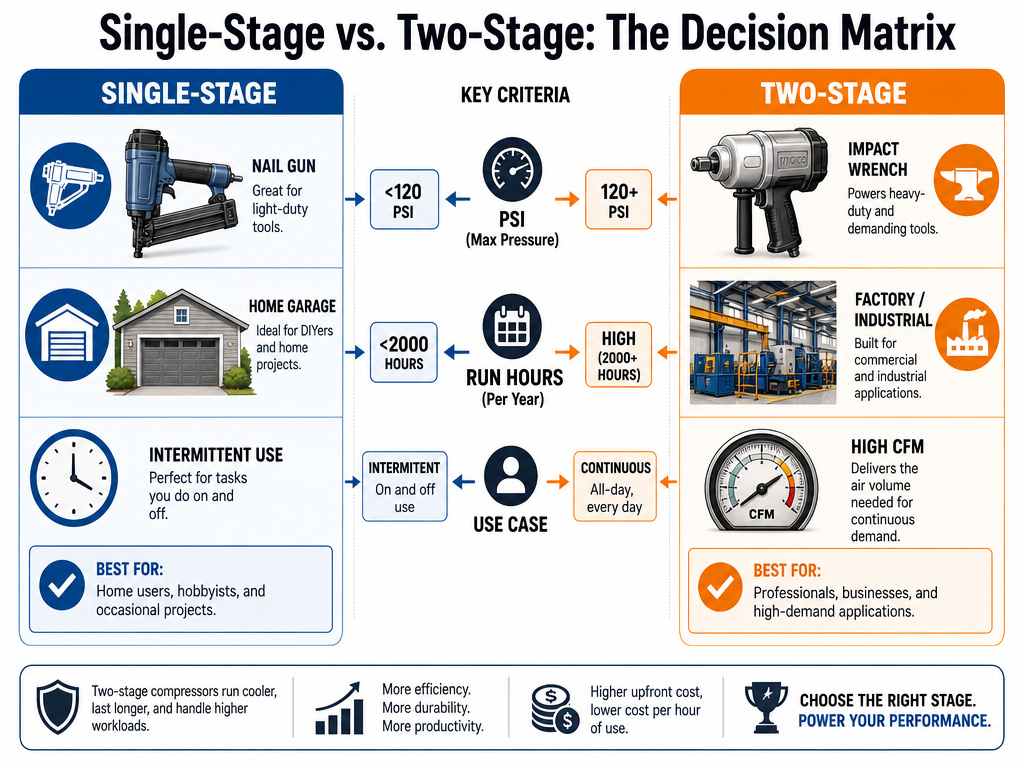
So, which one should you buy? It comes down to your pressure requirements, annual run hours, and duty needs.
Choose a Single-Stage Compressor If:
- Your air tools (nailers, framers, blowguns) require under 120 PSI.
- You run the compressor less than 2,000 hours per year (about 5.5 hours a day).
- Your use is intermittent, with plenty of time for the pump to cool.
- You’re on a tighter initial budget for a home garage or small workshop.
Choose a Two-Stage Compressor If:
- Your tools (large impact wrenches, sandblasters, some paint guns) need a consistent 120 PSI or more.
- You run multiple shifts or have high annual operating costs where a 10–12% energy saving matters.
- You need a high CFM at pressure to run tools like sanders or die grinders continuously.
- Your operation is industrial scale, and you’re evaluating options like rotary screw vs. Piston compressors for a base-load system.
The Hobbyist’s Break-Even Point
For a weekend warrior, the extra cost of a two-stage is hard to justify. The energy savings only become significant at high run hours. However, if you’re running a large sandblaster or a high-CFM sander often, the faster recovery and cooler operation of a two-stage might be worth the premium in saved time and frustration, even if the power bill savings are minimal.
Total Cost of Ownership: The 10-Year Math
Initial price is a distraction. For mid-to-high capacity compressors, the purchase price is only 10–15% of the total 10-year cost. Maintenance is another ~10%. The remaining 75–80% is electricity.
This is why the two-stage efficiency gain is a big deal for the right user. Aivyter notes that specific power consumption for a two-stage air compressor is 10% to 15% lower than for a single-stage compressor above 90 PSI, which can lead to significant savings over time in high-use scenarios. Over a decade, the accumulated energy savings can dwarf the initial price difference.
For a small shop, run the math. If your compressor only runs 500 hours a year, the annual savings might be $250. Will that offset the higher upfront cost in a reasonable time? Probably not. This ties directly back to the CAPS Australia finding that benefits aren’t noticeable below 90kW running one shift.
What is the difference between cylinders and stages?
People often think the number of cylinders equals the number of compression stages, but that’s not the case. A stage refers to how many times the air is compressed before storage. A two-stage compressor compresses the air twice, typically to a much higher final pressure, often around 175 PSI or more. This process can happen across multiple cylinders, with one set handling the first compression to an intermediate pressure and another set handling the second. The key is the multi-step compression, not simply counting the number of pistons you see on the pump.
Are two-stage compressors quieter than single-stage?
The available facts do not provide specific decibel ratings for noise levels. In practical terms, the operating noise of an air compressor is influenced by its design, cooling method, and installation. A two-stage rotary screw compressor, built for continuous industrial use, is often housed in an enclosure designed to dampen sound. For any compressor, proper mounting on vibration pads and ensuring adequate intake and exhaust airflow can significantly reduce perceived noise in a workshop or plant environment.
Frequently Asked Questions
Is a 2 stage air compressor worth it?
It’s worth it if your tools demand over 120 PSI consistently, you run more than one shift, or your highest-CFM tool (like a die grinder) dictates a need for maximum airflow.
What are the disadvantages of a single-stage air compressor?
The main disadvantages are thermal. They run hotter when pushed to their upper pressure limits (120-135 PSI), which can reduce efficiency and component life. They are also less efficient at these higher pressures, consuming more electricity per CFM delivered than a two-stage model.
How to tell if an air compressor is 2 stage?
Look at the pump on a piston compressor. If you see two cylinders of noticeably different sizes connected by a finned metal tube, it’s two-stage. If all cylinders are the same size, it’s single-stage. For rotary screw compressors, check the model name/spec sheet for “two-stage” designation.
Can a two-stage compressor run continuously?
Only if it’s a two-stage rotary screw compressor. These are engineered for 100% duty cycle, 24/7 operation. Two-stage reciprocating (piston) compressors are mechanically limited to an 80% duty cycle at best and require regular cool-down periods.
Do I still need an air dryer with a two-stage compressor?
Yes. While the intercooler removes a significant amount of moisture, the discharged air is still warm and holds water vapor. To achieve clean, dry air standards like ISO 8573-1 Class 4, you must pair the compressor with a refrigerated or desiccant air dryer.
The Bottom Line
Stop looking at tank size first. Start with the tool in your shop that has the highest continuous CFM demand at your required working pressure. That number. CFM at PSI, is your compressor’s report card.
If that number sits comfortably below 120 PSI and your runtime is measured in minutes per hour, a single-stage compressor is your efficient, simpler tool. But if your work pushes into the 120+ PSI range for extended periods, the two-stage’s thermodynamic advantage isn’t a luxury, it’s a mechanical necessity that will save energy and extend the machine’s life.
The real mistake is buying for a hypothetical future need. Buy for the air you actually use today. A perfectly sized single-stage unit beats an oversized, underutilized two-stage model every time on cost and practicality. But when your air demand grows, step up to a two-stage with confidence, knowing its intercooler is working hard to keep your power bill, and your tools, running cool.
