
Portable vs Stationary Air Compressor: Cost and Trade-Offs
This post contains affiliate links. As an Amazon Associate, we earn from qualifying purchases.
The portable vs stationary air compressor choice comes down to three things: mobility, required air flow (CFM), and duty cycle. A portable compressor is a mobile tool for intermittent use, with CFM output varying by model from light-duty (2-10 CFM) to heavy-duty industrial (30-100+ CFM), and it typically costs less upfront. A stationary compressor is a fixed shop asset for continuous, high-volume air, delivering 14-500+ CFM with a higher initial investment but lower long-term operating cost. For most home shops under 500 hours of annual use, a portable is the better buy; for professional shops running tools all day, stationary wins.
This isn’t just about wheels versus a concrete pad; the portable vs stationary air compressor question is about the air delivery system itself. A portable unit’s entire design, from its smaller pump to its lighter frame, prioritizes moving it over running it non-stop. A stationary compressor is built like a piece of shop infrastructure, with components rated for thousands of hours of continuous operation.
What follows breaks down the numbers behind the portable vs stationary air compressor trade-off: the real CFM ranges, the cost crossover point, and the specific failure modes you get when you pick the wrong one. By the end, you’ll know which compressor type fits your actual air demand, not just your garage space.
Key Takeaways
- The primary difference is mobility versus duty cycle. Portables move; stationary units run continuously.
- Match your compressor to your highest-CFM tool, not your tank size. A die grinder needing 5 CFM continuous will stall a 4 CFM portable.
- The cost advantage flips at 500 hours of annual use. Below that, a portable is cheaper over five years; above it, a stationary unit’s efficiency wins.
- Moving a stationary compressor more than once a month causes a 41% higher failure rate from vibration damage.
- For clean air in sensitive applications, the installation point for a quality moisture trap is at the regulator, not just at the tool.
The Core Difference: Mobility vs. Power
Look at the business end of each machine. A portable compressor has a compact pump, a small tank (typically 1-30 gallons), and a handle or wheels. A stationary unit has a larger, often two-stage pump, a massive tank (60-240+ gallons), and it’s bolted to the floor. One is a tool you store; the other is a system you install.
This design gap creates the performance chasm. According to data from Air Compressor Zone and Loyal Air Compressor, portable compressors deliver 2–20 CFM at the high end, with common “pancake” models in the 2-8 CFM range. Stationary compressors start at 14 CFM and scale to 500+ CFM for industrial rotary screw models.
Portable air compressors are designed for mobility and flexibility, easily moved from site to site. Stationary air compressors are fixed installations, designed for long-term use in facilities that need a steady, high-volume air supply. (JM Industrial)
The tank size difference is just a buffer. A bigger tank lets a smaller pump run less often, but it does not raise the compressor’s capacity to supply air. That’s all CFM. A 60-gallon tank on a 5 CFM pump will eventually fill, but if your tool needs 8 CFM, the tank will empty and the tool will stop. This is why sizing a compressor based on the tool with the highest continuous CFM demand is the only math that works.
Portable Air Compressors: When Mobility Is the Job
You need a portable compressor when the work moves. This isn’t just for contractors. It’s for the homeowner blowing out sprinklers, the car enthusiast airing up tires at a track day, or the woodworker needing to run a brad nailer in the driveway.
These units are tactical. Their job is to bring air to a point of use, not supply an entire network. A common setup is a small pancake compressor, which is quiet, oil-free, and rolls right to the job.
Where this goes sideways: Trying to run a high-CFM tool like a die grinder or DA sander off a small portable. The compressor will run non-stop, overheat, and its lifespan will plummet. Loyal Air Compressor notes that portable compressors are for intermittent, not constant use, while Air Compressor Zone reports a typical duty cycle of 50-75% for consumer models, with some industrial portables capable of 100%. That means it should run for half to three-quarters of a given hour, then cool down.
| Best For | Typical Portable Specs | Tool Match |
|---|---|---|
| Job sites, remote work | 2-8 CFM, 1-6 gal tank | Nail guns, tire inflation, small impacts |
| Intermittent shop use | 8-15 CFM, 10-30 gal tank | HVLP spray guns, moderate sanding |
| Industrial field work | 30-100+ CFM, tow-behind | Sandblasting, large breaker hammers |
For most DIY tasks and light contractor work, a portable electric compressor is the right call. Air Compressor Zone suggests it can handle applications under 8–10 CFM with intermittent demand, while Loyal Air Compressor notes a portable might handle demand below 15 to 20 CFM. If your work fits that profile, you’re in the sweet spot for a portable air compressor.
Stationary Air Compressors: The Shop’s Power Plant
A stationary compressor is what you install when your shop is the job site. It’s the difference between having a water bottle and having plumbing. These systems are designed to feed multiple outlets, often through a hard-piped air distribution system, providing consistent, high-volume air all day.
The heart of a stationary system is its duty cycle. Rotary screw models are designed for 100% continuous duty, they can run 24/7. Even large two-stage piston units, with a 50-75% duty cycle, are built for marathon sessions, not sprints. Their service intervals are measured in thousands of hours, not hundreds.
Common mistake: Buying a stationary unit for a home garage you use twice a month. You’ll spend more on the electrical install and floor space than you’ll ever save in efficiency. That “serious” 60-gallon tank becomes a very expensive tire inflator.
Here’s where they earn their keep:
- Auto body shops: Running a spray gun (9-14 CFM) and a sander simultaneously.
- Woodworking shops: Powering multiple sanders and a dust collection blast gate system.
- Manufacturing: As the primary air supply for pneumatic automation and assembly lines.
A 60-gallon stationary unit with 14+ CFM output can handle sustained high-draw tool use like sanding or painting full panels. When you need that kind of reliable, shop-wide air, you’re in the market for a true shop air compressor. The choice between a single stage vs two stage design is your next decision.
Head-to-Head: Specs, Costs, and Trade-Offs
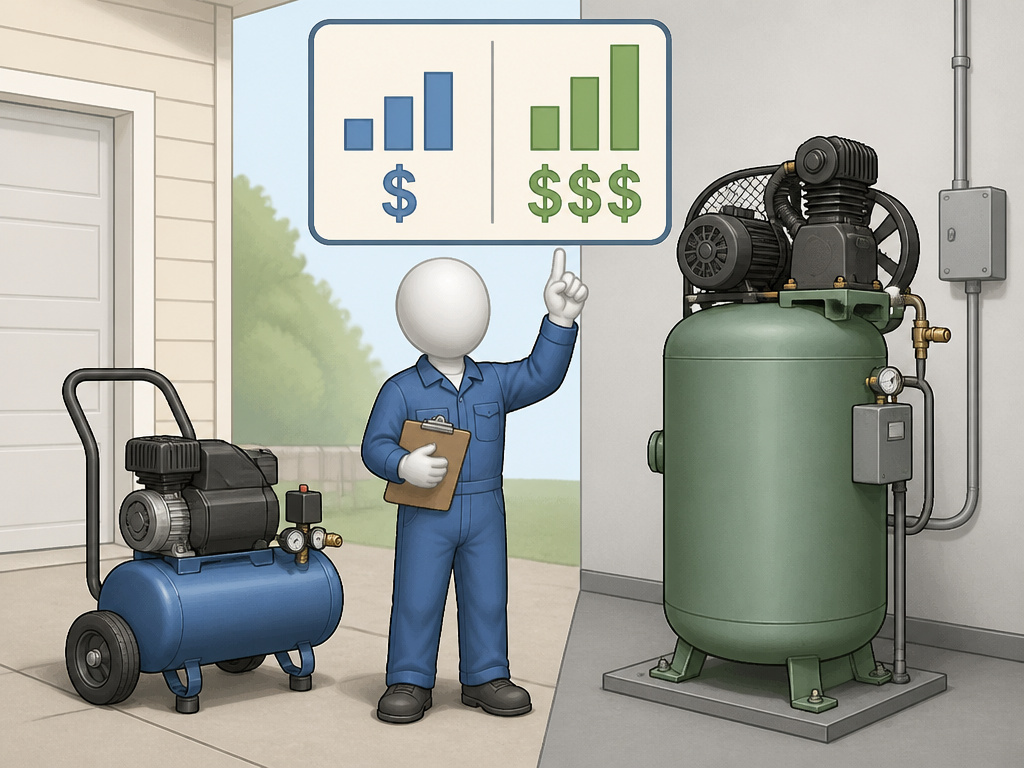
Here are the specifics. The table below puts the hard numbers from Air Compressor Zone and Loyal Air Compressor side-by-side. This isn’t marketing; it’s the performance envelope of each type.
| Factor | Portable Compressor | Stationary Compressor |
|---|---|---|
| CFM Range | 2–20 CFM (high end) | 14–500+ CFM |
| Tank Size | 1–30 gallon | 60–240+ gallon |
| Max PSI | 120–200 PSI | 125–175 PSI (piston) |
| Duty Cycle | 50–75% (consumer); 100% (some industrial) | 100% (rotary screw); 50–75% (piston) |
| Power Requirement | 120V, 240V, battery, or gas | 240V single-phase or 3-phase |
| Noise Level | 60–85 dBA | 62–80 dBA (often quieter with enclosure) |
| Upfront Cost | $100–$5,000+ | $500–$50,000+ |
The cost story has a twist. Over 5 years at moderate use (500 hours/year), a stationary electric piston compressor costs $1,200–$2,200 total including installation. A portable electric unit costs $300–$550 over the same period.
The stationary investment only pays off when annual use hours are high enough to benefit from its lower operating cost per CFM. The crossover point, according to this data, is right around that 500 hours/year mark. Below that, portable is cheaper. Above it, stationary wins on total cost of ownership.
Power is another divider. Most home-shop stationary units need a 240V outlet. Large industrial models require 3-phase power, which isn’t in most residential garages. This isn’t a plug-and-play upgrade; it’s an electrical project. Choosing between a gas vs electric power source adds another layer, especially for remote work where diesel’s 35-40% energy efficiency competes with electric’s 85-92%.
How to Choose: The 3-Question Checklist
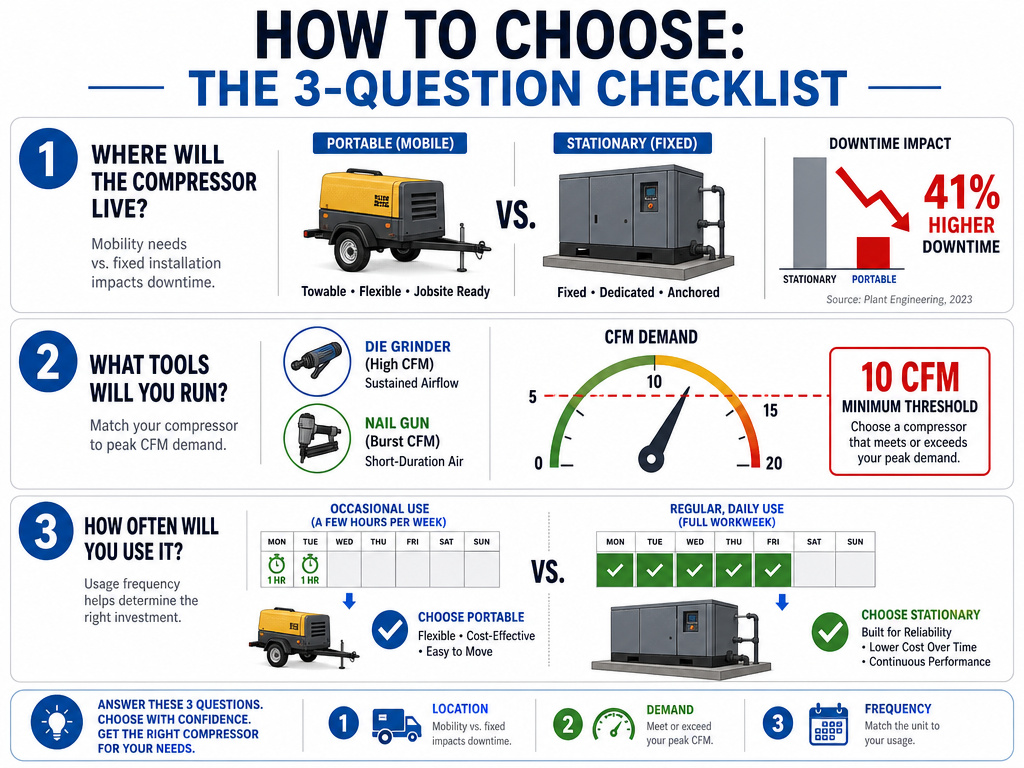
Forget the brand debates for a minute. Answer these three questions honestly, and the right type of compressor will snap into focus.
1. How often will you move it?
This is the mobility litmus test. If you answer “more than once a month,” you need a portable. Data from Industrial Equipment News shows that unplanned downtime for stationary compressors moved between field sites is 41% higher than for purpose-built mobile units. The vibration from travel cracks cooling lines and shakes electrical connections loose. If your project lasts less than 12 months at a site, the rule of thumb is to go mobile.
2. What is your highest continuous CFM demand?
List your air tools. Find the one with the highest continuous CFM requirement (not average). A framing nailer uses air in bursts; a die grinder uses it in a steady stream. If that number is under 8-10 CFM, a portable can likely handle it, intermittently. If it’s over 10-15 CFM, or you need to run two such tools at once, you’re looking at a stationary system. This is where understanding compressor stages matters for meeting high pressure demands efficiently.
3. How many hours will it run per week?
Be realistic. Two hours every Saturday? That’s 100 hours a year, solidly in portable territory. Eight hours a day, five days a week? That’s 2,000 hours a year, and you need a stationary compressor with a 100% duty cycle. This usage number directly triggers the cost crossover we saw earlier.
Installation, Maintenance, and Hidden Realities
The manual doesn’t tell you everything. Installing a stationary compressor isn’t just wheeling it into place. You need a level, solid foundation (often concrete), that dedicated 240V circuit, and proper ventilation. The noise is a constant low-frequency hum, placing it in a separate closet or outside is worth the extra plumbing.
For portables, the hidden killer is the extension cord. Running an undersized cord causes voltage drop, which makes the motor draw more amps, overheat, and fail prematurely. If you must use one, use the shortest, heaviest-gauge cord you can.
Maintenance diverges sharply:
- Portable (Oil-Free): Drain the tank after every use to prevent rust. Check the air filter. That’s mostly it. Simpler, but the pumps are louder and wear out faster.
- Stationary (Oil-Lubed): Regular oil changes (every 500-2000 hours), belt tension checks, and draining the tank are mandatory. A dirty intake filter can cut efficiency by 10%, according to Saidesi Air Compressor. It’s more involved, but a well-maintained oil-lubed pump will outlast multiple oil-free units.
Worth knowing before you start: Whether portable or stationary, install a quality moisture trap and filter at the regulator, not just a cheap in-line filter at the tool. That’s where you strip out the bulk of the water and oil before it ever enters your air hose, protecting every tool downstream.
Cost Comparison (Upfront & Long-term)
Upfront, portable compressors are generally less expensive, with consumer models starting much lower and industrial portables costing up to a certain point. Stationary units have a wider cost range, with basic piston models starting higher and rotary screw systems representing a significant capital investment. For long-term costs over five years at moderate use, a portable electric unit is cheaper. However, this changes with high annual usage. The key is matching the compressor’s duty cycle to your actual runtime; buying a less expensive portable for constant, heavy use leads to premature failure and higher costs.
Common Mistakes to Avoid
A major error is using a portable compressor for constant, high-demand applications. These units are designed for intermittent use, and pushing them beyond their duty cycle causes excessive heat and wear. Another mistake is moving a stationary compressor frequently. If you relocate a compressor more than once a month or for projects lasting less than a year, a mobile unit is the correct choice. Transporting a stationary model leads to a much higher rate of unplanned downtime from physical damage like cracked lines and loose connections. Always match the compressor’s design to your required mobility and runtime.
Frequently Asked Questions
Is a portable air compressor worth it for home use?
For most homeowners, absolutely. It handles tire inflation, nail guns, blowing out dust, and light air tool work. The upfront cost is low, and it stores easily. Unless you’re running a high-CFM tool like a sandblaster for hours, a portable like a California Air Tools or Makita model is the most practical air compressor for home workshops.
Can a portable air compressor run a paint sprayer?
It depends on the sprayer’s CFM demand. A small HVLP touch-up gun might only need 4-6 CFM, which a larger portable can handle for short periods. Painting a whole car door or furniture piece requires a steady 9-14 CFM, which will overwhelm most portables and lead to a blotchy finish. For painting, stationary is the standard.
What size stationary air compressor do I need for a shop?
Start by adding the CFM of all tools you might run simultaneously. A typical auto shop running multiple tools simultaneously needs to calculate the total continuous CFM demand of those tools. Then add a 30-50% buffer. That points you to a stationary compressor with a tank size of 60 gallons or more and a CFM output that meets your total demand.
Are oil-free compressors better?
They’re more convenient, no oil changes, and they can be tipped for transport. But they are significantly louder and have a shorter service life than a properly maintained oil-lubed pump. For a portable you use occasionally, oil-free is convenient. For a stationary shop workhorse, an oil-lubed system requires more maintenance but is common in industrial settings.
How important is tank orientation?
Tank orientation, vertical vs. Horizontal, is about footprint, not performance. Vertical tanks take up less floor space, which is crucial in a tight shop. Horizontal tanks are often lower to the ground and can be easier to move (if portable) or mount on a cart. The shape of the tank doesn’t affect air capacity or quality.
The Bottom Line
Don’t buy a compressor for the tank you see; buy it for the air you can’t see. The CFM at your required PSI is the only number that pays your tools.
If your work moves, or you use air for less than 500 hours a year, get a robust portable compressor.
If your shop is fixed and your tools drink air for more than a few hours a week, install a stationary system. Size it based on your peak simultaneous CFM demand, wire it correctly, and maintain it on schedule.
One final, essential rule: if you will move the compressor more than once a month, it must be a purpose-built portable. Forcing a stationary unit into a mobile life guarantees cracked lines and downtime. Match the machine to the mission, and you’ll have air when you need it.
