
Air Ratchet vs Impact Wrench: Which Should You Buy?
This post contains affiliate links. As an Amazon Associate, we earn from qualifying purchases.
An air ratchet is a slim, speed-focused tool that ratchets fasteners in tight spaces, with sources citing torque ranges from 25–70 ft-lbs to 60 or 130 ft-lbs, while an impact wrench is a bulkier, hammer-driven tool designed to break stubborn bolts loose, with sources citing torque ranges from 800–1,000+ ft-lbs to 1,800+ ft-lbs. For most home mechanics, the choice is dictated by access and bolt condition: if you work in cramped engine bays on clean fasteners, get the air ratchet; if you do suspension work or fight rusted lug nuts, you need the impact wrench.
That torque gap isn’t just a spec sheet number. It’s the physical line between a tool that spins a bolt and one that snaps it loose. The air ratchet wins on maneuverability, sliding into spots where the impact wrench’s bulky head and hammer mechanism simply can’t fit. Understanding the core difference in an air ratchet vs impact wrench is key to choosing the right tool.
What follows: a breakdown of where each tool excels, a head-to-head spec table, and the one maintenance habit that decides whether your pneumatic tools last a season or a decade.
Key Takeaways
- An air ratchet delivers 25–130 ft-lbs of torque and fits where an impact wrench can’t, making it the tool for dashboard bolts, valve covers, and confined engine work.
- An impact wrench delivers 500–1,800+ ft-lbs of breakaway torque, making it essential for suspension work, wheel service, and rusted or seized fasteners.
- Impact sockets are required for an impact wrench, and highly recommended for an air ratchet; using regular sockets risks cracking and flying shrapnel.
- Pneumatic tool longevity hinges on proper oiling before each use; skipping this dries out seals and leads to power loss, often mistaken for a broken tool.
- For a beginner building a home garage, an impact wrench is the better first buy because it solves problems no hand tool can, while an air ratchet is a productivity upgrade for specific, tight-space tasks.
The Core Trade-Off: Speed & Access vs. Raw Breaking Power
The whole air ratchet vs impact wrench debate comes down to one question: are you fighting space or fighting force?
An air ratchet is built for the first battle. Its long, slender neck and compact head are designed to slide into tight gaps. Think about the bolts holding an alternator bracket, tucked behind the power steering pump. A how to use an air ratchet guide will show you the technique, but the tool itself provides the reach. It ratchets, meaning it turns the socket in one direction with a return stroke, allowing you to work in a tight swing arc without removing the tool. You feel every turn through the grip.
An air ratchet is the spritz of compressed air that spins a dozen valve cover bolts off in thirty seconds. An impact wrench is the sledgehammer swing that cracks a lug nut rusted to a hub since the Obama administration. They operate in different physical worlds.
The impact wrench lives in the second world, the world of brute force. It doesn’t ratchet; it hammers. Inside the tool, a rotating mass called a hammer slams into an anvil, delivering concussive bursts of rotational energy. This hammer mechanism is why even a compact model like the Milwaukee M18 FUEL weighs over twice as much as a typical air ratchet. That mass translates to high breakaway torque. A 1/2″ model delivers 800 to 1,000+ ft-lbs of breakaway torque, enough to shear a bolt if you’re not careful. It’s the fastest way to remove lug nuts during a tire rotation.
Power, Precision, and the Jobs They Handle
This air ratchet vs impact wrench difference isn’t academic. It dictates your entire workflow in the shop.
When the Air Ratchet Is the Right Tool
You reach for the air ratchet when the fastener isn’t fighting you, but your elbow is. Its domain is the interior of the machine.
- Tight-space assembly: Dashboard bolts, interior trim, intake manifolds, and most under-hood accessories where a full-sized tool won’t clear.
- High-volume fastener running: Any job where you have a dozen or more same-sized bolts to remove or install, like a valve cover gasket or an oil pan. The speed saves your forearm.
- Final snug-down: After using a breaker bar or your impact wrench vs torque wrench to crack a bolt loose, the air ratchet can spin it out quickly. The reverse is also true, it can run a bolt in most of the way before you apply final torque with a calibrated wrench.
The control is tactile. Since the torque is low and direct, you can feel when a bolt is seated or if a thread is starting to cross. You’ll hear a change in the motor’s pitch when it meets resistance. That feedback is absent in the impact wrench’s concussive roar.
When the Impact Wrench Is Non-Negotiable
The impact wrench earns its keep when fastener torque exceeds human strength. Its job list is shorter but more critical.
- Suspension work: Control arm bolts, strut nuts, axle nuts, anything that sees road salt, weather, and high torque from the factory.
- Wheel service: The definitive tool for lug nuts. Nothing else comes close for speed.
- Breaking seized or corroded fasteners: This is its primary purpose. That concussive action transfers energy in a way that a steady pull from a breaker bar cannot, often shocking a frozen bolt loose without shearing it.
Precision is not its strength. While advanced cordless models like the Milwaukee M18 FUEL have an auto-shut-off mode that applies no more than 50 ft-lbs, most pneumatic impacts are blunt instruments. This is why any competent pneumatic impact wrench guide will tell you to use it only for initial breaking or rough tightening, finishing the job with a hand tool. The cordless vs pneumatic impact wrench debate often centers on this control, with battery tools offering more electronic precision.
| Aspect | Air Ratchet | Impact Wrench |
|---|---|---|
| Primary Mechanism | Ratcheting gear | Rotating hammer & anvil |
| Typical Torque Range | 25 – 130 ft-lbs (sources disagree) | 500 – 1,800+ ft-lbs |
| Best For | Speed in tight spaces | Breaking high-torque, seized, or corroded bolts |
| Drive Size | 3/8″ or 1/2″ | Primarily 1/2″ (1″ for heavy industry) |
| Typical Weight | 2 – 3 lbs | 5 – 8 lbs |
| Air Consumption | 3 – 4 CFM | 5 – 7 CFM |
| Noise Level | Moderate, whining motor | Loud, concussive banging |
| Key Limitation | Low torque, cannot break stubborn bolts | Bulky size, lacks fine control |
Common mistake: Using an impact wrench to fully tighten critical fasteners like lug nuts or cylinder head bolts. The hammering action can stretch the bolt beyond its yield point or give a false sense of tightness. Use it to run the fastener down, then finish with a torque wrench.
Sockets, Sizing, and Setup Costs
You can’t talk about these tools without talking about what attaches to them, and what feeds them.
The Socket Debate: Impact vs. Regular
This is a safety issue, not a recommendation. You must use impact sockets with an impact wrench. Regular sockets, made from chrome-vanadium steel, are hardened but brittle. The sudden, high-torque impacts from the wrench can cause them to crack or explode, sending sharp metal fragments flying. Impact sockets are made from chrome-molybdenum steel, which is softer and tougher. They’re designed to flex slightly under the hammer blows, absorbing the energy without failing. An impact socket strength analysis details the material science behind this. For an air ratchet, the rule is softer. Its lower torque means the risk is lower, but the principle is the same. Using impact sockets is still the best practice, they’re stronger and will last longer, and you won’t have to worry about mixing socket sets.
Drive Sizes and What They Mean
Both tools commonly use 3/8″ or 1/2″ square drives. The drive size determines the size of the anvil and the sockets you can use.
- 3/8″ Drive: More common on air ratchets. Fits a vast array of sockets suitable for most engine and interior work. It’s a general-purpose size.
- 1/2″ Drive: The standard for impact wrenches and many heavy-duty air ratchets. It accommodates larger sockets for lug nuts, axle nuts, and suspension components. Adapters exist to step a 1/2″ drive down to 3/8″, but they introduce a weak point and are not ideal for high-torque applications.
The Pneumatic Elephant in the Room: Your Air Compressor
This is the hidden cost and the most common point of failure for beginners. Both tools need clean, dry, compressed air at sufficient volume (CFM – Cubic Feet per Minute).
- Air Ratchet: Needs a smaller compressor. Its 3–4 CFM demand can be met by a pancake or portable compressor.
- Impact Wrench: Demands more. It consumes 5–7 CFM, and that’s often at 90 PSI. A small compressor will run constantly, cycle on and off, and struggle to maintain pressure, which kills the tool’s power. You need a larger tank and a compressor motor that can deliver sustained CFM. Getting the air compressor for impact wrench size wrong is the number one reason people think they bought a weak impact wrench.
The hose matters too. A cheap, undersized hose will restrict airflow, again sapping power. It’s a system, not just a tool.
Maintenance & Lifespan: Oil Is the Difference
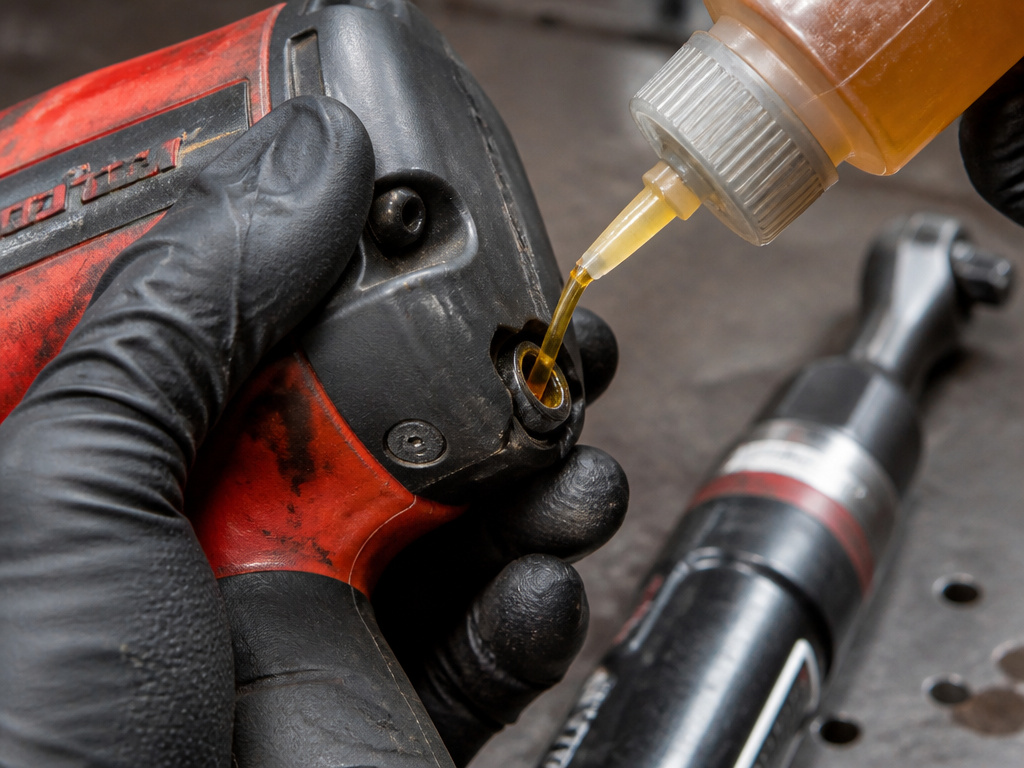
A pneumatic tool is a simple machine, but it’s a machine that runs on air and oil. Forget the oil, and the tool forgets how to work.
The part nobody mentions: Proper lubrication is critical for an air ratchet’s motor. A dry motor will wear quickly and lose power. You hear the difference long before you see the power loss.
An impact wrench’s hammer mechanism is even more demanding. The steel hammers and anvil slam together thousands of times a minute. Without a thin film of oil, they wear each other down, and the tool’s torque output drops steadily. This is the “losing power” issue famously documented with tools like the Ingersoll Rand 2131QT.
The regimen is straightforward but non-negotiable:
- Inline Lubricator (Oiler): The professional solution. Installed in the air line, it injects a fine oil mist into every tool connected. This is the best practice.
- Daily Manual Oiling: If you don’t have an oiler, you must add oil directly into the tool’s air inlet before each use. For an Ingersoll Rand impact wrench, add 10-15 drops of IR #10 Air Tool Oil into the air inlet before each use. Then run the tool for a few seconds to distribute it.
- Periodic Grease: The hammer mechanism inside an impact wrench also needs periodic greasing. The Ingersoll Rand manual specifies coating the hammers with a light film of Ingersoll-Rand 105-1LB Grease during a rebuild.
This maintenance reality is a key point in the electric ratchet vs air ratchet debate. Electric tools need no daily oiling, which is a genuine convenience. But when an air tool fails, it’s often repairable with a simple impact wrench rebuild kit, a luxury most sealed electric tools don’t offer.
Which Tool Should You Buy First?

Be honest. You probably want both. But if you’re building out your shop, the order matters.
Start with the impact wrench. Here’s why: it solves problems you cannot solve any other way. A breaker bar and a pipe extension might get a lug nut off, but they’re brutal, slow, and risk injury. The impact wrench does that job in two seconds. It enables suspension work, axle work, and any job involving large, tight, or rusty fasteners. It’s a force multiplier. A model like the Ingersoll Rand 2131QT (up to 1,350 ft-lbs) or a Milwaukee M18 FUEL cordless (up to 1,600 ft-lbs nut-busting) will handle many automotive tasks. Check the best air impact wrenches for current top picks.
The air ratchet is a productivity tool. It makes jobs you can do with a hand ratchet much, much faster and less fatiguing. If you regularly work in cramped engine bays, doing timing belts, manifold swaps, or accessory work, it’s a major advantage. But if your work is mostly suspension, brakes, and wheels, you’ll use it far less. It’s the second tool you buy, not the first.
For the home gamer on a tight budget, a mid-torque cordless impact wrench and a long-handled flex-head ratchet might be the smarter combo. It covers your high-torque needs while giving you manual access to tight spaces without the compressor investment. The cordless ratchet vs impact wrench dynamic is worth exploring if you want to avoid air lines altogether.
Which tool is more likely to over-torque or snap bolts?
The risk is far higher with an impact wrench. Its hammering action delivers concussive bursts of rotational energy, generating breakaway torque that can reach 1,000 foot-pounds or more. This immense force is essential for suspension work and rusted fasteners, but it can easily shear a bolt if applied carelessly. In contrast, an air ratchet produces significantly lower torque, with a typical range cited between 25 and 130 foot-pounds. This makes it much safer for final tightening on delicate components. Some modern impact wrenches offer auto-shutoff modes for precision, but the fundamental design is for power, not finesse. Technicians often use impact wrenches only for initial loosening or tightening, finishing the job with a torque wrench to avoid damage.
Frequently Asked Questions
Is an air ratchet faster than an impact wrench?
For pure free-spin RPM, yes, an air ratchet often spins faster, but the fact sheet does not provide a specific RPM range for air ratchets. But “faster” depends on the task. Spinning a clean bolt in open air? The air ratchet wins. Breaking a rusted lug nut loose? The impact wrench is infinitely faster, because the ratchet can’t do it at all. The impact wrench delivers its work in violent, high-torque bursts that overcome friction in seconds, while the ratchet relies on continuous, lower torque.
What is the difference between an air ratchet and an impact ratchet wrench?
An impact ratchet wrench (or cordless impact ratchet) is a hybrid. It has the slim head of a ratchet but contains a miniature hammer mechanism like an impact wrench. It delivers more torque than an air ratchet (often 80-250 ft-lbs) but with the concussive action of an impact. It’s louder, more powerful, and bulkier than a pure air ratchet, but still fits in tight spaces. It’s a distinct third category.
What are air ratchets good for?
Air ratchets are excellent for repetitive work in confined spaces where fasteners are accessible but numerous. Think: valve cover bolts, intake manifold bolts, transmission pan bolts, interior trim, and dashboard components. They are the tool for “disassembly and reassembly” speed when the fasteners aren’t seized.
Do I need impact sockets for an air ratchet?
You don’t absolutely need them for the lower torque of an air ratchet, but you absolutely should use them. Impact sockets are tougher and safer. Using a regular socket on a power tool, even a low-torque one, is a risk. The marginal cost of a set of impact sockets is cheap insurance against a cracked socket and potential injury. It also simplifies your toolbox, one set for all your power tools.
Before You Go
The right tool isn’t the one with the highest number on the box. It’s the one that matches the specific resistance in front of you. An air ratchet conquers space, an impact wrench conquers force.
If your garage sees more rust than tight corners, the impact wrench is your foundation. Buy it, learn its mechanics, and respect its power. If you live inside engine bays, the air ratchet will save your sanity and your wrists. And no matter which you choose, remember the one ritual that matters more than brand or model: a few drops of oil in the inlet every single time you pick it up. That’s the habit that turns a disposable commodity into a lifelong tool.
