
10 Best Dual Action Sanders in 2026
This post contains affiliate links. As an Amazon Associate, we earn from qualifying purchases.
Our best overall dual action sander is the Makita XOP02Z Cordless Dual Action Polisher for its cordless brushless power and professional-grade correction modes. The Rupes Skorpio III earns Best Premium Performance for shop-based auto work, and the CRAFTSMAN V20 is the top brushless cordless choice for mobile detailing.
Choosing the right DA sander means matching its power source and design to your specific workspace and projects. We researched specifications, expert round-ups, and patterns in owner feedback to find the ten models that best balance power, control, and practicality for different users.
Top 10 Dual Action Sanders in the Market
Certain content that appears on this site comes from Amazon. This content is provided "as is" and is subject to change or removal at any time.
The Best Dual Action Sanders, Reviewed
Makita XOP02Z Cordless Dual Action Polisher

What We Like
- Cordless design eliminates cord management
- Brushless motor runs cooler for longer life
- Selectable forced or free rotation modes
- Dual power modes for correction or long runtime
Trade-offs
- Tool only: requires separate Makita 18V battery
- At 8.2 lb, it's heavier than cordless rivals like the CRAFTSMAN
- Larger footprint than compact pneumatic sanders
Its selectable forced rotation mode distinguishes this polisher, allowing it to handle tough paint correction like a corded tool while the free spin option suits delicate finishing. This versatility, paired with the tool’s own high-power and low-power modes for either correcting work or extended polishing runtime, creates a cordless design capable of replacing a corded unit. It suits a detailer or woodworker needing professional results anywhere, free from an outlet.
You pay for that capability in bulk and weight. At over eight pounds without a battery, it demands more arm stamina than a lightweight pneumatic like the Rupes Skorpio III. And since it’s a bare tool, you’re investing in the battery ecosystem. But if you already own Makita LXT batteries, this polisher unlocks their potential for flawless surfaces, blending cordless freedom with the serious muscle usually found at the end of a power cord.
Rupes Skorpio III Pneumatic DA Sander

What We Like
- Extremely smooth and quiet operation
- Lightweight ergonomic design for effortless use
- Engineered motor maximizes torque with low airflow
- Versatile 6mm orbit for filler prep to clear coat
Trade-offs
- Pneumatic design requires a dedicated air compressor
- Central vacuum needs separate dust collection hookup
The 6mm orbital stroke is the key here, striking a deliberate balance between fast material removal and fine finish control. This makes the Skorpio III a uniquely versatile sander for professionals who need one tool to handle everything from shaping body filler to final polishing. It’s built for the long haul, with precision bearings and a motor designed to maintain consistent torque even when shop air pressure dips. If your work demands both speed and a flawless finish from a single, reliable sander, this is the engineered answer.
This pneumatic sander weighs just 1.8 pounds, making it exceptionally light for all-day use without causing user fatigue. Its ergonomic design and smooth, quiet operation contribute to this comfort. While it requires a permanent connection to an air compressor, this trade-off provides consistent torque even with low or inconsistent airflow, which is ideal for shop environments.
Porter-Cable 7424XP Random Orbital Polisher

What We Like
- Wide variable speed dial for precise control
- Swirl-free random orbital polishing action
Trade-offs
- Requires a wall outlet; no cordless option
With its electronic variable-speed dial offering a range from 2,500 to 6,800 orbits per minute, the PORTER-CABLE 7424XP provides control for different polishing stages. This random orbit design is specified for swirl-free sanding and polishing action. The tool’s weight is listed at 5.8 pounds.
The trade-off is its cord. The 4.5-amp motor needs an outlet, so you’re tied to a generator or extension cord in the driveway. But for most garage-based work where control and finish quality are paramount, this Porter-Cable’s speed precision is hard to beat.
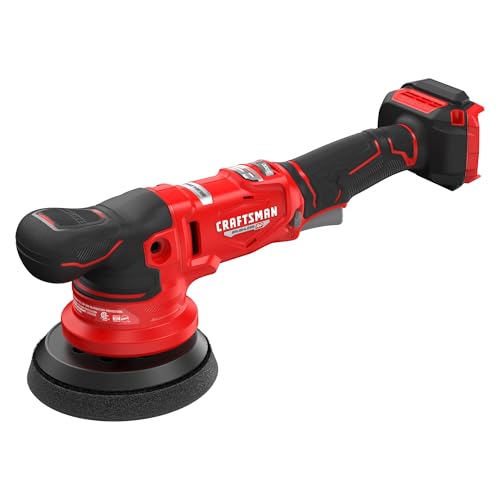
CRAFTSMAN V20 Cordless Dual Action Polisher
What We Like
- Brushless motor for long runtime and efficiency
- Constant speed under load for consistent finish
- In-line battery design minimizes surface marring
- Lock-on switch enables continuous operation
Trade-offs
- Tool only: requires separate V20 battery and charger
- At 4.5 lb, it's heavier than pneumatic sanders like the 1.8 lb Rupes
With a top speed of up to 6,000 orbits per minute and constant speed under load, this polisher maintains its pace as you work, which helps deliver a consistent finish. The cordless, brushless design is aimed at DIYers or mobile detailers who need to move around a vehicle without a power cord. Nine variable speed settings provide control for different stages of paint correction, from cutting to finishing.
The tool’s weight of 4.5 pounds is more than twice that of some dedicated pneumatic sanders, such as the 1.8-pound Rupes Skorpio. For polishing tasks where precise speed control is valuable, its in-line battery position is designed to help minimize surface marring. The included cutting, correcting, and finishing pads provide a starting point for various applications, though the required V20 battery and charger are sold separately.
Product photos
TCP Global Heavy Duty Air DA Sander
What We Like
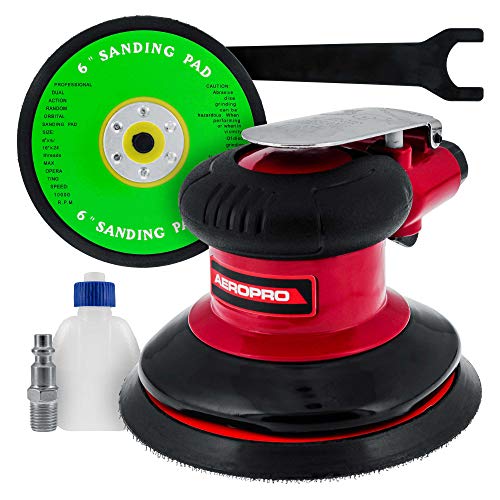
- Lightweight under 2 lbs for reduced fatigue
- Thumb-controlled lever for speed adjustment
- Heavy-duty ball bearing construction for low vibration
- Includes two 6-inch backing pad styles
Trade-offs
- Requires a capable 2 HP air compressor
- Air hose tethers you to a compressor
Weighing less than two pounds, this sander is built for long sessions on vertical panels and overhead work where arm fatigue is a real concern. The thumb-controlled air lever lets you dial in the pad speed on the fly for different stages of sanding. It includes both PSA and hook-and-loop backing pads, so you can use whichever discs you have on hand. This straightforward, heavy-duty pneumatic tool is suited for the automotive or woodworking shop where an air supply is already plumbed in.
You’ll need a compressor that can deliver 90 PSI and 4.5 CFM to run this sander, which typically means a 2-horsepower unit at minimum. That requirement makes it a non-starter for job sites without power or for the home garage that lacks a serious compressor. For those needing cordless freedom, the CRAFTSMAN V20 at 4.5 pounds offers a different kind of portability, though with a bit more weight in your hand.
Product photos
EVERGRADE Cordless Professional DA Sander

What We Like
- Compact, low-profile design for tight spaces.
- Low vibration for reduced hand fatigue.
- Cordless with pneumatic-like power feel.
- Lightweight for easy two-finger control.
Trade-offs
- Uses a proprietary 16V battery platform.
- Smaller orbit prioritizes finish work over heavy stock removal.
This cordless DA sander delivers pneumatic-level performance without an air hose, making it a direct replacement for a compressor-dependent tool in woodworking and auto paint prep. Its 2.5mm orbit is designed for refined surface control and reduced sanding marks, which matters for fine finish work. At 2.65 pounds with battery, the compact and palm-friendly design is easy to handle in tight work areas. The counterweight system helps reduce vibration, supporting longer sanding sessions with less hand fatigue.
Using this sander means committing to EVERGRADE’s 16V battery ecosystem. While this system keeps the tool balanced and compact, it won’t share packs with common 18V or 20V platforms. For pure, lightweight sanding in a shop with a dedicated air supply, a pneumatic tool like the Rupes Skorpio III will always be lighter and simpler. But if your work takes you away from an outlet or you just hate tripping over hoses, this sander bridges that gap effectively.
Product photos
Ingersoll Rand 311G DA Air Sander

What We Like
- Compact 10.1-inch length for tight spaces.
- Relatively lightweight 4.3-pound air tool design.
- Backed by a known industrial brand heritage.
Trade-offs
- Requires a capable air compressor to operate.
- Lacks the cordless convenience of battery-powered models.
At 4.3 pounds, the Ingersoll Rand 311G is a portable air sander that fits comfortably in one hand. Its 10.1-inch length helps it slide into toolboxes or under car dashboards where larger sanders might not fit. This compact pneumatic design focuses on access and control rather than covering large surface areas quickly.
The trade-off for that compact build is the inherent need for an air supply. You’re tethered to a compressor hose, which limits mobility compared to a cordless model. It also carries more heft than some ultra-lightweight air sanders, so it may not be the first choice for all-day overhead work. For a truly featherweight pneumatic experience, the Rupes Skorpio III is notably lighter, but the Ingersoll Rand offers a solid, balanced package in a manageable size.
Sunex Tools SX203N Quiet DA Sander

What We Like
- Insulated housing for quiet operation
- Built-in regulator for positive speed control
- Ball bearing construction reduces vibration
- Variable speed lever throttle
Trade-offs
- Pneumatic design requires a capable air compressor
- Free speed is fixed at 10,000 rpm maximum
- Tool-only with no battery or power cord
With a free speed of 10,000 rpm, this sander operates at a rate common for pneumatic tools. Its motor is housed in insulation for quiet operation, and ball bearing construction aims for vibration-free performance, which can matter during extended use. The built-in regulator provides positive speed control managed by a variable speed lever throttle.
As a pneumatic tool, it requires a dedicated air supply with a 1/4-inch NPT inlet and a minimum 3/8-inch hose. This ties it to a compressor, unlike cordless models. Its compact size, at just under ten inches in height, allows it to fit into tight spaces where larger tools might not.
KUIMIT 3-Inch Mini Air DA Sander

What We Like
- Compact, palm-sized design for tight spaces
- Built-in regulator for adjustable speed control
- Lightweight and low-vibration operation
Trade-offs
- Requires a separate air compressor to operate
- 3-inch pad limits sanding area for large surfaces
A free speed that can reach 11,000 RPM in a 3-inch package makes this pneumatic sander a specialist for confined spaces. Its compact, one-handed design and low vibration let you maneuver into dashboards, door jambs, and curved body panels where larger tools simply can’t fit. According to the brand, this dual-action sander is ideal for auto body, furniture, and metal products, widely used for sanding, grinding, polishing, and waxing.
This sander is strictly pneumatic, so you’ll need a capable air compressor nearby. With a 3-inch pad, it covers less area per pass than a standard 6-inch model, which affects work speed on large, flat surfaces. For detail work, however, this tool’s focused capability is hard to match. It excels in the niches where bigger sanders become cumbersome.
Product photos
WORKPRO Dual Action Random Orbital Polisher

What We Like
- High-power 1080W motor for demanding tasks
- Six variable speeds for waxing and polishing
- Ergonomic grip and auxiliary handle for control
- Comprehensive kit includes multiple pads
Trade-offs
- At 7.4 lb, it's heavier than the cordless CRAFTSMAN CMCE150B.
- Requires a continuous power cord for operation.
A 1080-watt motor provides the power for automotive detailing and polishing projects. Its speed can be adjusted from 1400 up to 5000 RPM, allowing for switching between waxing and polishing to improve work efficiency. The kit includes a wool buffer pad and six foam pads, along with two replaceable carbon brushes for durability and maintenance.
This tool weighs over seven pounds, which can lead to fatigue during extended overhead or vertical work. It’s a dedicated corded machine, so you’re trading the convenience of a battery for consistent, high-torque performance. If your projects are strictly in the garage and you need to remove deep scratches or oxidization, this WORKPRO delivers. For quick, cord-free wax jobs on a weekend cruiser, a tool like the Makita XOP02Z offers a different kind of flexibility.
Product photos
How We Evaluated Dual Action Sanders
Our evaluation relied on manufacturer specifications, professional tool summaries, and consistent patterns in owner feedback. We prioritized criteria that directly impact real-world use, such as power source and its practical implications. Other key factors were weight and ergonomics for managing user fatigue, plus orbit size and speed control for finish quality. To understand long-term performance, we also studied detailed reviews of DA sanders.
Our goal was to identify tools that excel in specific contexts, like a lightweight pneumatic sander for a body shop or a versatile cordless model for a home garage. The primary limit of this approach is that we cannot verify hands-on performance metrics like vibration dampening or exact runtime; we rely on documented specs and aggregated user experiences. For tasks like automotive paint correction, we consulted resources on the best automotive sanders to inform our selections.
What To Look For In Dual Action Sanders
Your workshop setup and the materials you sand most often dictate the best tool type. A mobile detailer needs a different machine than a stationary woodworker.
The core choice is power source: cordless for untethered freedom, pneumatic for lightweight power in a shop, or corded for consistent high torque. Then, consider orbit size for finish quality, weight for comfort, and whether you need variable speed control for different compounds or materials.
Power Source: Cordless, Pneumatic, or Corded
Cordless sanders like our top picks from Makita and CRAFTSMAN offer complete freedom of movement, ideal for working around a vehicle or in a driveway. They require investment in a compatible battery platform. Pneumatic sanders, such as the Rupes Skorpio III, are typically lighter and offer smooth, high-power operation but mandate a capable air compressor delivering sufficient CFM (often 8-12 CFM at 90 PSI).
Corded electric models, like the Porter-Cable 7424XP, provide consistent power without battery concerns but keep you near an outlet. Understanding the difference between DA and rotary polishers also helps, as some tools offer selectable modes.
Weight, Ergonomics, and Vibration
For extended sanding sessions on a car hood or furniture piece, tool weight and vibration directly affect fatigue. Pneumatic models often lead here, with some like the TCP Global model weighing under 2 pounds. Heavier corded or cordless tools around 7-8 pounds can be taxing overhead. Look for features like an in-line battery design (as on the CRAFTSMAN) to lower the center of gravity, or insulated housings like on the Sunex Tools model to reduce noise and vibration. Proper technique for using a dual-action sander is also crucial to minimize strain.
Orbit Size and Speed Control
Orbit size, measured in millimeters, influences the finish and aggressiveness. A common 3/16-inch (roughly 5mm) orbit balances speed and a swirl-free finish for general work. Smaller orbits, like on the KUIMIT 3-inch sander, are for delicate detail work. Variable speed control is essential for precision; a wide dial like on the Porter-Cable lets you match speed to the task, from heavy compounding to final wax application. For auto body professionals, selecting the right electric DA sander for auto body work involves balancing these factors for paint prep.
- Check the tool’s air consumption (CFM) against your compressor’s output if considering pneumatic.
- Verify battery compatibility for cordless tools; a “tool-only” listing means you need to buy a battery separately.
- Consider the backing pad size; a 6-inch pad is standard for large surfaces, while a 3-inch pad is for contours.
Match the tool’s core strength to your primary task, whether that’s featherlight sanding for automotive clear coats or powerful cordless correction for a DIY restoration.
Dual Action Sanders Compared
The following table compares key specifications across our top picks to help you see the differences at a glance.
| Product | Power Type | Weight | Max Speed |
|---|---|---|---|
| Makita XOP02Z Cordless Dual Action Polisher | Cordless | 8.2 pounds | 6,800 OPM |
| Rupes Skorpio III Pneumatic DA Sander | Pneumatic | 1.8 pounds | N/A |
| Porter-Cable 7424XP Random Orbital Polisher | AC only | 5.8 pounds | 6,800 OPM |
| CRAFTSMAN V20 Cordless Dual Action Polisher | Cordless | 4.5 pounds | 6,000 OPM |
| TCP Global Heavy Duty Air DA Sander | Pneumatic | 1.89 lbs | 10,000 RPM |
| EVERGRADE Cordless Professional DA Sander | Cordless | 2.65 lb | 10,000 RPM |
| Ingersoll Rand 311G DA Air Sander | Pneumatic | 4.3 pounds | N/A |
| Sunex Tools SX203N Quiet DA Sander | Pneumatic | N/A | 10,000 rpm |
| KUIMIT 3-Inch Mini Air DA Sander | Pneumatic | 2.4 pounds | 11,000 RPM |
| WORKPRO Dual Action Random Orbital Polisher | 9 Amp | 7.4 pounds | 5000 RPM |
Frequently Asked Questions
What is the best dual action sander?
The best dual action sander depends on your workspace and needs. For most professionals and serious DIYers who want cordless power, the Makita XOP02Z is the best overall. For a dedicated shop with an air compressor, the Rupes Skorpio III offers premium pneumatic performance.
What is the difference between a DA sander and a random orbital sander?
The terms are often used interchangeably, but “dual action” typically refers to a sander that combines a spinning and orbiting motion, commonly used for automotive paint correction. A random orbital sander is a type of dual action sander primarily for woodworking, designed to leave a swirl-free finish.
Are pneumatic sanders better than electric?
Pneumatic sanders are often lighter and can run cooler during extended use, making them a favorite in professional auto body shops. However, they require a significant investment in a capable air compressor. Electric sanders (corded or cordless) are more practical for home garages or mobile work where an air supply isn’t available.
What should I look for in a sander for auto body work?
For auto body work, prioritize a smooth, vibration-dampened tool to avoid marring the finish. A variable speed control is crucial for different stages of paint correction, from sanding primer to polishing clear coat. Many professionals prefer lightweight pneumatic models or specialized automotive sanders.
Can I use a dual action sander for woodworking?
Yes, dual action sanders are excellent for woodworking, providing a swirl-free finish. Look for a model with variable speed to handle different grits and materials, and consider a dust collection port. The orbital action is ideal for final sanding before applying a finish.
The Bottom Line
The Makita XOP02Z Cordless Dual Action Polisher is our best overall pick for its professional-grade, cordless power, making it ideal for technicians and serious DIYers already invested in the Makita 18V platform. For those on a tighter budget or needing a dedicated shop tool, the CRAFTSMAN V20 offers excellent cordless value, while the TCP Global air sander provides lightweight pneumatic performance.
Your single most important decision is choosing a power source that fits your environment. Committing to a cordless battery system, a capable air compressor, or a reliable corded outlet will determine which of these high-performing sanders is the right tool for your bench.
