
10 Best Granite Polishers in 2026
This post contains affiliate links. As an Amazon Associate, we earn from qualifying purchases.
Our best overall granite polisher is the Makita PW5001C for its durable, speed-controlled performance ideal for detailed countertop work. For a complete, affordable kit, the VEVOR 800W 4″ Wet Polisher Kit is our best value, while the Makita PK5011CX1 serves as the best high-power professional model for large-scale jobs. Choosing the right tool balances power, pad size, and control for your specific project size and frequency.
Polishing granite requires more than just a shine; it’s about protecting the stone’s surface and restoring its natural luster. The wrong tool can be too slow, too heavy, or lack the control needed to avoid damaging the slab. For both professional fabricators and do-it-yourself users, matching the tool to the task is critical.
This guide is based on manufacturer specifications, expert resources, and patterns in professional and DIY owner feedback. We’ve evaluated key specs like motor power, weight, speed control, and included accessories to help you find the right polisher for your workshop or home project.
Top 10 Granite Polishers in the Market
Certain content that appears on this site comes from Amazon. This content is provided "as is" and is subject to change or removal at any time.
The Best Granite Polishers, Reviewed
Makita PW5001C 4" Electronic Stone Polisher

What We Like
- Electronic speed control under load
- Lightweight 5.1 lb body for a 7.9A motor
- Variable speed dial for precise application matching
- Smooth soft start prevents material gouging
Trade-offs
- 4-inch pad limits work speed on large slabs
- Tool-only package requires sourcing pads separately
Its 7.9-amp motor delivers strong power while the tool body weighs only 5.1 pounds, which reduces arm strain during long polishing sessions. Electronic speed control maintains constant RPM under pressure, preventing stone burn for a uniform finish. This balance of power and manageable weight suits professionals on extended jobs and serious DIYers handling projects like kitchen countertops.
The trade-off is the 4-inch pad size. You’ll cover countertops just fine, but for vast commercial floors, you’ll want a larger machine like the Makita PK5011CX1 to save time. While it’s light for its power class, models like the Raizidom or Alpha VSP-320 are a full two pounds lighter if every ounce counts. Still, for most granite work, this polisher’s combination of muscle, manageable weight, and precise control is hard to beat.
VEVOR 800W 4" Wet Polisher Kit

What We Like
- Includes a full 7-pad polishing kit
- Built-in GFCI switch for safety
- Adjustable side handle for left/right use
- Bottom water injection for efficient cooling
Trade-offs
- At 9.2 lb, it's heavier than some 4-inch competitors
- Lacks the brand recognition of established pro lines like Makita
An 800W motor paired with a complete set of seven polishing pads means you can step right from grinding to a fine polish without a separate trip to the supplier. That’s the core of this kit’s value proposition. It’s a pragmatic choice for a homeowner tackling a countertop project or a tradesperson who needs a capable, all-in-one polisher without a premium brand price tag. The six-speed dial and GFCI protection show thoughtful design for control and safety on a wet job site.
You do feel its 9.2-pound heft during overhead work, a noticeable difference compared to lighter units like the Raizidom. The manual’s note about needing an additional waterproof sleeve for the air inlet is a critical, if minor, extra step. For pure, daily-driven polish on high-end stone, the smoother operation of a dedicated tool like the Makita PW5001C might justify its cost. But for the budget-conscious user who needs a complete kit ready to go, this VEVOR delivers substantial capability right out of the box.
Product photos
Makita PK5011CX1 5" Electronic Stone Polisher

What We Like
- High-output 11 AMP motor for demanding work
- Wide variable speed dial for precise control
- Water tube routed through handle for comfort
- Efficient four-outlet water distribution system
Trade-offs
- At 12 pounds, it's substantially heavier than most 4-inch polishers
- Its 21.7-inch length requires more clearance in tight spaces
The 11 AMP motor is the defining feature here, delivering the torque needed to maintain pad speed under heavy load on large granite slabs. This makes the PK5011CX1 a tool built for volume shop work or sustained polishing on big countertops where a smaller motor might bog down. The broad speed range, from 2,000 to 5,500 RPM, gives you the finesse for final polishing and the aggression for initial shaping, all controlled from a conveniently placed dial.
That professional-grade power comes with a physical footprint. You trade some maneuverability for that unstoppable motor, as the tool is longer and heavier than compact models like the VEVOR 800W. The integrated water valve and handle-routed hose are smart design choices that keep the workspace tidy, but be prepared to source your own splash guard and pads. This is a specialist’s tool where performance trumps portability.
Product photos
Raizidom Side-Exhaust Polisher Granite Polisher

What We Like
- Side-exhaust directs air away from work surface
- Durable cast housing for professional use
- Comes as a complete accessory kit
Trade-offs
- Fixed 4500 RPM speed lacks variable control
- Includes only a 4-inch backing pad for smaller work
Weighing 7.3 pounds, the Raizidom polisher is lighter than several comparable models, which can reduce fatigue during long polishing sessions. Its side-exhaust design directs air away from the work surface, a feature intended to minimize vibration and noise during operation. The durable, gravity-cast housing supports long-lasting professional use, and the tool includes a complete accessory kit with backing pad, side handle, muffler, air adapter, and water valve.
You trade some versatility for that lightness and clean exhaust. The fixed 4500 RPM speed is reliable for polishing, but it can’t be dialed down for more delicate shaping or coarse grinding like you can with the variable-speed VEVOR. It’s a specialist, not a generalist. For someone who needs to polish finished edges and seams all day without fatigue, the Raizidom’s design pays off. If your projects demand a single tool to handle everything from aggressive material removal to final shine, a variable-speed model will be a more flexible partner.
Product photos
Antstone 800W 4" Wet Polisher

What We Like
- Flexible splash guard for dust and shock protection
- Ergonomic dual handles for stable, long-term control
- Complete kit includes all necessary polishing accessories
- GFCI and double insulation for enhanced electrical safety
Trade-offs
- 4-inch pad size limits stock removal rate versus 5-inch models
An 800-watt motor with six speeds from 700 to 3000 RPM provides a wide range for polishing different materials, from delicate marble to concrete. Its flexible splash guard and three-hole water distribution system manage slurry to keep the workspace cleaner and reduce dust. Two ergonomic handles and a soft-start trigger are designed for stable, comfortable control during long polishing sessions.
The 4-inch pad size offers precision but removes material slower than a 5-inch model like the Makita PK5011CX1. The kit includes seven diamond polishing pads and all necessary accessories, so it arrives ready for a variety of stone polishing tasks. A U-shaped auxiliary handle with a rubber sleeve and a GFCI plug are included for enhanced operational safety.
Product photos
Alpha Professional Tools VSP-320 Polisher

What We Like
- Heavy-duty gear system for demanding work
- Long 15-foot electrical and water hoses
- Adjustable splash guard minimizes water ingress
- Inline GFCI on power cord for safety
Trade-offs
- 7.3 lb weight is mid-pack, not the lightest
The Alpha VSP-320’s heavy-duty gear system with a step-down transmission is the core of its design, built to handle the constant load and friction of polishing stone without wearing out prematurely. That 7-amp motor drives it all, offering a versatile 700-2500 RPM range for everything from grinding to final polishing. This is a tool for the shop or installer who needs a polisher that won’t quit when the job runs long, backed by long cords and a GFCI for practical, safe setup.
Alpha’s polisher uses a heavy-duty gear system with a step-down transmission, which means its internal components are built to withstand demanding jobs over many years. You pay for that durability with a tool that isn’t the lightest in its class. The center water-feed and EasyOn-EasyOff sleeve are thoughtful touches for all-day use, making it a solid, no-fuss workhorse rather than a feature-packed kit.
Stadea SWP103K Wet Polisher Kit

What We Like
- Ergonomic back handle minimizes hand fatigue.
- In-built water quick-connect with pressure control.
- DTM+ motor gear system for enhanced power.
- Includes 8-piece granite diamond polishing pad set.
Trade-offs
- At 10.4 lb, it is heavier than the 8.4 lb Makita PW5001C.
- The 17.5-inch length requires more storage space.
Stadea’s SWP103K polisher uses an ergonomic back handle and head-heavy design to transfer its 10.4-pound weight onto the stone surface, which helps create polishing pressure and aims to minimize hand fatigue. Its DTM+ motor system and variable speed dial, which can be set anywhere in a wide range, are intended to provide the power and control needed for polishing hard materials like granite and quartz. The design also includes an out-of-body back handle to prevent air vent blockage, which is meant to support motor performance and durability.
That focus on stability does come with a physical footprint. The tool is longer and heavier than some dedicated pro models like the Makita PW5001C, so it feels more substantial in hand and demands more room in a packed tool bag. The included kit is comprehensive for starting a polish, bundling a full range of diamond pads and a GFCI-protected cable for safety. For a shop tackling large, flat surfaces regularly, the thoughtful handle design and integrated water management justify the extra heft. For someone primarily doing edge work or needing maximum maneuverability, a lighter, more compact polisher might be a better fit.
Product photos
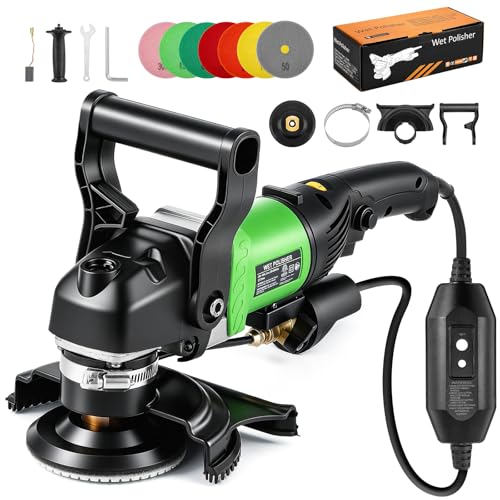
Bonvoisin 800W 4" Wet Polisher
What We Like
- Dust-free wet polishing with 3-hole water system
- Six adjustable speeds for versatile material work
- Ergonomic grip and lock trigger reduce fatigue
- Complete kit with pads and accessories ready to use
Trade-offs
- Requires constant water hose connection for operation
Its 3-hole water system and flexible splash guard enable dust-free wet polishing, which eliminates harmful silica dust and reduces cleanup time for indoor work. An 800-watt motor provides six adjustable speeds across a broad range, allowing for tasks from marble honing to high-gloss granite finishing with one tool. This combination of dust control and variable speed is designed for wet polishing of stone, granite, marble, tile, and concrete.
You’ll need to keep it tethered to a water source, which limits mobility compared to dry systems. The full kit approach means you can start polishing right out of the box, but the trade-off is you’re committing to the included pad selection. For those prioritizing maximum portability above all else, the lighter Raizidom Side-Exhaust Polisher offers a different balance, but you’ll sacrifice the Bonvoisin’s comprehensive dust containment.
Product photos
GLEX 800W Professional Wet Polisher

What We Like
- Class A GFCI anti-leakage protection switch
- Six adjustable speed settings up to 4000 RPM
- Includes motor waterproof cover and splash guard
- Comes with complete kit of pads and accessories
Trade-offs
- Fixed 4-inch pad size limits working width
- Weighs 8.9 pounds, which is heavier than several 4-inch rivals
An 800-watt motor delivers the torque and speed needed for aggressive grinding and high-gloss polishing on granite and marble. It spins up to 4000 RPM for efficient work. The integrated GFCI safety switch is a critical feature for any wet tool, providing a reliable shutoff if water meets electricity. This polisher suits a fabricator who needs a single, durable machine for the full polishing sequence, from shaping edges to final buffing, and appreciates that the kit arrives ready to work with a full set of diamond pads.
You trade some finesse for that raw power and high-speed capability. It’s a substantial tool at nearly nine pounds, which can lead to fatigue on long, detailed countertop installations compared to lighter models like the Alpha VSP-320. The 4-inch pad is standard for edge work, but for polishing large, flat surfaces, you’ll be covering less area per pass than you would with a 5-inch machine like the Makita PK5011CX1. It’s a workhorse designed for production, not the lightest tool for delicate stone restoration.
Product photos
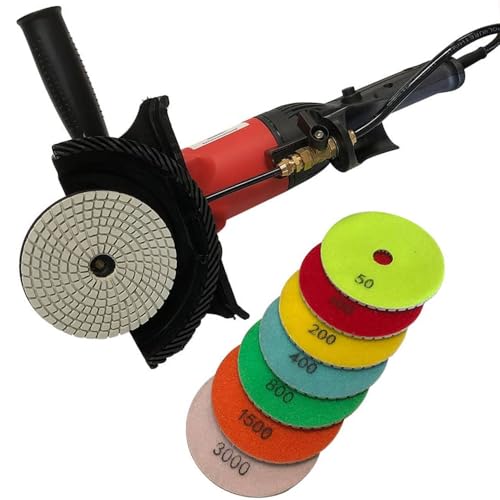
EDiamondTools 5" Variable Speed Wet Polisher Kit
What We Like
- Comes with a full seven-step polishing pad set.
- Variable speed provides control for grinding and polishing.
- Includes a rubber backing pad for secure pad attachment.
- Relatively lightweight for a wet polisher.
Trade-offs
- Lacks an integrated GFCI plug for electrical safety.
- Spindle thread is 5/8"-11, not the M14 common on some pro tools.
A complete seven-pad polishing set in the box means you can go from grinding to a high-gloss finish without hunting for additional components. That, combined with a variable speed range that covers all common polishing tasks, makes this kit ready for its first job. It’s a natural fit for a DIYer or a new stone worker who wants a single purchase to cover the entire polishing process. The 6-pound weight also helps keep fatigue down during longer countertop sessions.
You do trade some professional-grade features for that out-of-the-box completeness. It doesn’t have the built-in GFCI safety plug found on kits like the GLEX, and its spindle thread is a less common 5/8″-11. For a dedicated shop tackling heavy fabrication daily, a more powerful and adaptable tool like the Makita PK5011CX1 might be a better long-term investment. This EDiamondTools kit gets you started competently, with everything you need to learn the craft in one package.
Product photos
How We Evaluated Granite Polishers
Our evaluation began by compiling specifications and manufacturer data on motor amperage, variable speed ranges, and tool dimensions. We then reviewed professional fabricator resources and expert round-ups on stone-working techniques to understand which features translate to real-world performance. Finally, we analyzed patterns in owner feedback, looking for consistent praise or complaints about durability, ease of use, and the effectiveness of included kits.
We prioritized three criteria. First, motor power and control, as a polisher must maintain speed under load to work granite effectively without gouging. Second, tool weight and ergonomics, which directly impact user fatigue during long sessions. Third, the completeness and quality of the kit, as many users need ready-to-run packages with appropriate polishing pads. These factors separate professional-grade tools from basic DIY options.
Our research-based approach has limits. We cannot replicate the years of shop use that test a tool’s long-term transmission durability. We also can’t verify the lifespan of included diamond pads through owner reports alone. For tasks beyond polishing, like cutting tile, you’ll need specific diamond blades. Ultimately, our goal is to give you a clear, researched starting point for your purchase.
What To Look For In Granite Polishers
Selecting a granite polisher means matching its capabilities to your project’s scale and your own skill level. A tool that’s perfect for a professional shop might be overkill for a one-time DIY job. Focus on the motor, the handling, and what comes in the box.
Look for a variable-speed motor that won’t bog down, a comfortable weight you can manage overhead, and a kit that includes the right pads. Safety features like a GFCI plug are non-negotiable for wet work.
Motor Power and Speed Control
A polisher’s motor must deliver consistent power under the resistance of grinding granite. Amperage and wattage are key indicators; the models listed have motors ranging from 7.9 amps to 11 amps. More important than raw power is electronic speed control, which maintains a set RPM as you apply pressure, preventing damage to the stone. A wide variable speed dial, like the range found on several models, allows you to match the speed to the task, from aggressive grinding with coarse pads to fine polishing.
Weight, Balance, and Ergonomics
Polishing is a physical task, often done in awkward positions. A lighter tool, like the 5.1-pound Makita PW5001C, drastically reduces arm and shoulder fatigue over a workday compared to a 12-pound model. Consider the tool’s length and handle configuration; a second adjustable side handle or an ergonomic back handle improves control and stability. Features like a water tube routed through the handle, as on the Makita PK5011CX1, keep hoses tidy and improve maneuverability.
Kit Completeness and Safety
Many polishers are sold as tool-only or as complete kits. A full kit should include a backing pad, a set of diamond polishing pads in a progression of grits, and often a wrench. For wet polishing, which is essential for dust control and cooling, a built-in water injection system and a GFCI (Ground Fault Circuit Interrupter) switch or plug are critical safety features.
An integrated GFCI, like those on the VEVOR and Bonvoisin models, protects against electrical shock if water contacts the tool. After use, knowing how to clean polishing pads will extend their life.
- Check if the spindle thread (commonly 5/8″-11) matches your existing or planned accessories.
- Verify the included pad grit range covers both material removal (50-400 grit) and finishing (800-3000 grit).
- Look for a flexible or adjustable splash guard to help contain water and debris.
A complete, safe kit is often the best value for a DIYer, while a pro may prefer a tool-only purchase to use with their preferred polishing pad materials.
Granite Polishers Compared
The table below compares the key specifications of our top picks to highlight their differences in power, size, and intended use.
| Product | Motor Power | Speed Range (RPM) | Weight |
|---|---|---|---|
| Makita PW5001C 4" Electronic Stone Polisher | 7.9 AMP | Variable dial | 5.1 lbs |
| VEVOR 800W 4" Wet Polisher Kit | 800W | 700-3000 RPM | 9.2 pounds |
| Makita PK5011CX1 5" Electronic Stone Polisher | 11 AMP | 2,000 – 5,500 RPM | 12.0 Pounds |
| Raizidom Side-Exhaust Polisher Granite Polisher | N/A | 4500 RPM | 7.3 Pounds |
| Antstone 800W 4" Wet Polisher | 800W | 700-3000 RPM | N/A |
| Alpha Professional Tools VSP-320 Polisher | 7 Amp | 700-2500 RPM | 7.3 lb |
| Stadea SWP103K Wet Polisher Kit | N/A | 3000 RPM | 10.4 pounds |
| Bonvoisin 800W 4" Wet Polisher | 800W | 700-3000 RPM | N/A |
| GLEX 800W Professional Wet Polisher | 800W | 1000-4000 RPM | 8.9 pounds |
| EDiamondTools 5" Variable Speed Wet Polisher Kit | N/A | 700 – 3000 rpm | 6.0 pounds |
Frequently Asked Questions
What is the best polishing tool for granite?
For most detailed countertop work, a 4-inch variable-speed wet polisher with electronic control, like our best overall Makita PW5001C, offers the best balance of power and precision. For large slab polishing in a professional shop, a high-amperage 5-inch model, such as the Makita PK5011CX1, provides the power and work speed needed for productivity.
What is the best thing to polish granite with?
You polish granite with a series of diamond-impregnated resin pads, used with a variable-speed polisher and a constant stream of water. The process starts with a coarse grit pad to remove scratches or shape edges and progresses through finer grits (often up to 3000) to achieve a glossy finish. A specialized granite polishing compound can be used with a final buffing pad for extra shine.
Can you use an angle grinder to polish granite?
You can use a variable-speed angle grinder with a polishing pad attachment for some granite work, but a dedicated wet polisher is far superior for finishing. Polishers are designed for lower operating speeds to avoid burning the stone, have built-in water feeds, and their gear heads provide better control for the precise pressure needed. For grinding tasks, you would select among the best angle grinders.
What is the difference between polishing granite and marble?
Granite is harder and more abrasion-resistant than marble, so it can handle more aggressive polishing with coarser grit pads. Marble is softer and more sensitive to heat; it requires a gentler approach with finer grits and more water to avoid scratching or hazing the surface. The tools are similar, but the technique and pad sequence differ. Our guide on marble polishing machines covers this in detail.
Do I need a special drill bit for granite?
Yes, drilling into granite requires a diamond core bit or a carbide-tipped masonry bit designed for hard stone. Standard twist drill bits will dull immediately. Using the correct drill bits for granite and plenty of water for lubrication is essential for a clean hole and to prevent bit damage.
The Bottom Line
For the stone fabricator or serious renovator who needs a precise, durable tool for countertop edges and detailed work, the Makita PW5001C is the best overall granite polisher. Its electronic speed control and lightweight design provide the finesse required for a professional finish.
If you’re a DIYer starting your first project, the VEVOR 800W Kit offers remarkable value with everything you need to begin polishing safely. For shop-based professionals who demand maximum power for large slabs, the Makita PK5011CX1 is the tool that won’t quit under heavy use.
Regardless of your choice, prioritize a polisher with variable speed control and a built-in GFCI safety switch. Matching the tool’s power and pad size to your most common task is the single most important step to achieving a flawless, glossy finish on your granite.
